



Why Integrated POS Payment Processing for Jewelry Stores Is a Game-Changer

Integrated POS payment processing for jewelry stores connects your payment terminal directly to your point-of-sale software — so every transaction automatically updates your inventory, customer records, and sales reports in real time.
Here's how it works at a glance:
| Step | What Happens |
|---|---|
| Customer pays | Card terminal communicates directly with POS |
| Payment confirms | Inventory updates automatically |
| Sale records | Customer profile and purchase history logged |
| Reports update | Real-time sales data reflects instantly |
| Staff notified | No manual entry required at any step |
This eliminates the manual data entry that causes pricing errors, stock discrepancies, and delayed reporting — problems that hit especially hard when you're selling high-value pieces.
Jewelry retail is unforgiving. A single data entry mistake on a $5,000 diamond ring sale can cost you money, customer trust, or both. Generic retail software wasn't built for the complexity of serialized inventory, custom orders, repairs, or precious metal pricing. That's exactly why jewelry-specific integrated payment systems exist.
In this guide, you'll learn how to set up and use an integrated POS payment system that automates your workflows, reduces errors, and keeps your high-value sales running smoothly.
I'm Anthony Arechiga, Vice President of Sales at GemFind Digital Solutions, where I've spent over 15 years helping jewelry retailers implement the right technology — including integrated POS payment processing for jewelry stores — to grow their businesses and compete online. I'll walk you through everything you need to know to streamline your payment workflows and reduce costly manual errors.
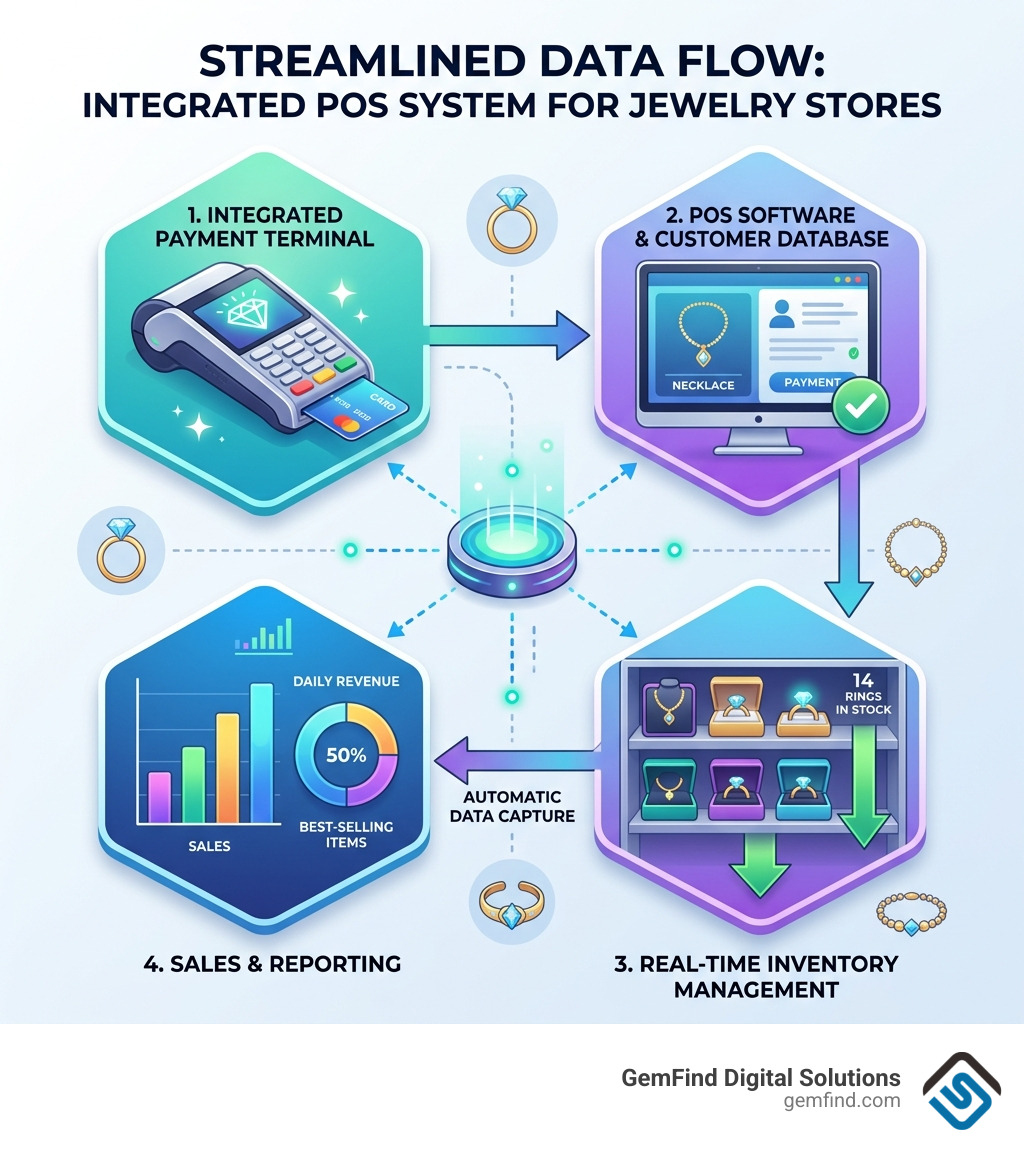
Integrated pos payment processing for jewelry stores word guide:
Understanding Integrated POS Payment Processing for Jewelry Stores
When we talk about integrated pos payment processing for jewelry stores, we are describing a "handshake" between your sales software and your credit card terminal. In a traditional, non-integrated environment, your staff has to look at the total on the computer, manually type that amount into a standalone credit card machine, wait for the slip to print, and then manually record the "Paid" status in the software.
This manual gap is where the gremlins live. It’s where a $1,200 sale accidentally becomes a $210 sale because of a typo, or where a transaction is approved on the terminal but the staff forgets to hit "Save" on the invoice, leaving your inventory levels incorrect.
With integrated solutions, the POS sends the exact dollar amount to the terminal automatically. Once the customer swipes or taps, the terminal sends a confirmation back to the POS. This direct communication ensures:
- Transaction Speed: Checkouts are up to 50% faster because there is no double-entry.
- Data Accuracy: The price on the tag is exactly what the customer pays.
- High-Ticket Handling: Specialized merchant accounts can be configured to handle the larger-than-average transactions common in our industry without triggering constant fraud freezes.
For jewelry stores, this isn't just about convenience; it's about maintaining the professional "boutique" experience that luxury clients expect. Nothing kills the mood of a high-value sale like a consultant fumbling with a clunky, disconnected credit card machine.
Key Benefits of Integrated Systems for High-Value Retail
High-value retail requires a higher level of security. When you are processing transactions for engagement rings or luxury watches, the stakes for fraud and chargebacks are incredibly high.
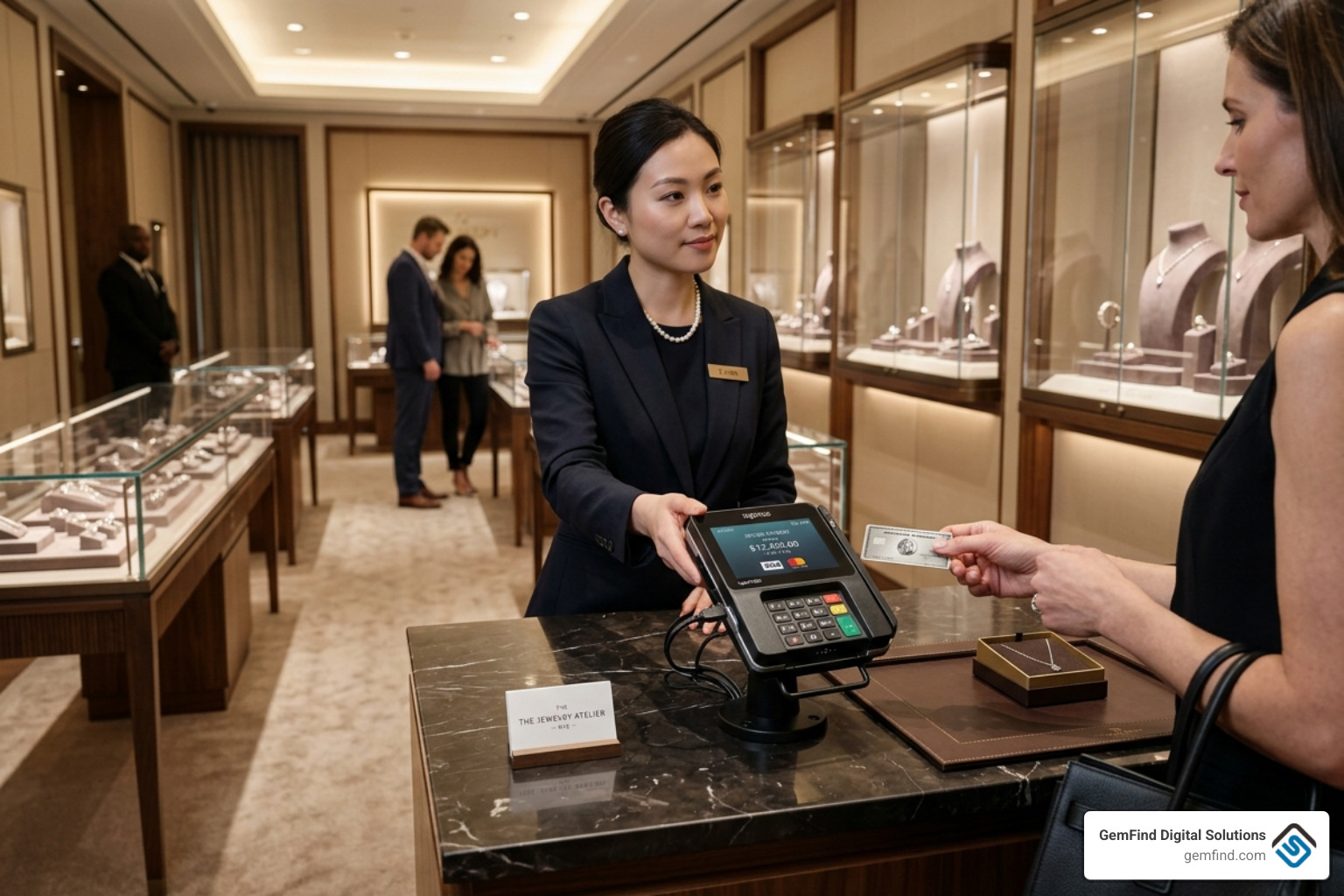
PCI Compliance and Security
Integrated systems offer end-to-end encryption. This means sensitive cardholder data never actually touches your store’s local computer network or servers. It is encrypted at the terminal and sent directly to the processor. This significantly simplifies your PCI compliance requirements and protects you from data breaches.
Fraud Protection and Reduced Chargebacks
Modern integrated pos payment processing for jewelry stores includes advanced fraud detection tools. These systems monitor for suspicious activity and utilize Address Verification Services (AVS) and CVV checks to ensure the person standing in front of you is the authorized cardholder. By using EMV (chip) technology integrated with your POS, you shift the liability for certain types of fraudulent transactions away from your business.
Improved Cash Flow
Many integrated partners now offer instant or same-day payouts. In an industry where inventory costs are high, getting your funds into your bank account quickly allows for better reinvestment and operational agility. Furthermore, real-time reporting means you can see exactly what your margins are the moment a sale is finalized.
How to Automate Jewelry Workflows and Inventory Tracking
The biggest headache for any jeweler is inventory. Between loose stones, mountings, and finished pieces, keeping a "live" count is nearly impossible without automation.
| Feature | Manual Entry System | Integrated POS System |
|---|---|---|
| Inventory Update | Staff must manually deduct stock later | Stock level drops the second payment clears |
| Error Rate | High (typos, forgotten entries) | Near zero (automated sync) |
| Stone Tracking | Difficult to link specific GIA certs | Certificates automatically attach to sales record |
| Multi-Store | Requires manual end-of-day sync | Real-time visibility across all locations |
Real-Time Stock Visibility
When your payments are integrated, your inventory is always accurate. If you sell a unique SKU in-store, an integrated system can immediately mark that item as "Sold" on your website. This prevents the nightmare scenario of selling the same one-of-a-kind piece to two different people at the same time.
Serialized Items and Stone Management
Jewelry POS systems are built to handle serialized inventory. You can track individual pieces by their unique attributes—carat weight, clarity, color, and cut. Integration ensures that when a specific diamond is sold, its accompanying digital certificate (like GIA or AGS) is automatically linked to the customer’s profile for future appraisals or insurance claims.
RFID and Advanced Integration
For stores with large inventories, RFID integration allows for batch scanning. Imagine doing a full store audit in minutes rather than hours. When combined with Jewelry Ar Pos Integration, you can even bridge the gap between virtual try-ons and physical sales data.
Managing Custom Orders, Repairs, and Financing
Jewelry stores aren't just "off-the-shelf" retailers. A significant portion of revenue comes from repairs and custom commissions. A generic POS struggles here, but a jewelry-specific integrated system thrives.
Deposit Management and Partial Payments
Custom jewelry often requires a 50% deposit upfront. Integrated systems allow you to take a deposit, link it to a specific work order, and keep the balance "open" until the piece is finished. When the customer returns, the system remembers exactly how much is owed, preventing any awkward math at the counter.
Repair Tracking and Notifications
You can track a repair from the moment it’s dropped off to the moment it leaves the shop. Many modern systems will even send an automated text or email to the customer the second the "Paid" status is updated in the system, letting them know their item is ready for pickup.
Layaway and Financing
High-ticket items often require financing or layaway plans. Integrated POS systems can manage these recurring payments or integrate with third-party lenders like Affirm or Wells Fargo. This makes luxury items more accessible to your customers while ensuring your records remain perfectly synced.
Integrated POS Payment Processing for Jewelry Stores and Custom Commissions
When dealing with custom commissions, you often have to deal with "Memo" sales—items you have in your store but don't technically own yet. Integrated jewelry software handles these specialized transactions natively.
- Memo Sales & Consignment: Easily track which items belong to vendors and automate the payout process once the item sells.
- Metal Price Integration: Some systems feature gold buying calculators that pull real-time market prices, ensuring your trade-in values and custom quotes are always accurate and profitable.
- Lab-Grown vs. Natural: Ensure your tagging and payment records clearly differentiate between lab-grown and natural stones to maintain transparency and compliance.
Supporting Omnichannel Sales with Integrated POS Payment Processing for Jewelry Stores
Today's customer might find a ring on Instagram, research it on your website at 11 PM, and come into the store the next day to buy it. They expect a seamless experience across all these touchpoints.
Integrated pos payment processing for jewelry stores supports this "omnichannel" approach by:
- Unified Reporting: Whether the sale happened on your Shopify site or at your front counter, the money goes to the same place and the reporting is centralized.
- Mobile "Tap to Pay": Use handheld smart terminals or even iPhones to take payments anywhere in the store. This "clienteling" approach allows you to stay with the customer throughout their journey rather than walking away to a fixed cash wrap.
- CRM and Loyalty: Because the payment is linked to a customer profile, you can see their entire purchase history. You’ll know that Mr. Smith bought earrings last year and might be looking for a matching necklace for his anniversary this year.
- Personalized Marketing: Use the data gathered from integrated sales to send targeted offers. If a customer frequently buys a specific designer, your system can automatically notify them when a new collection arrives.
Frequently Asked Questions about Jewelry POS Integration
How do integrated payments handle high-ticket fraud?
Integrated systems use multi-layered authentication. Beyond just the chip reader, they employ Address Verification Services (AVS) to match the billing address and CVV verification. Many systems also feature "suspicious activity monitoring" that flags transactions that fall outside of your store's normal patterns, giving you a chance to verify the sale before it's finalized.
Can I migrate data from legacy software?
Yes, though the timeline varies. Most modern providers offer a data analysis phase where they map your old inventory and customer records from legacy systems like JewelMate or The Edge. This process usually involves test migrations to ensure every diamond and every customer history note lands in the right place. Depending on the complexity, this can take anywhere from a few days to a couple of months.
What hardware is required for an integrated setup?
A modern setup typically includes:
- iPad or Tablet: For the main interface.
- Handheld Smart Terminals: For mobile checkout and "Tap to Pay."
- Bluetooth Barcode Scanners: For quick inventory lookups.
- RFID Readers: For rapid store-wide audits.
- Label and Receipt Printers: Specialized printers that can handle the tiny butterfly tags used for jewelry.
Conclusion
Switching to integrated pos payment processing for jewelry stores is one of the single most impactful moves you can make for your business. It protects your margins by eliminating entry errors, secures your high-value transactions against fraud, and provides the "wow" factor that modern luxury shoppers demand.
At GemFind Digital Solutions, we have over 25 years of industry-specific expertise. As a Shopify and Google Partner, we don't just provide generic tools; we build tailored tech stacks that understand the nuances of the jewelry world—from Edge POS integrations to custom-built apps that drive engagement.
Ready to stop wrestling with manual data entry and start focusing on your craft? Streamline your jewelry business with specialized apps and see how integrated technology can transform your showroom.


