



Why Managing Jewelry Inventory Is Harder Than It Looks
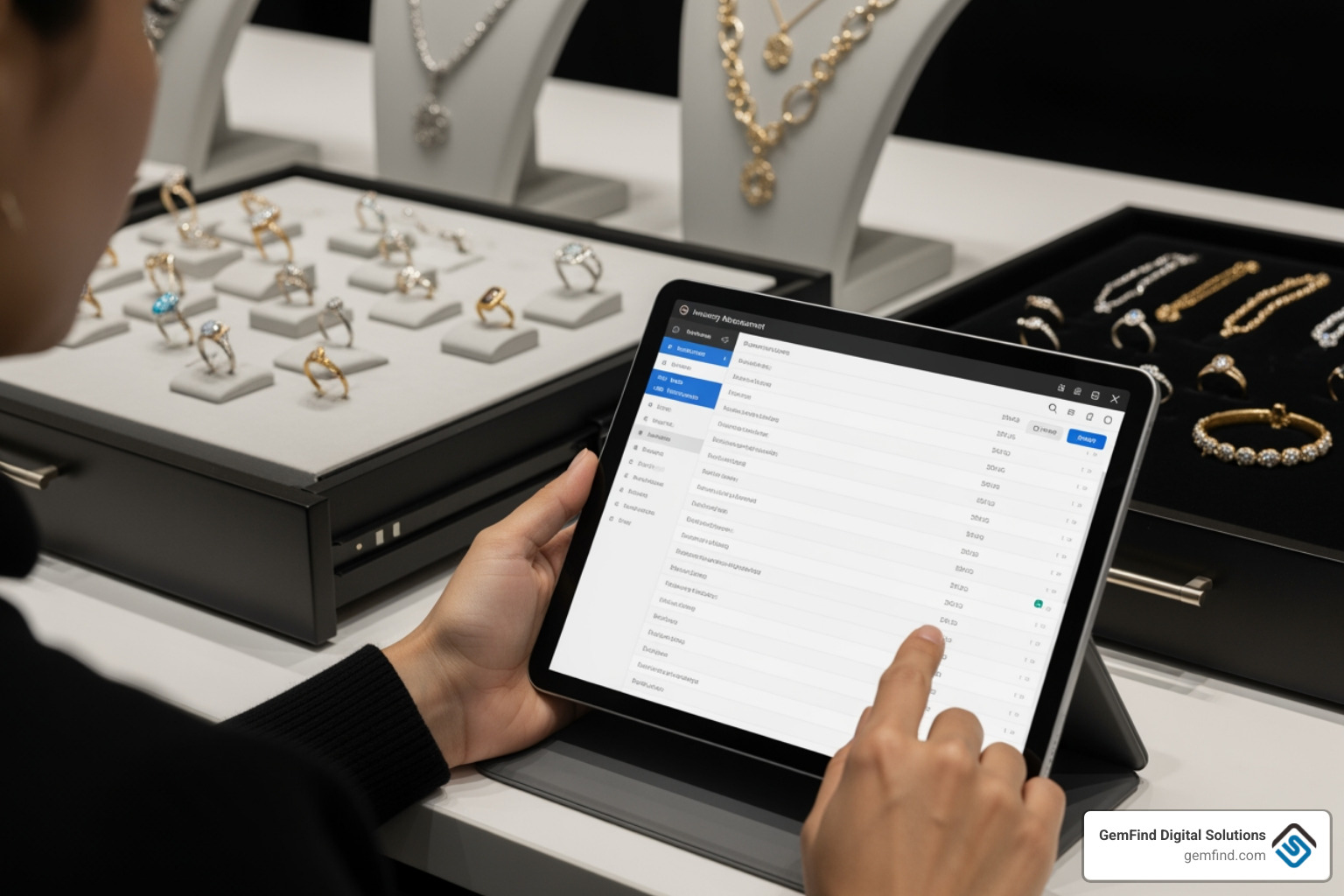
Jewelry inventory management software is the category of tools that helps jewelry businesses track stock, precious metals, gemstones, and valuations — all in one place.
The most effective solutions in 2026 are those that provide a seamless link between your physical stock and your digital presence. For many retail jewelers, The Edge is the gold standard, especially when paired with GemFind’s custom integrations.
Running a jewelry store means tracking hundreds — sometimes thousands — of unique, high-value items. Every ring, gemstone, and gram of gold needs to be accounted for.
Most store owners start with spreadsheets. It works at first. But as inventory grows, spreadsheets become slow, error-prone, and stressful. A misplaced item or an inaccurate valuation can cost you real money.
The right software changes that completely. It gives you real-time visibility into what you have, what it's worth, and where it is — across every location, display case, and safe.
I'm Anthony Arechiga, Vice President of Sales at GemFind Digital Solutions, where I've spent over 15 years helping jewelry businesses implement the right technology — including jewelry inventory management software — to grow their operations and compete online. In the sections below, I'll walk you through exactly what to look for and which features and integrations deliver the best results.
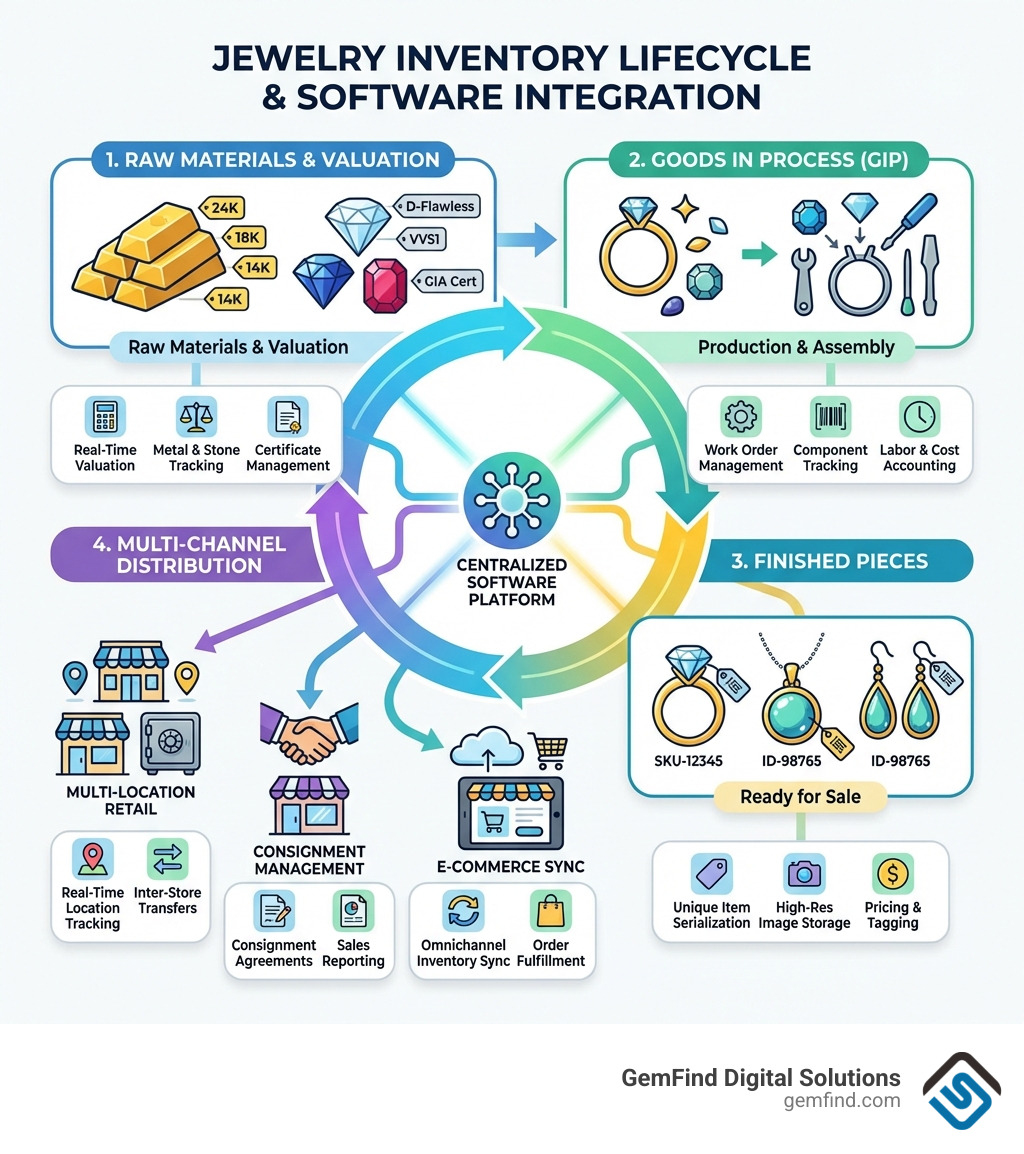
Why Jewelry Inventory Management Software is Essential
If you've ever spent a frantic Friday evening trying to find a specific 1.5-carat oval diamond that "should be in the safe," you already know why manual tracking is a recipe for a headache. Jewelry isn't like selling t-shirts; you aren't just tracking SKUs. You are tracking high-value assets that fluctuate in price based on global markets.
The Dangers of "Spreadsheet Creep"
Many jewelers start with a simple Excel sheet. But as you grow, "spreadsheet creep" sets in. Formulas break, someone forgets to update a row after a sale, and suddenly your "on-hand" value is off by $50,000. Jewelry inventory management software eliminates these human errors by providing a "single source of truth."
Real-Time Visibility and Stock Security
In our industry, security is paramount. You need to know exactly what is in your display cases versus what is in the back-room safe at any given second. Modern systems offer real-time visibility across multiple locations. This doesn't just prevent theft; it prevents "stockouts" where you miss a sale because you didn't realize a popular mounting was out of stock.
Valuation and Vendor Data
One of the most overlooked aspects of jewelry management is data consistency. This is why jewelry vendor data management is crucial for your website. If your internal inventory doesn't match what is shown on your website, you risk losing customer trust. Proper software ensures that the 14kt gold price reflects current market rates and that vendor specifications are accurate across all channels.
Key Features to Look For in Your System
When shopping for jewelry inventory management software, don't settle for a generic retail system. A system designed for a hardware store won't understand the difference between a VS1 and an SI2 clarity diamond. Here are the "must-have" features:
Karat-to-Pure-Gold Conversion
Your software should be smart enough to track precious metals by karat (9kt through 24kt), as well as platinum, palladium, and silver. Advanced inventory systems even include automatic purity coefficients. This means if you have 100 grams of 14kt gold scrap, the system knows exactly how much pure fine gold that represents based on live market pricing.
Granular Gemstone Grading
A diamond is more than just a "stone." You need fields for:
- Clarity: IF, VVS1, VS2, SI1, etc.
- Shape: Round, Princess, Cushion, Pear, etc.
- Cut: Excellent, Very Good, Good, Fair.
- Color: D through Z, plus fancy colors.
Serial Number Tracking and Appraisals
Every high-value piece should have a unique serial number. This is vital for handling warranties, repairs, and returns. Furthermore, look for a system that allows for appraisal uploads. Being able to attach a PDF of a GIA certificate or a high-resolution photo directly to the inventory item saves hours of filing.
The Power of the Cloud
At GemFind, we often talk about the benefits of centralized data. What is JewelCloud? It's a tool that allows you to sync thousands of products from top manufacturers directly into your ecosystem. When your inventory software integrates with a tool like JewelCloud, you can display vendor stock as if it were your own, expanding your "virtual vault" without the overhead cost.
Top Jewelry Inventory Management Software Solutions for 2026
Choosing the right platform depends on your business model. Are you a traditional brick-and-mortar store, a high-volume distributor, or a modern Direct-to-Consumer (DTC) maker?
| Feature | Cloud-Based Solutions | On-Premise Solutions |
|---|---|---|
| Accessibility | Anywhere with internet | Only inside the store |
| Updates | Automatic and instant | Manual and often paid |
| Security | Encrypted cloud servers | Physical server on-site |
| Upfront Cost | Low monthly fees | High initial investment |
RFID Technology: The Future of Stock Takes
If you find yourself spending days on end doing a full inventory count, you might want to look into RFID solutions. While traditional barcode scanning requires you to touch every item, RFID allows you to count thousands of items in minutes. Implementing RFID can significantly reduce the time it takes to complete a stock take, especially for stores with large assortments. Imagine waving a scanner over a tray and having 50 rings checked in instantly.
Leveraging Data for Sales
Once your inventory is organized, you can use that data to drive revenue. There are 7 ways to use your JewelCloud data to increase sales, such as creating personalized "wish lists" for customers based on the specific gemstones you have in stock or automating "back in stock" alerts for popular bridal mountings.
Specialized Jewelry Inventory Management Software for Retailers
The Edge
The Edge is a heavyweight in the industry, specifically built for retail jewelers. It isn't just a POS; it's a full operational system that handles everything from loose diamonds to detailed customer CRM.
- Best For: Large retail stores that need stability and depth.
- Pricing: The Edge Pricing starts at approximately $4,600 for a single-store, single-workstation setup. While the upfront cost is higher, it offers strong reporting for established businesses.
- Key Advantage: It is a "complete" system, meaning it handles repairs, layaways, and special orders without needing third-party add-ons.
Versatile Jewelry Inventory Management Software for Growing Brands
For the independent designer or the Direct-to-Consumer (DTC) jewelry brand, the right software acts like a "trusted buddy." It should be specifically designed to track the "making" process. If you buy gold wire and loose pearls to create a necklace, the system tracks the cost of those raw materials and calculates your exact cost-per-piece so you never underprice your work again. This helps keep your margins healthy as you scale your production.
When evaluating any inventory platform, make sure it supports your specific workflows — including repairs, special orders, vendor feeds, and e-commerce sync — and that it integrates with the tools you already use. The jewelry technology landscape evolves quickly, so choosing a solution with strong integration capabilities will help future-proof your investment.
Integrating Inventory with POS and E-commerce
The biggest mistake a jeweler can make is keeping their inventory in a silo. Your jewelry inventory management software must talk to your website and your Point of Sale (POS) system.
Omnichannel Retail
In 2026, customers often browse online before coming into the store. If your website says a ring is in stock, but it was sold an hour ago in-store, you’ve just created a bad customer experience. Modern inventory systems offer real-time synchronization. When an item sells on Shopify, it is instantly removed from your in-store inventory.
The "Diamond Link" Connection
For those focused on the bridal market, what is the DiamondLink®? It’s a tool we developed at GemFind that allows you to integrate vast diamond inventories from global suppliers directly into your website. By connecting this to your internal inventory management, you can offer a seamless "Build Your Own Ring" experience where the mounting comes from your stock and the diamond comes from a trusted vendor.
Accounting Automation
Stop manually entering invoices into QuickBooks. Most modern inventory tools integrate with accounting software (like Xero or QuickBooks) to automatically generate data based on your sales and purchases. This ensures your "landed cost" — which includes shipping, duties, and labor — is accurately reflected in your profit margins.
Frequently Asked Questions about Jewelry Inventory
How does software handle loose gemstones and precious metals?
Specialized jewelry inventory management software uses "item variations" and "unit of measure" tracking. For metals, it tracks by weight (grams or pennyweights) and purity. For gemstones, it allows for individual stone tracking with fields for carat weight, dimensions, and lab certifications (GIA, IGI, etc.). Some systems even offer "kitting," which deducts the loose stone and the mounting from inventory once they are assembled into a finished ring.
What is the difference between cloud-based and on-premise solutions?
On-premise solutions (like the traditional version of The Edge) are installed on your local store computer. They are incredibly stable and don't require internet to function, but they are harder to access remotely. Cloud-based solutions live on the internet. You can check your stock from your phone while at a jewelry trade show, and updates happen automatically.
Can inventory software help with jewelry repairs and consignments?
Yes! This is a critical feature for retail stores. A good system will allow you to take in a customer's jewelry for repair, take a photo of it, have them sign a digital agreement, and track its progress through the shop. For consignments, the software tracks items that you "borrow" from a vendor or "hold" for a customer, ensuring they aren't mixed up with your owned assets.
Conclusion
Managing a jewelry business is a labor of love, but it shouldn't be a labor of manual data entry. Transitioning from messy spreadsheets to a dedicated jewelry inventory management software is the single best move you can make for your operational clarity and long-term growth.
Whether you need the robust, all-encompassing power of The Edge, the visual simplicity of Sortly, or the RFID speed of JewelTrace, there is a solution that fits your scale. By integrating these tools with your e-commerce presence, you create a seamless experience for your customers and a stress-free environment for yourself.
At GemFind Digital Solutions, we specialize in making these technologies work together. As GemFind is a Certified Edge POS Partner, we help jewelers bridge the gap between their in-store inventory and their online storefront. We’ve spent 25 years helping the jewelry industry shine online — let us help you take the sweat out of your inventory management.
Ready to see how your inventory can work for you? Contact us today to learn more about our specialized apps and integrations.


