



Why Jewelry Virtual Try-On Software Is a Game-Changer for Online Jewelers

Jewelry virtual tryon software lets customers see how rings, earrings, necklaces, and bracelets look on their own hands, fingers, ears, or neck — in real time, directly from their browser or phone, no store visit needed.
Selling jewelry online has always had one big problem: customers can't feel it, hold it, or try it on. A flat product photo on a white background doesn't tell you if a ring fits your hand or if a necklace suits your neckline.
That gap between "looking at" and "experiencing" jewelry is exactly why so many online shoppers hesitate — and why so many returns happen after they don't.
The good news? That gap is closing fast. AR and AI now make it possible for shoppers to virtually wear your pieces before they buy, directly on your product pages. And the numbers back it up:
- Up to 85% higher conversions compared to standard 2D product images
- Up to 19% lower return rates
- Up to 350% higher engagement
- 50% higher purchase intent after using AR
The online jewelry market is on track to hit $31.9 billion by 2025. Jewelers who make it easy to shop online — and feel confident doing it — will capture that growth. Those who don't will keep losing sales to competitors who do.
I'm Anthony Arechiga, VP of Sales at GemFind Digital Solutions, where I've spent nearly two decades helping jewelry retailers grow their businesses through smarter digital tools — including jewelry virtual tryon software. In this roundup, I'll walk you through the leading technology so you can choose the right fit for your store.
Understanding Jewelry Virtual Tryon Software and How It Works
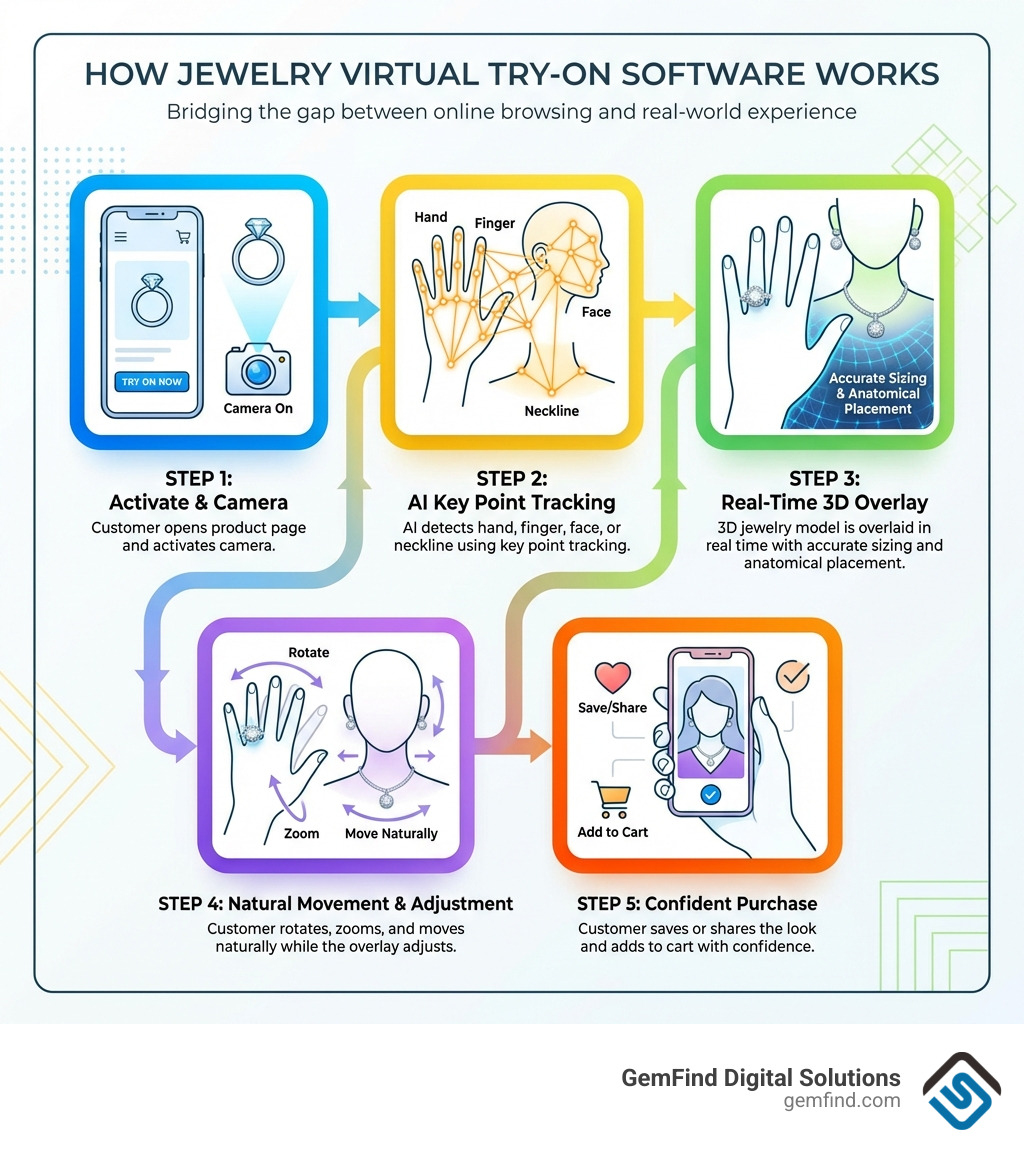
At its core, jewelry virtual tryon software is a blend of Augmented Reality (AR) and Artificial Intelligence (AI). It bridges the physical distance between a customer’s home and your showroom. But how does it actually turn a digital file into something that looks like it’s sparkling on a customer's finger?
The process starts with AR tracking and 3D modeling. Instead of a flat photo, the software uses a high-definition 3D model of the jewelry piece. When a customer clicks "Try On," the software activates their device's camera. Using neural networks, the system identifies specific anatomical markers—like the base of a ring finger or the curve of an earlobe.
Real-time rendering then ensures that the jewelry doesn't just sit on top of the image like a sticker. It reacts to the environment. If the customer moves their hand, the ring moves with them. If they tilt their head, the earrings sway. This motion response is what makes the experience feel "real" rather than "digital."
The Role of AI in Jewelry Virtual Try-On Software
AI is the "brain" behind the beauty. It handles the heavy lifting of machine learning and facial feature detection. For instance, when trying on a necklace, the AI doesn't just look for a neck; it maps the collarbone and adjusts the drape of the chain based on the user's posture.
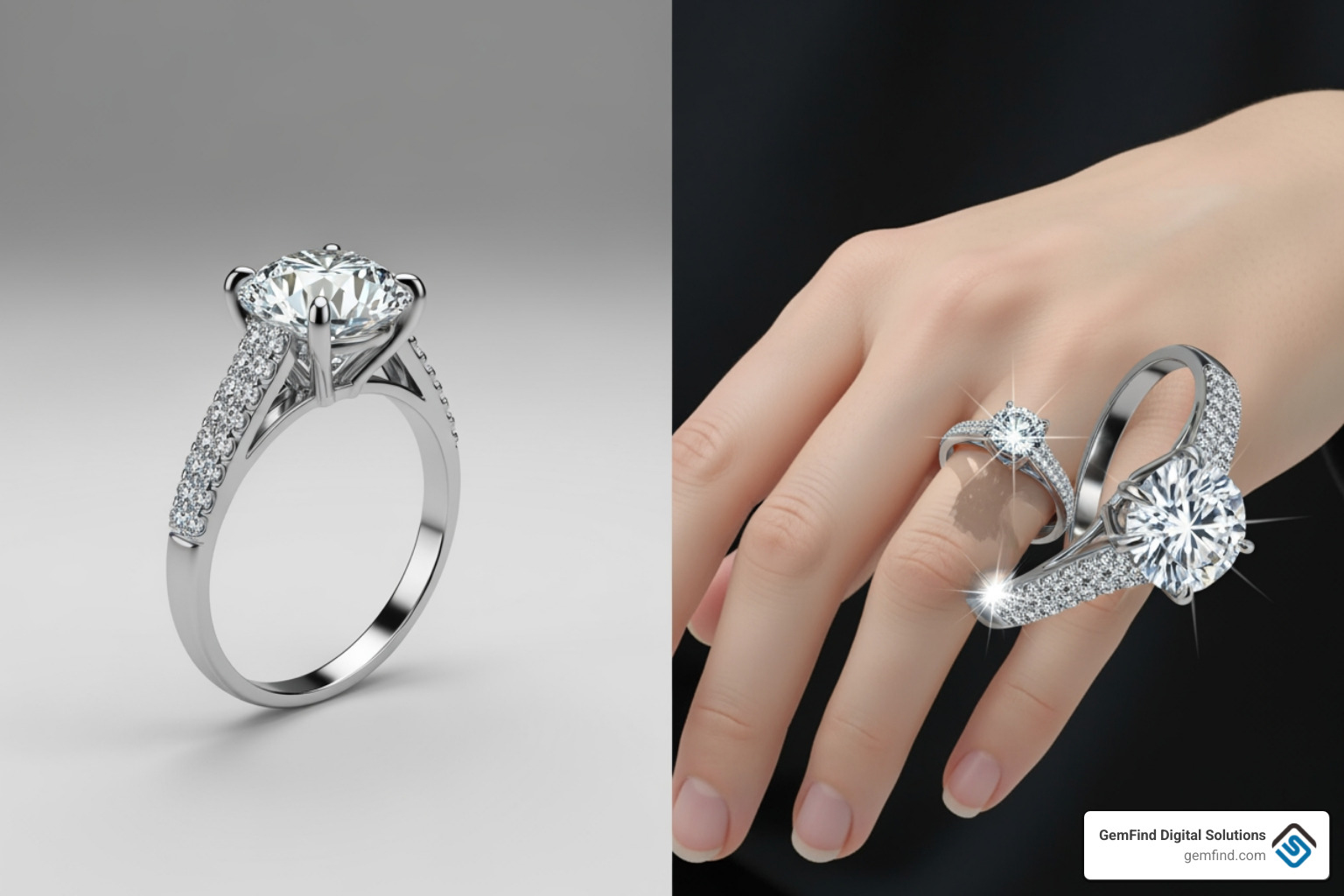
For rings, hand tracking is essential. The software must distinguish between fingers and understand depth so the ring appears to go around the finger, not just over it. Advanced tools also include lighting adjustments, where the AI analyzes the light in the user's room and applies similar reflections to the digital diamonds and gold, ensuring the sparkle looks natural.
Web-Based vs. App-Based Solutions
One of the biggest questions we hear at GemFind is whether you need a dedicated mobile app. In the past, you did. Today, markerless AR allows for seamless browser compatibility.
- Web-Based (No-Download): Customers can try on jewelry directly on your website. This is often preferred because it removes the "friction" of having to download an app just to see one ring. Modern cloud-based solutions are designed to ensure they won't slow down your site performance.
- App-Based / SDK Integration: Some brands prefer a dedicated app for a more immersive experience or to keep customers within their ecosystem. This uses a Software Development Kit (SDK) to build the try-on feature directly into your brand's existing mobile app.
For most independent jewelers, a web-based, cloud-hosted solution is the way to go—it's faster to launch and easier for the customer to use.
Key Benefits: Boosting Sales and Reducing Returns
The numbers don't lie. Integrating jewelry virtual tryon software isn't just a flashy trend; it’s a proven revenue driver. According to online jewelry sales statistics, the market is booming, and tech-savvy shoppers (especially Gen Z) are leading the charge.
We have seen retailers experience a 15% conversion uplift and a 35% increase in monthly orders after implementing these interactive tools that help jewelers sell more jewelry online. Perhaps the most significant stat for your bottom line is the 19% lower return rate. When a customer knows exactly how a 2-carat pear-shaped diamond looks on their specific hand, they are much less likely to be disappointed when the box arrives.
Enhancing the Customer Experience
Beyond the spreadsheets, VTO (Virtual Try-On) creates a sense of authentic self-reflection. It allows for easier and definite decision making. Customers can experiment at their own pace, in the comfort of their home, until they find the piece that reflects their style.
This technology also enables a 24/7 virtual showroom. Even if your physical store is closed, your website is working, offering a personalized shopping experience. You can even take it a step further by learning how to use video calling for clienteling for your jewelry store, combining the high-tech try-on with a high-touch personal consultation.
Reducing Operational Costs
Traditional jewelry photography is expensive. You need a studio, a photographer, a stylist, and a model. Then there's the security risk of shipping high-value inventory back and forth.
Shoot-free photography changes the game. By using CAD to 3D conversion, you can create lifelike lifestyle imagery without ever picking up a camera. Advanced AI tools allow you to take a flat product shot and place it on an AI-generated model instantly.
| Feature | Traditional Photoshoot | AI-Generated VTO |
|---|---|---|
| Cost | High (Studio, Model, Photographer) | Low (SaaS Subscription) |
| Speed | Days or Weeks | Minutes |
| Flexibility | Fixed angles/lighting | 360-degree views/adjustable light |
| Inventory | Requires physical piece | Can work from CAD or 3-4 photos |
| Returns | No impact | Proven to reduce returns by ~19% |
Essential Features of Jewelry Virtual Try-On Software
When you're shopping for the right software, don't just look at the price tag. Look at the features that will actually make a difference to your customers.
- 360-Degree Viewer: Customers should be able to rotate the piece to see the gallery, the prongs, and the underside of the setting.
- High-Definition Rendering: If the diamonds look like gray blobs, the sale is lost. You need "studio-grade" assets that show metal reflections and gemstone brilliance.
- Multi-product "Look Creator": Some platforms allow users to build a full look—trying on a necklace, earrings, and a ring simultaneously.
- Real-time Customization: This is where it gets exciting. Customers can swap a yellow gold band for platinum or change a round center stone for an oval and see the price update instantly. We've seen how how a custom jewelry builder can boost sales by giving the customer creative control.
Supported Jewelry Categories
Most modern jewelry virtual tryon software supports a wide range of categories. While rings are the most popular (and most difficult to track), high-end solutions also support:
- Engagement Rings & Wedding Bands: Including 5 reasons you need the ringbuilder® for your jewelry website to help them find the perfect fit.
- Earrings: Both studs and drops, with accurate "swing" physics.
- Necklaces & Pendants: With proper neckline alignment.
- Luxury Watches & Bracelets: Using wrist-tracking technology.
Accuracy in Sizing and Anatomical Placement
One of the biggest hurdles is anatomical placement. A ring shouldn't just float near a finger; it should sit at the base. Top-tier software uses key point detection to find the joints of the finger and the curve of the ear.
According to scientific research on AR interest by generation, Gen Z and Millennials are particularly sensitive to the realism of AR. If the placement is off, the "magic" is broken. That's why we recommend platforms that offer precise 3D scaling, ensuring the 1-carat diamond looks like a 1-carat diamond, not a boulder.
Integration and Compatibility Across E-commerce Platforms
At GemFind, we specialize in making these tools work with your existing setup. Most of the software mentioned here offers "plug-and-play" compatibility with major platforms:
- Shopify: The most popular choice, with many VTO tools offering direct apps in the Shopify App Store.
- WooCommerce & Magento: Often integrated via custom APIs or specialized extensions.
- BigCommerce: Supported by enterprise-level tools.
Additionally, if you are a diamond-heavy business, you should consider why you should have a virtual diamond list on your website. Integrating your live diamond feed with a virtual try-on tool is the ultimate "power move" for engagement ring sales.
Device and Browser Support
Your customers aren't just on desktops. In fact, most AR try-ons happen on mobile.
- Mobile-First Design: The software should work seamlessly on both iOS and Android.
- Cross-Platform Synchronization: If a customer starts a "look" on their laptop, they should be able to scan a QR code and instantly see it on their phone's camera.
- Browser-Based Processing: This ensures that the heavy AI calculations happen in the cloud, not on the user's phone, preventing the device from overheating or lagging.
Data Security and Privacy Measures
Privacy is a major concern when you're asking customers to turn on their cameras. Leading industry providers are PII compliant (including GDPR).
- No-Storage Policies: Reliable tools process the image in the browser and do not store the user's photos or login data on their servers.
- Encryption: Any data that is transmitted is heavily encrypted to protect customer identity.
- Transparency: Always choose a provider with a clear, easy-to-find privacy policy.
Frequently Asked Questions about Jewelry Virtual Try-On Software
Do I need to ship physical products to create 3D models?
No! This is one of the biggest misconceptions. Most modern services can create a "digital twin" using either your CAD files or just 3-4 high-resolution photos of the piece from different angles. This makes it incredibly easy to digitize your entire inventory without the risk of shipping.
How accurate is the virtual ring sizing?
While it's not a replacement for a physical sizer, it's very close. The software uses AI scaling and sometimes asks the user to hold a standard-sized object (like a credit card) near their hand as a reference point to calibrate the scale. This helps the customer visualize the "hand coverage" of different carat weights.
Is jewelry virtual try-on software compatible with Shopify?
Yes, absolutely. Most of the top providers offer seamless UI/UX integrations specifically for Shopify. At GemFind, we often help our clients with catalog mapping, ensuring that your Shopify SKUs are correctly linked to your 3D assets for a one-click publishing experience.
Conclusion
The "guessing game" of online jewelry shopping is officially over. By implementing jewelry virtual tryon software, you aren't just adding a cool gadget to your site—you're building trust, increasing confidence, and significantly boosting your bottom line.
At GemFind Digital Solutions, we’ve spent over 25 years as a dedicated partner to the jewelry industry. As a Shopify and Google Partner, we understand the technical nuances of making these tools work for your specific brand. Whether you’re looking for a simple ring try-on or a full-scale 3D configurator, we have the expertise to help you shine.
Ready to transform your online store? Start building a successful jewelry website today and let’s bring your showroom to your customers' fingertips.


