



Why Most Jewelry Websites Struggle to Convert Visitors into Buyers

Jewelry website conversion optimization is the process of making strategic changes to your online store so more visitors become paying customers. Here's a quick overview of what works:
| Strategy | Impact |
|---|---|
| High-quality 360° product views | Up to 30% conversion lift |
| Virtual try-on / AR tools | Up to 94% higher conversions |
| User-generated content (UGC) | Up to 102% conversion increase |
| Mobile-first design | Critical — 50%+ of traffic is mobile |
| Live chat support | 34% higher customer satisfaction |
| Abandoned cart email recovery | Recovers from a 70%+ abandonment rate |
| Flexible payments (BNPL) | Reduces hesitation on high-ticket items |
| Trust signals (certs, reviews) | Foundational for fine jewelry sales |
Here's a number that should get your attention: 98% of visitors leave a jewelry website without buying anything.
That's not just a traffic problem. It's a conversion problem.
The average jewelry site converts at just 1.7% — and fine jewelry sites often fall below 1%. Compare that to accessories e-commerce overall, which averages 7.4%, and the gap becomes hard to ignore.
Why is jewelry so different? Because buying a ring or necklace online isn't like buying a t-shirt. It's a high-consideration, emotionally driven purchase. Shoppers can't touch the metal, feel the weight, or see the sparkle in person. That creates hesitation — and hesitation kills sales.
The good news? That gap between your current conversion rate and the 3–5% that top-performing jewelry stores achieve is closeable. The right combination of visuals, trust signals, UX improvements, and smart follow-up can make a real difference.
I'm Anthony Arechiga, VP of Sales at GemFind Digital Solutions, where I've spent over 25 years helping jewelry retailers build high-performing websites and digital marketing strategies — making jewelry website conversion optimization a core part of what we do every day. Below, I'll walk you through the highest-impact changes you can make right now.
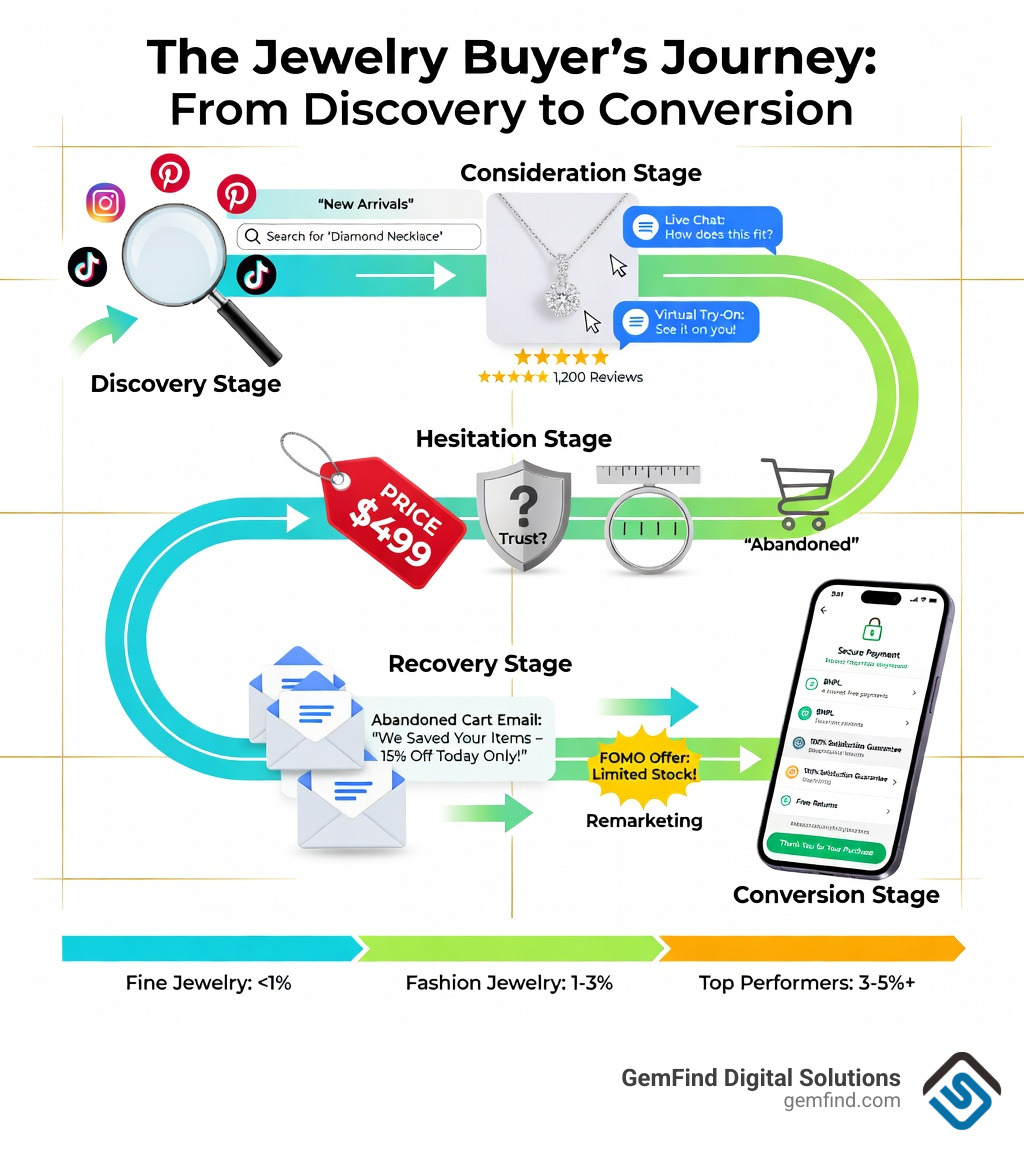
Jewelry website conversion optimization terms you need:
High-Impact Visuals and Interactive Technology
In the jewelry world, the eyes lead the wallet. Research shows that 93% of shoppers prioritize visual appearance above all other factors when making a purchase. Because your customers can’t physically hold a piece, your website must bridge the gap between digital browsing and a high-end in-store experience.
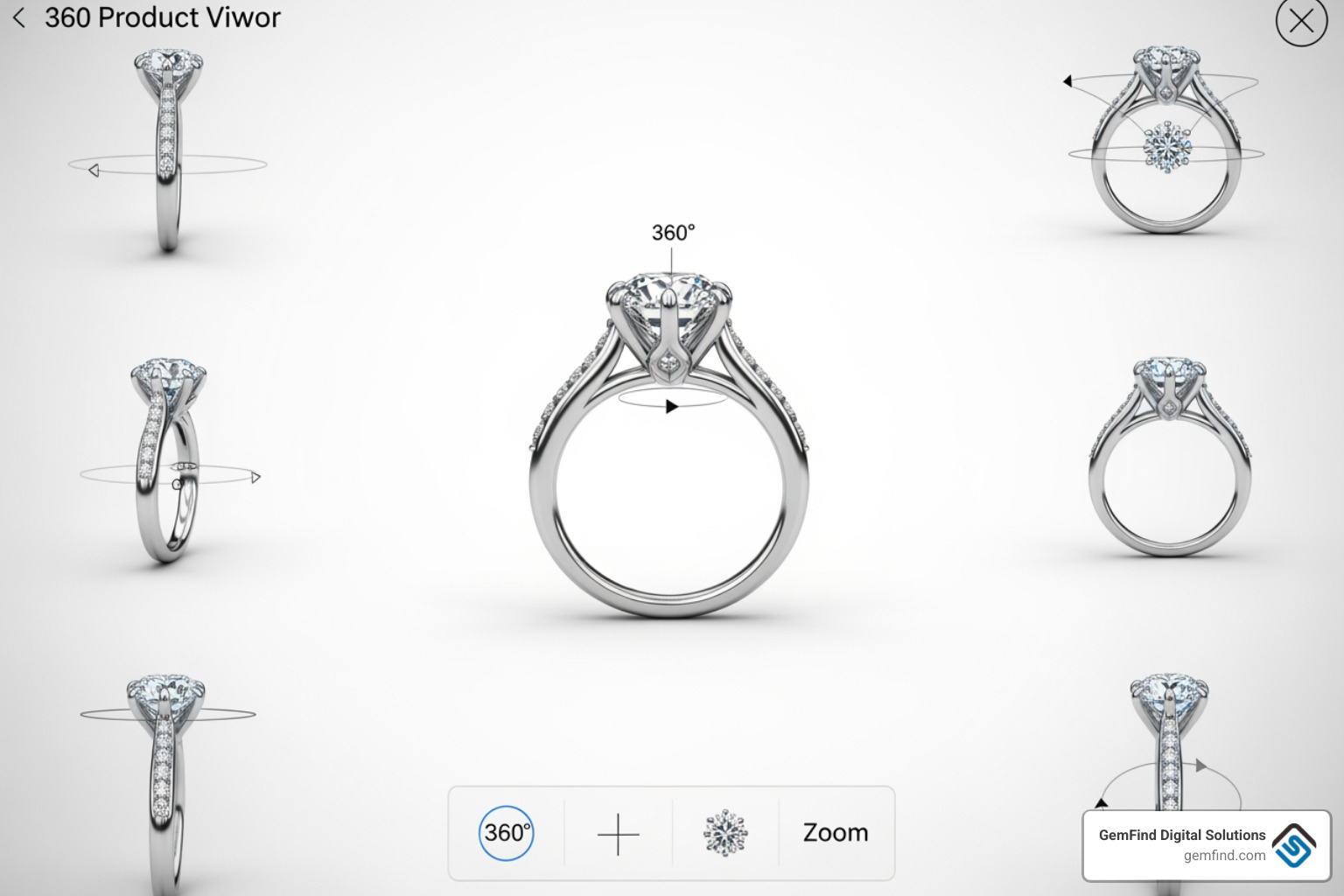
High-resolution photography is the baseline, but "flat" images are no longer enough. To truly master jewelry website conversion optimization, you need to showcase the "sparkle" through multiple lenses:
- Studio Shots: Clean, high-resolution images against a white background to show detail.
- Lifestyle Imagery: Photos of the jewelry being worn to provide a sense of scale and style.
- Zoom Functionality: Allowing users to see the intricate details of a setting or the clarity of a stone.
Beyond static images, 360-degree views are a game-changer. By allowing a customer to rotate a ring or pendant, you simulate the act of holding it in their hand. This transparency reduces "buyer's remorse" anxiety and can increase conversion rates by as much as 30%. Video demonstrations are equally powerful, capturing how the light hits a gemstone in motion—something a still photo simply cannot replicate.
Personalization Tactics for Jewelry Website Conversion Optimization
The more a customer interacts with a product, the more they feel a sense of ownership over it. This is why making your jewelry website more interactive is one of the most effective ways to boost sales.
Customization tools—such as "Build Your Own Ring" features or engraving previews—allow shoppers to create something unique. When a user can see their partner's initials engraved on a band in real-time, the emotional connection to the purchase skyrockets.
However, the "holy grail" of modern jewelry tech is the virtual try-on. Using Augmented Reality (AR), customers can use their smartphone camera to see how a pair of earrings looks on their ears or how a watch fits their wrist. A Shopify study on AR’s impact found that products utilizing these features see a staggering 94% higher conversion rate. It removes the single biggest hurdle in online jewelry sales: "Will this actually look good on me?"
Building Unshakable Trust and Credibility
Trust is the currency of the jewelry industry. When a customer is spending thousands of dollars on a high-ticket item, they aren't just buying a product; they are buying your reputation. If your site doesn't scream "legitimate," they will bounce faster than a loose diamond on a tile floor.
To build this trust, you must highlight your credentials prominently. This includes:
- Certifications: Displaying GIA, IGI, or AGS grading reports directly on the product page.
- Ethical Sourcing: Modern shoppers, particularly Millennials and Gen Z, care deeply about sustainability. Highlighting conflict-free diamonds or recycled metals can be a deciding factor.
- Authenticity Certificates: Providing a branded certificate of authenticity with every purchase.
Social proof is equally vital. While standard text reviews are helpful, User-Generated Content (UGC) is the gold standard. Seeing a "real" person wearing your jewelry in a non-studio setting provides a level of authenticity that polished marketing photos can't match. According to UGC impact statistics, incorporating customer photos and videos can increase conversion rates by up to 102.4%. Don't hide these at the bottom of the page—bring them up to the first fold where they can influence the initial decision.
Reducing Hesitation with Live Chat Support
Jewelry buyers always have questions. "Can this be resized?" "What is the clarity of this specific stone?" "Will it arrive by Friday?" If they have to wait 24 hours for an email response, the "buying mood" often evaporates.
Implementing live chat on your jewelry store's website provides the instant gratification that modern shoppers crave. Statistics show that 59% of customers are more likely to buy if their inquiry is answered in less than a minute.
Live chat isn't just for basic support; it’s a sales tool. It allows your team to offer expert consultations, much like a floor associate would in a brick-and-mortar store. This real-time assistance builds immense buyer confidence, leading to a 34% increase in customer satisfaction and a significant lift in overall jewelry website conversion optimization.
Mastering Jewelry Website Conversion Optimization through UX
User Experience (UX) is the invisible force that guides a visitor toward the "Checkout" button. If your site is cluttered, slow, or confusing, you are essentially putting a "Closed" sign in your digital window.
| Feature | Mobile Behavior | Desktop Behavior |
|---|---|---|
| Navigation | Prefers "Hamburger" menus and icons | Uses mega-menus and hover effects |
| Search | High usage of voice and auto-suggest | Detailed filtering and sorting |
| Images | Vertical, swipeable galleries | Large, high-res hover-to-zoom |
| Checkout | One-click / Digital Wallets (Apple Pay) | Standard form filling |
To ensure your site performs at its peak, you must focus on essential website features to boost conversions. This starts with site speed. Every second of delay in loading time can lead to a 7% drop in conversions.
Your navigation should be intuitive, allowing users to find what they need with minimal clicks. Robust filtering is non-negotiable for jewelry sites; customers should be able to sort by metal type, stone shape, price range, and occasion instantly. Finally, don't be afraid of white space. A clean, minimalist design allows your jewelry to be the star of the show rather than competing with a cluttered layout.
Mobile-First Design for Jewelry Website Conversion Optimization
With over 50% of all e-commerce traffic now coming from mobile devices, a "mobile-friendly" site isn't enough—it must be mobile-first. Many jewelry retailers lose sales because their beautiful desktop site becomes a nightmare to navigate on a small screen.
Common reasons visitors leave your website on mobile include:
- Buttons that are too small: Ensure all Call-to-Action (CTA) buttons are "thumb-friendly."
- Slow loading images: Use adaptive images that scale down for mobile networks.
- Non-responsive layouts: If a user has to "pinch and zoom" to read a product description, they will leave.
Google now uses mobile-first indexing, meaning your mobile performance directly impacts your SEO. A fast, responsive layout isn't just good for conversions; it's essential for being found in the first place.
Reducing Friction in the Checkout and Cart Experience
The moment a customer adds an item to their cart is the most critical point in the journey. Unfortunately, it’s also where most sales are lost. The industry average for cart abandonment is nearly 70%, and for high-ticket jewelry, it can be even higher.
To combat this, you need a multi-pronged approach:
- Abandoned Cart Recovery: Use automated email flows to remind customers of what they left behind. These emails have a 40% open rate in the jewelry industry—far higher than standard marketing blasts.
- Exit-Intent Popups: When a user moves their cursor to close the tab, trigger a popup offering a small discount or a free ring sizer to keep them engaged.
- FOMO and Urgency: Use tactics like "Only 2 left in stock" or "Order within 2 hours for Friday delivery" to encourage immediate action.
Remarketing is crucial for your jewelry website because jewelry is rarely an impulse buy. A customer might visit your site five times before pulling the trigger. Remarketing ads keep your brand top-of-mind while they are in the "consideration" phase.
Flexible Payment Solutions for High-Ticket Items
Price is the ultimate friction point. A $2,500 engagement ring can feel daunting when paid all at once. By offering tools to enhance your website like Buy Now, Pay Later (BNPL) options—such as Klarna, Affirm, or PayPal Credit—you make high-ticket items more accessible.
Breaking a large purchase into manageable monthly installments can turn a "maybe later" into a "yes today." Additionally, ensure your shipping and return policies are transparent and visible from the cart. Offering free shipping and a "no-questions-asked" 30-day return policy removes the risk of the purchase, which is essential for jewelry website conversion optimization.
Frequently Asked Questions about Jewelry Website Optimization
What is a good conversion rate for an online jewelry store?
A healthy benchmark for most online jewelry stores is between 1% and 3%. However, top-performing brands that have mastered their UX and trust signals often achieve 3% to 5% or higher. Fine jewelry (high-ticket) typically sees lower rates (under 1%), while fashion jewelry (lower price point) can see much higher engagement.
Why do jewelry websites have lower conversion rates than other industries?
Jewelry is a high-consideration, emotional, and expensive purchase. Unlike buying a book or a t-shirt, customers often need to consult with a partner, research gemstone quality, and overcome the "trust gap" of buying a luxury item without seeing it in person. This longer decision-making process naturally leads to more visits before a final conversion.
How can I improve my jewelry website's mobile conversion rate?
Focus on speed and simplicity. Use "Sticky Add to Cart" bars, implement one-click checkout options like Apple Pay or Shop Pay, and ensure your product images are optimized for fast loading on cellular data. The fewer obstacles between the customer and the "Buy" button, the higher your mobile conversion rate will be.
Conclusion
Mastering jewelry website conversion optimization isn't about one single "magic" trick; it's about refining every touchpoint of the customer journey. From the moment they see a sparkling 360-degree view to the second they see a flexible payment option at checkout, every detail matters.
At GemFind Digital Solutions, we’ve spent over 25 years helping independent jewelers navigate the digital landscape. As a certified Shopify and Google Partner, we specialize in creating tailored solutions—like our Edge POS integration and jewelry-specific apps—that turn browsers into lifelong customers.
Don't let your beautiful jewelry go unseen or unbought because of a sub-par website experience. Stop losing sales and start growing your jewelry business today with a data-driven strategy designed specifically for the jewelry industry.


