


Why Google SEO Location Is the Most Powerful Tool Your Jewelry Store Isn't Using

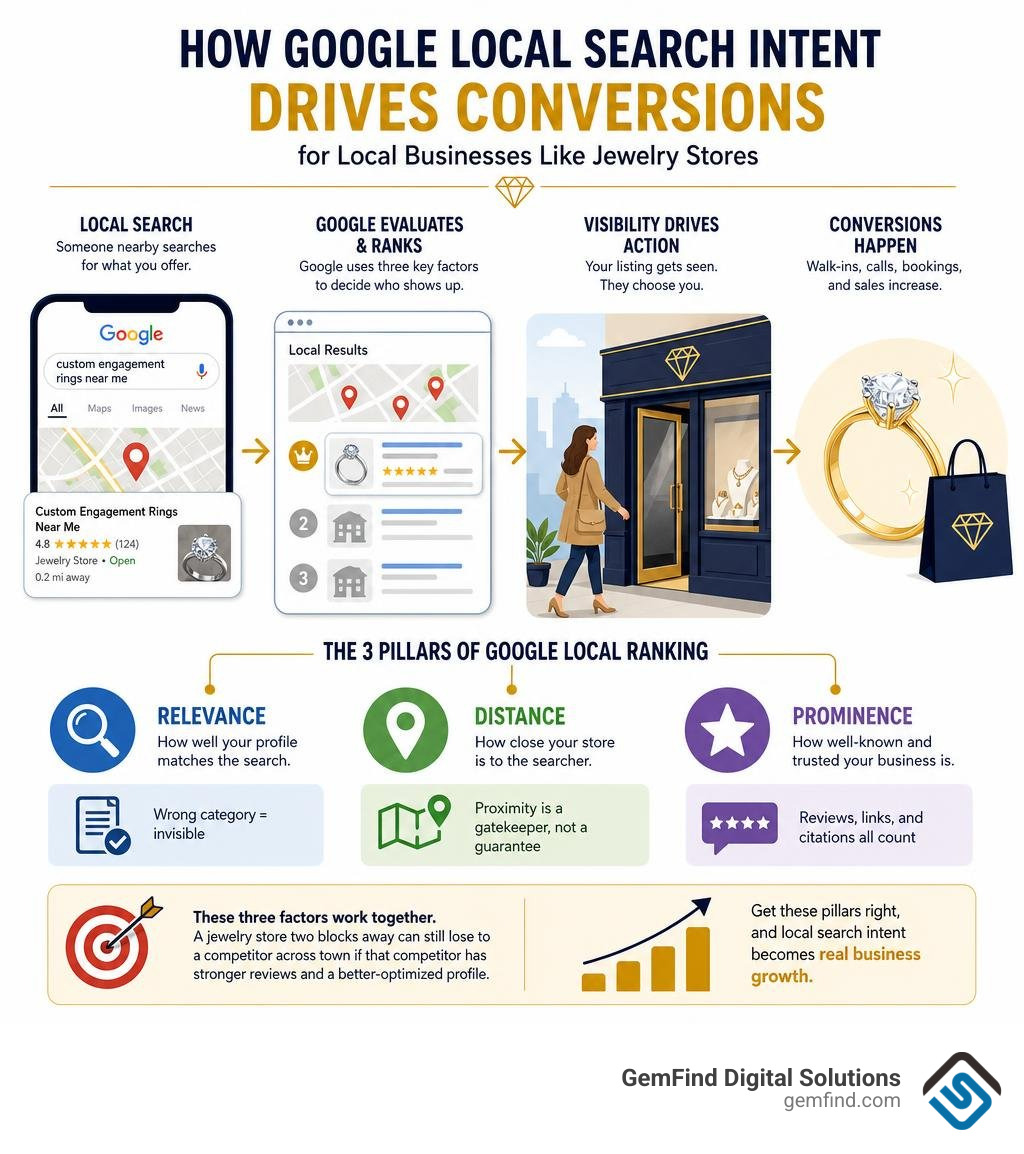
Google SEO location is how Google decides which local businesses to show — and where — when someone nearby searches for what you sell. For a jewelry store, this can mean the difference between a full appointment book and an empty showroom.
Here is how Google ranks local businesses:
| Ranking Factor | What It Means | Why It Matters |
|---|---|---|
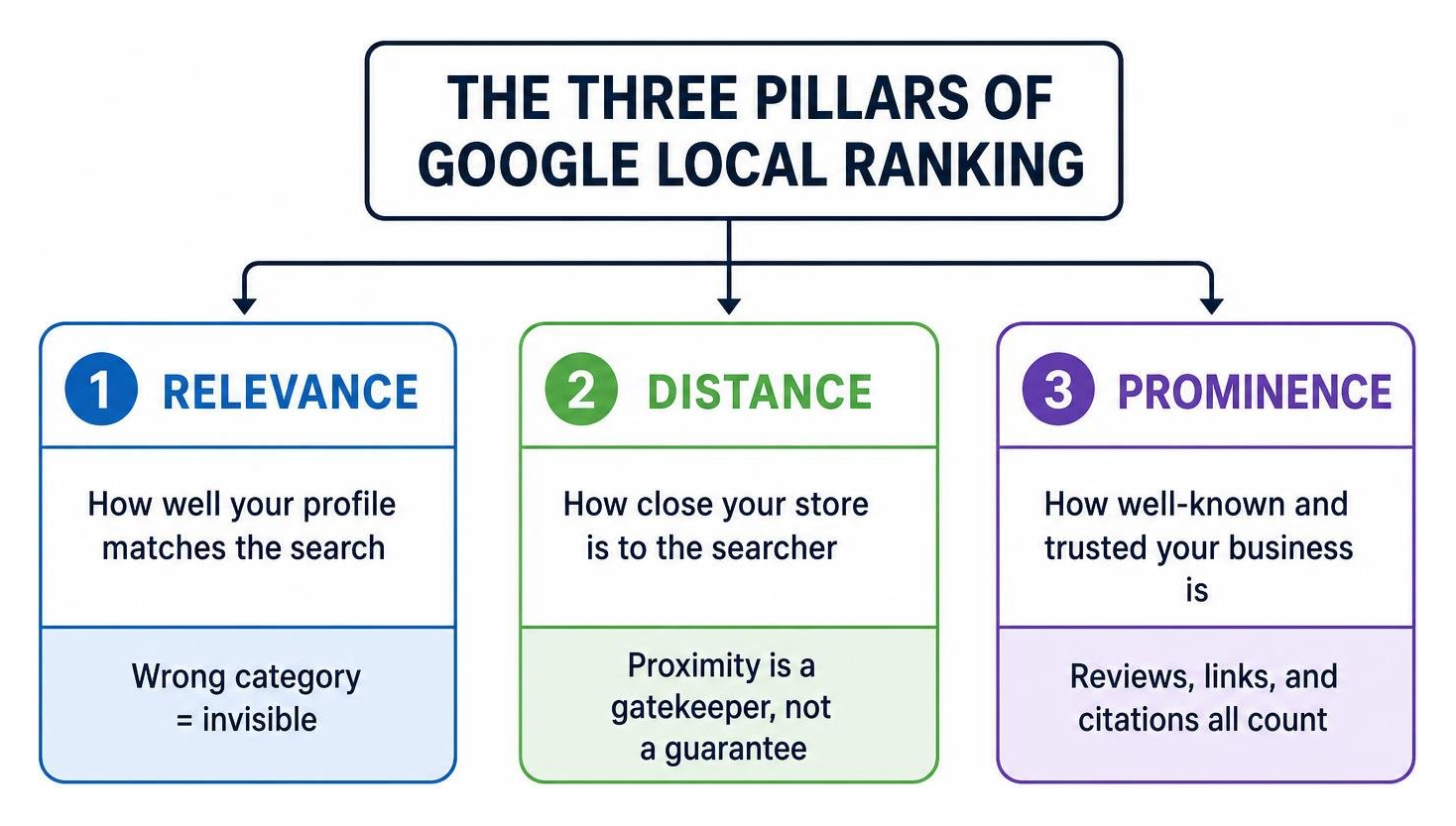
| Relevance | How well your profile matches the search | Wrong category = invisible |
| Distance | How close your store is to the searcher | Proximity is a gatekeeper, not a guarantee |
| Prominence | How well-known and trusted your business is | Reviews, links, and citations all count |
These three factors work together. A jewelry store two blocks away can still lose to a competitor across town if that competitor has stronger reviews and a better-optimized profile.
The stakes are high. Nearly 46% of all Google searches have local intent. Yet 60% of searches now end without a single click, because AI Overviews and Google's own answer boxes serve up answers directly on the results page. If your store isn't visible on the search results page — not just ranking somewhere beneath it — you may as well not exist.
I'm Morgan Price, a backlink outreach and local authority specialist who has spent years helping businesses build the kind of trusted digital presence that earns visibility in Google SEO location results across both traditional maps and AI-powered search. In the sections below, I'll walk you through exactly how Google's local ranking system works and what your jewelry store can do today to show up where your customers are already looking.
The Core Pillars of Google Local Ranking
When a customer searches for "custom engagement rings" or "jewelry repair near me," Google’s algorithm goes to work in milliseconds. It doesn't just look for websites that mention those keywords; it evaluates real-world entities.
According to Google's Official guidelines on local ranking, the local search algorithm is built on three core pillars: relevance, distance, and prominence. Understanding how these three elements interact is the key to unlocking your store's digital visibility.
Relevance: Matching Search Intent
Relevance is all about how well your local business profile matches what someone is searching for. If a user is looking for an "art deco engagement ring," Google wants to serve up a jeweler who specializes in vintage styles, not a wholesale gold buyer.
To establish strong relevance, your Google Business Profile (GBP) must be complete, detailed, and highly accurate. This starts with selecting the correct primary and secondary business categories. If you run a high-end jewelry store, setting your primary category as "Jewelry Store" is essential, but you should also utilize secondary categories like "Jewelry Designer," "Diamond Dealer," or "Jewelry Repairing" if you offer those services.
To dive deeper into setting up your maps presence properly, check out A Guide to Google Maps for Your Jewelry Store.
How Google SEO Location Signals Determine Distance
Distance—or proximity—is exactly what it sounds like: how far is the searcher from your physical storefront? However, how Google calculates this is much more complex than drawing a straight line on a map.
If a user has shared their precise location permissions on their mobile device, Google uses real-time GPS coordinates. But what if they haven't? As outlined in Google’s documentation on How Google determines searcher location, Google will estimate location using signals like IP addresses, past search history, and even the general area of previous queries.
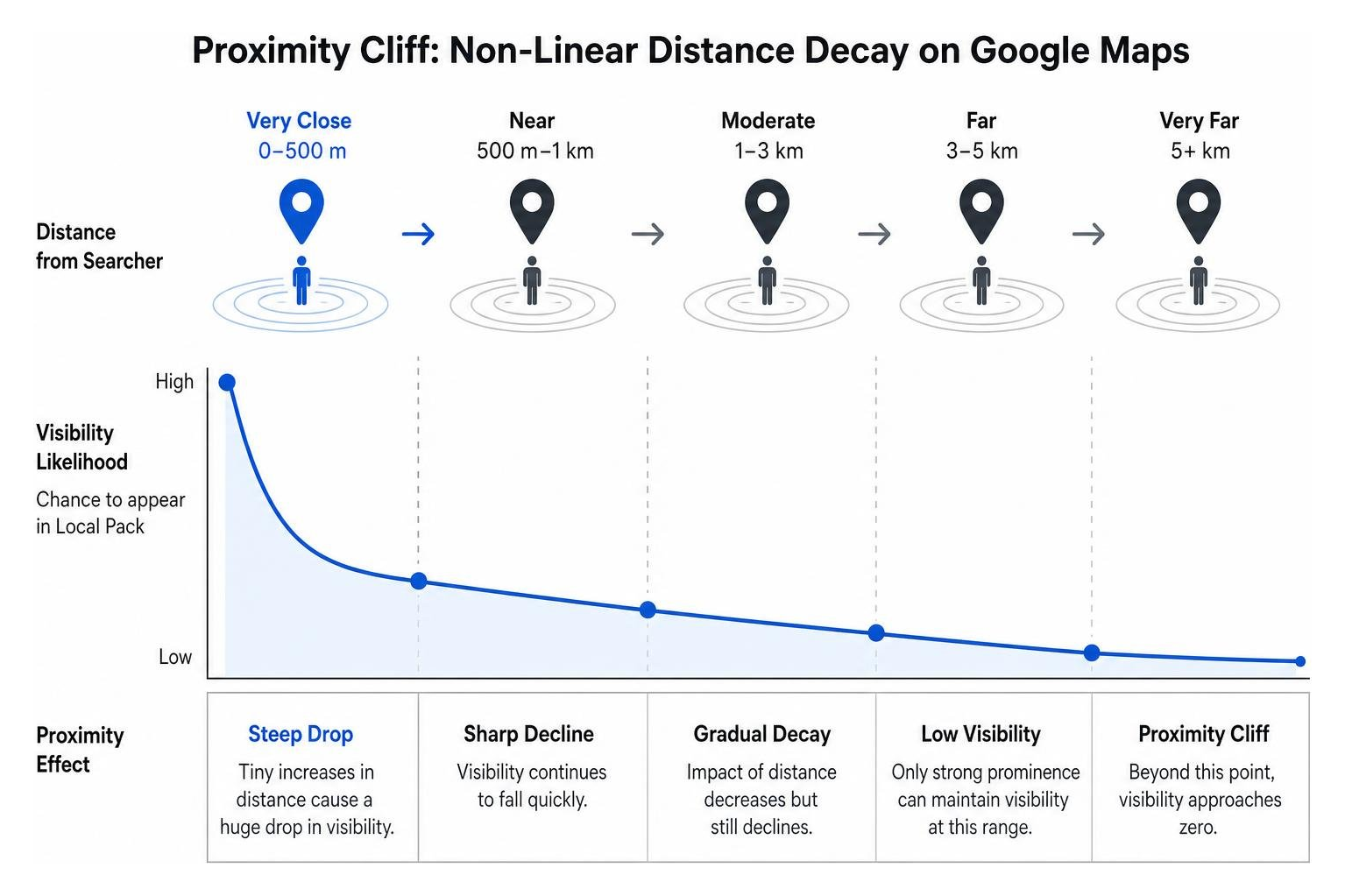
For your jewelry store, this means your visibility changes block by block. A user standing 500 meters from your door will see a completely different set of Map Pack results than someone standing 3 kilometers away. To optimize your site to capture these hyper-local searchers, check out our guide on How to Rank in Jewelry Stores Near Me Searches.
Prominence: Building Authority and Trust
Prominence is Google's measure of how well-known and reputable your business is in the offline and online worlds. Some landmarks or famous museums are naturally prominent, but for local businesses, Google calculates prominence using a variety of digital signals:
- Review Velocity and Sentiment: How many reviews do you have, how often do you get them, and are they positive?
- Local Citations: Consistent Name, Address, and Phone number (NAP) listings across reputable web directories.
- Web Links and Articles: High-quality backlinks from local blogs, news sites, and industry-specific authorities.
If your store has outstanding prominence, Google will often "stretch" your ranking radius, allowing you to show up for searchers who are miles away, bypassing closer competitors who lack digital authority. We have put together a comprehensive blueprint on this process in our guide on How to Optimize Your Local SEO for Your Jewelry Business.
Demystifying the Proximity Factor and the Proximity Cliff
Proximity is often called the "gatekeeper" of local SEO. If you are too far from the searcher, you aren't even eligible to compete in the local pack. However, recent data shows that the way Google handles proximity is shifting from simple distance metrics to complex, non-linear algorithms.
User-Anchored vs. Centroid-Anchored Queries
To understand how proximity affects your jewelry store, we must first look at how Google interprets search queries. According to empirical studies on How the proximity factor works on Google Maps, Google categorizes local searches into two distinct types:
- User-Anchored Queries: These are searches with high immediate intent or urgency, such as "jewelry repair near me" or "watch battery replacement." For these queries, Google anchors the search centroid directly to the user's exact GPS coordinates. The proximity decay is incredibly steep here.
- Centroid-Anchored Queries: These are searches for high-consideration or destination services, such as "best custom jeweler" or "designer engagement rings." Instead of looking at where the user is standing, Google anchors the search to a geographic centroid (like a city center or a renowned shopping district). This allows prominent businesses located further away to rank highly.
The Mathematical Reality of Proximity Decay
Proximity decay—the rate at which your rankings drop as a user moves away from your store—is non-linear. According to 2026 Geogrid data, there is almost zero rank change for searches within 600 meters of your storefront. However, between 1.5 and 4 kilometers, rankings hit a steep "proximity cliff" where visibility drops off almost entirely.
Interestingly, this cliff behaves differently depending on the business vertical. High-urgency services have a incredibly tight radius, whereas destination businesses enjoy a much wider ranking area:
| Industry Vertical | Average Proximity Cliff Distance | Proximity Influence on Rank |
|---|---|---|
| Emergency Services (e.g., Plumbers) | 1.2 km to 1.6 km | Extreme (88% of variance) |
| Dental & Medical Clinics | 3.5 km | Moderate (55% of variance) |
| Wedding Venues & Fine Dining | Up to 8.0 km | Low (22% of variance) |
Because jewelry purchases (especially bridal and custom designs) are high-consideration destination purchases, jewelry stores behave much like wedding venues. Your proximity cliff is softer, meaning you can expand your local reach significantly if you build strong prominence.
One highly effective way to draw in these customers from outside your immediate neighborhood is through location-based targeting. Learn more about this in our article on How Geofencing Can Drive New Customers to Your Jewelry Store.
Mastering Google SEO Location Optimization for Your Business
Now that we know the math behind the map, let's talk about the practical steps you can take to optimize your digital storefront.
Claiming and Verifying Your Google Business Profile
Your Google Business Profile is the absolute foundation of your local SEO. If you haven't claimed and verified your profile, you are leaving your local rankings completely to chance.
Verification is strictly enforced by Google, often requiring video verification of your physical storefront, tools, and signage. Once verified, you must fill out every single field of your profile. This includes:
- Accurate Business Hours: Keep these updated in real-time, especially for holidays.
- High-Quality Photos and Videos: Show your showroom, your team, and your actual jewelry-making process.
- In-Store Products: Retailers can display their real-time inventory directly on their profile using tools like Point of Sale (POS) integrations.
If you are new to this process, we recommend starting with our step-by-step walkthrough on Google My Business Basics.
Service Area Businesses vs. Physical Storefronts
For jewelers, having a physical showroom is the gold standard. However, some independent designers or mobile jewelry repairers operate as Service Area Businesses (SABs).
If you do not serve customers at your physical address, Google's guidelines require you to hide your address and set a service area polygon (usually within a 2-hour drive radius). While this keeps you compliant, managing an SAB profile requires a different approach to maintain visibility. To understand how to balance these settings, read our guide on Optimize Your Jewelry Store's Google Listing to Reach More Customers.
The Impact of Hidden Addresses on Map Pack Rankings
There is a long-standing debate in the SEO world: does hiding your address on your Google Business Profile hurt your rankings?
While Google's official stance is that hiding your address does not impact rankings, real-world testing by local SEO experts tells a different story. Listings with hidden addresses frequently experience a drop in Map Pack visibility compared to those with visible physical storefronts. Furthermore, customers are highly visual and trust-oriented; they are far more likely to visit or call a jeweler if they can see a real, physical address on the map.
To maximize your store's trust and map pack presence, explore our 4 Tips to Increase Your Jewelry Store's Local Visibility on Google.
On-Page Strategies and Location Page Architecture
While your Google Business Profile is crucial, it doesn't work in a vacuum. Google constantly crawls your website to verify the information on your GBP. If your website lacks strong local signals, your map rankings will suffer.
To build a highly effective local presence, we must optimize your website's architecture using dedicated location pages, as detailed in Semrush's guide on How to Create Optimized Location Pages.
Creating High-Performing Location Pages
If you have multiple showrooms, or if you want to attract customers from neighboring towns, you need dedicated, unique location pages. Do not simply copy and paste the same text and swap out the city names—Google's duplicate content filters will quickly penalize this.
Instead, craft individual pages that feature:
- Location-Specific Content: Mention local landmarks, parking directions, and community events you sponsor.
- Embedded Google Maps: Embed a map with a pin pointing directly to your store.
- Local Reviews: Feature testimonials from customers who live in that specific area.
- Clear Call to Actions (CTAs): Make it easy to "Book a Showroom Consultation."
For more direct tips on boosting these pages, read our guide on 5 Easy Steps to Boost the Google Map Ranking of Your Jewelry Business and Get More Customers. (Note: Link target verified as gemfind.com/blogs/digital-marketing/...)
Implementing Local Business Schema Markup
To help search engines understand your business details without any ambiguity, you should implement LocalBusiness structured data (Schema markup) in your website's HTML.
Schema markup is a standardized code (typically written in JSON-LD) that tells search engines exactly what your business is, your physical address, your phone number, your opening hours, and even your social media profiles. When your schema markup perfectly matches your GBP data, it sends a high-confidence signal to Google's ranking algorithm.
To learn how to set this up for your store, read our guide on Optimize Your Jewelry Store's Google Listing for Maximum Visibility.
Aligning Your Website with Google SEO Location Best Practices
Beyond schema, your website must adhere to general local SEO best practices. Ensure that your Name, Address, and Phone number (NAP) are formatted identically in your website's footer, your contact page, and all external directories.
Furthermore, because over 60% of global web traffic comes from mobile devices, your website must load fast and be incredibly easy to navigate on a smartphone. A slow, clunky mobile experience will cause local searchers to bounce back to the map and click on a competitor instead.
Discover how these pieces fit together in our article on How Local SEO Can Help Jewelers Attract More Customers.
The New Frontier: Localized SEO and Generative Engine Optimization (GEO)
As we navigate through 2026, the local search landscape is undergoing its biggest disruption in a decade. Traditional keyword strategies are no longer enough; we must now optimize for AI-driven answer engines.
According to research on Localized SEO and GEO: Get Cited by AI, AI Overviews now appear in over 50% of search results. In this new zero-click environment, your goal is no longer just "ranking first"—it is getting cited as a trusted source by AI models.
How AI Overviews and Answer Engines Use Local Data
AI search engines like Google Gemini and Perplexity do not just look at your website's text. They cross-reference data from multiple sources across the web to build a high-confidence model of your business.
As outlined in the guide on How to Optimize Your Local Content for Generative Search Answers, these AI engines look for:
- Factual Consistency: Is your NAP, pricing, and services identical across your website, GBP, and directories?
- Behavioral Verification: Are customers uploading geotagged photos of your store? (Geotagged customer photos are incredibly trusted by AI models because they contain forensic GPS metadata that cannot be faked).
- Real-World Activity: Does your POS data or check-in history verify that you actually operate in the area you claim?
Optimizing Local Content for AI Citations
To ensure your jewelry store is cited in conversational search queries like "Where can I find a trustworthy jeweler in Chicago who specializes in custom platinum settings?", you must adapt your content style.
Write in natural, authoritative language that directly answers complex "why" and "how" questions. Instead of keyword-stuffed lists, create deep-dive guides on jewelry care, diamond grading, and custom design processes. When AI engines synthesize answers for users, they will pull from and link back to websites that provide this structured, high-authority information.
To see how local campaigns can support this modern approach, read our guide on What Are Google Local Campaigns and How They Can Benefit Your Jewelry Store.
Frequently Asked Questions about Google Local SEO
Does hiding my address hurt my Google Maps ranking?
Yes. While Google officially states that Service Area Businesses with hidden addresses can rank just as well, real-world data and testing show that listings with visible physical storefront addresses have a distinct ranking advantage in the Map Pack. Additionally, displaying a physical address builds significantly more trust with potential customers.
How does Google know where a searcher is located?
Google uses several combined signals to estimate a searcher's location. This includes real-time GPS coordinates (if device location permissions are enabled), your internet connection's IP address, your set home and work addresses in your Google Account, and your past search history.
What is the difference between local SEO and GEO?
Local SEO focuses on optimizing your business to rank in traditional search results, Google Maps, and the Local 3-Pack. Generative Engine Optimization (GEO) is the practice of structuring your digital data, reviews, and content so that your business is cited and recommended inside AI-generated search summaries (like Google's AI Overviews).
Conclusion
Navigating the complexities of google seo location can feel like trying to grade a diamond without a loupe. Between non-linear proximity cliffs, strict Google Business Profile verification guidelines, and the rapid rise of AI-driven Generative Engine Optimization, keeping your jewelry store visible requires constant vigilance and expert execution.
Your digital presence is your second storefront. If it isn't polished, detailed, and optimized to shine in your local community, potential customers will simply walk into the showroom of the jeweler down the street.
At GemFind Digital Solutions, we have spent over 25 years helping independent jewelers and premier brands build digital strategies that drive real, measurable foot traffic and appointments. As a certified Google Partner, we specialize in jewelry-focused SEO, custom web design, and seamless integrations (like Edge POS) designed to show your real-time inventory to local searchers.
Ready to claim your digital territory and dominate your local market? Let us handle the complex math of the map pack so you can focus on what you do best: helping your customers celebrate life's most precious moments. Explore our Local SEO Services for Small Business and schedule a consultation with our team today.


