

How Google Site Ranking Works

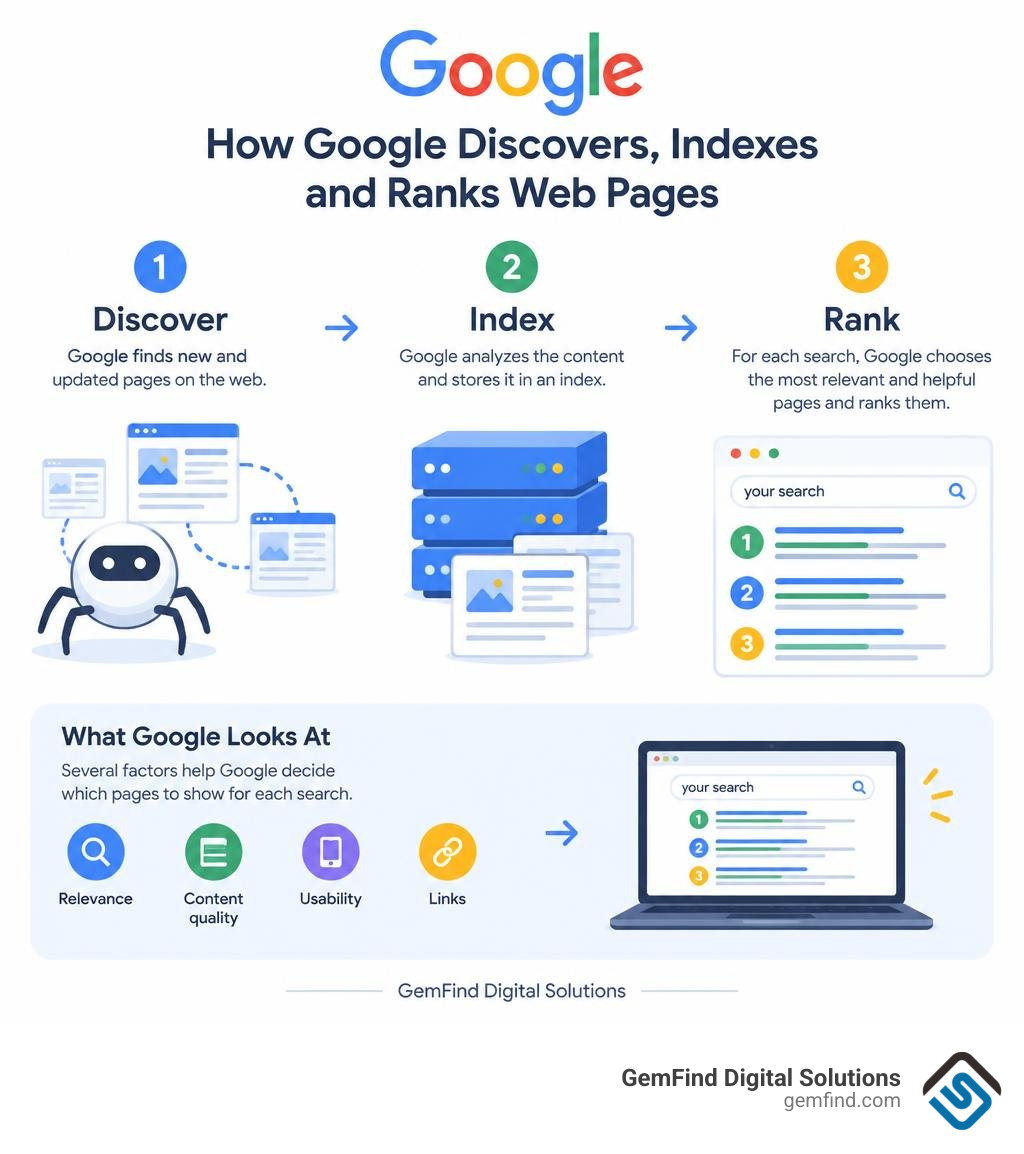
Google site ranking is where a page appears for a specific search. There is no single rank for your whole website. Google first needs to discover and index a page. Then its systems choose which indexed pages best answer each search, weighing factors such as relevance, content quality, usability, and links. Your position can change with the query, location, device, and competition.
For a jewelry store, that means a page might rank well for “custom engagement rings in Denver” but not for “engagement rings.” This guide will show you how to check those positions, understand what affects them, and make improvements that last.
I’m Morgan Price, a backlink outreach specialist who earns editorial links through careful research and genuine relationships. I’ll bring that long-term approach to improving google site ranking, starting with the difference between being indexed and earning a visible position.
Easy google site ranking word list:
- search engine optimisation seo
- seo services
- affordable seo companies
Understanding Google Site Ranking: Indexing vs. Positioning
To build a reliable digital presence, we must first master the mechanics of how Google discovers and categorizes content. Google does not rank sites as unified wholes; it evaluates individual URLs. Before any page can win traffic, it must travel through a multi-tiered pipeline: discovery, crawling, rendering, indexing, and finally, algorithmic positioning.

Every website operates with an allocated crawl budget—the volume of URLs Googlebot can and wants to crawl within a specific timeframe. Crawl budgets are heavily determined by site speed, hosting stability, and overall brand popularity. To direct bots effectively, we maintain clean XML sitemaps that prioritize canonical URLs and prune obsolete redirects. As outlined in the official Google Search Central documentation, search engines process these files to understand content relationships and detect recently updated resources.
| Stage Metric | Search Engine Indexing | Keyword Positioning (Ranking) |
|---|---|---|
| Primary Goal | Storing content in Google's massive global database | Serving the most authoritative answer in search results |
| Evaluation Criteria | Technical health, crawlability, canonicals, index directives | Relevance, authority, user intent match, UX signals |
| Diagnostic Tool | URL Inspection Tool & Coverage Reports | Performance Reports, Rank Trackers, SERP Analytics |
| Typical Timeline | 4 to 30 days for new pages | 3 to 6 months for competitive search terms |
| Actionable Fix | Adjust robots.txt, fix canonicals, submit sitemaps | Enhance on-page depth, build backlinks, improve UX |
Understanding this distinction prevents wasted effort: indexing is a technical baseline, while positioning is a competitive achievement.
Indexing vs. Ranking: The Crawl-to-SERP Journey
A page that is crawled is not guaranteed to be indexed, and an indexed page is not guaranteed to rank. When Googlebot visits a page, it analyzes page assets, parses Document Object Model (DOM) elements, evaluates canonical tags, and verifies whether a noindex meta directive is present.
Data shows that indexing a brand-new page can take anywhere from 4 to 30 days depending on site architecture and crawl priority. To confirm where your page stands, verify its status within Google Search Console tools. The URL Inspection feature delivers real-time diagnostic reporting directly from Google's index, showing whether a URL has been crawled, whether mobile usability checks pass, and if structured data renders without errors.
How Google's Search Algorithms Evaluate Search Intent and Authority
Once a page enters the index, Google's sophisticated ranking algorithms analyze its context against specific search intents:
- Informational Intent: Queries where users seek knowledge or answers (e.g., "diamond clarity chart").
- Transactional Intent: High-intent commercial queries where visitors intend to buy (e.g., "buy 2-carat lab-grown diamond ring").
- Navigational Intent: Searches targeting a specific brand destination (e.g., "GemFind login").
To achieve high positioning, a page's content must match the precise intent format Google rewards. Understanding how SEO can drive sustainable growth requires aligning topical expertise with Google’s Quality Rater Guidelines, which emphasize Experience, Expertise, Authoritativeness, and Trustworthiness (E-E-A-T).
Core Factors Influencing Your Google Site Ranking
Achieving visibility on modern Search Engine Results Pages (SERPs) demands an integrated approach across technical infrastructure, on-page optimization, and authoritative backlink acquisition.

Technical SEO, Core Web Vitals, and Page Speed
Google prioritizes pages that deliver an instant, stable user experience. Core Web Vitals measure real-world user engagement metrics, focusing on:
- Largest Contentful Paint (LCP): Measures loading performance. The main content element should load within 2.5 seconds.
- Interaction to Next Paint (INP): Measures page responsiveness to user input.
- Cumulative Layout Shift (CLS): Measures visual stability during rendering (preventing jumping buttons and shifting text).
Website performance is not merely a technical checkbox; it directly drives business revenue. Studies show that even a single-second delay in page load time causes a noticeable drop in conversion rates. On mobile devices—which govern Google's mobile-first indexing pipeline—fast server response times and optimized image compression ensure low bounce rates and higher algorithmic positioning.
On-Page Optimization and Semantic Relevance
On-page SEO tells search engines what your content covers and why it serves the user best. Beyond placing primary terms in the title tag, URL slug, and H1 heading, modern search requires natural semantic depth.
Implementing structured data markup (such as Schema.org for Products, LocalBusiness, and Articles) helps search engines parse page details directly, qualifying your listings for eye-catching rich snippets. Structuring your architecture through proven effective on-page SEO strategies and applying modern keyword clustering techniques prevents internal keyword cannibalization and builds broad semantic coverage across entire topic silos.
Off-Page Signals, Backlinks, and Topical Authority
A website cannot rank for competitive commercial terms without external validation. Backlinks act as independent votes of confidence. However, algorithmic systems value link quality over sheer quantity. A single editorial mention from an established industry publication carries significantly more ranking weight than dozens of low-tier directory submissions.
Mastering off-page SEO fundamentals means earning links naturally through original research, digital PR, and relationship-driven outreach. For localized businesses, integrating off-page authority with tactical local search optimization tactics ensures dominant positioning across Google's Local Map Pack.
Realistic Timelines: How Long Does It Take to Rank?
A common misconception among business owners is that SEO generates overnight results. In reality, moving a page from initial indexing to top-tier search visibility follows an organic timeline dictated by trust, historical domain performance, and competitive landscape analysis.

New Pages vs. Established Domains: The 3-to-6-Month Reality
Data gathered across millions of search queries shows that the average time required for a page to reach a top-10 position on Google is between 3 to 6 months. For brand-new domains lacking backlink equity, Google often applies an initial evaluation phase (frequently called the sandbox period) to gauge user engagement, crawl consistency, and bounce rates before granting persistent high rankings.
Using a comprehensive ranking timeline analysis, marketers can calculate ranking velocity by analyzing keyword difficulty, target query volume, and referring domain strength. Targeting low-competition, long-tail search phrases accelerates this trajectory, building foundational traffic while your overall domain authority matures.
Managing SERP Volatility and Maintaining First-Page Stability
Securing a first-page ranking is only half the battle; retaining it requires continuous optimization. Long-term search studies reveal clear volatility trends:
- Only 27% of websites that reach the top 10 retain their first-page positions over a 13-month monitoring window.
- 73% of websites fall off page one after 13 months due to competitive updates, algorithmic shifts, or content staleness.
- Across broader industry datasets, only 7.65% of all domains maintain completely stable top-10 rankings over multi-year periods.
Analyzing macro ranking keyword metrics demonstrates that sites maintaining consistent rankings invest in continuous content refreshes, technical audits, and steady backlink acquisition to defend their organic market share.
Tracking and Checking Keyword Positions Effectively
Monitoring your search engine rankings requires clean, objective data. When business owners search for their own sites manually, browser personalization, browsing history, and geographic cache distort the results.
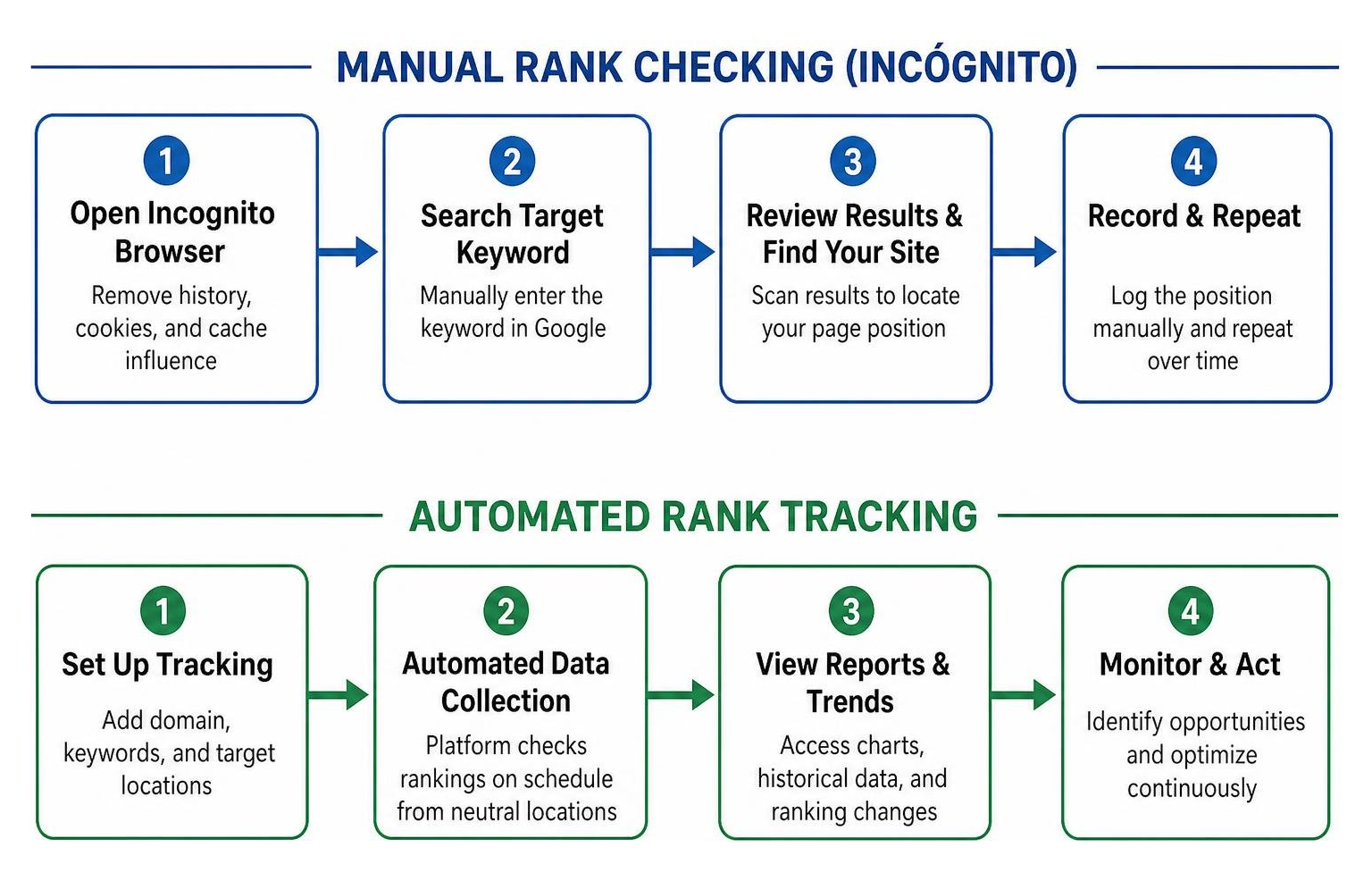
To assess your standing objectively, solid Search Engine Optimization (SEO) fundamentals require utilizing neutral reporting tools alongside Google Search Console.
Monitoring Google Site Ranking: Manual Verification vs. Automated Tracking
| Feature / Variable | Manual Incognito Verification | Automated Rank Tracking Platforms |
|---|---|---|
| Location Precision | Rough (defaults to ISP / Wi-Fi IP location) | Precise (set to specific postal codes or cities) |
| Device Separation | Restricted to the active testing device | Simultaneous Desktop and Mobile SERP tracking |
| Personalization Bias | Moderate (browser fingerprinting can influence data) | Zero (uses raw, unbiased SERP data feeds) |
| Time Investment | High (must be conducted query by query) | Automated (schedules daily or weekly automated scans) |
| Historical Graphing | None (requires manual spreadsheet logging) | Built-in historical trendlines and ranking shift alerts |
Automated platforms eliminate guesswork by scraping neutral SERP snapshots across targeted global or localized coordinates, providing an unvarnished assessment of true ranking positions.
Essential Diagnostics for Position Tracking
When evaluating your keyword performance reports, prioritize these four primary metrics:
- Average Position: Tracks your baseline visibility across thousands of long-tail and head terms.
- Impression Volume: Reveals how often your snippet appears in user search results, often signaling ranking improvements before clicks arrive.
- Organic Click-Through Rate (CTR): Evaluates how effectively your title tags and meta descriptions entice users to choose your listing over competitors.
- Crawl Anomaly Diagnostics: Flags technical issues (such as 404 response errors, server timeouts, or improper canonicals) that can cause immediate ranking drops.
Modern Search Evolution: Generative AI and the Future of Search
Search is undergoing its most significant evolution in two decades. The rise of conversational AI, Large Language Models (LLMs), and Google’s Search Generative Experience (SGE / AI Overviews) is changing how users consume information.
Searchers no longer rely exclusively on short keyword strings; they enter complex, multi-layered natural language prompts. For high-consideration purchases—such as bridal jewelry—nearly half of all U.S. adults under 30 now use AI platforms like ChatGPT for product research and brand discovery.
How AI and SGE Reshape Google Site Ranking Dynamics
The rollout of AI Overviews at the top of Google search results has reduced traditional search ad click-through rates and pushed conventional organic blue links lower down the viewport. Rather than indexing pages purely on matched strings, generative engines synthesize multi-source answers, pulling direct insights from trusted, context-rich domains.
If an AI overview directly answers a user's question on the SERP, traditional organic clicks decrease. However, inclusion as a cited source within an AI Overview generates highly targeted, high-intent referral traffic.
Optimizing Content for Search Generative Experience and AI Answers
To ensure your web pages are selected as primary citation sources by generative AI systems:
- Adopt Conversational Q&A Formats: Structure sections with direct questions as subheaders followed immediately by clear, factual answers.
- Implement Robust Schema Markup: Use JSON-LD structured data to help AI bots understand your exact entities, products, reviews, and specifications.
- Demonstrate Unmatched First-Hand Experience: Original research, unique photography, proprietary case studies, and transparent author credentials cannot be synthesized by AI scrapers, making them high-priority sources for Google's models.
Frequently Asked Questions About Google Site Ranking
What is the fastest way to get a new webpage indexed and ranking?
The fastest path to indexing begins by publishing technical, error-free content and linking to it directly from high-authority internal pages on your website. Next, inspect the exact URL inside Google Search Console and click "Request Indexing." Ensure your XML sitemap is updated and submitted. For new domains, earning an editorial backlink from an established, frequently crawled website signals Googlebot to discover and process the new URL within days rather than weeks.
Why do search positions fluctuate between desktop and mobile devices?
Google uses mobile-first indexing, meaning it crawls and evaluates the mobile version of your site as the primary baseline. Rankings diverge between devices due to distinct viewport rendering, mobile page speed scores, touch usability, and geographic intent. Mobile searches place higher weight on local proximity and immediate physical availability compared to desktop queries.
How many target keywords should a single web page focus on?
A single web page should focus on one primary target keyword and a tightly related cluster of 3 to 7 secondary semantic variations. Attempting to optimize a single URL for unrelated concepts dilutes page relevance and causes keyword cannibalization. Group related phrases with identical search intent onto one comprehensive URL, and create distinct, dedicated pages for concepts that require unique answers.
Conclusion
Earning and maintaining a top Google site ranking is an ongoing process of strategic alignment, technical refinement, and relationship-driven authority building. There are no shortcuts or permanent rankings. Search engines reward websites that consistently provide fast, frictionless user experiences paired with authoritative, deeply helpful content.
At GemFind Digital Solutions, we have spent over 25 years helping businesses thrive online through industry-tailored web design, digital marketing, and high-impact SEO strategies. As a certified Google and Shopify Partner, our team builds digital growth engines that turn search engine visibility into bottom-line revenue.
Ready to take control of your organic search performance? Dive into our comprehensive SEO Jewelry Guide 2026 to uncover advanced strategies designed to help your brand dominate the first page of Google.
— Morgan Price, Backlink Outreach Specialist


