

Why Programmatic Direct Advertising Matters for Modern Media Buyers

Programmatic direct advertising lets an advertiser buy digital ad inventory from a specific publisher through automated platforms, with terms agreed in advance. Instead of manually trafficking an insertion order or competing for every impression in an open auction, the buyer can secure a fixed CPM, defined placements or audiences, and, in guaranteed deals, a committed number of impressions.
For a jewelry retailer, that can mean reserving premium placements on a trusted fashion, bridal, or local lifestyle site for a new collection launch - while still using programmatic tools for targeting, creative delivery, pacing, and reporting.
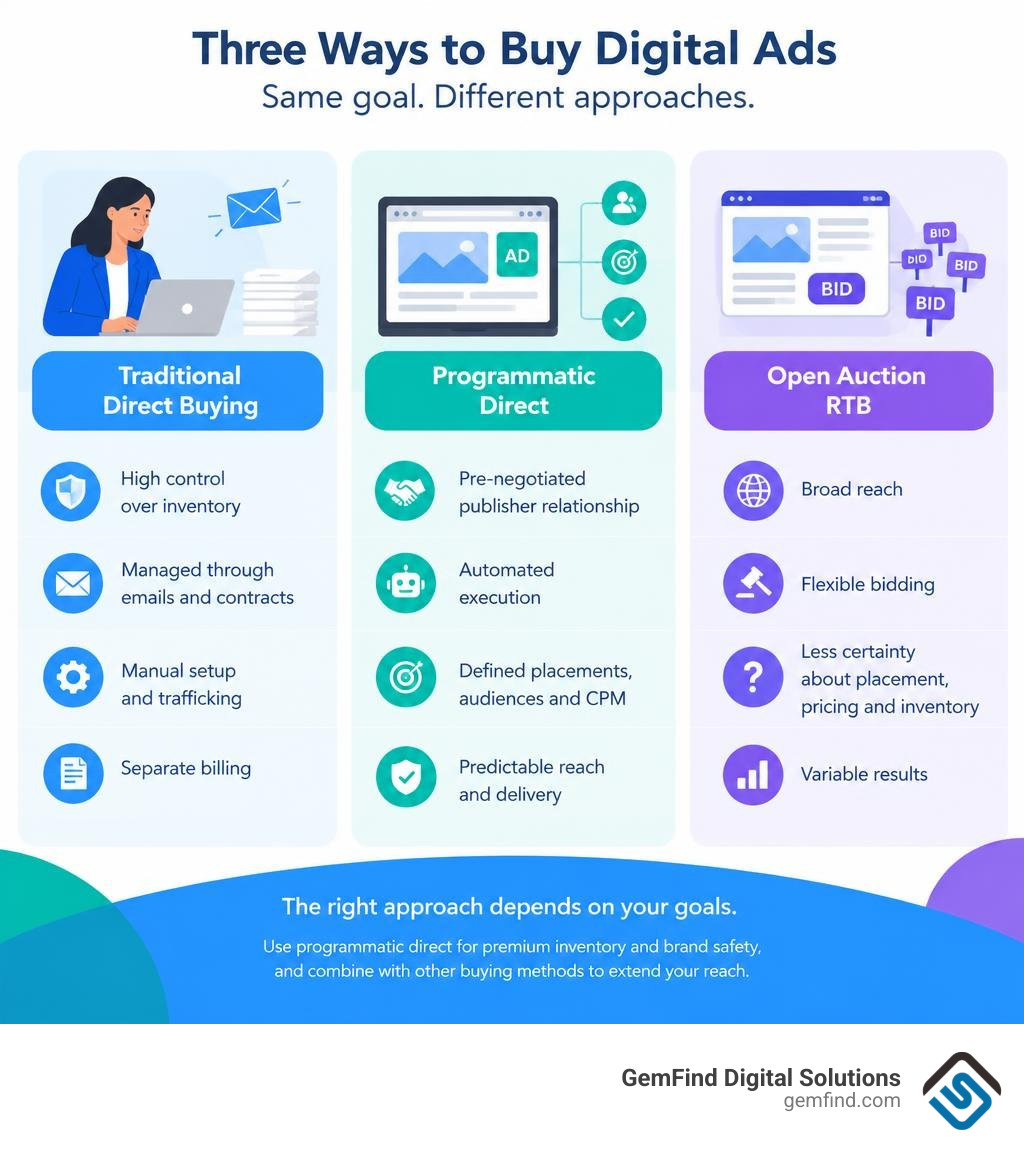
It sits between two familiar buying models:
- Traditional direct buying: High control, but often managed through emails, contracts, manual setup, and separate billing.
- Open-auction RTB: Broad reach and flexible bidding, but less certainty about placement, pricing, and available inventory.
- Programmatic direct: A pre-negotiated publisher relationship with automated campaign execution.
This approach is especially useful when brand fit, premium context, predictable reach, and launch timing matter as much as scale. It is not a replacement for every auction buy. Many strong media plans use programmatic direct for high-value inventory, then use private marketplaces and open auctions to extend reach.
I am Anthony Arechiga, Vice President of Sales at GemFind Digital Solutions, where I have worked since 2007 helping jewelry businesses grow through web, e-commerce, and digital marketing strategies. That experience informs a practical view of programmatic direct advertising: use automation to reduce friction, but keep control over the publishers, audiences, and placements that protect your brand.
What Is Programmatic Direct Advertising and How Does It Work?
At its core, programmatic direct advertising merges the trust of traditional relationship-driven media buying with the speed and precision of modern ad-tech platforms. Rather than relying on disparate email chains, PDF rate cards, and manual trafficking spreadsheets, both the buyer and the publisher execute their pre-negotiated terms inside an ad server and demand-side platform (DSP).
The transaction workflow operates seamlessly across unified ad systems:
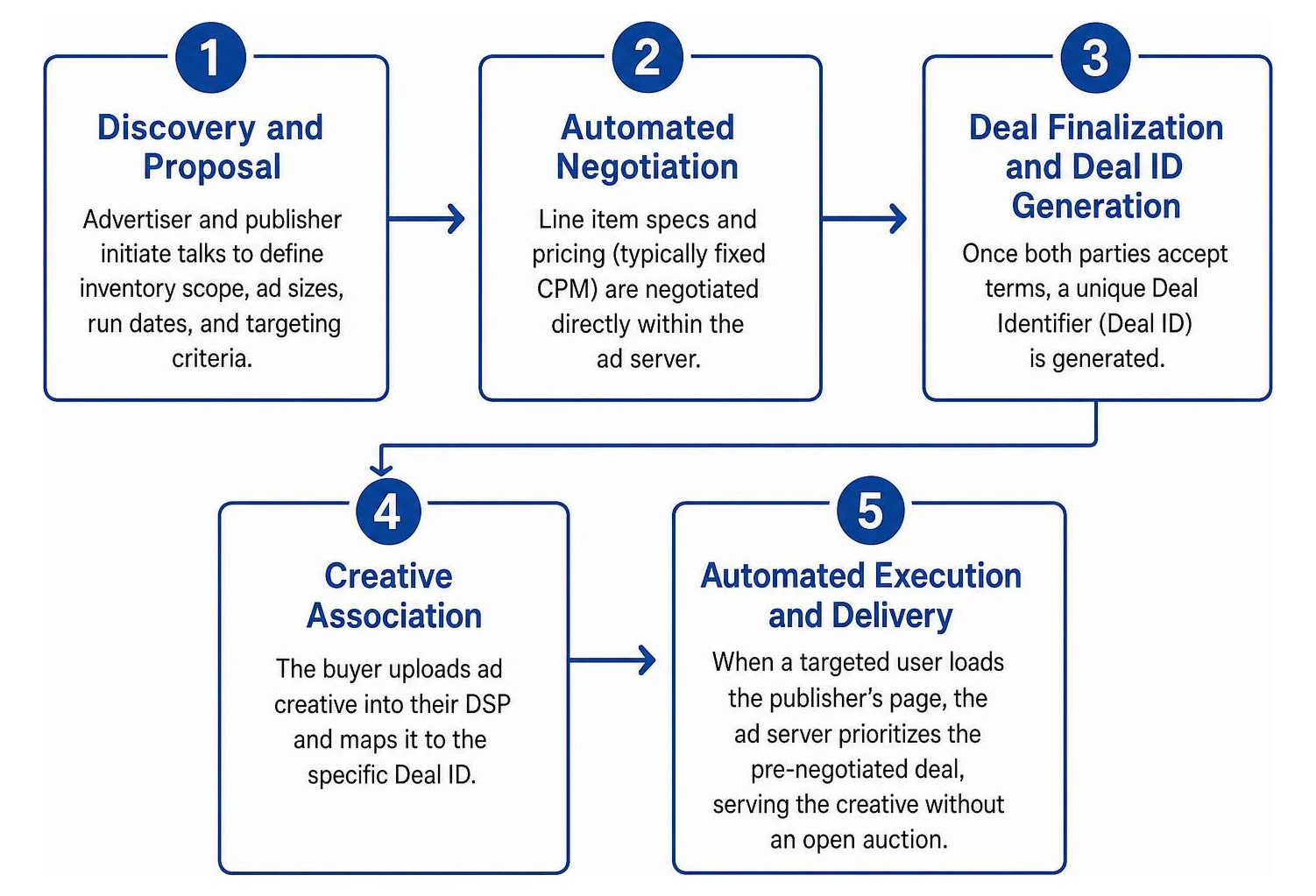
- Discovery and Proposal: The advertiser and publisher initiate talks via an ad tech marketplace or direct outreach, defining inventory scope, ad sizes, run dates, and targeting criteria.
- Automated Negotiation: Line item specifications and pricing models (typically fixed CPM) are negotiated directly within the ad server. Reviewing official Google Ad Manager programmatic direct setup guidelines illustrates how seamlessly these buyer-seller proposals can be updated and accepted in real time.
- Deal Finalization and Deal ID Generation: Once both parties accept terms, a unique Deal Identifier (Deal ID) is generated.
- Creative Association: The buyer uploads ad creative directly into their DSP and maps it to the specific Deal ID.
- Automated Execution and Delivery: When a targeted user loads the publisher's page, the ad server prioritizes the pre-negotiated deal, serving the creative without passing the impression through an unpredictable public auction.
Deconstructing Programmatic Direct Advertising vs Traditional Direct IOs
For decades, direct insertion orders (IOs) served as the gold standard for premium media buying. However, traditional IOs carry significant administrative overhead. Teams frequently navigate protracted contract negotiations, manual ad tag exchanges, disparate spreadsheet tracking, and frustrating billing reconciliations at the end of every billing cycle.
In fact, while about 70% of ad buys historically ran through manual insertion orders, programmatic transaction models have grown at a 37% faster rate than traditional direct buys. This shift is driven by tangible operational efficiencies: publishers save up to 57% of their time when migrating to automated direct environments, while advertisers reduce operational reservation workloads by roughly 29%.
Automating campaign trafficking eliminates copy-paste tagging errors and dramatically cuts down on billing discrepancies. Instead of waiting weeks for post-campaign reporting, media buyers gain real-time analytics dashboards, unified invoice settlement, and instant creative auditing.
Real-Time Bidding vs Programmatic Direct
Real-Time Bidding (RTB) revolutionized digital marketing by opening up vast pools of publisher inventory through dynamic, millisecond-level auctions. However, the open auction model presents trade-offs: bidstream volatility, fluctuating CPMs, unpredictable placement adjacency, and heightened brand safety risks.
Programmatic direct solves these challenges by taking auctions completely out of the equation:
- Pricing Stability: In open RTB, dynamic bidding means your CPM fluctuates based on auction density. Programmatic direct locks in pre-negotiated, fixed CPMs.
- Inventory Access: RTB primarily monetizes non-guaranteed, remnant impressions. Programmatic direct gives buyers guaranteed access to high-impact, above-the-fold placements and homepage takeovers.
- Brand Protection: Rather than relying on keyword blacklists across millions of unvetted domains, programmatic direct runs solely across chosen, reputable publisher environments.
- Publisher Yield: Publishers protect their premium real estate by securing guaranteed revenue commitments without subjecting their brand equity to aggressive price erosion in public bid streams.
Core Deal Types in Direct Programmatic Media Buying
Programmatic media buying is not a one-size-fits-all model. To build an effective media plan, buyers must understand the mechanics and commitments associated with each primary programmatic deal structure.

| Deal Type | Inventory Commitment | Pricing Model | Auction Mechanics | Buyer Priority | Primary Use Case |
|---|---|---|---|---|---|
| Programmatic Guaranteed | 100% Reserved | Fixed CPM | None (Direct Delivery) | Highest | Product launches, holiday takeovers, exclusive sponsorships |
| Preferred Deals | Unreserved | Fixed CPM | None (First-Look Right) | High | Targeted audience matching, flexible recurring campaigns |
| Private Marketplace (PMP) | Unreserved | Floor CPM | Closed Invitation Auction | Medium | Category-level reach, high-intent niche targeting |
| Open Auction (RTB) | Unreserved | Dynamic Market | Public Real-Time Auction | Lowest | Broad brand awareness, retargeting scale |
Programmatic Guaranteed Deals
Programmatic Guaranteed (PG) represents the absolute closest digital equivalent to a traditional reservation contract, supercharged with modern automation. In a guaranteed agreement, the buyer commits to purchasing 100% of the agreed-upon impression volume at a fixed CPM, and the publisher reserves that exact inventory exclusively for them.
According to a Google Ad Manager Programmatic Guaranteed overview, these deals allow media buyers to combine direct placement reservations with advanced audience overlay capabilities. As more than 91% of display advertising is bought programmatically, programmatic guaranteed deals account for roughly 10% of that total programmatic market, with direct deals driving one in every two programmatic dollars spent in the United States.
PG is ideal for high-stakes brand campaigns, holiday jewelry sales events, time-sensitive product launches, or digital sponsorships where missing an impression goal is not an option.
Preferred Deals and Private Marketplaces
For campaigns requiring greater volume flexibility, non-guaranteed programmatic direct structures offer an ideal alternative:
- Preferred Deals (First-Look): The publisher gives a specific buyer the initial opportunity to purchase an impression at a pre-negotiated, fixed CPM before that impression is made available to private or open auctions. The buyer retains complete flexibility: their DSP evaluates the incoming impression against its custom first-party data and decides whether to bid or pass. If the buyer passes, the publisher simply routes the impression downstream.
- Private Marketplaces (PMPs): Instead of a 1-to-1 fixed transaction, a PMP is an invitation-only closed auction. Publishers invite a select cohort of buyers to compete for curated tranches of inventory with an established minimum floor price. PMPs allow media buyers to access premium editorial environments while retaining algorithmic bid optimization across multiple placements.
Technical Infrastructure and Implementation Requirements
Successfully executing direct programmatic buying requires seamless integration across every layer of the ad-tech stack:
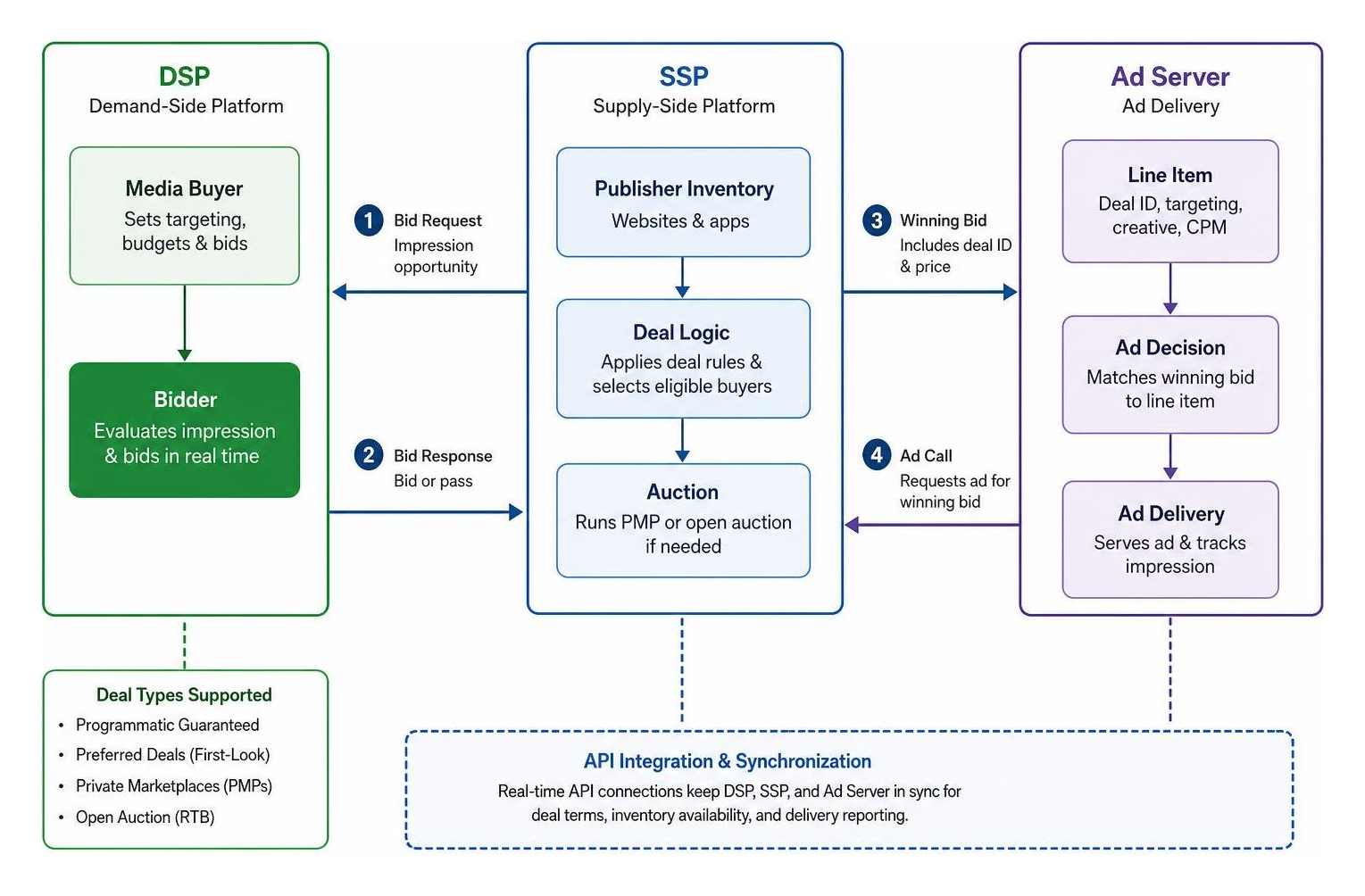
A functional ecosystem depends on tight API synchronization between the publisher's Supply-Side Platform (SSP), their primary ad server (such as Google Ad Manager), and the advertiser's chosen Demand-Side Platform (such as Display & Video 360). As detailed in this buyer's guide to Programmatic Direct execution, standardizing line-item parameters and syncing buyer seats in marketplace discovery interfaces are critical steps for error-free setup.
Ad Server Integration and Deal ID Configuration
When setting up direct programmatic campaigns, technical alignment prevents delivery bottlenecks:
- Deal ID Matching: The ad server issues an alphanumeric Deal ID that encapsulates all deal parameters (flight dates, CPM rate, floor pricing, and environment). This exact ID must be mapped within the DSP line item.
- Creative Formats and Specifications: High-impact direct campaigns rely on sophisticated assets. Reviewing supported programmatic direct creative guidelines ensures compliance across rich media, interactive HTML5 displays, VAST/VPAID video, rewarded video, and native ad units.
- Targeting Priority Alignment: Within the publisher's ad server, Programmatic Guaranteed line items must be configured with Sponsorship or Standard reservation priority levels to ensure they outrank open auction bidding and meet delivery quotas.
Best Practices for Launching Programmatic Direct Advertising Campaigns
To maximize return on ad spend (ROAS) when activating programmatic direct deals, media buyers should follow these operational principles:
- Leverage First-Party Data: Layer your own high-intent customer segments, CRM lists, and past-purchaser audiences directly within your DSP to bid exclusively on high-value users visiting premium publisher sites.
- Establish Global Frequency Capping: Manage frequency across direct deals and open RTB line items simultaneously within your DSP to prevent audience ad fatigue and avoid wasting impressions.
- Conduct Soft Launches: Activate deals 48 to 72 hours ahead of major marketing pushes to verify bid responses, tracking tag validation, creative rendering, and impression matching.
- Monitor Real-Time Pacing Controls: Track hourly and daily delivery rates against flight milestones to catch underdelivery or DSP response errors early.
Navigating Challenges and Future Trends in Programmatic Buying
While programmatic direct offers unmatched predictability, modern media buyers must navigate technical variables to safeguard campaign performance.
Managing Forecasting Accuracy and Discrepancies
Inventory forecasting is an ongoing operational challenge. Sudden news cycles, seasonality, or technical changes can alter publisher site traffic. If a publisher over-forecasts traffic for a Programmatic Guaranteed deal, delivery may fall short. Conversely, under-forecasting can cause campaigns to exhaust budgets prematurely.
Furthermore, discrepancies between DSP impression records and publisher ad server counts can emerge due to latency, ad-blockers, or viewability thresholds. Media teams should implement continuous pacing dashboards, agree on common measurement standards (e.g., IAB/MRC verified impressions), and maintain active communication channels with publisher ad ops teams throughout the flight.
Cookieless Identity and AI-Driven Buying in 2026
The advertising landscape has fundamentally transformed with privacy regulations, third-party cookie phaseouts, and modern identity solutions. Programmatic direct has emerged as a major beneficiary of these industry shifts:
- First-Party Publisher Context: Direct relationships allow brands to bypass reliance on third-party tracking by leveraging publishers' authenticated, logged-in subscriber data and contextual categorization.
- Data Clean Rooms: Advertisers and publishers safely match proprietary first-party datasets in secure, privacy-compliant clean rooms to execute high-match-rate direct deals without exposing raw user records.
- AI-Powered Pacing and Creative Optimization: Machine learning models now forecast impression availability dynamically, adjust delivery pacing against conversion patterns, and personalize creative variations in real time.
- Omnichannel Direct Deals: Direct programmatic pipelines have expanded far beyond desktop display, powering premium transactions across Connected TV (CTV), digital out-of-home (DOOH), retail media networks, and in-game environments.
Frequently Asked Questions About Programmatic Direct
What is the main difference between programmatic direct and RTB?
The primary difference lies in the buying mechanism and inventory certainty. RTB relies on an open, dynamic real-time auction where the highest bidder wins each individual impression, resulting in variable pricing and unreserved inventory. Programmatic direct bypasses public bidding entirely, using automated platforms to execute pre-negotiated deals at fixed CPM rates with guaranteed or first-look access to premium placements.
How do programmatic guaranteed deals handle creative management?
In a Programmatic Guaranteed setup, creative trafficking is managed primarily through the buyer's DSP. The advertiser uploads, hosts, and updates creative assets within their platform. Once linked to the appropriate Deal ID, the publisher's ad server automatically pulls and renders the approved creative formats based on pre-established ad specifications, eliminating manual tag swaps.
When should a media buyer prioritize programmatic direct over private marketplaces?
Media buyers should choose programmatic direct (specifically Programmatic Guaranteed) when planning major product launches, exclusive holiday promotions, high-impact homepage takeovers, or when securing fixed impression counts is critical to campaign success. PMPs are better suited for ongoing, flexible campaigns where the buyer wants private access to quality inventory but prefers algorithmic bidding flexibility without volume commitments.
Conclusion
Programmatic direct advertising represents an essential middle ground for modern media buyers: combining the institutional safety, premium placement quality, and volume guarantees of direct publisher relationships with the agility, targeting sophistication, and operational speed of programmatic technology.
By strategically blending Programmatic Guaranteed deals for cornerstone brand moments with Preferred Deals, PMPs, and open auctions for ongoing reach, marketers can construct resilient, high-performing media campaigns. For fine jewelry retailers and luxury brands looking to elevate their market presence and drive measurable store and online sales, partnering with specialized industry experts for bespoke digital marketing strategies provides the competitive edge needed to thrive across today's digital landscape.


