



Why Your Shopify SEO Ranking Is the Difference Between Being Found and Being Forgotten

Shopify SEO ranking determines whether your jewelry store shows up when shoppers are ready to buy — or gets buried where no one looks.
Here's a quick answer to what actually moves the needle:
How to improve your Shopify SEO ranking:
- Audit your technical foundation — fix crawl errors, canonical tags, and sitemap issues in Google Search Console
- Target the right keywords — focus on search intent, not just search volume
- Optimize every page — title tags, meta descriptions, H1s, and URLs all matter
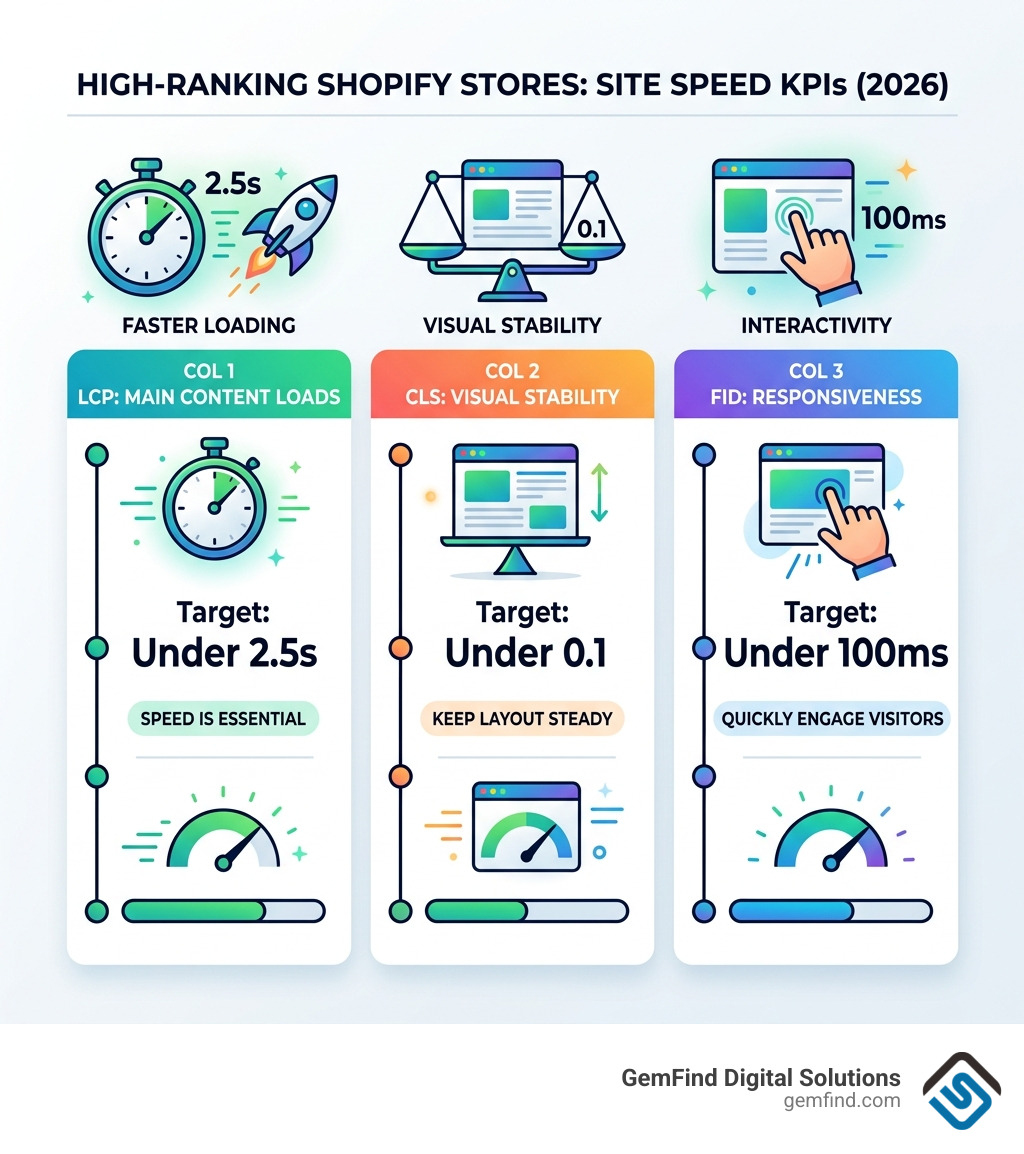
- Speed up your store — hit Core Web Vitals targets (LCP under 2.5s, CLS under 0.1)
- Add structured data — product schema and Google Merchant Center feeds boost visibility
- Build authority — earn backlinks, publish helpful content, and interlink your pages
- Track everything — use Google Search Console and GA4 to measure what's working
With over 5.3 million Shopify stores competing for attention, and the top search result capturing more than 27% of all clicks, sitting on page two is essentially invisible. Google processes more than five trillion searches every year — and every one of those searches is a potential customer looking for exactly what you sell. For jewelry store owners, that gap between page one and page two isn't just a ranking problem. It's a revenue problem.
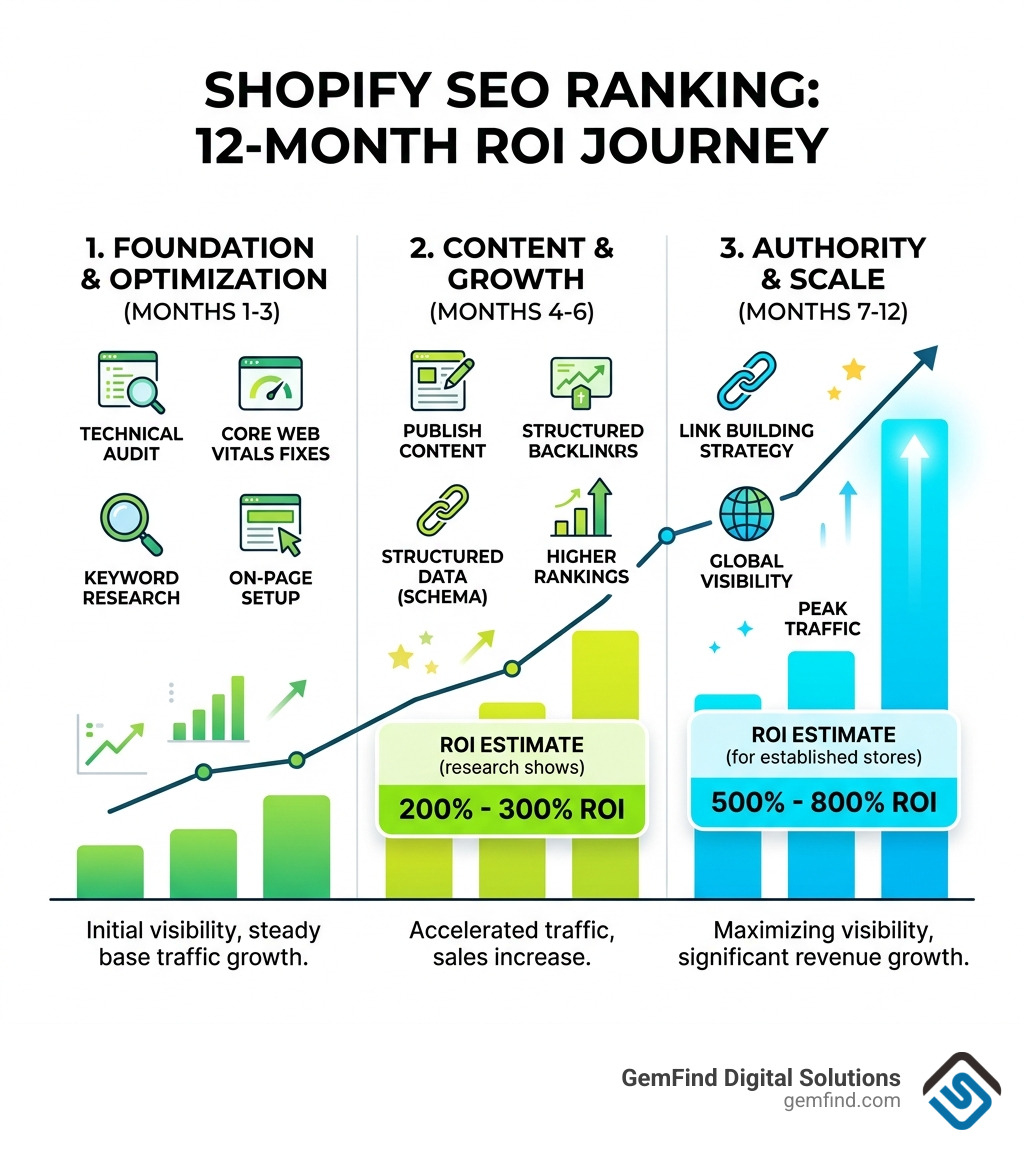
The good news? Most Shopify stores aren't losing to better businesses. They're losing to better-optimized ones. Small, consistent improvements to your SEO foundation can compound into serious results — research shows SEO can deliver 200–300% ROI within 3–6 months, growing to 500–800% for established stores after 12+ months.
I'm Morgan Price, a backlink outreach and SEO specialist with a track record of building sustainable, white-hat link profiles that strengthen Shopify SEO ranking for e-commerce brands through ethical, relationship-driven strategies. In this guide, I'll walk you through every layer of Shopify SEO — from technical audits to content and authority building — so you can stop hiding on page two and start selling.
Auditing Your Shopify SEO Ranking Foundation
Before we start adding fancy keywords or building links, we need to make sure the "plumbing" of your store is working. If search engine crawlers can’t find your pages, or if they get confused by duplicate versions of the same product, your shopify seo ranking will never reach its potential.
Indexation and Crawl Errors
The first step is checking your Index Coverage report in Google Search Console. This tells us exactly which pages Google has found and whether it encountered any errors. Common issues include "404 Not Found" errors, which happen when you delete a product without setting up a redirect. We always recommend using Shopify’s built-in URL redirects to send that old traffic to a relevant collection page instead of a dead end.

Sitemaps and Robots.txt
One of the best things about Shopify is that it automatically generates a sitemap.xml file for you. This is essentially a map for Google to follow. You should submit this link (usually yourstore.com/sitemap.xml) to Google Search Console and Bing Webmaster Tools immediately. While Shopify manages your robots.txt file (which tells bots where not to go), you can now customize it if you need to hide specific administrative pages from search results. For more on these basics, check out Improving search engine optimization (SEO) - Shopify Help Center.
Solving the Duplicate Content Dilemma
Shopify has a specific quirk: products can often be reached through multiple URLs (e.g., via the "all products" list or via a specific collection). This creates duplicate content, which can dilute your ranking power. Shopify uses canonical tags to tell Google which version is the "master" copy. We ensure these are correctly implemented so Google doesn't penalize you for having "copied" your own descriptions.
Shopify vs. WordPress
A common question we hear is whether Shopify is as good as WordPress for SEO. While WordPress is content-led and highly customizable, Shopify is purpose-built for commerce. It handles SSL, sitemaps, and clean URL structures out of the box, making it a powerful foundation for jewelry retailers who want to focus on sales rather than server maintenance. For a deeper dive into why this matters for your specific niche, see our guide on Unlocking Success: Essential SEO for Jewelry Store Websites.
Strategic Keyword Research and On-Page Optimization
Keywords are the bridge between what your customer is thinking and what your store is offering. But in 2026, it’s not just about volume; it’s about search intent.
Understanding Intent: Transactional vs. Informational
If someone searches for "how to clean a diamond ring," they have informational intent. They want a blog post. If they search for "14k gold halo engagement ring," they have transactional intent. They want a product page. We map your keywords so that your collection pages act as "hubs" for broad terms, while your product pages target specific, long-tail descriptions.
Optimizing the "Big Three": Titles, Metas, and URLs
To improve your shopify seo ranking, every page needs a unique:
- Title Tag: Keep it under 60 characters. Place your primary keyword near the beginning. (e.g., "Handmade Gold Necklaces | [Your Brand Name]")
- Meta Description: You have about 160 characters to "sell" the click. Include a call to action like "Shop our latest collection."
-
URL Structure: Keep them short and descriptive. Use hyphens, not underscores.
yourstore.com/products/gold-hoop-earringsis much better thanyourstore.com/products/prod-12345-xyz.

Content Hierarchy and Accessibility
Use one H1 tag per page (usually the product name). Use H2s and H3s for sub-sections like "Materials" or "Sizing Guide." This helps Google understand the structure of your content. Additionally, don't forget image alt text. Not only does this help with accessibility for visually impaired shoppers, but it also allows your stunning jewelry photography to show up in Google Image Search and Google Lens. For a full list of on-page tasks, refer to the SEO Checklist: 50 Tips to Optimize Your Website (2026) - Shopify.
We can't stress enough that Why You Should Care About On-Page SEO is about more than just bots; it's about making your site readable and trustworthy for humans.
Technical Excellence: Speed, Schema, and AI Readiness
As we move deeper into 2026, Google’s algorithms are increasingly focused on the user experience. If your site is slow or hard to use on a phone, your rankings will suffer.
Core Web Vitals and Site Speed
Google uses a set of metrics called Core Web Vitals to measure page performance. Even a one-second delay can cause a massive drop in conversions. On Shopify, site speed is often impacted by "app weight"—having too many unnecessary apps running scripts in the background.
| Metric | Target Score | What it Measures |
|---|---|---|
| Largest Contentful Paint (LCP) | Under 2.5s | How fast the main content loads |
| Cumulative Layout Shift (CLS) | Under 0.1 | Visual stability (do things jump around?) |
| First Input Delay (FID) | Under 100ms | Interactivity and responsiveness |
Structured Data and JSON-LD
Structured data (or Schema markup) is a piece of code that tells Google specific details about your products, like price, availability, and star ratings. Shopify themes often include basic schema, but advanced stores use JSON-LD to ensure they qualify for "Rich Snippets." This is how you get those gold stars to appear directly in the search results, which can significantly boost your click-through rate.
The Rise of AI Overviews and Visual Search
With the growth of AI Overviews (now appearing in about 16% of queries) and visual search tools like Google Lens (processing 20 billion searches a month), your SEO strategy must evolve. Google Lens is particularly important for jewelry; 25% of visual searches are shopping-related. If your images are high-quality and properly tagged, a customer can snap a photo of a ring they like and find your store instantly. For more technical tips, see How to Get Your Jewelry Store Website to Rank #1 on Google.
Building Authority and Content for Long-Term Growth
Technical fixes might get you to page one, but authority keeps you there. This is where off-page SEO and content strategy come into play.
The Power of Content Clusters
Don't just write random blog posts. Create "content clusters." For example, have a main pillar page about "The Ultimate Guide to Ethical Diamonds" and link it to smaller articles about "Conflict-Free Sourcing," "Lab-Grown vs. Natural," and "How to Read a GIA Report." This tells Google you are an expert in this niche.
Backlink Strategy: Quality Over Quantity
A backlink is like a "vote of confidence" from another website. One link from a reputable fashion magazine or a high-authority jewelry blog is worth more than a thousand links from spammy directories. We focus on building relationships with influencers and industry publications to earn these high-value links. Learn more about this in our article: What is Off-Page SEO & How Does it Help Increase Visibility for Jewelry Websites.
Local SEO for Brick-and-Mortar Jewelers
If you have a physical showroom, Local SEO is non-negotiable. 84% of consumers search for local businesses daily.
- Optimize your Google Business Profile: Ensure your Name, Address, and Phone number (NAP) are consistent everywhere.
- Encourage Reviews: 75% of shoppers read at least four reviews before buying.
- Location Pages: Create specific landing pages for the cities you serve.
For a specialized look at local tactics, see How to Optimize Your Local SEO for Your Jewelry Business.
Frequently Asked Questions about Shopify SEO Ranking
How long does it take to see Shopify SEO ranking improvements?
SEO is a marathon, not a sprint. Technical fixes (like fixing broken links or sitemaps) can show results within a few weeks. However, meaningful ranking improvements for competitive keywords usually take 3 to 6 months. For established stores in highly competitive jewelry niches, it can take 6 to 12 months to see the full compounding effect of your efforts. As noted in SEO Ranking Defined: 6 Factors Influencing Your SEO Ranking - Shopify, factors like domain age and existing authority play a huge role in this timeline.
Which Shopify SEO apps and themes are most effective for ranking?
In 2026, the best "app" is often fewer apps. We recommend using Shopify 2.0 themes because they are built with clean, lightweight code that prioritizes speed. For optimization, apps like SEO Manager or Plug in SEO can help with bulk meta edits and broken link tracking. However, no app can replace a solid strategy. For an updated list of tools, check out the Shopify SEO Guide 2026: How Stores Rank on Google.
When should I hire an agency for Shopify SEO ranking?
If you’ve hit a growth plateau, if your competitors are consistently outranking you, or if you simply don't have the 20+ hours a week required to manage a modern SEO campaign, it’s time to call in the experts. At GemFind Digital Solutions, we bring over 25 years of specific jewelry industry expertise to the table. As a certified Shopify and Google Partner, we don't just understand SEO; we understand how people shop for jewelry.
Conclusion
Improving your shopify seo ranking is the most sustainable way to grow your business. Unlike paid ads, which stop sending traffic the moment you stop paying, SEO builds an asset that works for you 24/7. Aim for an SEO score of at least 80/100 on major auditing tools as your benchmark for a healthy store.
Ready to dominate the search results? Start by reviewing our Shopify SEO Guide for Jewelry Stores or explore our full range of digital marketing services to see how we can help you shine online. Stop hiding on page two — your customers are looking for you. Let's make sure they find you.


