


Why Sustainable Engagement Ring Options Matter More Than Ever in 2026

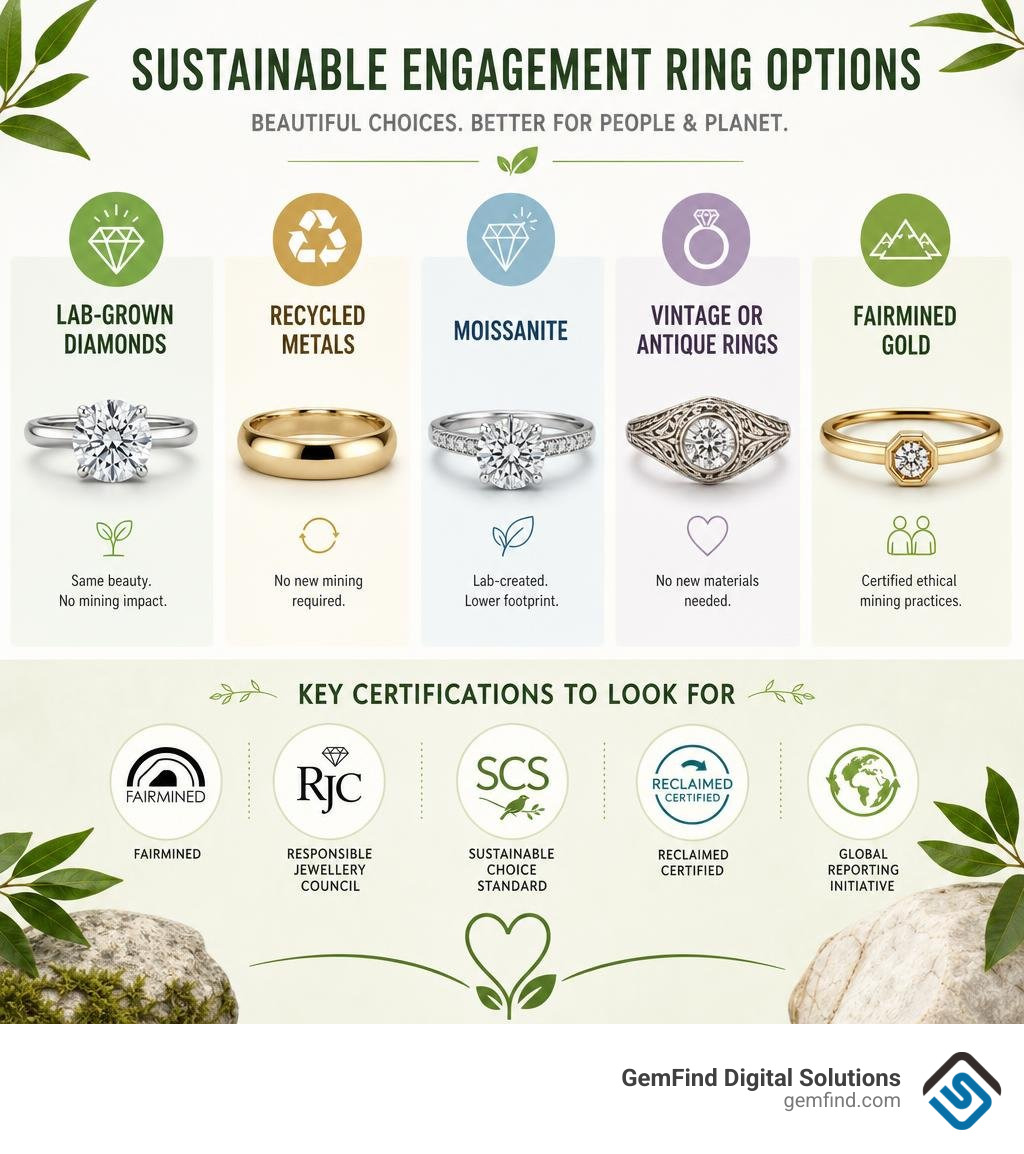
If you're exploring sustainable engagement ring options, here's a quick look at the most popular choices available right now:
| Option | Why It's Sustainable | Typical Cost vs. Traditional |
|---|---|---|
| Lab-grown diamonds | Same as mined diamonds, no mining impact | 20-40% less |
| Recycled gold/platinum | No new mining required | Similar to standard |
| Moissanite | Lab-created, minimal environmental footprint | Significantly less |
| Vintage or antique rings | No new materials needed | Varies |
| Fairmined gold | Certified ethical mining practices | Slight premium |
The engagement ring industry has a complicated history. Traditional diamond mining has been linked to human rights violations, environmental damage, and conflict funding. At the same time, precious metal mining often harms local ecosystems and denies workers fair wages and safe conditions.
That's changing fast.
In 2026, conscious couples are pushing jewelers to do better — and many brands are rising to the challenge. From lab-grown diamonds that cost 20-40% less than mined stones, to recycled metals and traceable gemstones, the options have never been more varied or more beautiful.
And the good news for jewelry retailers? This shift isn't a threat — it's an opportunity.
I'm Anthony Arechiga, VP of Sales at GemFind Digital Solutions, where I've spent nearly two decades helping jewelry retailers connect with modern buyers — including the growing segment actively searching for sustainable engagement ring options. In this guide, I'll walk you through exactly what's available, what to look for, and how to position your store to meet this demand.
Explore more about sustainable engagement ring options:
What Makes an Engagement Ring Truly Sustainable?
To understand what makes an engagement ring sustainable, we have to look past the surface sparkle and trace the entire supply chain. A truly sustainable ring is crafted with minimal environmental disruption, protects human rights, supports local communities, and maintains economic transparency from the mine (or lab) to the jewelry box.
When evaluating sustainable engagement ring options, three core pillars define their ethical and environmental footprint:
- Ethical Sourcing and Conflict-Free Diamonds: Historically, the global diamond trade has been plagued by "blood diamonds"—stones mined in war zones and used to finance armed conflict. Today, ethical sourcing means guaranteeing that a gemstone did not fund violence, was mined under safe working conditions, and that the miners received fair wages.
- Recycled Precious Metals: Mining a single ounce of gold can require the displacement of tons of earth, often involving toxic chemicals like cyanide and mercury that pollute local water systems. By choosing recycled gold, platinum, or silver, jewelers bypass the destructive mining process entirely. Recycled metals are refined back to their pure elemental state, offering the exact same physical quality and beauty as newly mined metals without the ecological tax.
- Fair Trade and Community Support: Truly ethical brands go beyond "doing no harm" by actively supporting social causes. This can include investing in local mining communities, funding educational initiatives, or participating in environmental restoration projects like reforestation or ocean cleanup.
As couples search for jewelry that reflects their personal values, they are also paying close attention to aesthetics. Modern eco-conscious designs seamlessly blend ethics with artistry. You can explore how these values translate into gorgeous, contemporary aesthetics in our breakdown of popular bridal styles.
For a comprehensive look at the industry's shift toward ethical production, The Good Trade's guide to ethical rings provides excellent context on how modern brands are paving the way for a cleaner, more transparent future in jewelry design.
Top Sustainable Engagement Ring Options for Modern Couples

Choosing a sustainable engagement ring does not mean compromising on style, durability, or brilliance. In fact, some of the most breathtaking and unique designs in 2026 are born from sustainable practices. Whether your aesthetic is minimalist, vintage, or deeply organic, there is a perfect ethical match for your love story.
Let's look at some of the standout sustainable engagement ring options available on the market today:
- Minimalist Elegance: For couples who love clean lines and modern simplicity, bezel settings are an exceptional choice. A perfect example is The Organic Bezel Solitaire Emerald, which pairs a classic bezel setting with a vibrant, ethically sourced emerald for a look that is both timeless and contemporary.
- Nested and Modular Sets: If you want a ring that can grow, change, or stack over time, nested designs offer incredible versatility. The Dahlia nested ring set features a stunning, nested structure designed to fit together like two halves of a whole. These rings can be worn separately or together to create a bolder, highly personalized silhouette.
- Nature-Inspired and Whimsical Designs: Organic textures, leaf motifs, and colorful alternative gemstones are incredibly popular for couples seeking something unconventional. The Lavender Moissanite Leaf Ring captures this fairy-tale aesthetic beautifully, combining a unique lavender-hued moissanite stone with delicate, solid gold leaf details.
If you are eager to explore a wide variety of ethical designs, customizable settings, and certified conflict-free gemstones, we highly recommend browsing Engagement Rings | Unique, Ethical Diamonds & Gemstones. For couples who want a seamless online design experience backed by industry-leading transparency, Brilliant Earth: Engagement Rings & Fine Jewelry remains a pioneer in the space, offering a vast array of trackable natural diamonds, lab-grown stones, and recycled metal settings.
Lab-Grown Diamonds as Sustainable Engagement Ring Options
Lab-grown diamonds have completely transformed the bridal jewelry landscape. Grown in highly controlled laboratory environments that replicate the intense heat and pressure of the earth's mantle, these stones are physically, chemically, and optically identical to natural diamonds.
Because they bypass the physical mining process, lab-grown diamonds have a significantly smaller environmental footprint—especially when grown using facilities powered by renewable energy. Furthermore, because their production is entirely traceable, they are 100% conflict-free.
Beyond their stellar environmental credentials, lab-grown diamonds offer massive financial advantages, typically saving couples 20% to 40% compared to natural diamonds of equivalent cut, color, clarity, and carat weight. This affordability allows couples to prioritize stone quality or allocate their budget toward custom, artisanal settings.
The rapid rise of lab-grown stones is shifting consumer expectations and forcing traditional retailers to adapt. To understand this transition, check out our analysis of how lab-grown diamonds impact the market.
For couples who love nature-inspired, highly textured aesthetics, The Mossy Lab-Grown Diamond Twig Ring is an extraordinary option. This ring features a brilliant 0.80ct lab-grown diamond set on a band cast from real forest twigs, beautifully merging cutting-edge gemstone technology with old-world, organic craftsmanship.
Recycled Metals and Alternative Gemstones for Sustainable Engagement Ring Options
While diamonds remain the traditional favorite, many modern couples are choosing alternative gemstones and unique metal compositions to make their engagement rings truly one-of-a-kind.
- Moissanite: Originally discovered in a meteor crater, moissanite is a naturally occurring mineral that is incredibly rare on Earth. Today, all moissanite used in jewelry is lab-grown. It is nearly as hard as a diamond (scoring 9.25 on the Mohs scale compared to a diamond's 10) and actually boasts a higher refractive index, meaning it sparkles even more brilliantly under the light—all at a fraction of the cost of a diamond.
- Recycled and River Gold: Utilizing recycled gold is one of the easiest ways to reduce your ring's carbon footprint. For an even more unique story, some artisanal jewelers incorporate natural river gold panned by hand from local rivers, which avoids toxic chemical processing entirely.
- Remediation Metals: Some highly progressive jewelers source their copper and alloy metals from recycled industrial materials, such as vintage electrical wiring from old groundwater remediation systems, giving a whole new meaning to the term "circular economy."
If you love the warmth of rose gold and delicate, vintage-inspired metalwork, The Flours Rose Gold Ring features a stunning twisted-prong setting handcrafted from ethical recycled gold enhanced with natural river gold.
For those who prefer a classic, multi-stone look, The White Trilogy Ring offers a beautiful three-stone design in solid recycled white gold, which can be set with your choice of ethical diamonds or moissanite.
To help you compare your options, we've put together a quick comparison of the three most popular gemstone types:
| Gemstone Type | Hardness (Mohs Scale) | Origin | Brilliance (Refractive Index) | Best For |
|---|---|---|---|---|
| Lab-Grown Diamond | 10 | Created in a controlled laboratory | 2.42 | Traditionalists wanting a 100% conflict-free, chemically identical diamond. |
| Moissanite | 9.25 | Lab-created silicon carbide | 2.65 - 2.69 | Couples seeking maximum sparkle, durability, and excellent affordability. |
| Recycled Natural Diamond | 10 | Mined historically, re-cut and polished | 2.42 | Lovers of natural history who want a mined stone without supporting new mining. |
How to Verify a Jeweler's Sustainability Claims

With "greenwashing" on the rise, it is more important than ever for consumers and retailers alike to know how to separate genuine sustainability from clever marketing. A brand can easily call their products "eco-friendly" or "ethical" without actually changing their supply chain.
To ensure your ring is truly sustainable, look for verifiable, third-party certifications and transparent sourcing policies. Here is a step-by-step framework to verify a jeweler's claims:
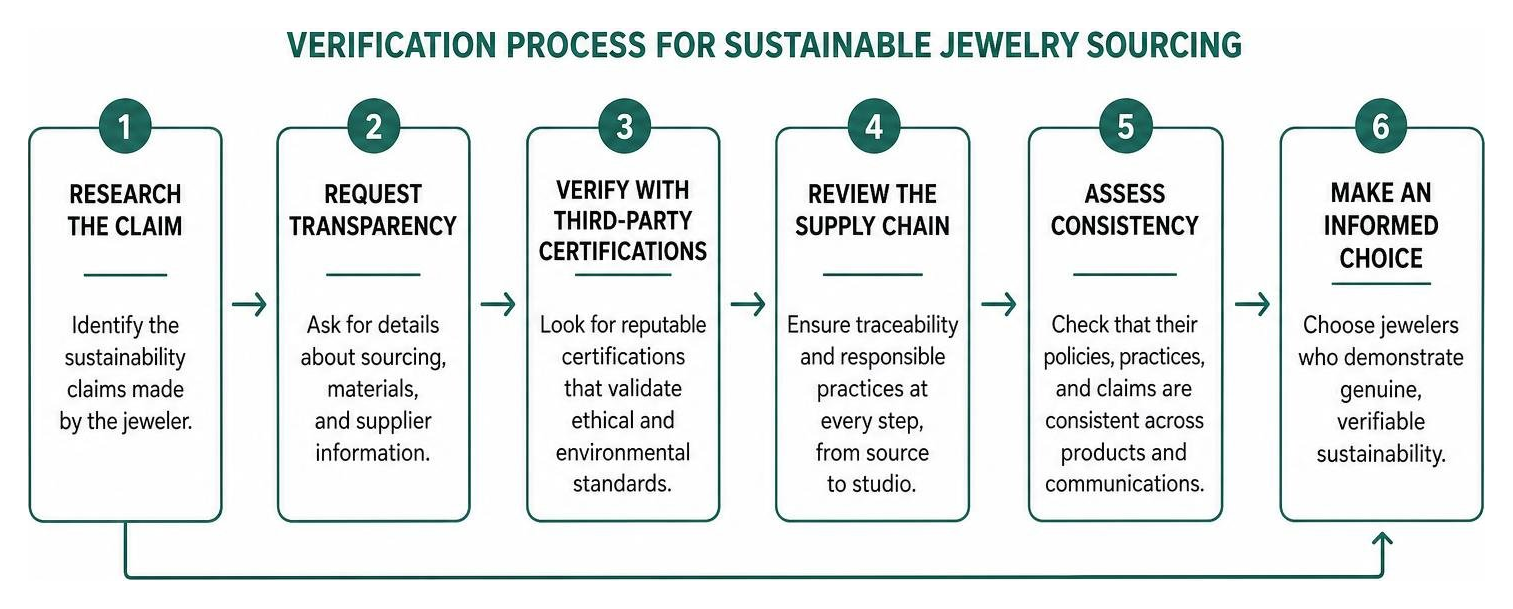
When evaluating a jeweler, look for these key industry certifications:
- Kimberley Process Certification Scheme (KPCS): An international registry established to prevent "conflict diamonds" from entering the mainstream rough diamond market. While a good baseline, keep in mind that the Kimberley Process has narrow definitions of conflict and does not always guarantee fair wages or environmental protection.
- Fairmined Gold Certification: This label guarantees that gold comes from empowered, responsible, artisanal, and small-scale mining organizations. It ensures fair wages, safe working conditions, and strict environmental protections, including the minimization of chemical use.
- Responsible Jewellery Council (RJC): The RJC certifies fine jewelry companies for responsible ethical, social, and environmental practices throughout their entire supply chains, from mine to retail.
- SCS Global Services Certification: For lab-grown diamonds, SCS certification verifies that the stones are sustainably grown, climate-neutral, and produced under strict ethical and environmental standards.
If a jeweler cannot tell you exactly where their metals were refined or where their gemstones were cut, it is a sign that their supply chain lacks the transparency required for true sustainability.
Frequently Asked Questions About Ethical Engagement Rings
Buying an engagement ring is a major emotional and financial milestone. Here are answers to some of the most common questions couples ask when navigating sustainable engagement ring options.
Are lab-grown diamonds real diamonds?
Yes, absolutely. Lab-grown diamonds are 100% real diamonds. They possess the exact same chemical, physical, and optical properties as natural diamonds. They are made entirely of carbon crystallized in a cubic structure. The only difference is that they are grown in a controlled laboratory setting over a matter of weeks rather than taking billions of years to form deep within the Earth. Even professional gemologists cannot tell them apart without specialized laboratory equipment designed to detect trace growth patterns.
How much can you save by choosing a lab-grown diamond?
On average, you can expect to save between 20% and 40% (and sometimes up to 50% or more for larger carat weights) by choosing a lab-grown diamond over a mined diamond of identical size, cut, color, and clarity. This massive price difference is because lab-grown diamonds have a much shorter, more efficient supply chain with fewer middlemen, lower overhead costs, and no expensive, labor-intensive mining operations to fund.
What is the most eco-friendly metal for an engagement ring?
The most eco-friendly metal option is 100% recycled gold or platinum. Recycled metals require no new mining, preventing habitat destruction, soil erosion, and chemical runoff. Another excellent, highly sustainable option is Fairmined gold, which actively supports small-scale, artisanal mining communities by ensuring they operate under strict environmental protections and receive fair economic premiums.
Conclusion
The demand for sustainable engagement ring options is not a passing fad—it represents a fundamental, permanent shift in how consumers view luxury. Modern couples in 2026 want their jewelry to tell a story of love, responsibility, and hope for the future.
For independent jewelry retailers, embracing this shift is the key to thriving in a competitive market. By offering lab-grown diamonds, recycled metals, and transparently sourced gemstones, you can build deep trust with a new generation of loyal customers.
At GemFind Digital Solutions, we have spent over 25 years helping jewelry retailers navigate these shifting consumer behaviors. As a certified Shopify and Google Partner, we design custom websites, integrate state-of-the-art Edge POS systems, and build specialized digital tools that make showcasing your ethical inventory effortless.
If you want to learn how to attract and convert conscious couples online, explore our guide on how to sell more bridal jewelry online or dive into our comprehensive digital marketing guide for selling engagement rings.
Ready to elevate your digital presence and connect with modern, eco-conscious jewelry buyers? Contact us at GemFind Digital Solutions today to discover how our specialized web tools and marketing strategies can help your business shine.


