


Why Your Jewelry Business Needs Google Shopping Ads Now
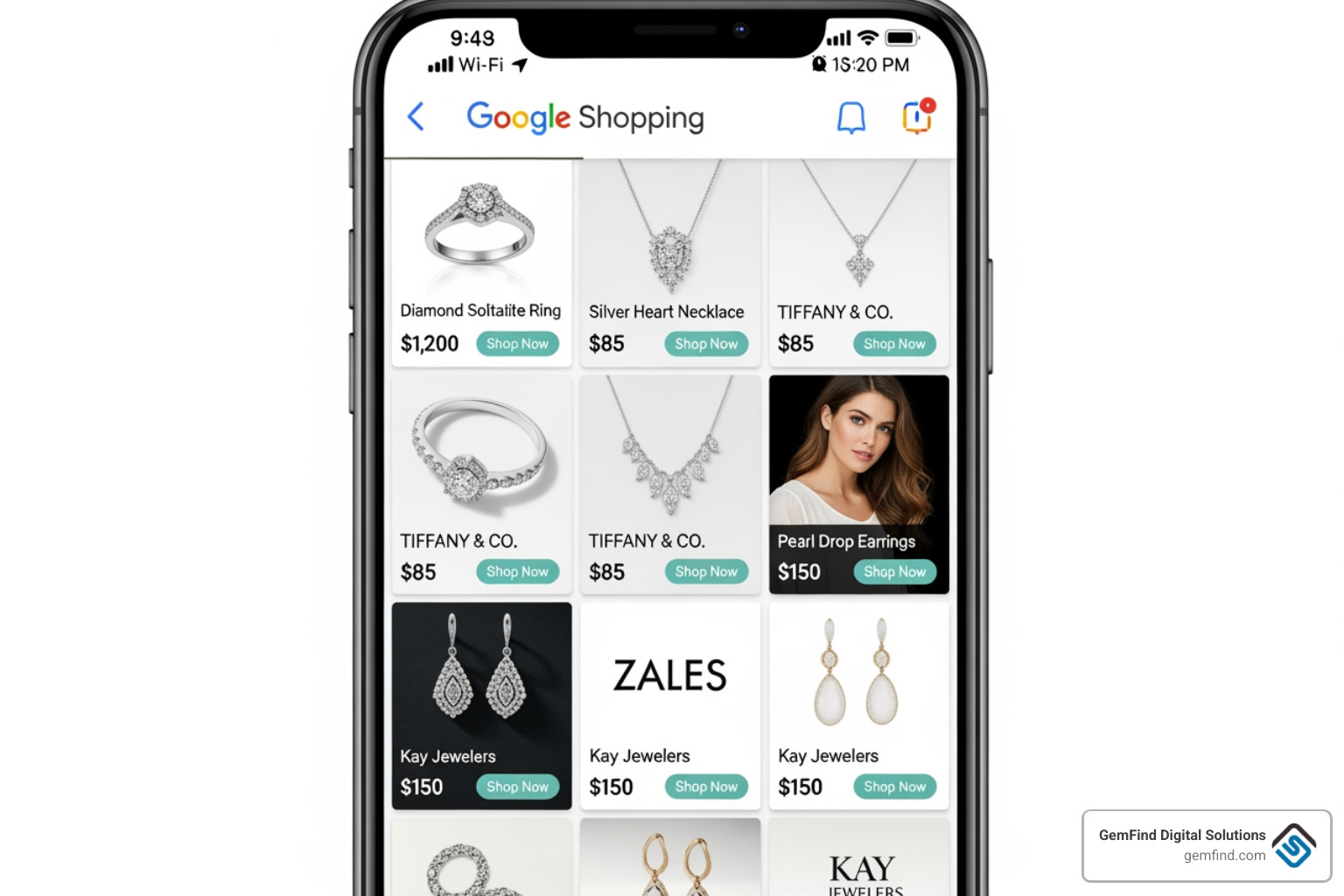
Google Shopping ads for jewelry stores are visual product ads that appear at the top of Google search results. They showcase your jewelry with high-quality images, prices, and store information before a customer even clicks.
For jewelers, this is a powerful way to get your pieces in front of shoppers at the exact moment they are searching for items like engagement rings, wedding bands, or everyday fine jewelry.
Key Benefits of Google Shopping Ads for Jewelers:
- Visual Showcase: Capture attention with stunning product images that highlight details like gemstone cuts and metal finishes.
- High-Intent Targeting: Reach shoppers actively searching for specific pieces like "diamond engagement rings" or "14k gold hoop earrings."
- Price Transparency: Attract serious buyers by showing pricing upfront, which helps filter out casual browsers.
- Top Placement: Appear above traditional text ads and organic results for highly relevant searches.
- Better Qualified Clicks: Pre-qualify customers before they visit your site, reducing wasted ad spend.
- Local and Online Reach: Drive both e-commerce sales and in-store foot traffic from the same product feed.
- Mobile Dominance: Capture the large share of jewelry searches happening on mobile devices.
The jewelry industry is competitive, and today's shoppers start their journey online, even when they plan to buy in-store. While traditional text ads describe a product, they cannot fully showcase the sparkle of a diamond ring or the craftsmanship of a handmade bracelet.
Google Shopping ads solve this by putting your products front and center with rich visuals. When someone searches for jewelry, your pieces can appear in a visual carousel with images, prices, and your store name. This format naturally attracts ready-to-buy customers who are closer to making a purchase decision.
Jewelers who use Shopping ads effectively often see strong returns. For example, sustainable jewelry brands and custom designers have reported significantly higher returns on ad spend and major lifts in website traffic when they combine optimized product feeds with well-structured campaigns. These kinds of outcomes show what happens when you match the right ad format with a highly visual product and data-driven strategy.
This guide will walk you through exactly how to set up and optimize Google Shopping ads for your jewelry business.
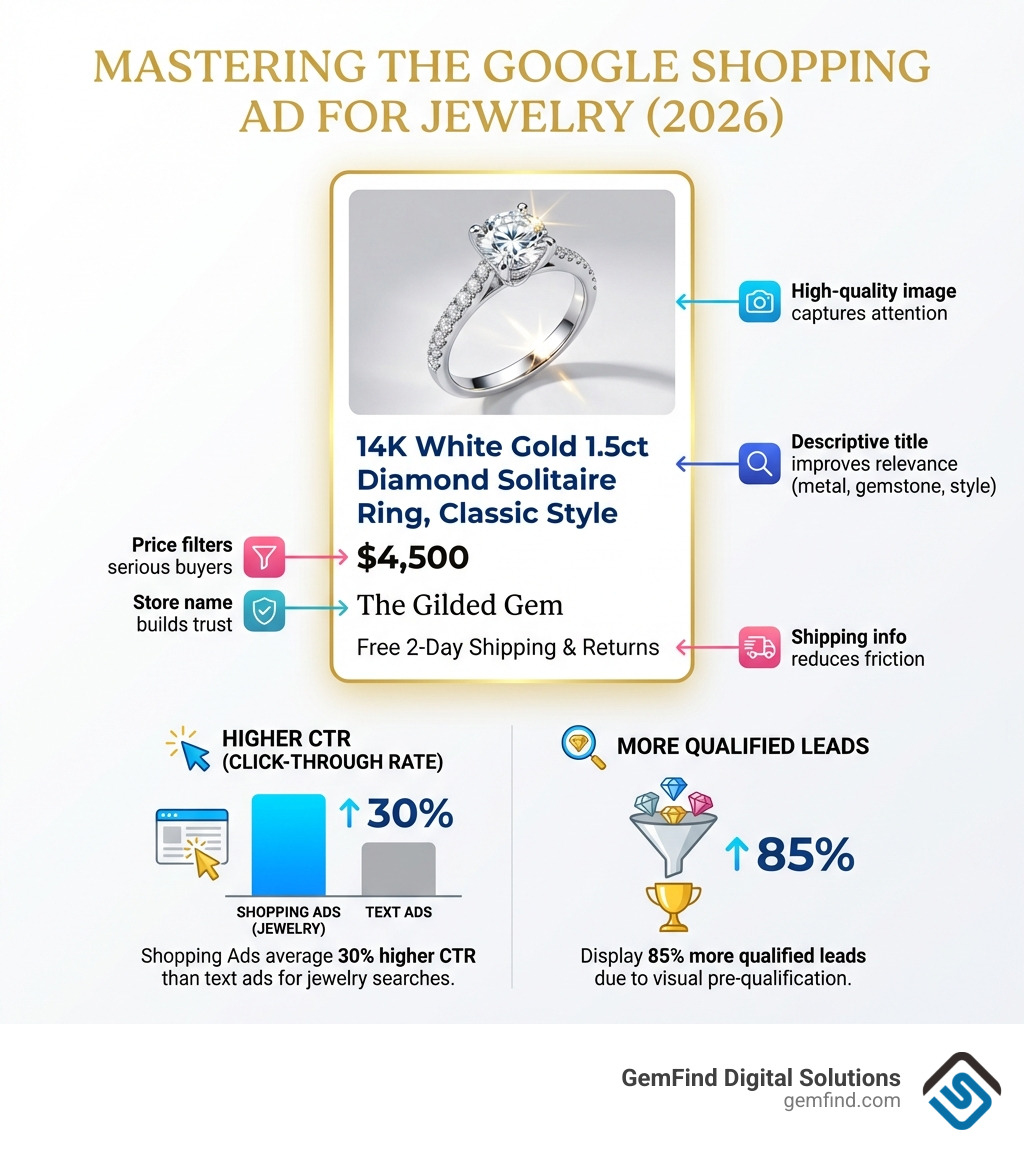
Why Google Shopping is a Jeweler's Best Friend
For jewelry businesses, Google Shopping Ads are an indispensable tool. Jewelry is an inherently visual product, and customers often decide based on aesthetics. Google Shopping delivers what these shoppers crave: a visual-first experience directly in their search results.
When a potential customer searches for "14k gold earrings," they immediately see a stunning image of your product, its price, and your store name. This transparency and visual appeal create a powerful first impression, showcasing your craftsmanship before a click even happens.
This format leads to higher quality clicks. Shoppers who click a Shopping Ad have already seen the product and its price, meaning they are more interested. This pre-qualification reduces wasted ad spend by focusing on high-intent buyers. These ads often appear at the very top of the page, giving your business prime visibility in a crowded online marketplace.
To understand more about the components of these powerful ads, Google provides a helpful resource: What makes up a Shopping ad page.
Shopping Ads vs. Traditional Search Ads: What's the Difference?
While both Shopping Ads and traditional Search Ads connect you with customers, their impact on jewelry retailers is distinct.
Traditional Search Ads are text-based. They rely on compelling ad copy and keywords. When a customer searches for "diamond necklace," a Search Ad might say, "Exquisite Diamond Necklaces - Shop Our Collection." The user must click to see the product.
In contrast, google shopping ads for jewelry stores are highly visual, featuring a product image, title, price, and store name directly in the search results. Potential customers see the actual piece of jewelry before they click, which is a game-changer for a visual product like jewelry.
Another difference is how they're triggered. Search Ads rely on keywords you bid on. Shopping Ads are generated from your product data feed, which you submit to Google Merchant Center. Google's algorithms then match your products to relevant searches.
This distinction impacts click qualification. With Shopping Ads, the visual and price information acts as a strong pre-qualifier, leading to more qualified leads. For traditional Search Ads, the user's intent might be less clear until they land on your website.
Here's a quick comparison:
| Feature | Google Shopping Ads | Traditional Search Ads |
|---|---|---|
| Format | Visual carousel with product image, price, store | Text-based ad with headline, description, URL |
| Trigger | Product data feed (Google determines relevance) | Keywords (we bid on specific search terms) |
| Placement | Often at the very top, within a visual carousel | Above or below organic results, text-based |
| User Experience | Visual, immediate product and price information | Textual, requires click for product details |
| Click Quality | High, pre-qualified shoppers (image/price seen) | Good, but requires strong ad copy to qualify |
| Ideal Use Case | Showcasing specific products, e-commerce sales | Driving traffic for broader terms, services, brand awareness |
A Step-by-Step Guide to Launching Google Shopping Ads for Jewelry Stores
Ready to make your jewelry sparkle on Google? Setting up google shopping ads for jewelry stores involves connecting your product catalog with Google's advertising platform to present your items in the most appealing way.
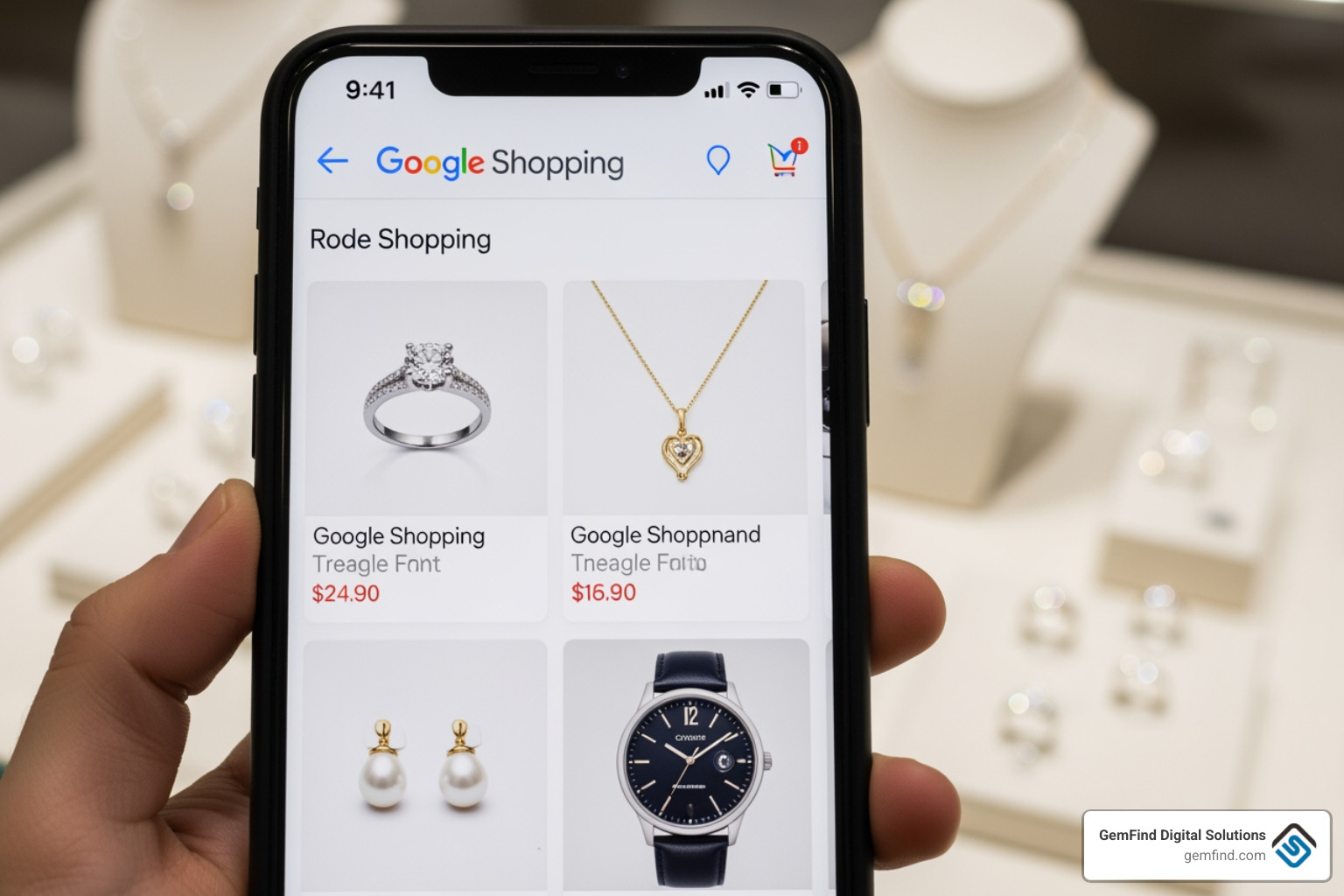
The journey begins with Google Merchant Center, which acts as the bridge between your store and Google Ads. From there, you'll optimize your product data and configure your campaigns to reach the right customers.
Step 1: Set Up Your Google Merchant Center
Google Merchant Center (GMC) is your digital storefront on Google and is essential for running Shopping Ads.
- Sign Up: Go to the Google Merchant Center website and sign up with your Google account, providing accurate business information.
- Verify Your Website: Google needs to confirm you own your website. You can do this via an HTML tag, HTML file, Google Analytics, or Google Tag Manager.
- Link Your Google Ads Account: Link your GMC and Google Ads accounts. This allows your product data to flow into your ad campaigns.
- Configure Tax & Shipping Settings: Set up your tax rates and shipping services, including costs and delivery times. Transparency here builds customer confidence.
For a comprehensive walkthrough, refer to Google's Onboarding guide for Shopping ads page. Accuracy in these initial steps is crucial.
Step 2: Optimize Your Jewelry Product Feed
Your product feed is the heart of your google shopping ads for jewelry stores. It's a file with all the product details Google uses to generate your ads. A well-optimized feed is the difference between getting noticed and getting lost.
- High-Resolution Images: Jewelry is visual. Use crisp, high-quality images that showcase your pieces beautifully. The image is the first thing a customer sees.
- SEO-Rich Titles: Craft titles with important keywords. Instead of "Ring," try "14K White Gold Round Diamond Engagement Ring." Include material, gemstone, and style.
- Detailed Descriptions: Provide comprehensive descriptions. Highlight unique features, craftsmanship, and certifications. More information helps Google match your products to relevant searches.
- Accurate Pricing: Ensure your prices are always up-to-date and match your website to avoid ad disapprovals.
-
Global Trade Item Numbers (GTINs): For branded products, GTINs (like UPCs) are often required. If you sell custom pieces without GTINs, mark
identifier_existsasnoin your feed.
Essential jewelry attributes to include in your feed:
- Material: e.g., 14K Gold, Sterling Silver, Platinum
- Gemstone: e.g., Diamond, Sapphire, Emerald
- Carat Weight: e.g., 1.5 Carat Diamond
- Metal Type: e.g., Yellow Gold, White Gold, Rose Gold
- Style: e.g., Solitaire, Halo, Stud, Pendant
- Occasion: e.g., Engagement, Wedding, Anniversary
- Brand: If applicable
- Gender: e.g., Women's, Men's, Unisex
The more precise your data, the better Google can display your jewelry to the right audience.
Step 3: Choose and Build Your Campaign
With your Merchant Center and product feed ready, it's time to build your campaigns in Google Ads.
Google Ads offers different campaign types that integrate with your feed. While Standard Shopping campaigns offer granular control, Performance Max campaigns leverage machine learning to automate ad placement across all of Google's properties. For many jewelers, Performance Max has proven incredibly effective.
Key areas to focus on:
- Campaign Type: Decide between a Standard Shopping or a Performance Max campaign. Performance Max is often recommended for its broad reach and automation.
- Budget: Start with a comfortable daily budget and adjust as you gather data. High-value jewelry can justify higher costs per click.
- Bidding Strategies: Focus on conversion-based strategies like "Maximize Conversions" or "Target ROAS" (Return on Ad Spend) to ensure your budget drives sales.
- Location Targeting: For local stores, target specific cities, regions, or a radius around your physical location.
- Ad Scheduling: Schedule ads to run during peak hours, days, or buying seasons like Valentine's Day or Mother's Day.
Advanced Strategies to Maximize Your ROI
Once your basic google shopping ads for jewelry stores are running, it is time to strengthen your strategy. The competitive jewelry market demands data-driven tactics to thrive. This means using automation, connecting online ads to in-store sales, and timing your campaigns for seasonal surges.
For example, a custom jewelry retailer that focused on more precise targeting and dynamic product visibility saw a substantial increase in monthly sales, showing the power of strategic optimization.
Using Automation with Google Ads
Automation and machine learning are integral to scaling advertising efforts. Google offers campaign types and bidding strategies designed to maximize performance across its properties.
By connecting your product data to Google Ads and enabling automated bidding strategies that optimize for conversions or revenue, your ads can appear across Google Search, the Shopping tab, YouTube, Display, Gmail, and Maps from a unified strategy. This broad reach helps ensure you are present wherever potential customers are researching or shopping.
When you provide your product feed and other assets (images, videos, headlines), Google's systems can intelligently place them where they are most likely to drive conversions. You can also provide "audience signals" and new customer acquisition goals to guide the machine learning toward your ideal buyers. This lets Google's AI handle much of the day-to-day optimization, freeing you to focus on offer strategy, merchandising, and creative.
For more details, Google offers resources like Create a Performance Max campaign with products from Merchant Center page.
Drive In-Store Sales with Local Inventory Features
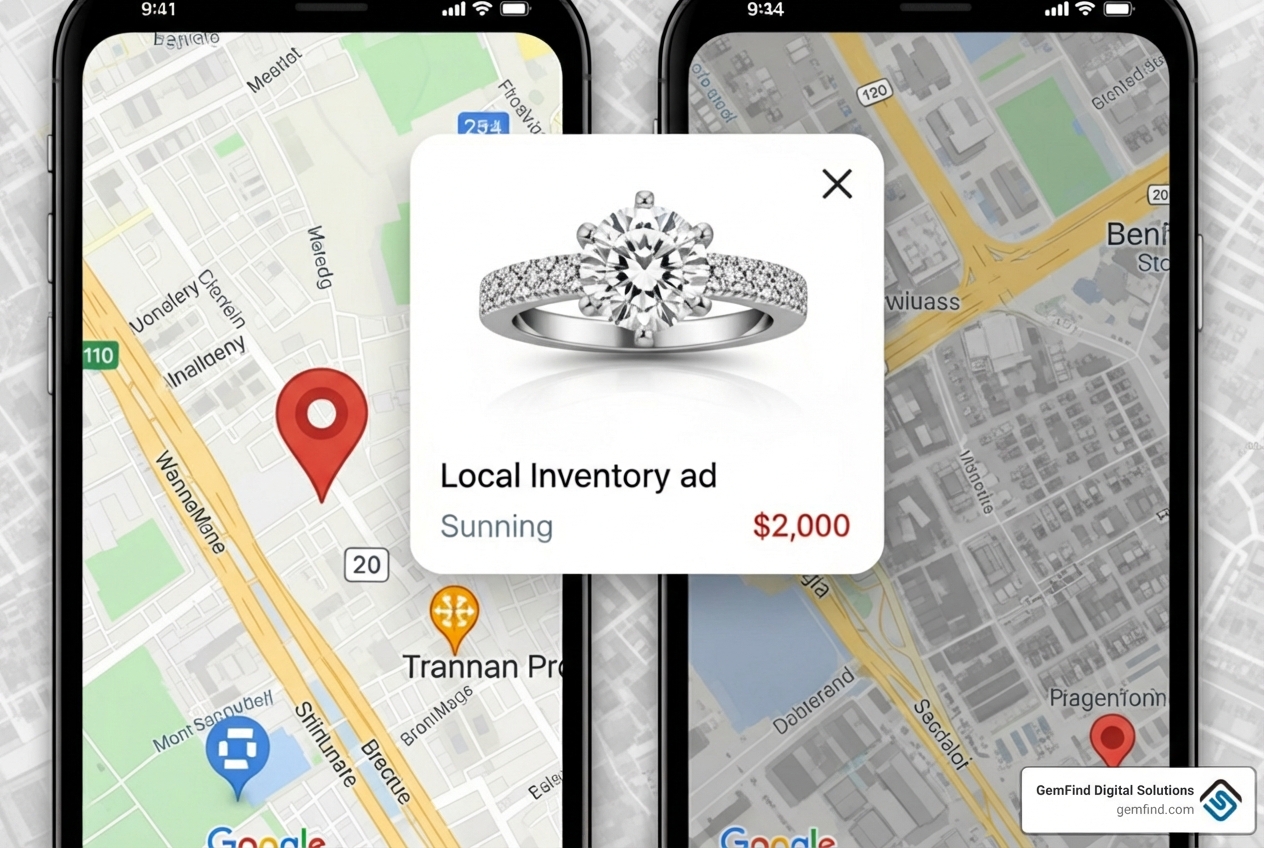
For jewelry stores with physical locations, bridging the gap between online interest and in-store visits is essential. Google Shopping's local-focused features allow you to showcase in-store product availability to nearby shoppers.
When a customer searches for phrases like "diamond tennis bracelet near me," your listings can highlight products that are currently available at your brick-and-mortar store. These experiences can include your store name, address, hours, and other helpful details, making it easy for high-intent shoppers to visit.
This approach is especially powerful for driving foot traffic. For instance, one boutique engagement ring designer boosted website traffic by 70% using location-based campaigns optimized for mobile. By showing what is available nearby and making it simple to find your store, you remove friction and turn online browsers into in-store buyers.
Capitalize on Seasonal Demand and Promotions
The jewelry business is famously seasonal, with sales spikes around holidays like Valentine's Day, Mother's Day, and the end-of-year engagement season. Google Shopping ads for jewelry stores are well positioned to capitalize on these peak periods.
Google Ads allows you to respond quickly to these market shifts. You can schedule campaigns to align with seasonal trends, ensuring your most relevant products are featured when demand is highest. For example, promote gift collections for Mother's Day, graduation pieces in late spring, or highlight engagement rings during peak proposal times.
Promotional extensions and sale price annotations can further lift your campaigns by showcasing special offers or financing options directly in your ads. By strategically adjusting bids, budgets, and product groupings during high-demand windows, you can help ensure your inventory moves when customer intent is at its peak.
Measuring Success and Avoiding Common Pitfalls
Launching google shopping ads for jewelry stores is just the beginning. The real impact comes from continuous optimization. To ensure your campaigns are performing well, you must track results, understand your metrics, and learn from the data. This approach allows you to refine your strategy and improve your return on investment.
How to Measure the ROI of your Google Shopping Ads for Jewelry Stores
Measuring the Return on Investment (ROI) of your ads is essential for making informed decisions. Here are the key metrics to focus on:
- Return on Ad Spend (ROAS): This is one of the most important metrics, showing how much revenue you generate for every dollar spent on ads. A 5x ROAS means you are making $5 for every $1 spent. Many successful jewelry brands using Google Shopping and data-driven campaigns have achieved impressive double-digit ROAS when their feeds and targeting are properly optimized.
- Conversion Tracking: Accurately track conversions, whether they are online sales, lead forms, or phone calls. Robust conversion tracking provides a clear picture of which campaigns and products drive results.
- Cost Per Acquisition (CPA): This metric shows how much it costs to acquire a new customer. Monitoring your CPA helps ensure your campaigns remain profitable, especially for higher-ticket items like engagement rings.
- Click-Through Rate (CTR): A strong CTR indicates your ads are appealing and relevant to searchers, which is a good sign of ad quality and alignment between your feed and search intent.
- Google Analytics Integration: Connecting Google Ads with Google Analytics provides deeper insights into user behavior after they click an ad, such as bounce rates, time on site, and conversion paths.
- Attributing In-Store Sales: For jewelers with physical stores, attributing online ad influence to in-store sales is vital. This can involve offline conversion tracking or using point-of-sale and CRM data to connect online engagement with in-store transactions.
Continuous optimization based on these metrics is critical for long-term success.
Common Mistakes to Avoid
Even with the best intentions, it is easy to make avoidable mistakes. Here are common pitfalls for jewelry retailers and how to avoid them:
- Poor Quality Images: Jewelry is visual. Blurry, dark, or low-resolution images reduce perceived value and trust. Use professional, high-quality photos that show detail and sparkle.
- Inaccurate Product Data: Your product feed is effectively your ad. Incorrect prices, outdated stock, or missing attributes can lead to ad disapprovals and disappointed customers. Keep inventory and pricing synced.
- Neglecting Negative Keywords: Use negative keywords to exclude irrelevant searches. Adding terms like "free," "cheap," or "costume" can prevent your high-end jewelry from showing to the wrong audience and wasting budget.
- Ignoring Mobile Optimization: With a large share of jewelry searches on mobile, a site that is not mobile-friendly will lose customers. Ensure your site is responsive, fast, and offers a smooth mobile checkout experience.
- Setting and Forgetting Campaigns: Google Ads requires ongoing management. Regularly review search terms, adjust bids, pause underperforming products, and test new creative.
- Vague Product Titles: Use descriptive titles so Google and customers can understand your product. Instead of "Diamond Ring," use something like "14K White Gold Round Diamond Solitaire Engagement Ring" with key attributes included.
Frequently Asked Questions about Google Shopping Ads for Jewelry
How much should a jewelry store budget for Google Shopping Ads?
There's no single number; budgeting is about strategy. Start with a daily budget you're comfortable with and adjust based on performance data. Focus on Return on Ad Spend (ROAS) rather than total spend. For example, if you aim for a 5x ROAS ($5 in revenue for every $1 spent), you can determine an acceptable cost per conversion. The competitive jewelry market often allows for higher bids on high-value items. Be prepared to adjust your budget during peak seasons when competition increases.
How do Shopping Ads fit with other digital marketing strategies?
Google Shopping Ads are a key part of a broader digital marketing mix. They excel at capturing high-intent buyers actively searching for products.
A comprehensive strategy integrates other channels:
- Search Campaigns: Capture buyers searching for specific brands or services.
- Meta Ads (Facebook/Instagram): Build brand awareness and create desire among users who aren't actively searching.
- Display Ads: Use for remarketing to keep your brand top-of-mind for users who have visited your site.
- Video Ads (YouTube): Showcase the beauty and story behind your jewelry to connect emotionally with consumers.
- SEO: Build long-term organic traffic and credibility to complement your paid efforts.
A strong strategy uses each platform to address a different stage of the customer journey, working together to drive sales.
What are the future trends for jewelry advertising?
The online advertising landscape is always evolving. For google shopping ads for jewelry stores, key trends are on the horizon:
- AI-Powered Search (SGE): Google's Search Generative Experience will use AI to provide summarized answers. Your content must be structured to answer direct questions so AI can easily synthesize information about your products.
- Visual Search Technology: The ability to search using images will become more common. Optimizing your product images and data for visual search will be crucial.
- Increased Automation: Tools like Performance Max will continue to evolve, offering more sophisticated machine learning to automate campaigns and scale your efforts efficiently.
- Hyper-Personalization: Using data to deliver highly personalized ad experiences will become more critical, showing the right product to the right person at the right time.
- Importance of First-Party Data: With evolving privacy regulations, leveraging your own customer data will be essential for effective targeting and remarketing.
Conclusion: Make Your Jewelry Brand Shine Online
In the dazzling world of jewelry, your digital presence must sparkle just as brightly. Google Shopping ads for jewelry stores offer an effective way to showcase your products to high-intent buyers, driving both online sales and foot traffic to your store.
We have explored how the visual-first format of Shopping Ads, combined with meticulous product feed optimization, helps your jewelry stand out. We have covered the steps to set up your campaigns, plus advanced strategies like automation, local-focused features, and capitalizing on seasonal demand. We also looked at how to measure success through key metrics like ROAS and how to avoid common pitfalls that can hold back performance.
The future of jewelry advertising is visual, intelligent, and personalized. By embracing these tools, your brand can stand out in an evolving digital landscape. To effectively implement these strategies and integrate them with your e-commerce platform and in-store systems, partnering with an industry expert is invaluable. GemFind Digital Solutions has over two decades of experience helping jewelers succeed online, offering custom digital marketing, web design, and specialized apps for the jewelry industry.
Let GemFind help you connect with more customers and turn browsers into buyers.
Get a customized Google Ads strategy for your jewelry business.


