


Why Meta Ads Management Is the Growth Engine Modern Jewelry Stores Can't Ignore

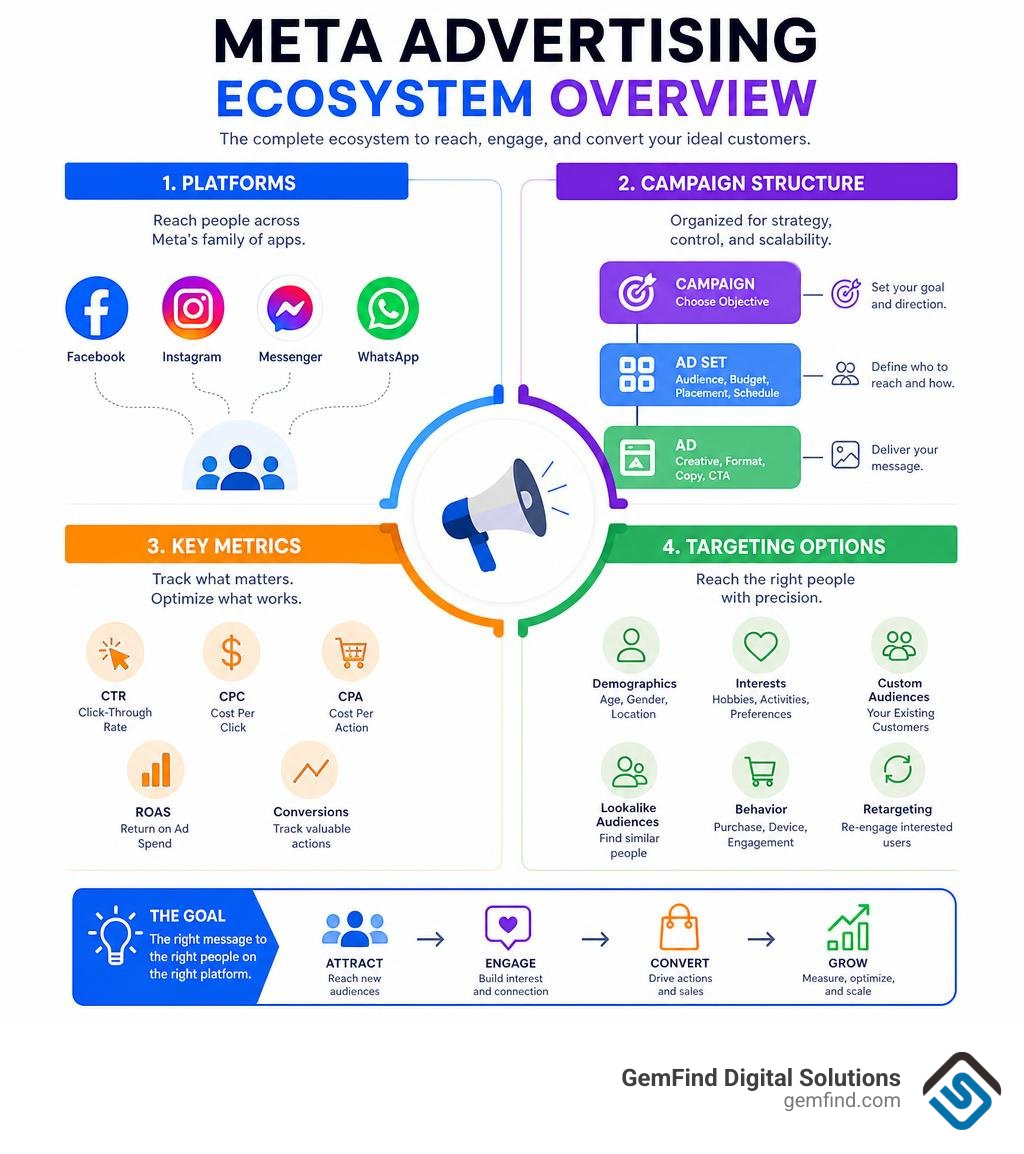
Meta ads management is the process of planning, creating, launching, optimizing, and measuring paid advertising campaigns across Meta's family of platforms — Facebook, Instagram, Messenger, and WhatsApp — through a centralized tool called Meta Ads Manager.
Here's a quick snapshot of what it covers:
| Area | What It Involves |
|---|---|
| Campaign Setup | Choosing objectives, budgets, and bidding strategies |
| Audience Targeting | Demographics, interests, custom audiences, lookalikes |
| Ad Creatives | Images, videos, carousels, and dynamic formats |
| Performance Tracking | CTR, CPC, ROAS, CPA, and conversion data |
| Optimization | A/B testing, creative rotation, retargeting flows |
| Compliance | Ad policies, privacy rules, special ad categories |
For jewelry store owners, this matters a lot. Meta platforms capture 60% of US social ad spending — and the right campaigns can reduce your cost per lead by an average of 30% while delivering up to 2.5x more conversions.
But Meta's ad platform has changed dramatically. It's no longer just a Facebook tool. It's a full cross-platform system that puts your products in front of the right shoppers — whether they're scrolling Instagram Reels or browsing Facebook Marketplace. And managing it well requires more than just boosting a post. It requires strategy, structure, and the right knowledge.
That's exactly what this guide delivers.
I'm Morgan Price, a strategic link-building and digital marketing specialist with hands-on experience helping brands build high-performance systems around meta ads management — from campaign architecture to scaling with automation. In the sections ahead, you'll find everything you need to run smarter, more profitable Meta campaigns for your jewelry business.
Understanding Meta Ads Manager vs. Facebook Ads Manager
To master meta ads management in July 2026, we first need to clear up a very common point of confusion: the difference between the legacy Facebook Ads Manager and the modern Meta Ads Manager.
When Facebook rebranded to Meta, its advertising core underwent a massive transformation. It evolved from a single-channel tool into a highly unified, cross-platform dashboard. Today, Meta Ads Manager is the centralized control center where we build, launch, and monitor paid advertising campaigns across Facebook, Instagram, Messenger, WhatsApp, and the Audience Network.
Instead of managing separate budgets, assets, and targeting parameters for each individual social channel, we use Meta Ads Manager to orchestrate campaigns that span the entire Meta ecosystem. If you are just starting out, reviewing the official resources on Getting started with Meta Ads Manager - Meta Blueprint is an excellent way to familiarize yourself with the basic navigation of this interface.
The Evolution of Cross-Platform Advertising
In the early days of social media marketing, running ads on Instagram and Facebook required completely separate workflows. Today, Meta's unified system relies on advanced machine learning to optimize where your ads appear.
Through features like automatic placements, Meta's algorithms determine in real-time whether a prospective customer is more likely to engage with your jewelry brand on their Instagram Feed, an Instagram Story, a Facebook Reel, or even within a WhatsApp chat. This cross-platform reach allows us to build a seamless customer journey. For a deeper look at how these platforms work together to drive retail traffic, explore our detailed resource, A Guide to Social Media Advertising for Jewelry Stores.
By leveraging the Audience Network, we can also display your ads on high-quality third-party mobile apps and websites, extending your store's reach far beyond Meta's native apps.
The Core Pillars of Meta Ads Management
Effective meta ads management rests on a three-tiered campaign structure: Campaigns, Ad Sets, and Ads.
- Campaign Level: This is where we define our primary business objective. Whether your goal is to generate local store visits or secure high-ticket engagement ring sales, your campaign objective sets the rules for how Meta's algorithm optimizes your budget.
- Ad Set Level: At this tier, we define our target audience, choose our ad placements, establish our daily or lifetime budget, and select our bidding strategy.
- Ad Level: This is the creative layer where we upload images, write copy, build videos, and set our destination URLs.
To help you align your business goals with Meta's native capabilities, we have compiled a table comparing the primary campaign objectives and their corresponding optimization goals:
| Campaign Objective | Ideal Use Case | Primary Optimization Goal |
|---|---|---|
| Awareness | Launching a new bridal collection or brand launch | Maximize Reach or Impressions |
| Traffic | Driving potential buyers to your educational blog posts | Landing Page Views or Link Clicks |
| Engagement | Getting video views on a diamond-grading tutorial | ThruPlay Video Views or Post Engagement |
| Leads | Booking in-store consultation appointments | Instant Form Submissions or Quality Leads |
| Sales | Direct e-commerce purchases of fine jewelry | Offsite Conversions (Purchases) |
Campaign Structure and Bidding Strategies
When setting up your campaign architecture, we must choose how to distribute our budget. Meta offers Advantage+ Campaign Budget (formerly Campaign Budget Optimization or CBO), which automatically distributes your budget in real-time to the best-performing ad sets. If you prefer granular control over how much spend goes to specific audiences, you can opt for Ad Set Budgets (ABO) instead.
We also need to choose a bidding strategy that aligns with our financial goals:
- Highest Volume (Lowest Cost): Meta spends your budget to get the maximum number of conversions possible without bid constraints.
- Cost Cap: We set a maximum average cost per action (CPA) we are willing to pay, helping us maintain profitability.
- Bid Cap: We set the absolute maximum bid we will allow in any individual ad auction.
For a comprehensive walkthrough on structuring these settings for a luxury retail environment, see A Jeweler's Guide to Running Successful Facebook Ad Campaigns. To keep your account clean and organized, we also recommend checking out A Guide to Organizing Facebook Ads for Jewelry Stores and our foundational guide, Facebook Ads 101 for Jewelers.
Ad Creative Testing and Optimization
No amount of technical targeting or bidding optimization can save an ad creative that fails to stop the scroll. In meta ads management, continuous creative testing is the absolute key to maintaining high return on ad spend (ROAS) and fighting off ad fatigue.
We utilize dynamic creatives to automatically mix and match headlines, primary text, images, and video assets to deliver the most personalized ad variation to each user. By running structured A/B tests, we can scientifically isolate which creative elements—such as a lifestyle photo versus a clean product shot—drive the lowest cost per conversion.

Advanced Audience Targeting and Segmentation
Meta's targeting capabilities are incredibly sophisticated. We can segment audiences based on core demographics (such as age, gender, and geographic location) as well as detailed interest targeting (such as users showing interest in "engagement rings," "fine jewelry," or "wedding planning").
However, the real power of meta ads management lies in custom and lookalike audiences.
- Custom Audiences: Built using your first-party data, such as your existing customer email lists, website visitors tracked by the Meta Pixel, or users who have engaged with your Instagram profile.
- Lookalike Audiences: Meta's algorithm analyzes the common characteristics of your custom audience (like your past buyers) and finds new, high-intent prospects who share those identical behaviors and traits.
To learn how to configure these powerful targeting tools for your business, read our step-by-step guide on How to Set Up Look-Alike Audiences on Facebook for Your Jewelry Store. For deeper insights into finding high-intent shoppers, explore our strategic articles on Effective Strategies to Target Jewelry Buyers on Facebook, How to Target Jewelry Buyers on Facebook, and How to Target Jewelry Shoppers on Facebook.
Retargeting and Funnel Alignment
The customer journey for luxury purchases is rarely instantaneous. A shopper looking for a diamond necklace might visit your website, view a product page, and leave to think it over. This is where retargeting becomes essential.
By implementing the Meta Pixel and the Meta Conversions API (CAPI), we can track custom events—such as "ViewContent," "AddToCart," and "InitiateCheckout." We then build retargeting campaigns that serve tailored ads to these warm prospects, reminding them of the exact items they left behind.
Understanding the psychology of these warm audiences is key. We highly recommend reviewing our resources on Why Remarketing Ads on Facebook Work and Why Remarketing on Facebook Ads Work. Once you have captured their interest, you can master the final conversion steps by reading How to Sell Jewelry to a Facebook User.
Measuring Performance and Full-Funnel Integration
To run profitable campaigns, we must move beyond vanity metrics like "likes" and focus on hard performance data. We continuously monitor several key performance indicators (KPIs) inside our analytics dashboard:
- Click-Through Rate (CTR): Measures the percentage of people who saw your ad and clicked it. A low CTR usually indicates that your creative or offer isn't resonating.
- Cost Per Click (CPC): The average amount you pay for each click on your ad.
- Cost Per Acquisition (CPA): The total ad spend divided by the number of completed conversions (e.g., booked appointments or sales).
- Return on Ad Spend (ROAS): Your total revenue generated divided by your total ad spend.
Because modern customer journeys touch multiple channels, we utilize advanced attribution modeling to understand exactly how Meta ads interact with organic search, email marketing, and direct traffic.

Integrating Meta Ads Management with Your Marketing Funnel
Paid ads should never live in a silo. True marketing success happens when we integrate meta ads management with our broader digital ecosystem.
For example, we can align our Meta campaigns with our search engine optimization (SEO) and Google Ads strategies. While Google Ads captures high-intent search traffic from users actively looking for "local jewelers," Meta ads can nurture that same audience visually, keeping your brand top-of-mind.
Furthermore, integrating your ad campaigns with your CRM and marketing automation systems allows you to instantly sync leads generated on Meta to your sales team. To learn how to build a fully automated marketing system, read our comprehensive Jewelry Marketing Automation Guide 2026. You can also explore how these systems connect with in-store operations in The Future of Jewelry Retail: Integrating Client Management and Marketing Automation and How Marketing Automation Can Increase Ecommerce Jewelry Sales & In-Store Leads.
Scaling Campaigns with Automated Meta Ads Management Tools
When you are ready to scale your campaigns, manual adjustments can become incredibly time-consuming. Fortunately, the developer ecosystem has created powerful programmatic tools using Meta's Marketing API.
For technical teams and advanced agencies, open-source projects like the TheMattBerman/meta-ads-kit provide AI copilot frameworks that automate daily campaign checks, budget pacing, and creative fatigue detection. Additionally, developers can reference specialized tools such as the docs/tools-reference.md at main · rafaelszago/meta-ads-mcp repository or the meta-ads-manager - Pinkfish - AI Agents & Workflows for Getting Work Done server to build custom automation workflows.
If you need to monitor your campaigns while away from your desk, the official mobile app is a fantastic resource. You can download it via the Meta Ads Manager App - App Store or the Meta Ads Manager - App Store to pause underperforming creatives, adjust budgets, and view real-time performance reports on the go.
Navigating Compliance, Privacy, and Common Pitfalls
Running ads on Meta platforms requires strict adherence to their advertising policies. If you violate these guidelines, you risk having your ads rejected or, worse, your entire ad account disabled.
Some of the most common pitfalls include:
- Special Ad Categories: If your ads relate to Credit, Employment, Housing, or Social Issues/Politics, you must declare them. For jewelry retailers offering store financing, failing to select the "Credit" category can result in immediate ad rejection.
- Data Privacy & iOS Tracking: Since the rollout of iOS 14.5 and subsequent privacy updates, tracking web behavior has become more difficult. Relying solely on the browser-based Meta Pixel is no longer enough; you must set up the Conversions API to ensure accurate, privacy-compliant tracking.
- Prohibited Content: Avoid making unrealistic product claims, using low-quality landing pages, or displaying misleading before-and-after images.
To ensure your campaigns remain fully compliant and perform at their best, read our strategic guide on Things to Consider When Advertising on Facebook and Instagram for Your Jewelry Store.
Avoiding Budget Overspending and Ad Fatigue
One of the biggest budget drains in meta ads management is ad fatigue. This occurs when your target audience sees the exact same ad too many times, leading to dropping CTRs and rising CPAs.
To prevent this, we recommend:
- Automated Rules: Set up rules inside Ads Manager to automatically pause ads or decrease budgets if the frequency (the average number of times a user sees your ad) exceeds a benchmark like 3.5.
- Creative Rotation: Maintain a fresh library of creatives and rotate them into your ad sets regularly.
- Seasonal Planning: Adjust your budgets and messaging ahead of major shopping seasons. For actionable advice on managing your ad spend during peak times, explore our resources:
Frequently Asked Questions about Meta Ads
What is the difference between Meta Ads Manager and Meta Business Suite?
Meta Business Suite is an all-in-one management tool designed for handling your organic presence. It allows you to schedule organic posts, reply to customer messages, and view general page insights across Facebook and Instagram. Meta Ads Manager, on the other hand, is a dedicated platform built specifically for creating, targeting, budgeting, and analyzing paid advertising campaigns with advanced administrative and programmatic controls.
What is a realistic starting budget for Meta ads?
While you can technically start running ads for as little as $10 a day to test creative concepts, most businesses find that a daily budget of $20 to $50 per ad set is the practical minimum. This budget size allows Meta's algorithm to exit the "learning phase" efficiently, gathering enough conversion data to optimize your delivery and lower your overall costs.
How long does it take to see conversion results?
Most campaigns will begin generating immediate impressions and clicks. However, because Meta's machine learning requires time to optimize, it typically takes 3 to 6 weeks of consistent data gathering for the algorithm to locate your ideal buyers and deliver stable, highly profitable conversion numbers.
Conclusion
Mastering meta ads management is one of the most powerful moves you can make to secure predictable, scalable growth for your jewelry store. From setting up a clean campaign structure to leveraging advanced lookalike targeting and integrating your ads with marketing automation, every step you optimize brings you closer to your business goals.
But you don't have to navigate this complex landscape alone. At GemFind Digital Solutions, we combine over 25 years of jewelry industry expertise with our status as a certified Shopify and Google Partner to design full-funnel marketing systems that scale. From Edge POS integrations to custom jewelry tools, we know exactly what it takes to turn digital impressions into lifetime customers.
Ready to scale your ROI with expert campaign management? Partner with experts for Meta Ads Management and let's grow your business together.


