


Why Most Jewelry Stores Struggle with Google Ads (And How to Fix It)
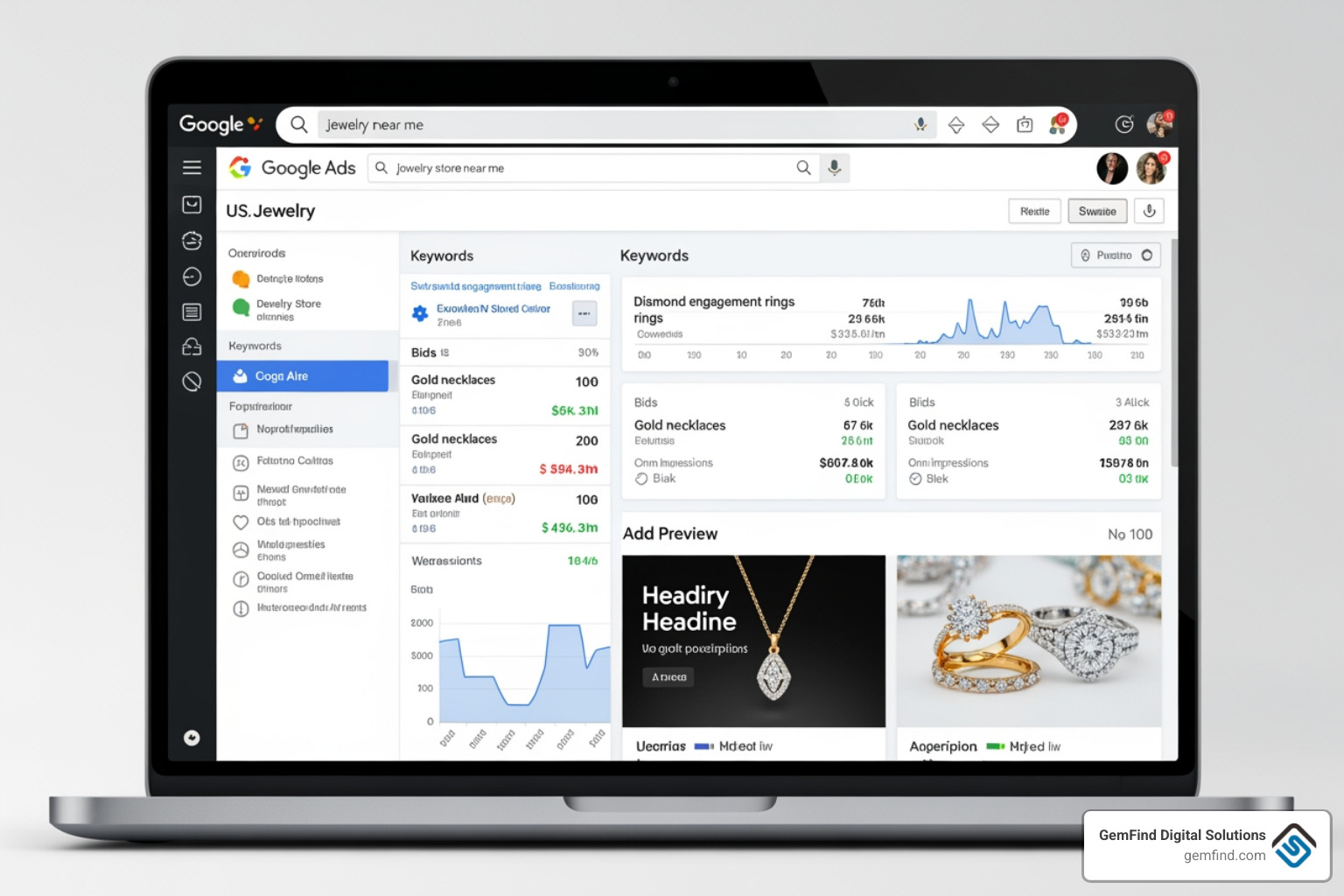
Jewelry store Google Ads can be one of the highest-ROI tools available to jewelers — but only when set up correctly.
Here's a quick-start overview of what it takes to win:
| Goal | Best Campaign Type | Avg. CPC Range |
|---|---|---|
| Capture high-intent buyers | Search Ads | $0.80 – $6.00+ |
| Showcase products visually | Google Shopping / Performance Max | $0.80 – $4.50 |
| Drive foot traffic locally | Local Campaigns + Maps | $0.99 – $4.50 |
| Re-engage past visitors | Display Remarketing | Lower than Search |
| Build brand awareness | YouTube Video Ads | Varies |
Monthly budget expectations:
- Local/niche focus: $1,000 – $2,000/month (~300–800 clicks)
- National reach: $3,000 – $6,000/month
- Luxury or competitive e-commerce: $10,000+/month
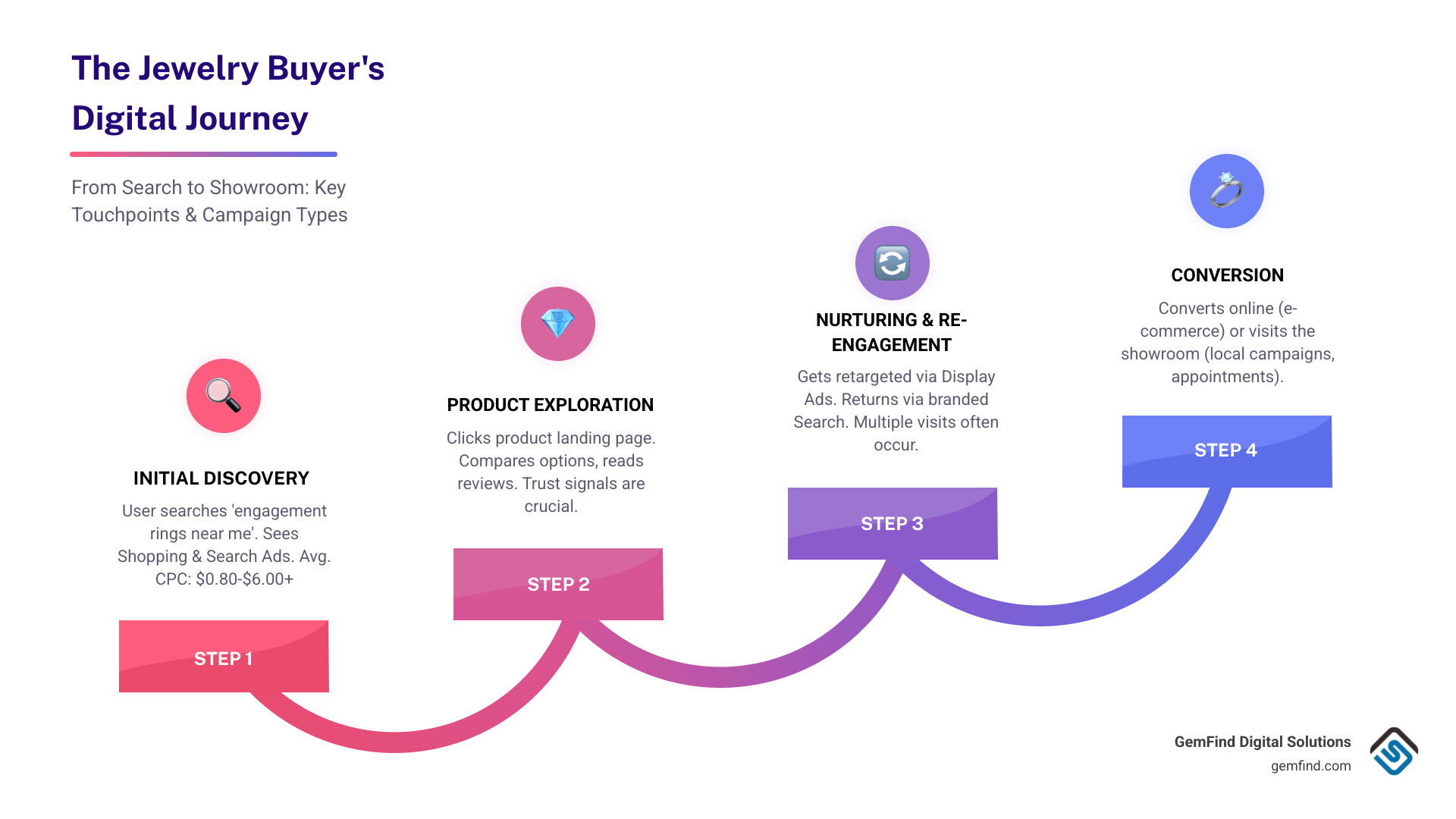
Jewelry is not an impulse category. Shoppers compare prices, check certifications, read reviews, and often visit a product page multiple times before buying. That means your Google Ads strategy needs to do more than just show up — it needs to build trust at every step of the journey.
The problem? Most jewelry stores run generic campaigns, skip feed optimization, and pour budget into broad keywords that attract window shoppers instead of serious buyers. The result: high spend, low return.
Done right, though, the payoff is real. Stores that combine smart campaign structure, strong product feeds, and jewelry-specific targeting have seen 20–40% ROAS improvement within 30–45 days.
This guide walks you through exactly how to get there.
I'm Anthony Arechiga, Vice President of Sales at GemFind Digital Solutions, where I've helped jewelry retailers navigate jewelry store Google Ads since 2007. Over nearly two decades, I've worked with independent jewelers and established brands alike to turn underperforming ad budgets into predictable revenue engines. Let's dig into what actually works.
Choosing the Right Jewelry Store Google Ads Campaign Types
Navigating campaign types in Google Ads is a bit like exploring a treasure chest; each "gem" offers a unique way to shine, but you have to know which one to pick for the specific occasion. For a jewelry store, a one-size-fits-all approach is the fastest way to drain your bank account. Instead, we recommend a "full-funnel" approach that uses different campaign types to capture different types of intent.
Search Ads: Capturing the "I Want to Buy Now" Crowd
Search Ads are the text-based ads that appear when someone types a specific query into Google. These are foundational. We generally divide these into two categories:
- Branded Search: Bidding on your own store name. This is low-hanging fruit. If you don't bid on your name, your competitors might! Branded keywords typically yield the highest conversion rates because the trust is already established.
- Generic/Intent Search: Targeting terms like "rose gold necklaces" or "diamond stud earrings for sale." These capture users at the "moment of need."
Shopping Ads: The Visual Powerhouse
For jewelry, seeing is believing. Google Shopping ads show a photo of your piece, the price, and your store name before the user even clicks. This is critical because jewelry is a visual and emotional purchase. Shopping ads rely on your product data feed rather than just keywords. If your feed is optimized, these ads can be your most consistent source of revenue.
Performance Max (PMax)
PMax is Google's AI-driven campaign type that puts your ads across Search, Shopping, YouTube, Display, and Maps all at once. For jewelry brands, PMax is a scalable conversion engine. It uses machine learning to find audiences that are likely to convert based on your existing customer data. However, it requires high-quality assets (videos and lifestyle photos) to work effectively.
More info about jewelry store google ads complete guide
YouTube and Display: Building the Dream
While Search and Shopping capture existing demand, YouTube and Display create desire. YouTube ads are excellent for storytelling—showing the craftsmanship of a custom ring or the emotion of a proposal. Display ads (the banners you see on other websites) are perfect for keeping your brand top-of-mind for people who have previously visited your site but haven't bought yet.
Driving Online and In-Store Sales with Local Campaigns
For many independent jewelers, the goal isn't just an online sale; it's getting a person through the front door. This is where Local Campaigns and Local Inventory Ads (LIA) become your best friends.
When someone searches for "jewelry stores near me" (a term with over 673,000 monthly searches!), Google can show an ad that includes your distance from them, your store hours, and even whether the specific item they want is currently in stock.
We use geo-targeting to ensure your ads only show to people within a reasonable driving distance of your showroom. You can even set up "Store Visit" conversions to track how many people clicked an ad and then physically walked into your shop. This bridges the gap between digital browsing and physical buying.
More info about how to create a call only campaign in google ads for your jewelry store
Strategic Keyword Targeting and Budgeting for Maximum ROAS
One of the biggest pitfalls we see is jewelers bidding on keywords that are too broad. If you bid on the word "jewelry," you are competing with everyone from Tiffany & Co. to Amazon, and you'll likely attract people looking for "cheap costume jewelry" or "jewelry repair" when you want to sell a $5,000 engagement ring.
To achieve a strong Return on Ad Spend (ROAS), you must focus on transactional intent.
| Campaign Tier | Monthly Budget | Expected Clicks | Best For |
|---|---|---|---|
| Local/Niche | $1,000 – $2,000 | 300 – 800 | Local showrooms, specific niches (e.g., lab-grown) |
| National | $3,000 – $6,000 | 1,000 – 2,500 | Multi-category e-commerce stores |
| Luxury/Enterprise | $10,000+ | 3,000+ | High-volume brands, competitive bridal markets |
The Power of Long-Tail Queries
While "engagement rings" is a massive keyword, it is also incredibly expensive (CPCs can range from $2.50 to over $6.00). However, a "long-tail" keyword like "custom 14k gold sapphire engagement ring" might only cost you $1.50 per click. Why? Because it's more specific. The person searching for that knows exactly what they want, making them much more likely to convert.
Negative Keywords: Your Budget's Shield
Negative keywords are terms you don't want to show up for. In the jewelry world, this is a "hidden money saver." We recommend adding a robust list of negatives, including:
- "Free", "Cheap", "Inexpensive"
- "DIY", "How to make", "Wholesale"
- "Costume", "Imitation", "Fake"
- "Repair" (unless you specifically want repair leads)
More info about how much should jewelers spend on ppc ads
Effective Keyword Research for Jewelry Store Google Ads
Effective research means looking beyond just volume. You need to understand the buyer's journey.
- Informational: "What are lab-grown diamonds?"
- Navigational: "Kay Jewelers near me" (90,500 monthly searches)
- Transactional: "Buy lab-grown diamond earrings"
We focus on the transactional and navigational terms for the best ROI. For example, "lab-grown diamonds" has seen a massive surge in interest. By targeting "lab-grown diamond engagement rings" specifically, you can reach a modern audience that values sustainability and price-point flexibility.
More info about how jewelers can outsmart not outspend competitors on google ads
Optimizing Shopping Feeds and Creative Assets
In jewelry store Google Ads, your product feed is essentially your "creative." If your feed is messy, your ads will be too. Google Merchant Center is the engine behind your Shopping and PMax campaigns, and it needs high-quality data to run smoothly.
The Product Title Formula
Don't just name your product "The Stella Ring." Google's algorithm won't know what that is. Instead, use a structured formula: [Brand] + [Gender/Occasion] + [Metal/Purity] + [Product Type] + [Stone/Carat] + [Key Design Feature]
Example: "GemFind Fine Jewelry Women's 14K White Gold Engagement Ring 1ct Round Diamond Solitaire"
High-Resolution Imagery and Lifestyle Photography
Jewelry is a "trust" category. If your photos look like they were taken in a dark basement with a flip phone, nobody is going to give you their credit card number.
- White Background: Essential for Shopping ads.
- Lifestyle Shots: Essential for PMax and Social. Show the jewelry being worn so the customer can understand the scale and how it sparkles in natural light.
- 360-Degree Views: These have been shown to boost engagement by up to 50%. It allows the customer to feel like they are holding the piece in their hand.
More info about how to make animated google ads for your jewelry store
Creating Compelling Visuals for Jewelry Store Google Ads
Beyond just static images, consider using video and interactive elements. Video campaigns can turn emotion into action by showcasing the "sparkle" that a static image just can't capture.
We also recommend utilizing ad extensions. These make your ad larger and more informative.
- Sitelink Extensions: Link to specific collections (e.g., "Best Sellers," "New Arrivals").
- Price Extensions: Show prices for specific services or products directly in the search result.
- Promotion Extensions: Highlight a Valentine's Day or Mother's Day sale.
Overcoming Industry Challenges: Seasonality and Remarketing
The jewelry industry is famously seasonal. You likely do a huge chunk of your annual business during Valentine’s Day, Mother’s Day, and the November-December holiday corridor.
The Seasonal Playbook
During peak seasons, competition increases, and CPCs can rise by 25% to 100%. If you don't adjust your bids and budgets 2–4 weeks before the holiday, you'll miss the surge.
- The "Warm-Up" Phase: Start increasing awareness 4 weeks out.
- The "Peak" Phase: Shift budget heavily toward high-intent Search and Shopping ads 1–2 weeks before the holiday.
- The "Last Minute" Phase: Use Local Ads to capture people who need to buy something today in-store.
More info about how long does it take for google ads to work for your jewelry store
The Role of Remarketing
Because jewelry is a high-consideration purchase, most people won't buy on the first click. They'll look at your ring, then look at three other stores, then talk to their spouse, then come back.
Remarketing allows you to "follow" those visitors with ads as they browse other sites or watch YouTube. This keeps your brand top-of-mind. You can even segment your remarketing:
- Product Viewers: Show them the exact ring they looked at.
- Cart Abandoners: Give them a gentle nudge or a small incentive (like free shipping) to complete the purchase.
Measuring Success and Scaling Your Campaigns
You can't manage what you don't measure. In the jewelry world, success isn't just about "clicks" or "impressions" (which just mean how many times your ad was seen). It's about Return on Ad Spend (ROAS) and Cost Per Acquisition (CPA).
We recommend integrating your Google Ads with your CRM (like Edge POS) and Google Analytics. This allows us to track the full journey—from the first click to the final sale, whether that sale happened online or in your store.
More info about how to measure roi on your ppc campaigns
Conclusion
Mastering jewelry store Google Ads is a journey, not a sprint. It requires a deep understanding of jewelry-specific intent, a polished product feed, and the ability to pivot during seasonal surges.
At GemFind Digital Solutions, we’ve spent over 25 years perfecting this craft. As a Google and Shopify Partner, we don't just "run ads"—we build integrated digital ecosystems. Whether it's connecting your Edge POS to your online store or creating high-converting landing pages, our goal is to ensure your budget is an investment, not an expense.
Next steps for jewelry retailers:
- Audit your current keywords: Are you paying for "cheap" or "DIY" searches?
- Refresh your creative: Do you have high-res, lifestyle, and 360-degree imagery?
- Set up conversion tracking: Are you tracking phone calls and store visits?
- Plan for the next holiday: Don't wait until the week of the event to start your campaigns.
More info about jewelry digital marketing
What is a realistic budget for a local jewelry store?
For a local jewelry store focusing on a specific city or region, a budget of $1,000 – $2,000 per month is a great starting point. This typically supports 300–800 high-intent clicks. This allows you to dominate local "near me" searches and run a targeted Shopping campaign for your best-selling items.
How can I stop wasting money on "cheap jewelry" searches?
The most effective way is through a rigorous Negative Keyword List. By explicitly telling Google not to show your ads for terms like "cheap," "discount," "costume," or "imitation," you ensure your budget is reserved for buyers looking for quality and value. Additionally, targeting the "Top 30% Household Income" demographic can help filter out low-budget browsers.
Why are my jewelry ads getting clicks but no sales?
This is usually a "trust friction" issue. If people are clicking but not buying, check your landing page:
- Is the price clear?
- Are there high-quality photos and videos?
- Do you show certifications (GIA, etc.)?
- Is your site mobile-friendly and fast?
- Do you have clear return and shipping policies? Jewelry is a trust-based purchase; if your website doesn't look as professional as your showroom, shoppers will bounce.


