


Why Virtual Try-On Jewelry is Transforming the Shopping Experience
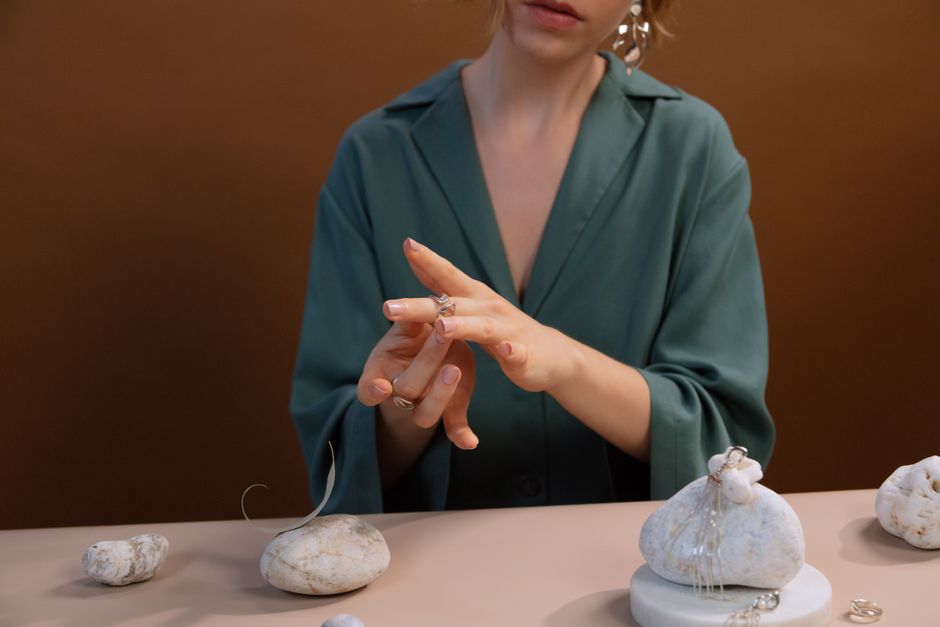
Virtual try-on jewelry is an augmented reality (AR) technology that allows customers to see how rings, earrings, necklaces, and other pieces look on them before buying—using just their smartphone camera or uploaded photo. Here's what you need to know:
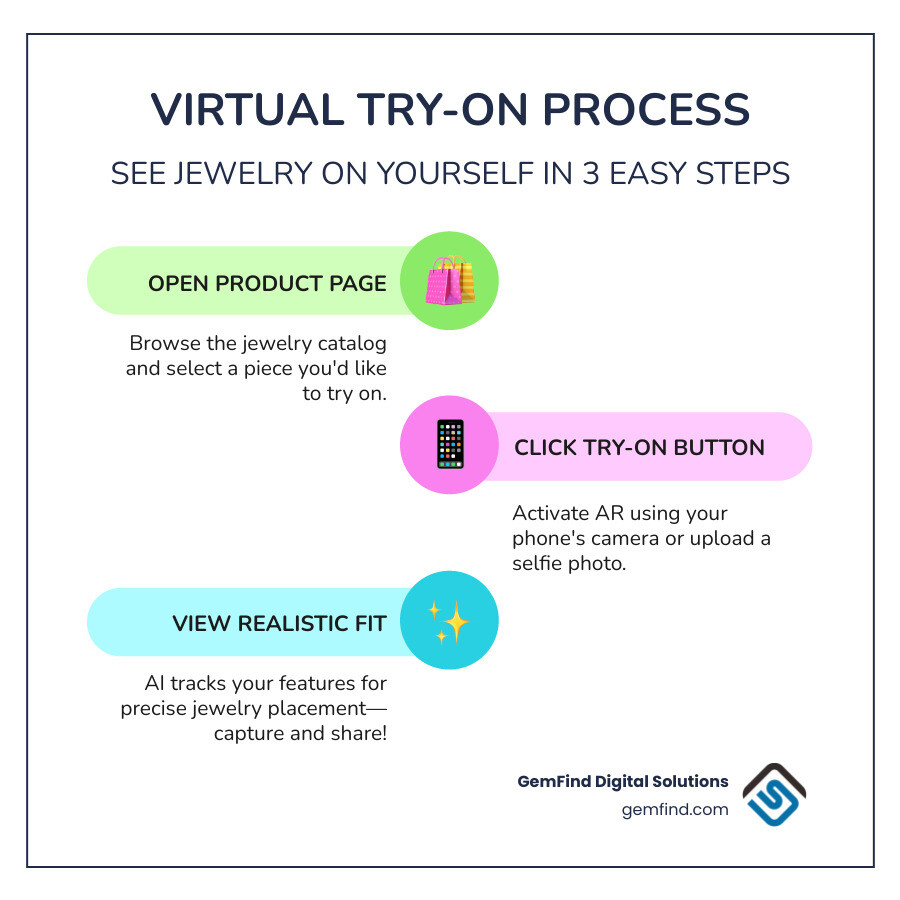
How Virtual Try-On Jewelry Works:
- Choose a piece - Browse jewelry from a digital catalog
- Activate AR - Use your phone's camera or upload a selfie
- See yourself wearing it - AI tracks facial features or hands to place jewelry realistically on your image
Key Benefits:
- Reduces purchase hesitation by letting customers "try before they buy"
- Cuts return rates by up to 40% through accurate visualization
- Works instantly through web browsers—no app download required
- Increases customer engagement and time spent on websites
Technologies Used:
- Augmented Reality (AR) for real-time overlays
- Artificial Intelligence (AI) for precise feature tracking
- 3D modeling for realistic jewelry rendering
One of the most notable shortcomings of online jewelry shopping has always been the inability to see how a piece looks on you. Virtual try-on technology bridges this gap between physical showrooms and digital storefronts—what the industry calls moving from "bricks to clicks."
Online jewelry sales are predicted to grow from 13% of the total global market in 2021 to 18-21% by 2025. Yet many shoppers still hesitate to buy jewelry online because they can't physically try it on. More than 6 in 10 customers prefer stores that offer AR experiences, and remarkably, 4 in 10 shoppers would be willing to pay more for an item if they could first see it in AR.
I'm Anthony Arechiga, Vice President of Sales at GemFind Digital Solutions, where I've spent over 17 years helping jewelry retailers succeed with e-commerce and digital marketing technologies. Virtual try-on jewelry has become one of the most powerful tools for converting browsers into buyers, and I've seen how it transforms reluctant online shoppers into confident customers.
Basic Virtual try-on jewelry glossary:
What is Virtual Try-On Jewelry Technology?
At its core, Virtual try-on jewelry is a digital solution that uses a combination of advanced software to simulate the experience of wearing a physical piece of jewelry. Gone are the days of trying to imagine how a 2-carat pear-shaped diamond might look on your specific finger size. Today, we use "markerless AR," which means the software doesn't need a special sticker or printed guide to know where your hand or face is—it recognizes your anatomy instantly.

The magic happens through three main pillars:
- Augmented Reality (AR): This is the "overlay" that places a digital object into your real-world view.
- Artificial Intelligence (AI): AI acts as the brain, identifying your ring finger, earlobe, or neckline with surgical precision.
- 3D Modeling: To make the jewelry look real, we create high-fidelity 3D models that replicate how gold reflects light and how diamonds sparkle.
When you make your jewelry website more interactive, you move beyond static photos and give customers a reason to stay on your page longer.
2D Image Overlays vs. Full 3D AR Experiences
Not all virtual try-ons are created equal. It’s important to understand the difference between a simple photo sticker and a true AR experience.
| Feature | 2D Image Overlay | Full 3D/AR Experience |
|---|---|---|
| Visual Depth | Flat, lacks perspective | Realistic 360-degree depth |
| Movement | Static; item doesn't move with you | Real-time motion tracking |
| Realism | Low; looks "Photoshopped" | High; includes physics and light reflections |
| User Interaction | Upload photo only | Live camera "magic mirror" effect |
| Cost | More budget-friendly | Higher investment, higher conversion |
The Mechanics of Virtual Try-On Jewelry
How does the software know exactly where an earring should hang? It uses sophisticated face and hand tracking. Neural networks—a type of AI—are trained on thousands of images of different hands and faces. This allows the tool to identify specific "anchor points" like the center of an earlobe or the base of a ring finger.
Modern physics engines even ensure that a pendant "rests" naturally against a user's collarbone rather than floating in mid-air. These interactive tools for jewelers are designed to provide an anatomically accurate fit that responds instantly as the user moves their head or hand.
Accuracy Across Skin Tones and Body Types
A major concern for many shoppers is whether the technology will work for them. We’ve seen incredible advancements in AI that allow for lighting adaptation. This means the virtual gold or silver will change its "glow" based on the lighting in your room, ensuring the piece looks natural against any skin tone.
Furthermore, local image processing ensures that the rendering happens right on your device. This not only makes the experience faster but also upholds high privacy standards, as your personal photos don't necessarily need to be stored on a remote server to provide a realistic preview.
The Benefits of Virtual Fitting for Shoppers and Retailers
The "why" behind Virtual try-on jewelry is simple: it removes the "fear of the unknown." When a customer can see a piece on themselves, their confidence skyrockets.
From a business perspective, the numbers are hard to ignore. Research shows that 4 in 10 shoppers are willing to pay more for AR-enabled items. This isn't just a gimmick; it's a value-add. Additionally, with online jewelry sales predicted to reach up to 21% of the market by 2025, retailers who don't offer these tools risk being left behind.
Enhancing the Customer Journey
The journey from "just looking" to "add to cart" is often paved with questions. Is this necklace too long? Do these studs look too big for my ears? Virtual fitting provides 24/7 showroom access, answering these questions at 2 AM from the comfort of the customer's couch.
We also see a massive boost in social sharing. Shoppers love to "snap" a photo of their virtual try-on and send it to friends or family via WhatsApp for a second opinion. To make this work, it’s vital to follow tips for taking the best jewelry photos for your website, ensuring your digital assets are high-quality enough to be rendered beautifully in AR.
Retailer ROI and Integration
For retailers, the ROI comes from two places: increased conversions and significantly reduced return rates. Because the customer has already "seen" the scale and fit, they are much less likely to be disappointed upon arrival.
Integration has also become much easier. Most modern solutions are "WebAR," meaning they work directly in a mobile browser without requiring the customer to download an app—a major friction point. Whether you are using a cloud-based deployment or a specific plugin, it’s easier than ever to take control of your jewelry photography and turn those assets into interactive experiences.
Finding the Perfect Fit with Virtual Try-On Jewelry
Engagement ring shopping is perhaps the most emotional purchase a person will ever make. It’s also the one where "scale" matters most. A 1-carat diamond looks very different on a size 4 finger than it does on a size 9.
With Virtual try-on jewelry, couples can experiment with:
- Carat Size Visualization: See the "finger coverage" of different diamond weights.
- Metal Color Switching: Instantly swap between yellow gold, white gold, and rose gold to see which complements your skin tone best.
- Shape Comparison: Not sure if you’re an Oval or a Radiant person? You can toggle between them in seconds.
For a deeper dive into this process, you might find a virtual engagement ring try-on guide helpful for setting expectations.
Exploring Earrings and Necklaces via Virtual Try-On Jewelry
Earrings and necklaces present a unique challenge: movement. A good AR tool uses "motion accuracy" to ensure that as you turn your head, the earrings dangle and catch the light naturally. For necklaces, the software maps the individual anatomy of the wearer’s neck to ensure the chain sits where it should.
This technology is also great for learning how to wear ear cuffs and studs in a "stack." Many platforms now offer mix-and-match tools, allowing you to virtually layer multiple necklaces or try on a full bridal set (earrings and necklace) simultaneously to ensure they don't clash.
Virtual Fitting for Watches and Bracelets
Wrist tracking has reached a point of incredible precision. For luxury watches, the 360-degree viewing capability is essential. Shoppers want to see the thickness of the case and how the light hits the dial. Virtual try-on for bracelets allows for "stacking" simulations, showing how a new bangle might look alongside your existing timepiece.
Frequently Asked Questions about Virtual Try-On
Is my privacy protected when I upload a photo?
Yes. Most reputable virtual try-on tools use local processing. This means the image of your face or hand is processed within your web browser and is not uploaded to a permanent server. We recommend looking for tools with clear privacy policies that state images are deleted immediately after the session ends.
How accurate is the sizing for virtual rings?
While the visual scale is very accurate (showing the proportion of the gem to the finger), virtual try-on is an estimation tool. It is excellent for style and scale, but we always recommend a professional consultation or a physical sizer for the final ring size. Think of it as a "style guide" rather than a "ruler."
Can I use virtual try-on without downloading an app?
Absolutely. Most modern jewelry retailers use WebAR technology. This allows you to simply scan a QR code or click a "Try It On" button on a product page to launch your camera directly in your browser (Safari, Chrome, etc.). It’s a seamless integration designed for the modern, shopper.
Conclusion
The future of jewelry retail is undeniably digital and deeply personal. As AI-driven personalization becomes the standard, we are moving toward a world where your online shopping experience feels just as bespoke as a visit to a high-end boutique.
Beyond just AR, we are seeing the rise of "video clienteling," where sales teams can join customers on a live call and help them navigate the virtual try-on process in real-time. At GemFind Digital Solutions, we’ve spent over 25 years helping jewelers navigate these technological shifts. Whether it's learning how to use video calling for jewelry clienteling or helping you start building your Shopify jewelry store, we are here to help you shine in the digital age.
The "test drive" is no longer reserved for the car lot—it’s now an essential part of the jewelry box. Are you ready to let your customers try on their dreams?


