


Compare Diamond Color Grades at a Glance

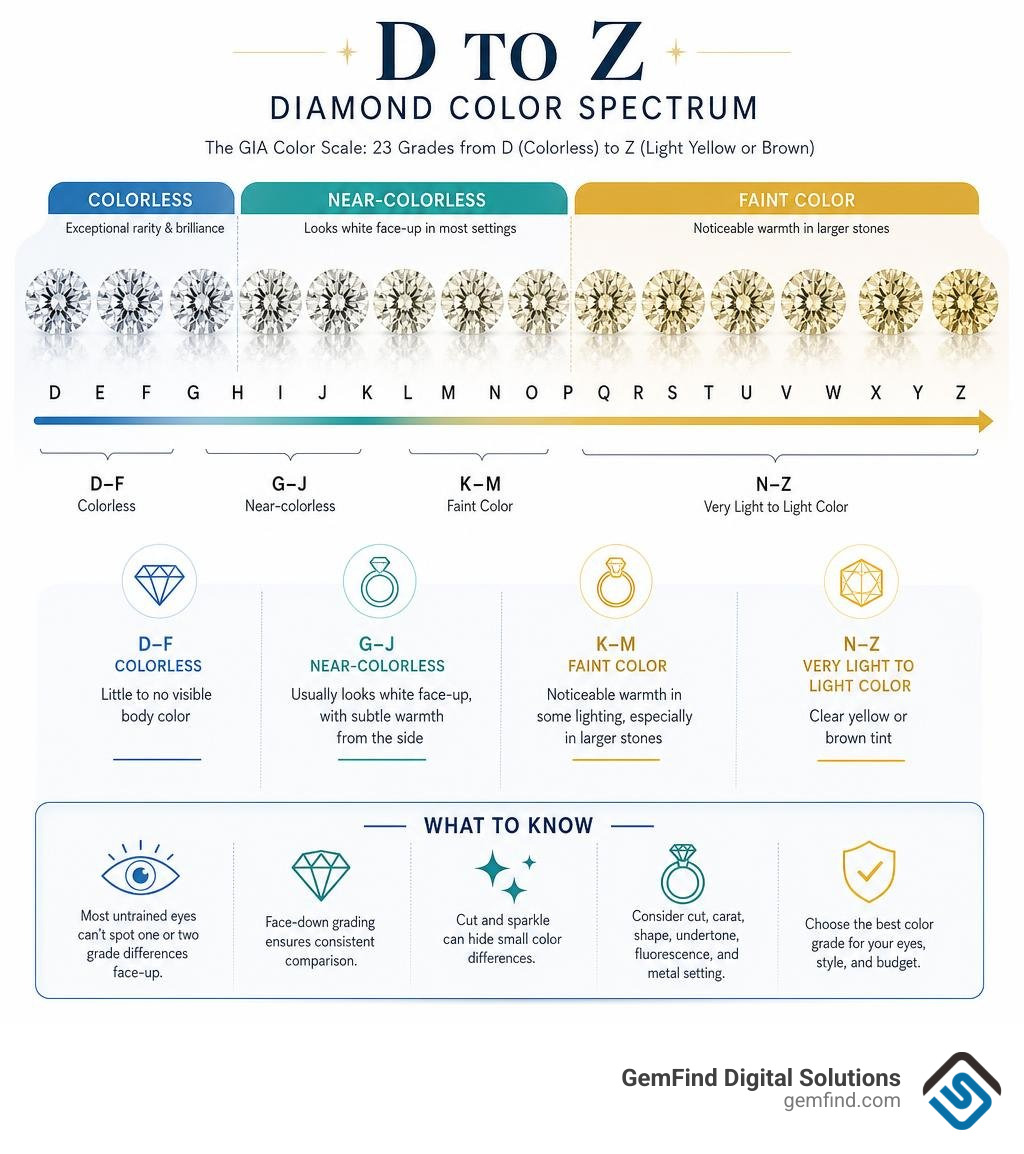
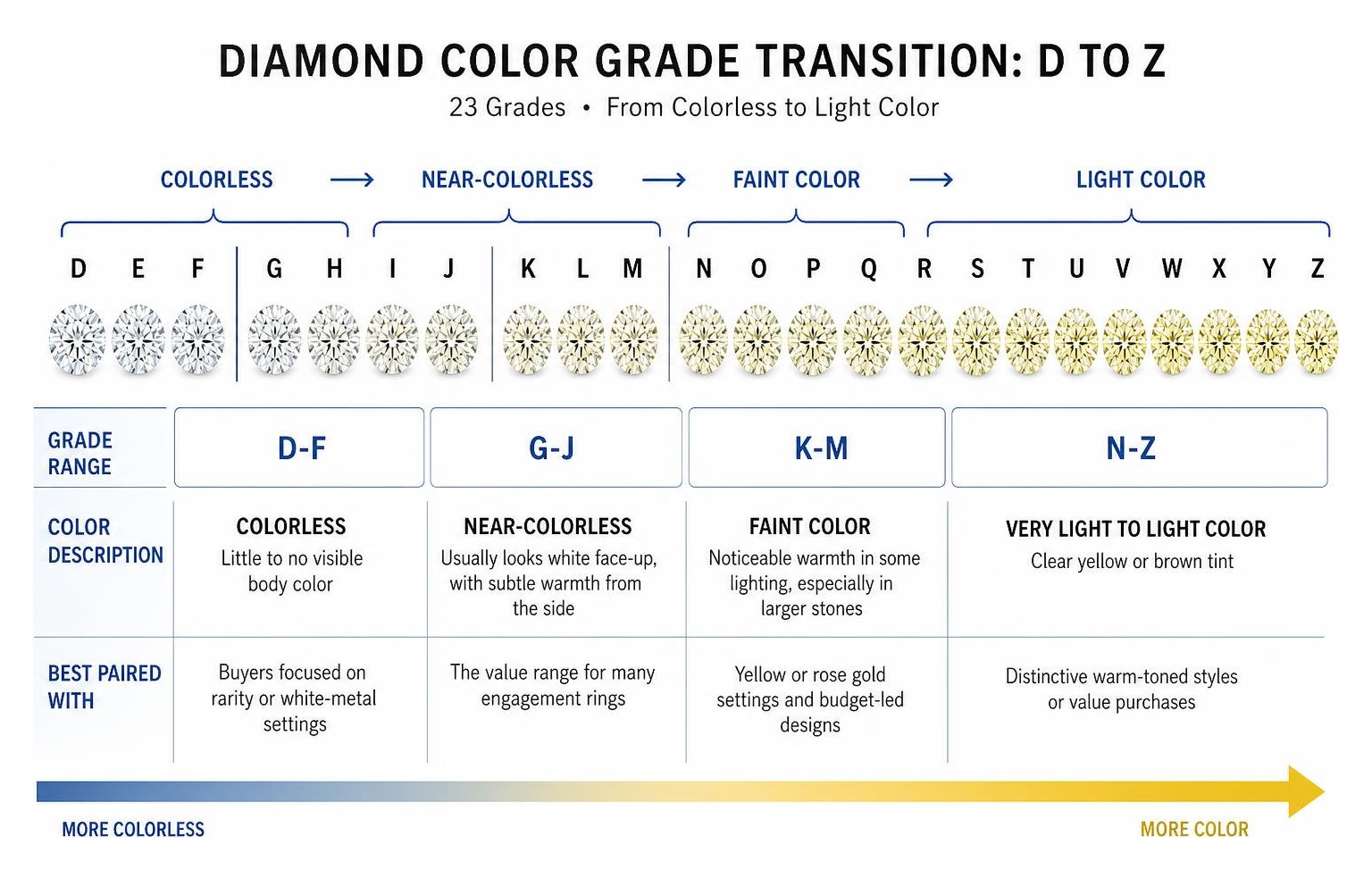
A diamond color grade comparison shows how much yellow or brown body color a white diamond has, from D (colorless) to Z (light yellow or brown). For most shoppers, the quick takeaway is simple: D-F is the rare premium tier, G-H looks white in most rings for less money, and I-J or K-M can offer strong value when paired with the right setting.
| Color range | What it looks like | Best fit |
|---|---|---|
| D-F: Colorless | Little to no visible body color | Buyers focused on rarity or white-metal settings |
| G-J: Near-colorless | Usually looks white face-up, with subtle warmth from the side | The value range for many engagement rings |
| K-M: Faint color | Noticeable warmth in some lighting, especially in larger stones | Yellow or rose gold settings and budget-led designs |
| N-Z: Very light to light color | Clear yellow or brown tint | Distinctive warm-toned styles or value purchases |
The GIA scale has 23 grades, from D through Z. It begins at D because GIA wanted to avoid the confusing A, B, C, and number-based terms used before a shared industry standard existed. Gemologists grade loose diamonds face-down against known comparison stones, but shoppers usually see a mounted diamond face-up, where cut and sparkle can hide small grade differences.
That gap matters. Most untrained eyes cannot spot a one- or two-grade change, such as D versus E or G versus H, when diamonds are viewed face-up in a ring. A smart comparison also considers the diamond's cut, carat weight, shape, undertone, fluorescence, and the metal around it.
I am Anthony Arechiga, Vice President of Sales at GemFind Digital Solutions, where I have helped jewelry businesses build stronger digital and e-commerce experiences since 2007. My work with jewelers and online selling strategies gives me a practical view of how clear diamond color grade comparison content can help customers make confident choices.
Diamond color grade comparison basics:
- ring setting style guide
- diamond carat weight calculator
- custom diamond ring builder
The Ultimate Diamond Color Grade Comparison: D to Z Scale Breakdown
Understanding diamond color comes down to measuring what you do not see. When evaluating a white diamond, gemologists are evaluating the lack of body color inside the stone's crystal lattice. The benchmark for this evaluation is the standard standard 23-point scale established by the Gemological Institute of America (GIA) in 1953. To learn more about the foundation of this grading framework, explore the official GIA 4Cs Color D-to-Z reference.
When diamonds form deep within the earth under extreme heat and pressure, trace elements—most notably nitrogen—become trapped inside the carbon structure. A single nitrogen atom substituted for a carbon atom absorbs blue light, causing the human eye to perceive a natural yellowish tint. The more nitrogen atoms present, the higher the color saturation and the further down the alphabet the grade falls.
The historical reason the GIA scale begins at the letter D surprises many consumers. Before the mid-20th century, jewelers used arbitrary, non-standardized systems. Grades were labeled with "A," "AA," "AAA," Roman numerals, or subjective descriptors like "gem blue" and "river." To establish an objective benchmark free from historic bias or marketing fluff, the GIA made a fresh start by beginning its scale at the letter D—a letter grade never previously associated with top quality.
To evaluate these subtle distinctions accurately, laboratories compare loose stones under strictly calibrated daylight-equivalent lighting against physical master comparison stones. These master sets consist of pre-graded diamonds or precise cubic zirconia indicators representing the absolute threshold of each grade.
Colorless vs. Near-Colorless Tiers (D-F vs. G-J)
Natural diamonds falling into the D-F colorless range represent the top 2% of all gem-quality mined diamonds worldwide. Because of their natural scarcity, these stones command a 30% to 50% price premium over near-colorless stones. D represents complete colorlessness; E displays minute traces of color detected only by senior gemologists viewing the stone face-down; and F carries tiny color traces that remain invisible to non-experts face-up. For a deeper look into adjacent grade dynamics, read the Diamond Color Guide: D vs E vs F vs G vs H (2026).
However, the near-colorless tier (G through J) is where true buying power lies. Stones in the G-H range deliver an astounding 98% visual equivalence to D-F colorless diamonds when set in jewelry, yet cost roughly 30% to 40% less. While a D-color diamond can cost $6,500 to $7,500 in a 1-carat VS2 specification, an identical G-color VS2 stone typically sits between $4,800 and $5,600. Once mounted face-up on a finger, the light return generated by a high cut quality masks those faint trace elements, making G-H near-colorless diamonds virtually indistinguishable from their higher-priced colorless counterparts.
Faint to Light Tiers (K-M and N-Z)
Moving into the K-M range reveals a faint warmth. In small carat weights under 0.50 carats, K-M diamonds often face up surprisingly bright. As carat weight increases, however, light travels through a longer optical path, revealing clear soft yellow, cognac, brown, or gray undertones.
While grades N through Z present visible yellow or light brown body color that is obvious across a room, K-M stones offer significant budget reallocation potential. Lower color grades trade at steep price discounts—often 50% or more below D-color baseline pricing. When paired intentionally with rich setting metals like yellow or rose gold, faint warmth transforms from an apparent spec drawback into an intentional vintage aesthetic.
How Gemologists Perform a Side-by-Side Diamond Color Grade Comparison
When gemologists perform an official color evaluation, they do not hold a diamond up to the light or admire its brilliance face-up. Sparkle and light return are actually the enemies of accurate color grading because facet reflections mask body color.
To perform an objective diamond color grade comparison, graders place the loose, unmounted diamond table-down (face-down) on a neutral white folded card or grading trough. This table-down orientation allows light to pass directly through the pavilion without bouncing through the crown facets.
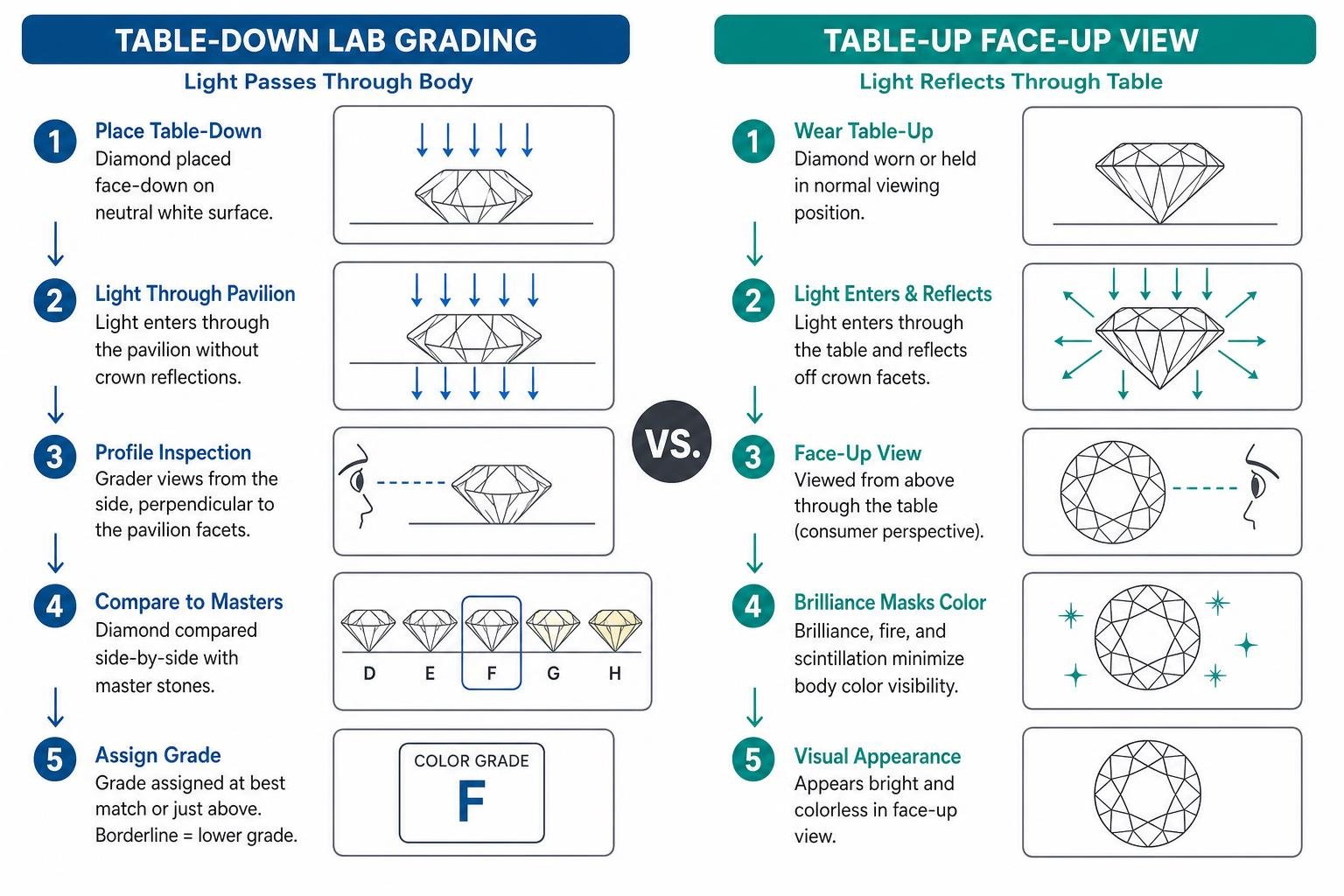
Graders inspect the stone from a profile angle perpendicular to the pavilion facets inside a daylight-balanced light box (emitting a color temperature around 5500K–6500K). The diamond is shifted alongside certified master comparison stones until its body color matches or sits just above a master indicator. Graders work quickly—often within 10 to 15 seconds per observation—to prevent eye fatigue from skewing their color acuity. If a diamond sits precisely on the border between two grades, gemological standards dictate assigning the more conservative (lower) grade.
Conducting a Table-Up Diamond Color Grade Comparison
While gemological laboratories evaluate stones face-down, consumers wear their jewelry face-up. This creates a fascinating divergence between paper specifications and real-world beauty. Face-up brilliance, fire, and scintillation actively shield body color from the viewer's eye.
When conducting a face-up visual comparison, most people cannot discern a difference of one or two adjacent color grades. For detailed real-world photography of these optical realities, examine Side By Side Diamond Color Comparisons.
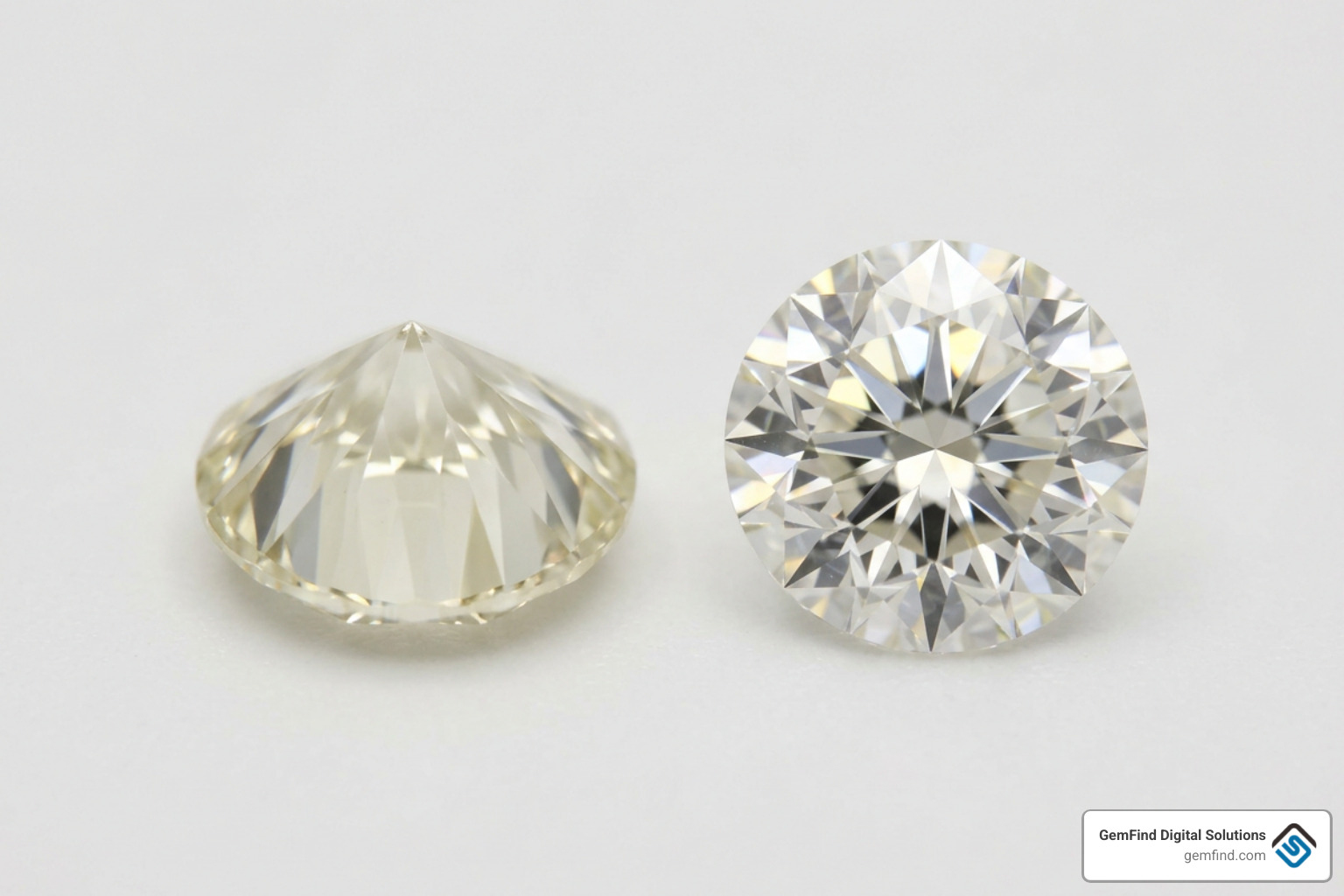
When comparing D versus E, or G versus H, face-up visual differences are virtually imperceptible without high-powered magnification and controlled laboratory lighting. The G-H tier serves as the industry's visual sweet spot: it presents a bright, crisp white face-up view to the naked eye while saving buyers thousands of dollars compared to top-tier colorless grades.
GIA vs. AGS: A Technical Diamond Color Grade Comparison
While the GIA D-to-Z alphabetical scale is the global standard, the American Gem Society (AGS) developed a technical numeric scale from 0.0 to 10.0 that directly corresponds to standard letter grades. Understanding how these systems overlap helps buyers read diverse diamond certificates confidently:
- AGS 0.0 to 1.0 (Colorless): Direct equivalent to GIA grades D, E, and F.
- AGS 1.5 to 3.0 (Near-Colorless): Direct equivalent to GIA grades G, H, I, and J.
- AGS 3.5 to 4.5 (Faint Color): Direct equivalent to GIA grades K, L, and M.
- AGS 5.0 to 7.0 (Very Light Color): Direct equivalent to GIA grades N, O, P, Q, and R.
- AGS 7.5 to 10.0 (Light Color): Direct equivalent to GIA grades S through Z.
Both laboratories require loose stone evaluation because mounting settings introduce metal reflections ("color bleeding") that distort accurate body color reads. While AGS has largely merged its operational focus into GIA grading benchmarks in recent years, numeric references remain prominent on legacy reports and vintage diamond documentation.
Key Factors That Influence Perceived Diamond Color
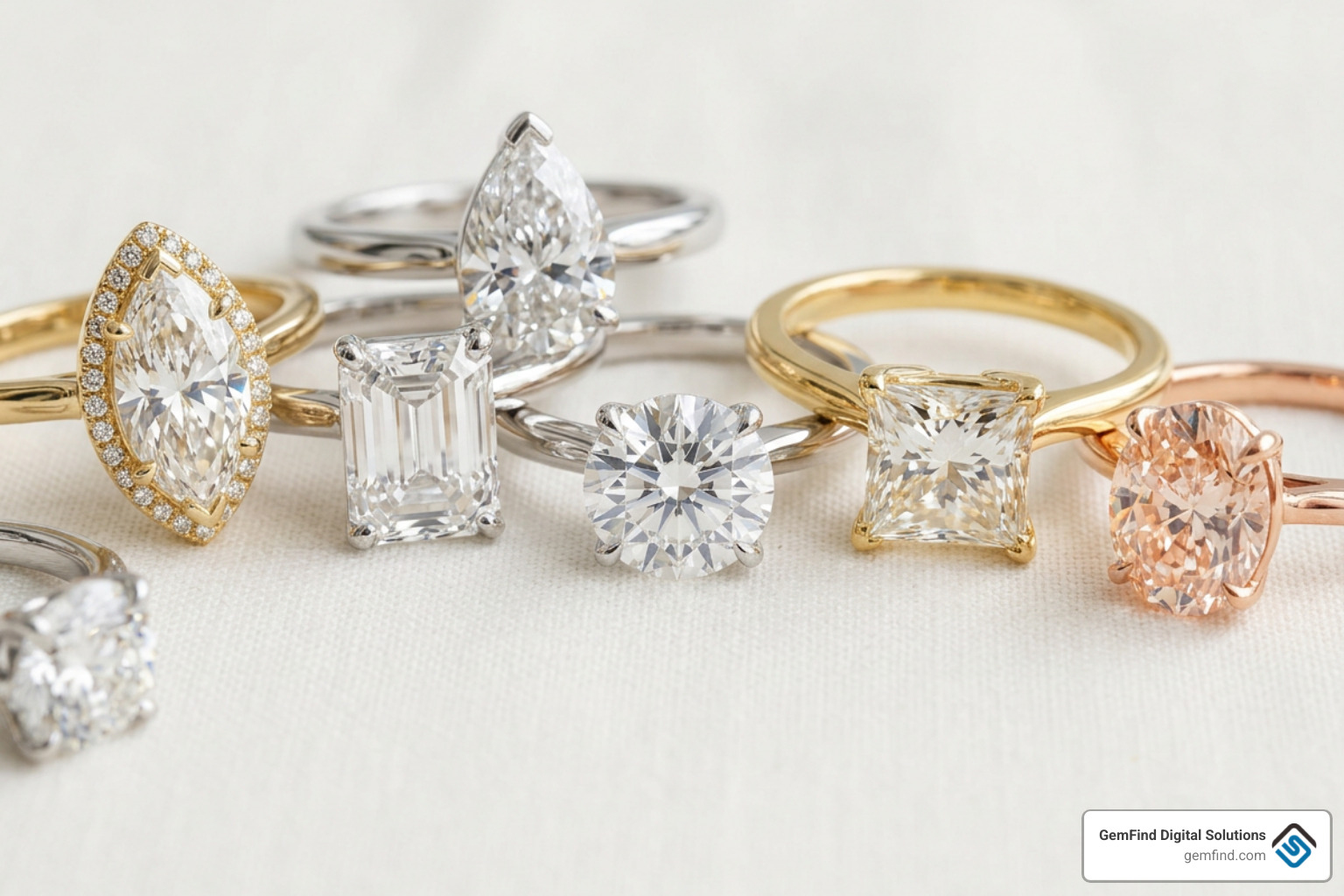
Paper grades tell only half the story. The way human eyes perceive color in a set diamond depends heavily on physical geometry, mounting choices, and lighting environments.
Carat Weight and Diamond Shape Dynamics
Carat size plays a major role in how concentrated body color appears. Larger diamonds contain a deeper physical mass and longer light paths, making natural body tinting much easier to spot. A 0.70-carat I-color diamond may look completely white face-up, whereas a 2.50-carat I-color diamond of identical proportion will display visible warm undertones around its outer edges.
Furthermore, diamond shape dictates how light travels through the stone:
- Round Brilliant Cuts: Featuring 58 strategically angled facets, round brilliants excel at dispersing light and creating maximum fire. This intense scintillation masks body color better than any other shape, allowing buyers to drop to G, H, or even I grades safely.
- Step Cuts (Emerald & Asscher): Step cuts act like wide, open glass windows with flat broad tables. They lack high scintillation, revealing natural body warmth and inclusions clearly. Buyers selecting step cuts should prioritize higher color grades (D–F or G minimum).
- Elongated Fancy Shapes (Oval, Pear, Marquise): Shapes with sharp points or narrow ends tend to trap body color near their tips. An oval or pear-cut diamond usually shows more visible warmth at its ends than a round diamond of identical color grade.
To understand how physical dimensions alter visual properties, try using a diamond carat weight calculator when planning your ring specs.
Ring Setting Metals and Perceived Whiteness
Precious metal choice physically alters perceived diamond color through reflection:
- Platinum and White Gold: These cool white metals reflect crisp light into the stone. They are best paired with D through H color grades. Setting an I, J, or K stone into platinum can highlight the contrast between the white metal and warm stone, making natural tinting more obvious.
- Yellow Gold: Yellow metal absorbs and reflects warm tones. Placing an H, I, J, or K color diamond into a yellow gold setting masks its natural body warmth, making the stone appear visually whiter by comparison.
- Rose Gold: The pinkish hue of rose gold hides warmth exceptionally well, allowing buyers to select I down to M color grades without creating jarring color contrasts.
Fluorescence, Clarity, and Color Interaction
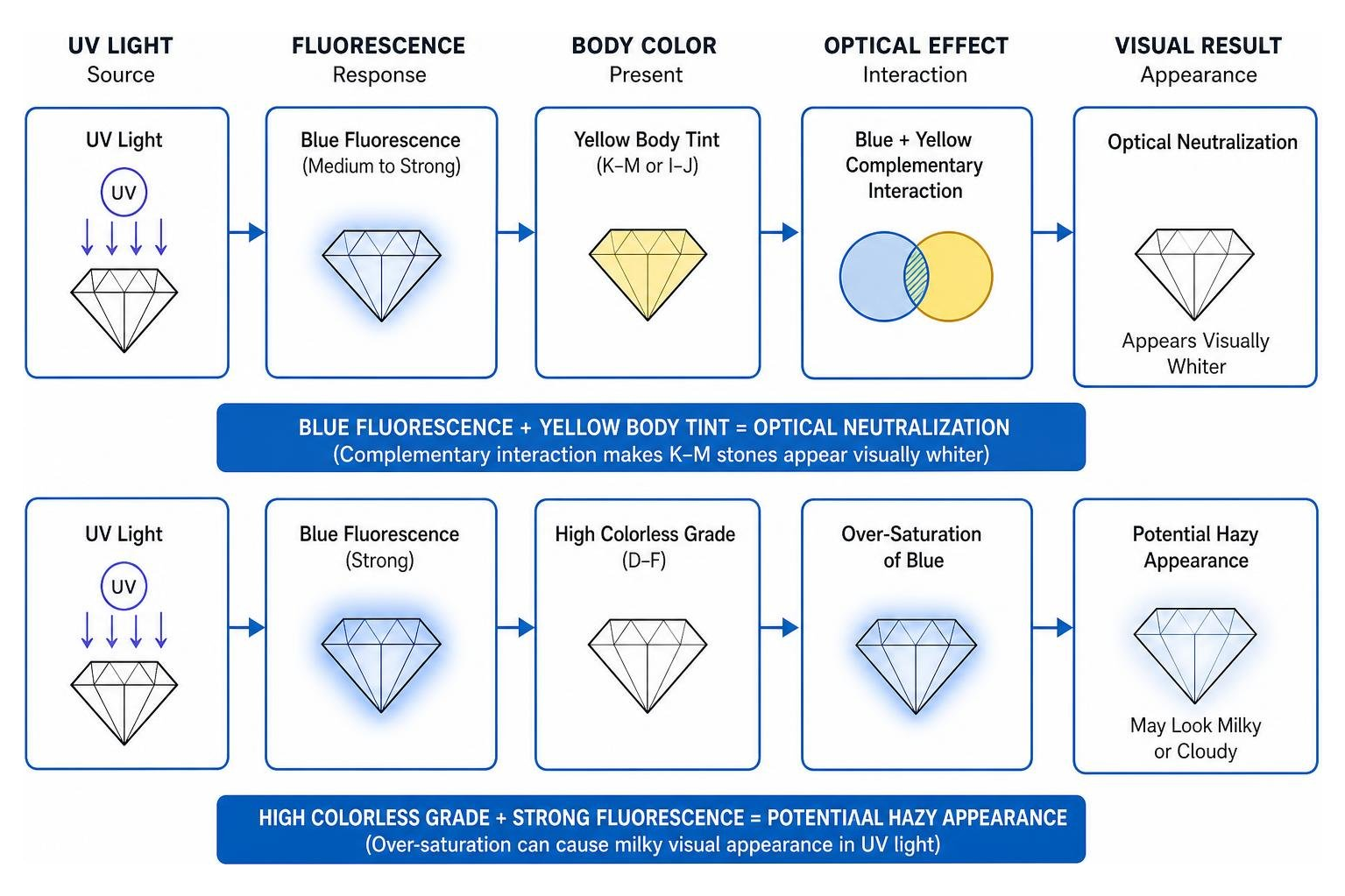
Fluorescence refers to a diamond's ability to emit a soft glow—usually blue—when exposed to ultraviolet (UV) light. In faint yellow diamonds (K-M range) or near-colorless I-J stones, medium to strong blue fluorescence acts as an optical equalizer. Because blue and yellow are complementary colors, the blue fluorescence neutralizes yellow body warmth in natural sunlight, making a lower-grade stone look visually whiter.
However, in high colorless grades (D-F), strong fluorescence can occasionally cause a stone to look hazy, milky, or cloudy in direct sunlight.
Color and clarity also interact. Step cuts paired with cloud inclusions can make lower-color stones look dull. Combining an eye-clean VS2 or SI1 clarity grade with an optimal cut grade yields maximum light return, effectively obscuring subtle body tinting.
Smart Buying Strategies: Maximizing Value Across Color Grades
To balance your budget while achieving a stunning visual result, use this quick reference table comparing color tiers, cost shifts, and optimal setting metals:
| Color Tier | Average Price Shift | Visual Equivalence (Face-Up) | Recommended Setting Metal | Optimal Buyer Profile |
|---|---|---|---|---|
| D - F (Colorless) | Baseline Premium (+30% to 50%) | 100% Pure White Benchmark | Platinum, White Gold | Rarity collectors, "D-Flawless" purists |
| G - H (Near-Colorless) | Save 30% to 40% vs D-F | ~98% Visual Equivalence | Platinum, White Gold, Rose Gold | Value Sweet Spot (50% of market) |
| I - J (Near-Colorless) | Save 40% to 50% vs D-F | Slight warmth in larger carats | Yellow Gold, Rose Gold | Budget maximizers seeking larger carats |
| K - M (Faint Warmth) | Save 50% to 65% vs D-F | Noticeable warm, vintage hue | Yellow Gold, Warm Antique Bands | Vintage style lovers, maximum carat size |
Each single grade step down the scale generally reduces price by 8% to 12%. Because G-H grades dominate roughly 50% of the engagement diamond market, opting for G or H allows you to redirect thousands of dollars into a larger carat weight or a superior cut grade.
Natural vs. Lab-Grown Diamond Color Value
Both natural and lab-grown diamonds share identical chemical, physical, and optical properties, but their color distribution and pricing dynamics differ fundamentally.
Lab-grown diamonds are typically grown via Chemical Vapor Deposition (CVD) or High Pressure High Temperature (HPHT) methods. HPHT stones often achieve D-F colorless grades with ease. However, CVD lab-grown diamonds can occasionally retain minor trace elements like boron, which creates a very faint bluish tint rather than the yellow tint common in natural diamonds.
Because lab-grown production costs do not scale up exponentially with color rarity, the price gap between a D-color lab-grown diamond and an H-color lab-grown diamond is minimal. In natural diamonds, where colorlessness is a rare freak of nature, that same grade gap costs thousands of dollars. To explore how these shifting dynamics reshape retail trends, review our analysis on how will lab grown diamonds affect the diamond market.
Frequently Asked Questions About Diamond Color Comparison
What diamond color grade offers the best value for money?
The G-H near-colorless range provides the ultimate sweet spot for value. G-H diamonds face up visually white in almost any ring style while costing 30% to 40% less than rare D-F colorless stones.
Why does the GIA diamond color scale start at the letter D?
The GIA deliberately started its scale at "D" in 1953 to distance its objective grading standards from older, inconsistent market terms that used A, B, C, Roman numerals, or subjective descriptions like "blue-white."
Can the human eye spot the difference between D and G color diamonds?
Mounted in a ring and viewed face-up, the untrained eye generally cannot tell a D-color diamond from a G-color diamond. Subtle body color differences are usually visible only when loose stones are evaluated face-down side-by-side against master stones in a laboratory.
Conclusion
Conducting a smart diamond color grade comparison comes down to balancing certification specs against real-world visual performance. Prioritizing cut quality above all else ensures maximum brilliance, which hides body warmth and allows you to select near-colorless grades like G or H with complete confidence. Match your chosen color grade with an appropriate mounting metal, and you will create a ring that looks icy white while keeping your budget intact.
At GemFind Digital Solutions, we have helped retail jewelers and diamond brands connect with consumers through custom web development, e-commerce integrations, and smart digital tools for over 25 years.
If you are a jewelry retailer looking to showcase interactive diamond inventory or build an immersive online shopping experience, discover how a custom engagement ring website powered by our complete ring builder app guide can help your business thrive.


