


Why Every Jewelry Professional Needs a Diamond Carat Weight Calculator
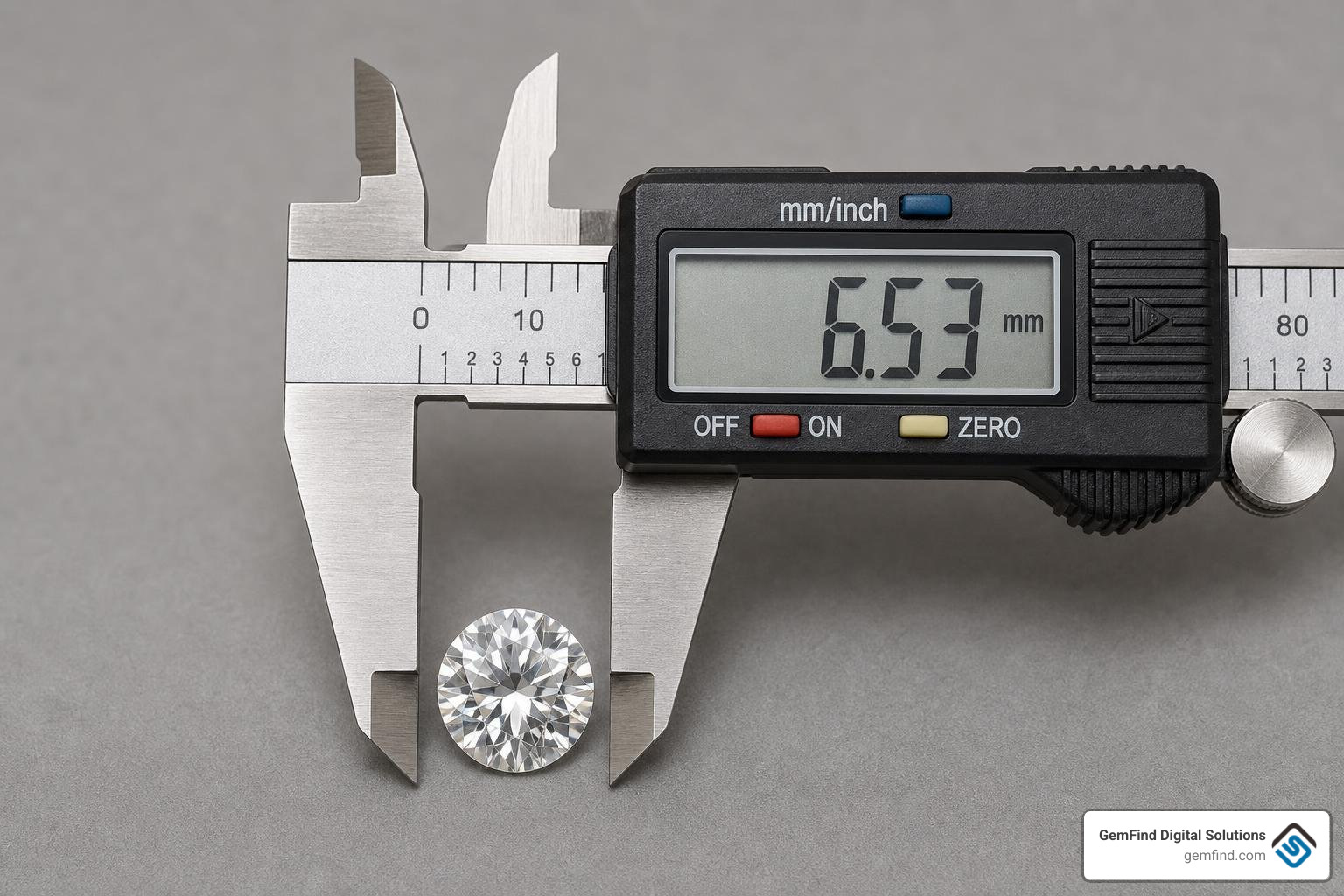
A diamond carat weight calculator is one of the most practical tools in a jewelry professional's toolkit — it estimates a diamond's weight in carats directly from its physical dimensions, no scale required.
Here's a quick answer if that's all you need:
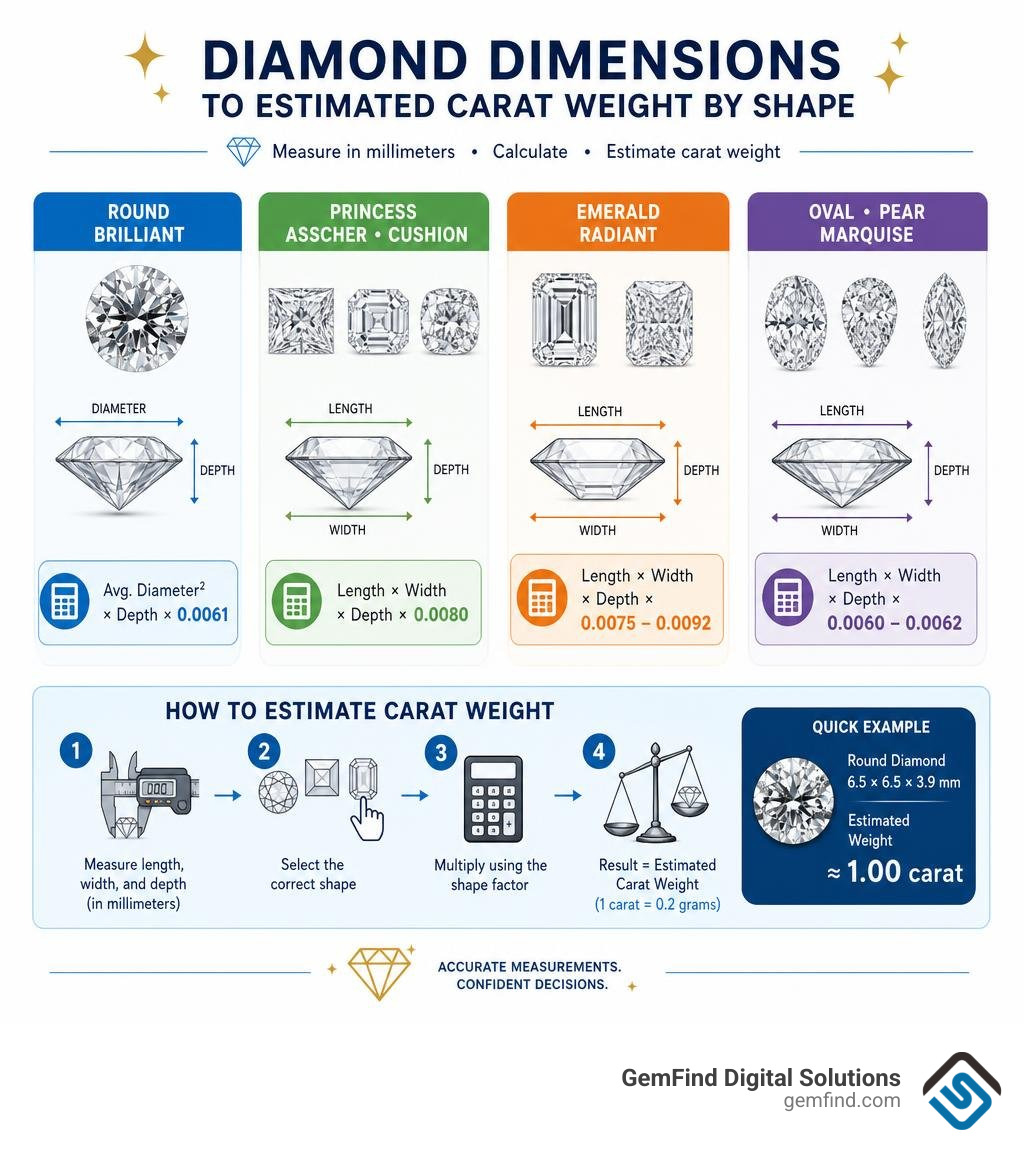
| Diamond Shape | Formula | Key Factor |
|---|---|---|
| Round Brilliant | Avg. Diameter² × Depth × 0.0061 | 0.0061 |
| Princess / Asscher / Cushion | Length × Width × Depth × 0.0080 | 0.0080 |
| Emerald / Radiant | Length × Width × Depth × 0.0075–0.0092 | varies |
| Oval / Pear / Marquise | Length × Width × Depth × 0.0060–0.0062 | 0.0062 |
To use any formula:
- Measure length, width, and depth in millimeters
- Select the correct shape
- Multiply using the shape factor above
- Result = estimated carat weight (1 carat = 0.2 grams)
Quick example: A round diamond measuring 6.5 × 6.5 × 3.9 mm estimates to approximately 1.00 carat.
But knowing how to calculate weight is only part of the picture. The real value comes from understanding what that weight means — for pricing, for comparisons between diamonds and other gemstones, and for building buyer confidence online.
Whether you're helping a customer compare a 1-carat round versus a 1-carat oval, or trying to explain why two diamonds that look the same size can have different weights, these formulas give you clear, credible answers fast.
I'm Anthony Arechiga, VP of Sales at GemFind Digital Solutions, where I've spent nearly two decades helping jewelry retailers use technology — including tools like the diamond carat weight calculator — to better serve customers and grow online sales. In this guide, I'll walk you through everything from the formulas behind the calculations to how carat estimates connect to real-world diamond value.
What a diamond carat weight calculator Does and Why It Matters
At its core, a diamond carat weight calculator is a mathematical bridge. It allows jewelers, appraisers, and consumers to estimate the carat weight of a diamond using only its physical measurements in millimeters.
This tool becomes indispensable when you are dealing with a mounted diamond. If a diamond is securely set into an engagement ring, bezel, or heavy halo, you cannot simply pop it out to place it on a micro-balance scale without risking damage to the setting. By taking precise measurements of the stone's length, width, and depth, and identifying its shape, you can use standard Diamond dimension calculator methodology and standards to find an incredibly accurate weight estimate.
This is highly valuable across several key scenarios:
- Buying and Selling: When evaluating estate jewelry or trade-ins, a calculator lets you quickly check if the stone matches its reported weight.
- Insurance and Appraisals: Appraisers rely on these formulas to document and value mounted diamonds for insurance policies.
- Customer Education: It helps demystify diamond pricing for customers who might not understand how depth and proportions affect the overall price.
How a diamond carat weight calculator Works
The magic of the calculator lies in geometry and physics. Every diamond shape has a unique geometric profile. By multiplying the length, width, and depth (LWD) of a diamond, we get a baseline volume estimate.
To convert this volume into mass (grams) and then into carats (where 1 carat equals exactly 0.2 grams), the calculator applies a universal constant. Because all diamonds have a highly consistent physical density of 3.52 g/cm³, we can use shape-specific factors to compress these conversions into a single, easy-to-use coefficient.
For loose diamonds, a physical scale is always the gold standard. But for mounted diamonds, a digital caliper and a shape-based calculation formula are your best friends.
Carat Weight vs Diamond Size vs Visual Spread
One of the most common points of confusion for retail customers in June 2026 is the difference between carat weight (mass) and visual size (how big the stone looks from the top).
A diamond's visual size is often referred to as its "spread" or "face-up size." For example, a standard 2-carat round brilliant diamond typically has a diameter of approximately 8 mm. However, if that diamond is cut too deep, a significant portion of its weight will be hidden in the pavilion (the bottom half of the stone). It might weigh 2 carats but only have a visual spread of a 1.75-carat stone (around 7.6 mm).
Conversely, fancy shapes like ovals naturally offer a larger visual spread. An oval diamond distributes its weight over an elongated surface, making it look larger than a round brilliant of the exact same carat weight.
Diamond and Gemstone Value Comparisons
When comparing different gemstones, density (specific gravity) plays a massive role. Not all gemstones weigh the same per cubic millimeter.
| Gemstone | Specific Gravity (g/cm³) | Weight of a 6.5 mm Round Stone |
|---|---|---|
| Diamond | 3.52 | ~1.00 ct |
| Sapphire / Ruby | 4.00 | ~1.14 ct |
| Moissanite | 3.22 | ~0.91 ct |
| Emerald | 2.72 | ~0.77 ct |
Because of these differences, you cannot use a diamond carat weight calculator directly for other gemstones without adjusting for density. If you put a sapphire's dimensions into a diamond calculator, the estimate will be too low because sapphire is denser than diamond. You can explore these differences using advanced tools like the Precise Gemstone Carat Weight Calculator from Dendritics to see how specific gravity alters weight across over 100 different gemstone types. Understanding these Gemstone density and weight calculation principles ensures you never make a costly pricing error on a non-diamond stone.
Diamond Carat Weight Formulas by Shape
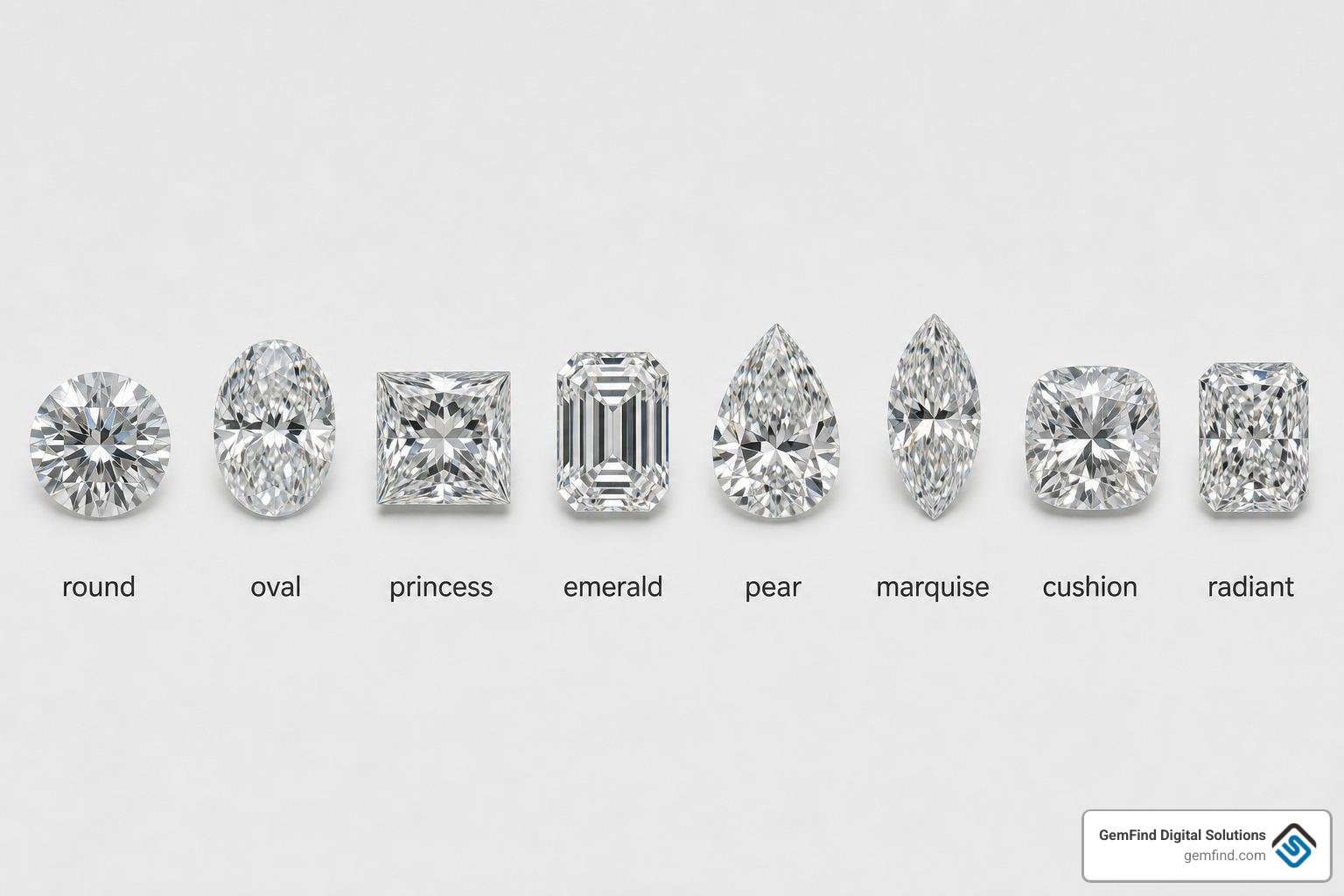
To manually estimate weight or program a calculator, you must use shape-specific coefficients. These mathematical constants absorb the conversion factors for volume, density, and carats.
Round Brilliant Formula
The round brilliant is the most popular cut in the world, and its formula is the most straightforward. Because a round cut is symmetrical, we measure its diameter in multiple directions to find the average diameter.
$$\text{Estimated Carat Weight} = \text{Average Diameter}^2 \times \text{Depth} \times 0.0061$$
- Average Diameter: $(\text{Minimum Diameter} + \text{Maximum Diameter}) / 2$
-
Example: A round brilliant measures 6.50 mm by 6.47 mm with a depth of 3.95 mm.
- $\text{Average Diameter} = (6.50 + 6.47) / 2 = 6.485\text{ mm}$
- $\text{Calculation:} \ 6.485 \times 6.485 \times 3.95 \times 0.0061 \approx 1.01\text{ carats}$
Oval, Pear, and Marquise Formulas
Elongated fancy shapes require slightly different multipliers to account for their rounded bellies and pointed ends (wings).
$$\text{Estimated Carat Weight} = \text{Length} \times \text{Width} \times \text{Depth} \times \text{Shape Factor}$$
-
Oval Multiplier: Typically 0.0062
- Example: An 8 × 6 mm oval diamond with a 3.6 mm depth:
- $8.00 \times 6.00 \times 3.60 \times 0.0062 \approx 1.071\text{ carats}$
- Pear Multiplier: Typically 0.0061 (adjusts for the pointed tip)
- Marquise Multiplier: Typically 0.0058 (adjusts for the sharp points at both ends)
Princess, Asscher, Cushion, Radiant, and Emerald Formulas
Square and rectangular cuts carry more weight in their corners and profiles, which means they use significantly higher shape factors.
-
Princess Cut: Multiplier is 0.0080 to 0.0083
- Example: A princess cut measuring 5.8 × 5.8 × 4.2 mm:
- $5.8 \times 5.8 \times 4.2 \times 0.0083 \approx 1.17\text{ carats}$
- Emerald / Radiant Cut: Multiplier is 0.0075 to 0.0092 (depending heavily on the length-to-width ratio)
- Cushion Cut: Multiplier is 0.0080 (accounting for its rounded corners)
Length-to-Width Ratios and Adjustment Factors
For fancy shapes, the length-to-width (L/W) ratio directly impacts how much mass is packed into the stone's outline. A highly elongated emerald cut (e.g., a 2.5:1 ratio) has different geometric volume characteristics than a square emerald cut (Asscher, 1:1 ratio).
To maintain accuracy, professional appraisers adjust the shape factor based on the L/W ratio:
| Shape | L/W Ratio | Adjustment Factor |
|---|---|---|
| Emerald | 1.00 : 1 (Square) | 0.0080 |
| Emerald | 1.50 : 1 | 0.0092 |
| Emerald | 2.00 : 1 | 0.0100 |
| Emerald | 2.50 : 1 | 0.0106 |
Measuring a Diamond Correctly Before Using a Calculator
The old saying "garbage in, garbage out" perfectly applies to a diamond carat weight calculator. If your physical measurements are off by even 0.1 mm, your final carat estimate can be wrong by 5% to 10%.
To get accurate results, you must use digital calipers or a high-precision lever gauge (like a Presidium gauge) capable of measuring to 0.01 mm.
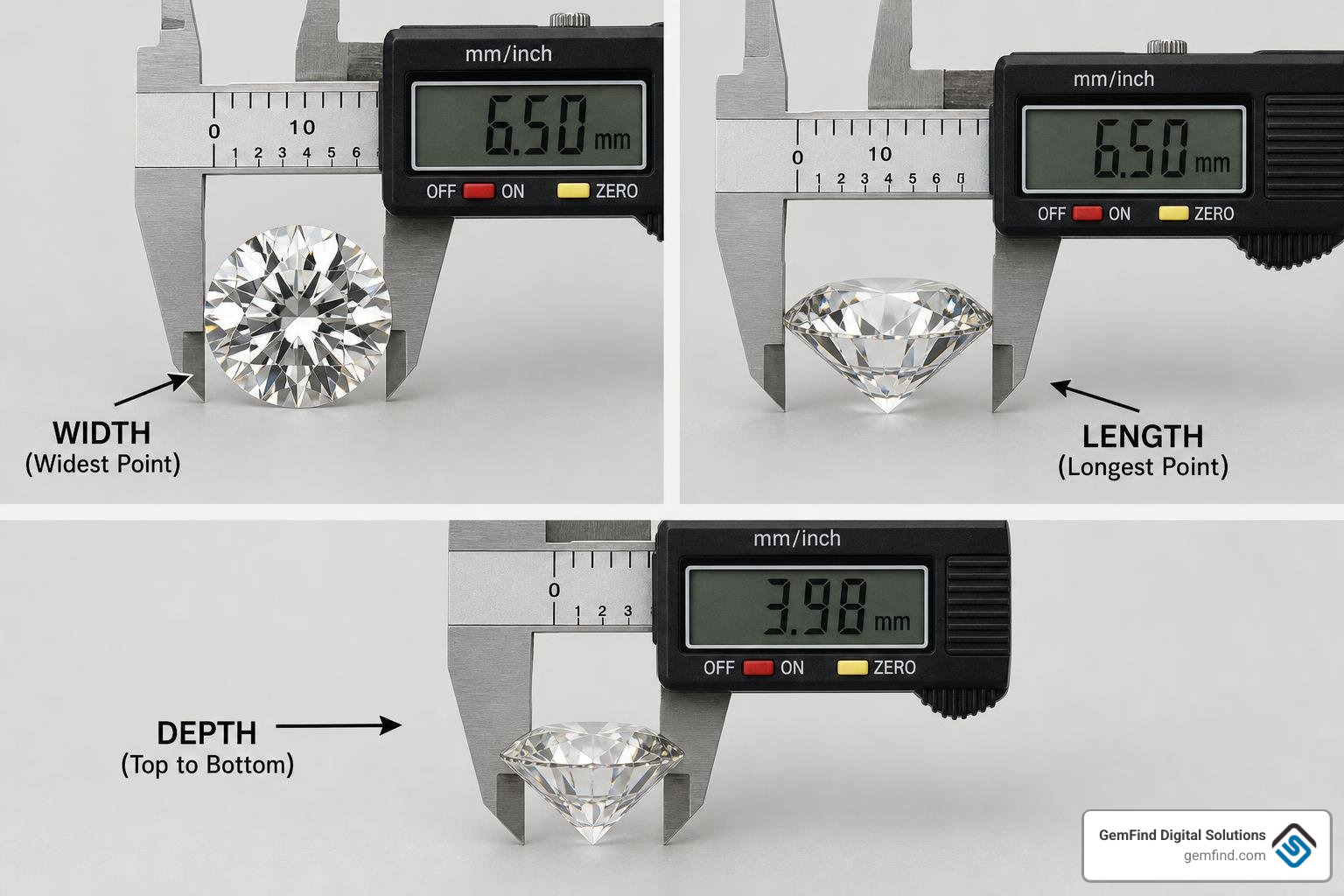
How to Measure Length, Width, and Depth
- Length: Measure the longest distance across the top of the stone (from tip to tip on a marquise or pear, or corner to corner on a princess).
- Width: Measure the widest part of the stone perpendicular to the length. For round stones, take multiple measurements across different axes and average them.
- Depth: Measure from the flat top of the stone (the table) straight down to the very bottom point (the culet).
Always keep your calipers perfectly flat and perpendicular to the stone. Tilted calipers are the number one cause of inaccurate depth readings.
Mounted Diamonds, Melee Stones, and Ring Settings
Measuring loose diamonds is simple, but mounted stones present real challenges. Prongs and bezels often block access to the widest parts of the stone, or hide the girdle entirely.
When measuring mounted stones:
- Estimate the hidden depth by measuring from the table to the metal setting, and subtract the estimated thickness of the metal.
- For tiny accent stones (melee), use specialized melee size charts to estimate weight based on diameter alone, as measuring depth on a 1.5 mm stone set in a ring is nearly impossible.
- If you are designing custom rings, tools like our interactive ring builders can help you visualize how different stone sizes fit within Popular bridal diamond ring styles.
Common Measurement Mistakes
Avoid these frequent errors to keep your calculations precise:
- Using Inches: Always measure in millimeters. Do not try to measure in inches and convert them mathematically.
- Ignoring the Girdle: If a diamond has an extremely thick girdle, that extra band of weight is not accounted for in basic formulas.
- Selecting the Wrong Shape: Putting cushion-cut dimensions into a round brilliant calculator will yield wildly incorrect results.
- Confusing Carat with Karat: Carat (ct) is a unit of weight for gemstones, while karat (K) is a measure of gold purity!
Accuracy Limits: Girdle Thickness, Cut Quality, and Real-World Corrections
While a diamond carat weight calculator is incredibly useful, it is important to remember that it provides an estimate, not a certified weight. Real-world diamonds are rarely cut to mathematically perfect proportions.
Why Estimates Differ From Actual Carat Weight
Two diamonds with the exact same length, width, and depth can weigh different amounts due to subtle cut variations:
- Pavilion Bulge: Some fancy cuts (like pears and ovals) are cut with "bulgy" pavilions to retain weight, hiding extra mass below the girdle.
- Crown Height: A higher crown adds weight that isn't fully captured by simple length and width dimensions.
- Old European / Mine Cuts: Antique diamonds were cut by hand and often have extremely deep pavilions, thick girdles, and large open culets, making standard modern calculators underestimate their weight.
Girdle Thickness and Weight Correction Factors
The girdle is the outer rim of the diamond where the top (crown) meets the bottom (pavilion). A standard formula assumes a "thin to medium" girdle. If the girdle is thicker, you must apply a correction factor to the calculated weight.
- Slightly Thick to Thick: Add 1% to 3% to the final estimate.
- Very Thick: Add 4% to 6%.
- Extremely Thick: Add 7% to 10% (or up to 18% for stones with extreme pavilion bulges).
Using Standard industry diamond weight estimation formulas with these manual corrections prevents you from underestimating the value of a stone with a heavy waist.
When to Seek Professional Measurement
You should never rely solely on a calculator estimate for:
- Legal Appraisals: Official estate valuations or insurance claims require precise, certified weight.
- Buying/Selling Transactions: If you are buying or selling a high-value stone, it should be unmounted and weighed on a calibrated, certified carat scale.
- Certification: Grading reports from labs like the GIA or AGS must always show the exact physical weight of the loose stone.
Using Carat Estimates to Understand Diamond Worth
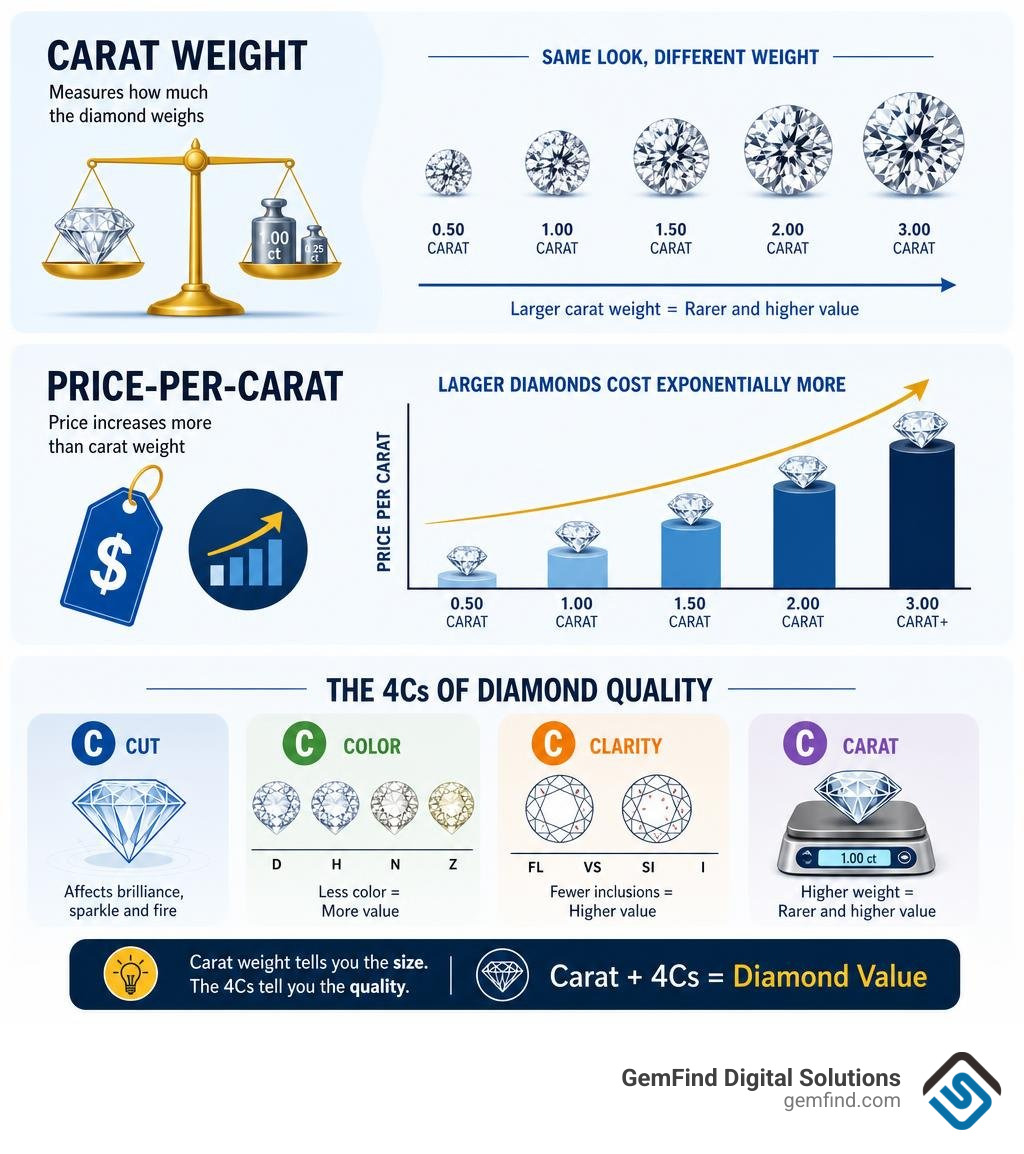
Once you have estimated the carat weight of a diamond, you can begin to understand its potential market value. However, carat weight is only one piece of the pricing puzzle.
How Carat Weight Affects Price
Diamond pricing is non-linear. A 2-carat diamond does not simply cost twice as much as a 1-carat diamond of equal quality—it can cost three to four times more. This is because larger diamonds are much rarer in nature.
Prices jump significantly at "milestone" weights, such as 0.50 ct, 0.75 ct, 1.00 ct, 1.50 ct, and 2.00 ct. A diamond weighing 0.98 carats will be priced significantly lower than a diamond weighing 1.01 carats, even though their visual size is virtually identical.
Why Carat Weight Alone Does Not Determine Value
Carat weight is just one of the famous 4Cs (Carat, Cut, Color, Clarity). A 1.50-carat diamond with poor clarity (I3) and a yellowish tint (M) might be worth a fraction of a flawless (FL), colorless (D) 0.75-carat diamond.
Additionally, the rise of lab-grown diamonds has completely shifted the market. While they share the exact same physical properties and density (3.52 g/cm³), lab-grown diamonds are priced much lower than natural stones. Understanding the Lab-grown diamond market impact is essential for anyone trying to estimate a stone's true resale worth in today’s landscape.
Comparing Online Diamond Weight Calculators
There are several excellent online tools available, each tailored to different needs:
- Simple Estimators: Tools like the Diamond Weight Calculator - Bluestone Trading Company Inc. and Diamond Weight Calculator - Calculate Carat Weight from Dimensions are fantastic for quick, straightforward measurements.
- Advanced Gemstone Calculators: If you are dealing with mounted stones or colored gems, the Precise Gemstone Carat Weight Calculator from Dendritics and the Diamond Weight Estimation Calculator (+ Weight Estimation Formulas) offer deeper options for girdle thickness and culet size adjustments.
- Consumer-Friendly Valuation Tools: For quick resale or trade-in estimates, platforms like the Diamond Weight Calculator - myGemma, the Diamond Weight Calculator - Estimate Carat from Dimensions (LWD) - AZCalculator, and the Diamond Carat Weight Calculator – Shape-Based Size Estimator help bridge the gap between dimensions and market value.
For jewelry retailers looking to stay competitive, integrating these types of digital tools into your website is a proven way to engage modern shoppers. Keeping up with Engagement Ring Trends 2024 and building a modern digital storefront are key elements outlined in our Ultimate Jewelry Ecommerce Guide 2026. If you're looking to elevate your store's style, you might also want to explore our insights on classic jewelry designs like the Diamond Cut Cuban Link.
Frequently Asked Questions about a diamond carat weight calculator
Can a diamond carat weight calculator replace a certified scale?
No. A calculator only provides a mathematical estimate based on volume and average density. It cannot account for microscopic internal characteristics or minor structural irregularities. For legal, financial, or grading purposes, always use a certified loose-stone scale.
What is the relationship between diamond volume, density, and carat weight?
Weight is the product of volume and density. Because diamonds have a consistent density of 3.52 g/cm³, we can calculate their volume in cubic millimeters ($Length \times Width \times Depth \times \text{Shape Factor}$) and convert that volume directly into carats.
How big is a 2-carat diamond?
For a standard round brilliant cut, a 2-carat diamond has a diameter of approximately 8.0 mm. For fancy cuts like ovals or marquises, the visual spread may look larger, while deeper cuts like princess or cushion cuts will have smaller top-down dimensions for the same weight.
Conclusion
Understanding how to use a diamond carat weight calculator gives you the confidence to make smart, informed decisions—whether you are appraising an antique ring, educating an online shopper, or buying estate jewelry. While these formulas are incredibly accurate, they should always be paired with professional expertise and certified equipment for final valuations.
At GemFind Digital Solutions, we specialize in helping jewelry businesses bridge the gap between traditional craftsmanship and modern digital tools. From interactive diamond search engines to a Complete ring builder app guide, we build the technology that keeps your store ahead of the curve. Ready to elevate your jewelry business online? Contact our team at GemFind today to get started!


