


E-Commerce Marketing in 2026: What Every Online Store Needs to Know

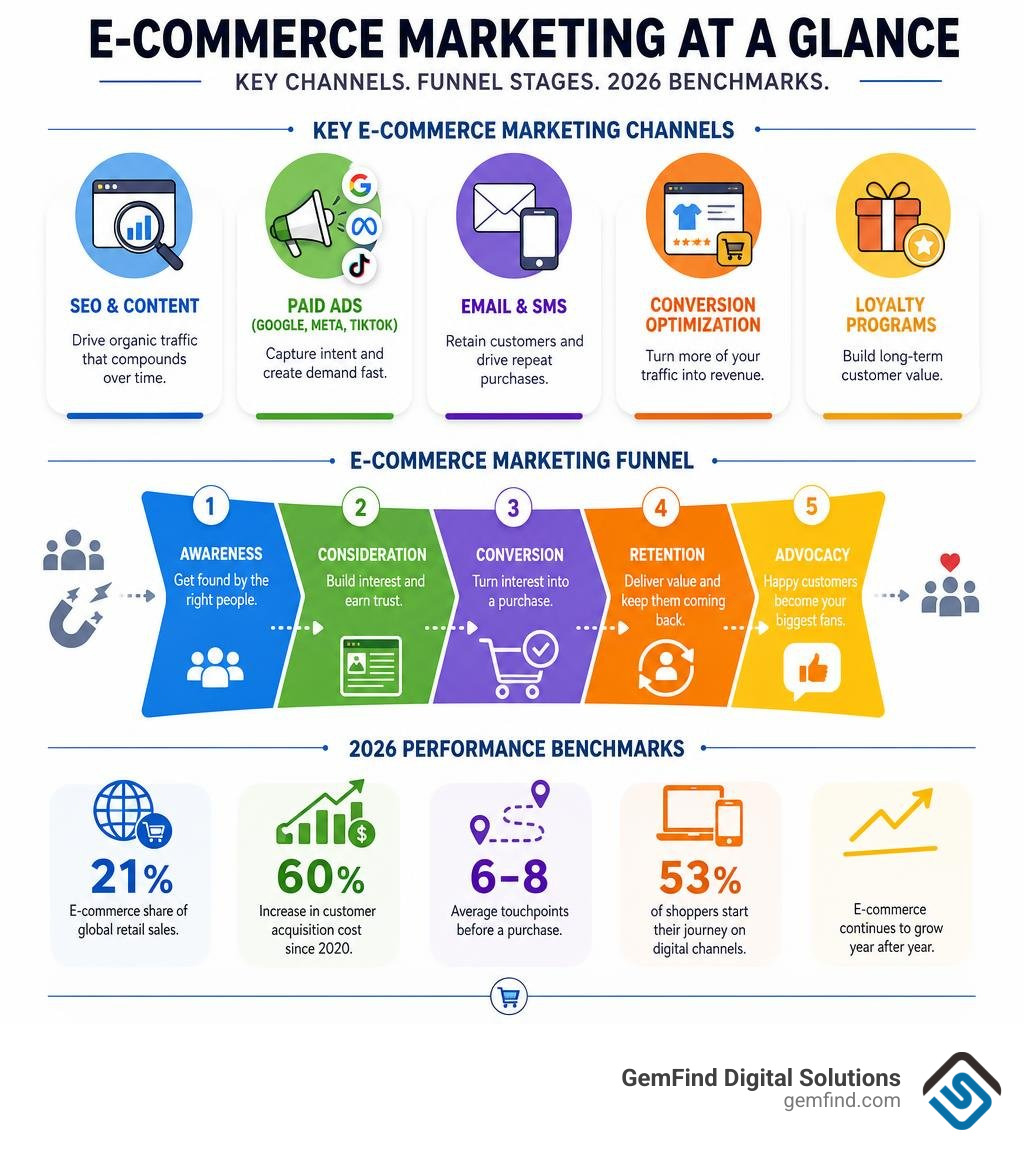
E-commerce marketing is the process of driving awareness, traffic, and sales to an online store — then keeping those customers coming back.
Here's a quick breakdown of what it covers:
| What It Is | What It Does |
|---|---|
| SEO & content | Brings in free, compounding organic traffic |
| Paid ads (Google, Meta, TikTok) | Captures intent and creates demand fast |
| Email & SMS | Retains customers and drives repeat purchases |
| Conversion optimization | Turns existing traffic into actual revenue |
| Loyalty programs | Builds long-term customer value |
The stakes are real. E-commerce now accounts for over 21% of global retail sales, and that number keeps climbing. At the same time, the cost of acquiring a new customer has risen 60% since 2020. That means the old playbook — just run more ads — no longer works on its own.
Today's winning brands combine smart traffic acquisition with airtight conversion and strong retention. The average customer journey spans 6 to 8 touchpoints before a purchase. And with 53% of shoppers starting on digital channels, your marketing strategy determines whether they find you — or your competitor.
For jewelry store owners especially, the challenge is layered. You're selling high-consideration, high-emotion products in a crowded market. Every click costs more. Every lost cart stings more. And building trust online, without a physical storefront to fall back on, takes a deliberate strategy.
This guide breaks down exactly how to build that strategy — from first click to loyal customer.
I'm Anthony Arechiga, VP of Sales at GemFind Digital Solutions, where I've spent nearly two decades helping jewelry retailers build stronger online presences and more effective e-commerce marketing programs. In that time, I've seen what separates the stores that grow from the ones that stall — and it almost always comes down to strategy, not budget.
What is E-Commerce Marketing and Why Does It Matter in 2026?
In July 2026, the digital marketplace is louder and more crowded than ever before. With global retail e-commerce projected to hit nearly $7.9 trillion this year, representing roughly a quarter of all retail sales, the opportunity is massive. However, simply setting up an online storefront and hoping people find it is no longer a viable business plan.
E-commerce marketing is the strategic practice of using digital channels to guide potential customers through their entire shopping journey: finding your store, purchasing your products, and becoming passionate brand advocates.
In the early days of online retail, customer acquisition was relatively straightforward and inexpensive. Today, however, rising privacy regulations, cookie deprecation, and intense competition have driven Customer Acquisition Costs (CAC) to historic highs. According to recent data, average CAC across the e-commerce industry has risen 60% since 2020, with typical DTC acquisition costs climbing from $274 to $318 in a single year.
Because of these rising costs, brands can no longer survive on transactional, one-off purchases. This is why first-party data has become the ultimate competitive moat. In fact, 72% of top DTC brands cite first-party data as their primary competitive advantage in paid acquisition in 2026 — up from just 38% in 2023. By capturing your own customer data, you can build personalized marketing campaigns that bypass expensive ad networks. For a deeper look at these shifting dynamics, explore Shopify's Guide to Ecommerce Marketing.
The Core Formula of Successful E-Commerce Marketing
To understand how to grow an online store profitably, we must look at e-commerce through a simple, mathematical lens. Successful marketing is not about vanity metrics like social media likes or overall page views. Instead, it is governed by a core compounding formula:
$$\text{Revenue} = \text{Traffic} \times \text{Conversion Rate} \times \text{Customer Lifetime Value (Retention)}$$
If you treat these three pillars as isolated channels, you will end up overspending on traffic while watching your margins dissolve. However, when you treat them as compounding multipliers, minor improvements in each area yield massive revenue shifts.
Consider this real-world scenario: An online store averages 100,000 monthly visitors with a 1.5% conversion rate and a $100 average order value, generating $150,000 in monthly revenue. If that store focuses on Conversion Rate Optimization (CRO) and lifts its conversion rate from 1.5% to 2.5%, revenue jumps to $250,000. That is a 67% revenue lift with absolutely zero extra ad spend.
Pouring expensive paid traffic into a store with a leaky checkout and poor retention is like trying to fill a bucket with holes in the bottom. True profitability lives in customer retention. It is five to seven times more expensive to acquire a new customer than it is to retain an existing one. Repeat buyers are the lifeblood of your margin because their acquisition cost is zero. To see how this mathematical framework applies specifically to the high-ticket jewelry sector, check out our guide on Online Marketing Strategies for Jewelry Stores.
Building a Profitable E-Commerce Marketing Strategy from Scratch
Building a successful marketing program from scratch requires a structured blueprint. You cannot simply jump into running TikTok ads or writing blog posts without a solid foundation.
First, you must establish clear SMART goals (Specific, Measurable, Achievable, Relevant, and Time-bound). Instead of aiming to "increase sales," your goal should be: "Increase our repeat purchase rate by 15% and raise our Average Order Value (AOV) to $150 by the end of Q4."
Next, you must define detailed buyer personas. An e-commerce buyer persona goes beyond basic demographics like age and location. You need to understand their digital shopping habits, their preferred communication channels (email vs. SMS), their primary friction points, and what drives their loyalty.
Finally, you must build a unified data foundation. In 2026, fragmented data is a business killer. If your e-commerce platform, your email marketing software, and your customer service desk do not share data in real-time, you will deliver a disjointed, frustrating experience. Utilizing a Customer Data Platform (CDP) or tightly integrating your tech stack ensures that when a customer abandons a cart, asks a question on live chat, or purchases in-store, your marketing system immediately knows and adjusts its messaging.
For jewelry retailers, this integration must extend to your physical store. Connecting your digital storefront to your physical inventory through tools like an Edge POS integration is crucial for maintaining accurate stock levels and delivering a seamless omnichannel experience. Learn how to map out this entire process in A Comprehensive Ecommerce Guide for Jewelry Stores.
Defining Your Funnel and Budget Allocation
An average e-commerce marketer now engages customers across 10 different channels simultaneously. To keep your campaigns organized and profitable, you must structure your marketing budget using a funnel-based approach and the 70/20/10 budget allocation rule:
- 70% of Budget (Core Proven Channels): This budget goes directly into channels with highly predictable, measurable returns. For most stores, this includes Google Shopping, high-intent search ads, and automated email/SMS retention flows.
- 20% of Budget (Testing and Scaling): This portion is allocated to channels that show strong potential but require more refinement, such as paid social prospecting on Meta or TikTok, influencer collaborations, and mid-funnel content marketing.
- 10% of Budget (Experimental Campaigns): This is your innovation fund. Use it to test emerging platforms, cutting-edge AI personalization tools, interactive quizzes, or experimental local sponsorships.
Your messaging must align with where the customer stands in their journey:
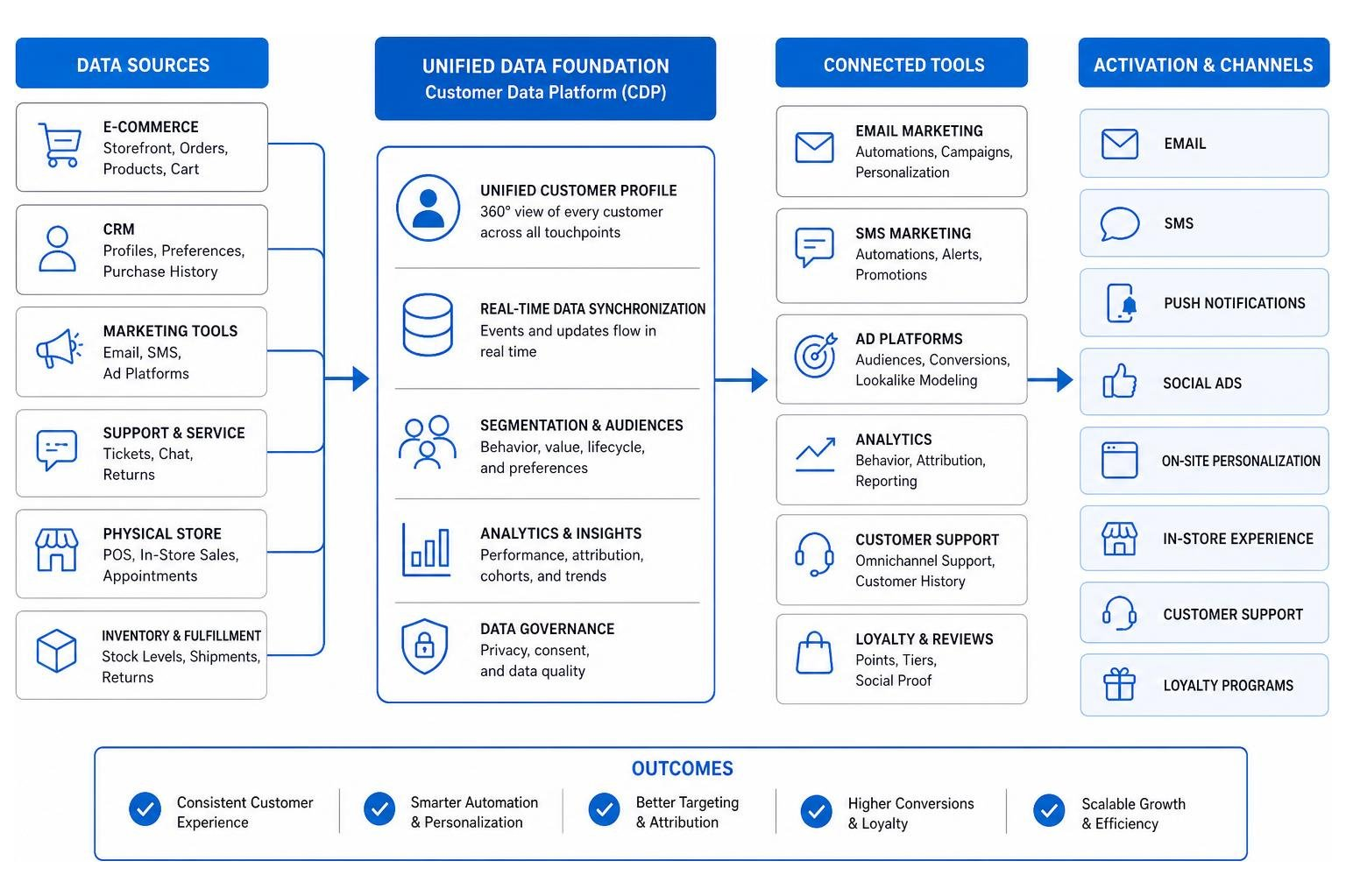
- Top-of-Funnel (TOFU - Attraction): Focus on broad audience reach, brand storytelling, educational blog content, and short-form video to introduce cold audiences to your brand.
- Middle-of-Funnel (MOFU - Consideration): Engage warm prospects who have visited your site but haven't bought. Use lead generation quizzes, gift guides, browse abandonment emails, and social proof.
- Bottom-of-Funnel (BOFU - Conversion): Drive immediate action with cart abandonment sequences, limited-time promotions, clear shipping thresholds, and a frictionless checkout.
Remember to adjust your budget allocation for seasonality. If you sell fine jewelry, your Q4 holiday season and Q1 Valentine's Day budgets will look vastly different from your late-summer budgets. Plan ahead so your ad accounts have enough conversion data to optimize before peak shopping seasons arrive.
Organic vs. Paid Acquisition: Balancing the Channel Mix
A healthy, sustainable e-commerce business relies on a balanced mix of organic and paid acquisition channels. Relying solely on paid ads is incredibly risky — if ad costs spike or an algorithm changes, your traffic can vanish overnight. Conversely, relying purely on organic search takes time and may not deliver the immediate sales volume you need to scale.

To help you balance your channel mix, let's compare the two primary acquisition strategies:
| Metric / Feature | Organic Acquisition (SEO, Content) | Paid Acquisition (PPC, Social Ads) |
|---|---|---|
| Upfront Cost | Low (primarily sweat equity or content creation) | High (direct cost-per-click or cost-per-impression) |
| Speed to Results | Slow (typically takes 3 to 6 months to build momentum) | Instant (traffic starts flowing as soon as campaigns launch) |
| Long-Term ROI | High (compounds over time; traffic is free once ranked) | Flat (stops generating traffic the moment you stop paying) |
| Targeting Precision | Moderate (based on search intent and content relevance) | Extremely High (demographics, behaviors, custom lists) |
| Primary Moat | High (hard for competitors to copy organic rankings) | Low (competitors can easily outbid your ad placements) |
To explore more industry-wide benchmarks and performance data comparing these strategies, read the latest Shopify Ecommerce Statistics.
Organic Search and Content: The Compounding Moat
Organic search (SEO) remains the single largest driver of digital traffic, accounting for 53.3% of all website traffic for e-commerce sites. Unlike paid ads, which stop delivering traffic the moment your budget runs dry, organic SEO is a compounding asset. The work you do to optimize your site today will continue to drive free, high-intent traffic years down the road.
To build a durable organic moat in 2026, your SEO strategy must focus on three core areas:
- Long-Tail Keywords (4+ words): Broad search terms like "gold rings" are highly competitive and expensive. However, long-tail search terms like "14k yellow gold stackable diamond rings" drive 70% of organic traffic and boast an incredible 80% conversion rate because they capture buyers with highly specific intent.
- Schema Markup: Adding product schema markup to your product pages allows search engines to display rich snippets — such as price, availability, and review ratings — directly in search results. This simple technical step can boost your organic click-through rate (CTR) by 30% to 50%.
- Product Videos: Video content is the dominant medium for product discovery, with 62% of consumers preferring video over static images. Furthermore, 85% of shoppers watch a product video before making a purchase. Embedding rich, fast-loading product videos on your product pages satisfies search engines and keeps shoppers engaged.
For a complete step-by-step framework on optimizing your online jewelry store for search engines, read our Ultimate Jewelry Ecommerce Guide 2026.
Paid Search and Social: Capturing and Creating Demand
While organic search builds long-term equity, paid acquisition is how you capture immediate high-intent buyers and scale your revenue predictably.
Google Shopping and Performance Max (PMax) are the gold standards for capturing active search intent. When a consumer searches for a specific product, Google Shopping displays your product image, title, and price directly at the top of the search results page. However, PMax campaigns must be managed carefully. Because Google's algorithm is designed to maximize conversions, it will often bid on your own branded search terms and retarget past visitors, cannibalizing organic traffic and artificially inflating your reported ROAS. To prevent this, always apply brand exclusions to your PMax campaigns.
On the paid social side, platforms like Meta (Facebook & Instagram) and TikTok are unmatched for creating demand. Through machine-learning ad formats like Meta's Advantage+ Shopping campaigns, these platforms analyze vast amounts of user data to show your products to people who don't even know your brand exists yet.
However, running paid ads in 2026 requires flawless technical execution. Because of modern browser tracking limitations, implementing server-side tracking (such as Meta Conversions API and Google Enhanced Conversions) is mandatory. Without it, you can lose up to 20% to 40% of your conversion data, making it impossible for the ad algorithms to optimize your campaigns effectively.
Maximizing Conversions and Plugging the Checkout Leak
Most online stores do not actually have a traffic problem; they have a conversion leak. They spend thousands of dollars to bring visitors to their site, only to watch 70% of shoppers who add an item to their cart leave without buying.
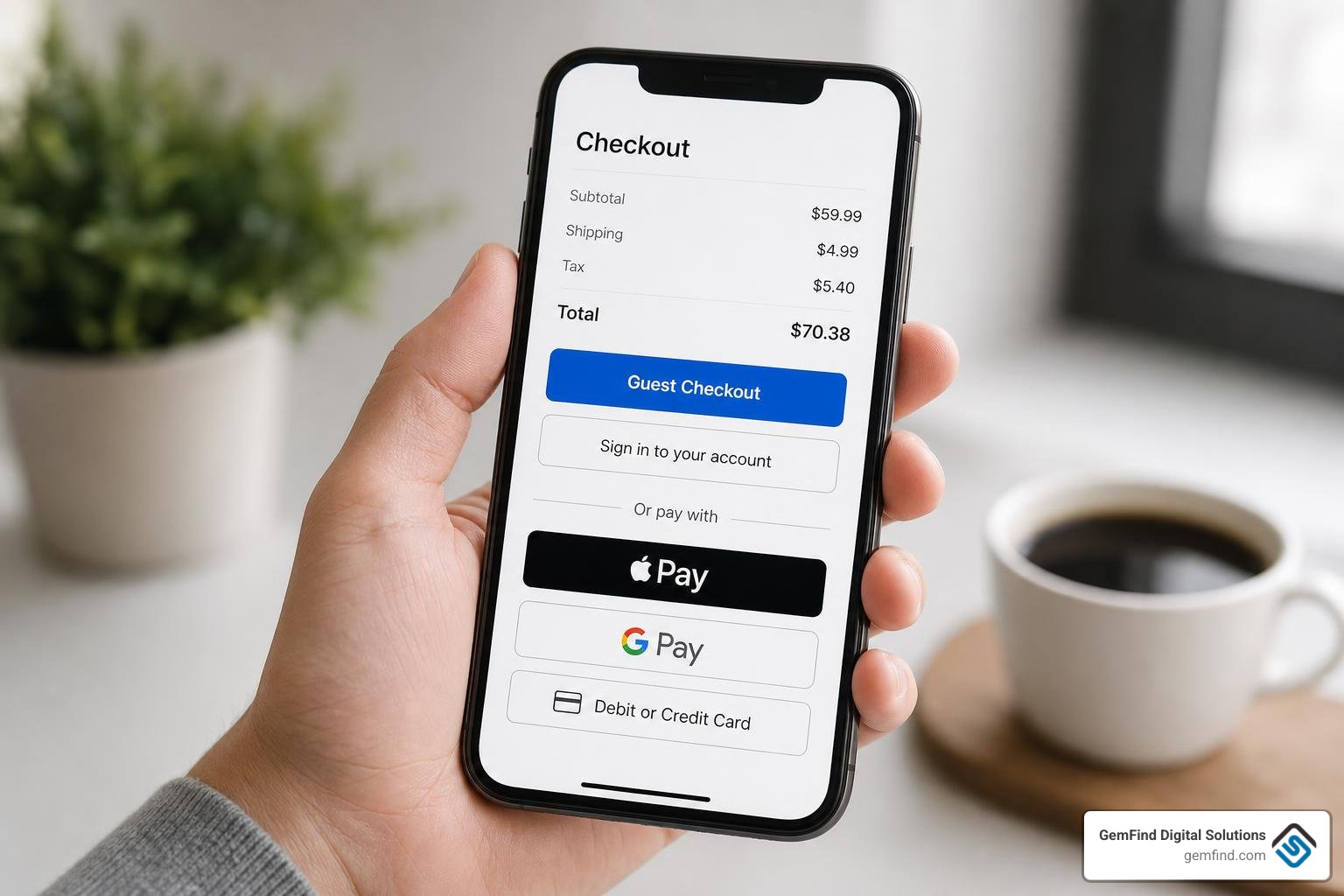
If you can plug the leaks in your conversion funnel, you will instantly make every dollar of your paid and organic marketing budget significantly more effective.
Leveraging AI and Personalization in E-Commerce Marketing
Modern consumers expect their online shopping experiences to be tailored to their unique preferences. In fact, 58% of consumers value personalized product recommendations, and 55% appreciate highly personalized content.
However, there is a massive "personalization misfire" happening in the industry today: 79% of marketers use AI to personalize content, yet only 25% of consumers say they actually want more of what they are currently receiving. Why the disconnect? Because most brands confuse cosmetic personalization (like inserting a first-name token into an email subject line) with true behavioral personalization.
To win in 2026, you must leverage AI to deliver real, dynamic value:
- Dynamic Product Recommendations: Display product blocks on your website that change in real-time based on the visitor's browse history, past purchases, and real-time intent.
- Behavioral Trigger Campaigns: Move away from generic "batch-and-blast" marketing campaigns, which actively damage customer loyalty for 23% of consumers. Instead, use AI to trigger highly specific, automated messages based on user actions, such as viewing a specific product category multiple times without purchasing.
- Predictive Churn & Send-Time Optimization: Use machine learning to predict when a customer is likely to drift away and automatically send a personalized re-engagement offer at the exact time of day they are most likely to open their inbox.
Reducing Cart Abandonment and Friction
To recover the billions of dollars lost to abandoned carts every year, you must systematically eliminate friction from your website, particularly on mobile devices. Over 70% of all e-commerce traffic now comes from mobile devices, yet mobile conversion rates average half of what desktop converts.
To turn mobile browsers into buyers, implement these best practices:
- Eliminate Unexpected Costs: The number one reason shoppers abandon their carts at the final step is unexpected shipping costs and hidden fees. Display your shipping costs, taxes, and delivery timelines upfront on the product page. Implementing a progress bar that shows how close a shopper is to a free shipping threshold (e.g., "Add $15 more to unlock free shipping!") is an incredibly effective way to reduce cart abandonment while simultaneously lifting your Average Order Value.
- Provide Trusted, Frictionless Payment Options: Forcing a customer to manually type in a 16-digit credit card number on a mobile keyboard is a guaranteed way to lose a sale. Offer one-click digital wallets like Apple Pay, Google Pay, and Shop Pay.
- Optimize Page Speed: A page load delay of even one second can cause conversions to drop by several percent. E-commerce sites with a page speed of under 2 seconds experience a 30% higher conversion rate than those with load times of 5 seconds or more. Compress your images, minimize redirects, and audit your site's technical health regularly.
Customer Retention: The True Profit Engine
With customer acquisition costs continuously climbing, customer retention is where the actual profit of an e-commerce business lives. True brand loyalty has declined by 5% over the past year, meaning consumers are more willing than ever to switch brands if their experience is disjointed or if they find a better value elsewhere.
To build a highly profitable online store, you must transition from a transactional business model to a relationship-based model. By focusing on customer lifetime value (LTV) and the repeat purchase rate, you build a sustainable growth engine that doesn't require constant, expensive ad spend to survive. To see how marketing automation can bridge the gap between initial digital touchpoints and long-term customer relationships, read our guide on How Marketing Automation Can Increase Ecommerce Jewelry Sales.
Email, SMS, and Loyalty Programs
Email and SMS marketing are the undisputed heavyweights of customer retention. For brand communications, 69% of consumers cite email as their preferred channel, while SMS acts as an incredibly high-engagement complement for urgent, time-sensitive updates. In fact, email marketing continues to deliver an average return of $36 for every $1 spent, making it the highest-ROI channel in your entire marketing toolkit.
To unlock this profit, you must implement automated lifecycle email flows:
- The Welcome Series: Introduce new subscribers to your brand story, showcase your craftsmanship, and offer a small initial incentive to drive their first purchase.
- Browse & Wishlist Abandonment: If a subscriber views a specific product or adds it to their wishlist but doesn't buy, trigger an automated email containing social proof, customer reviews, and alternative product recommendations.
- Multi-Stage Cart Recovery: Set up a three-step automated sequence to recover lost sales. Send a polite reminder 1 hour after abandonment, a social-proof-focused email highlighting customer reviews 4 to 6 hours later, and a final small incentive or free shipping offer 24 hours later. A well-optimized sequence can successfully recover 10% to 14% of abandoned carts.
- Value-Driven Loyalty Programs: Move away from traditional points-and-tier programs, which are losing their effectiveness. Instead, build a loyalty program focused on genuine value and trust. Offer exclusive perks, early access to new product launches, and personalized rewards that make your best customers feel valued.
For a deeper dive into crafting retention campaigns that keep your audience highly engaged, check out our Jewelry Digital Marketing Complete Guide.
Frequently Asked Questions about E-Commerce Marketing
What is the best marketing channel for a new online store?
There is no single "best" channel, as different channels serve different purposes. For a new store, we recommend a balanced, sequential approach:
- High-Intent Search (Google Shopping & SEO): Start by capturing shoppers who are actively looking to buy your specific products.
- Paid Social (Meta & TikTok): Use targeted visual ads to build brand awareness and introduce your products to cold audiences.
- Automated Email Marketing: Immediately set up welcome and cart recovery flows to capture and convert early website traffic.
For a comprehensive blueprint on launching and marketing a new digital storefront, explore our Sell Jewelry Online Ultimate Guide.
How do you calculate minimum viable ROAS?
Your minimum viable (or break-even) Return on Ad Spend (ROAS) is determined entirely by your gross margins, not by generic industry benchmarks. To find your break-even ROAS, use this simple formula:
$$\text{Break-Even ROAS} = \frac{1}{\text{Gross Margin \%}}$$
For example, if your store operates on a 50% gross margin, your break-even ROAS is:
$$\frac{1}{0.50} = 2.0\text{x}$$
Any campaign performing above a 2.0x ROAS is profitable. However, if your store operates on a tighter 25% gross margin, your break-even ROAS jumps to 4.0x. Understanding your unit economics ensures you scale your budgets profitably.
Why is my online store getting traffic but no sales?
If your store is successfully attracting visitors but failing to generate sales, you are likely suffering from one of three common conversion leaks:
- Hidden Fees at Checkout: Unexpected shipping costs, taxes, or handling fees revealed only at the final step of checkout are the primary cause of lost sales.
- Poor Mobile User Experience: If your site load speed is slow (over 2-3 seconds) or your checkout form is long and complicated on mobile devices, shoppers will leave.
- Lack of Trust and Social Proof: High-ticket purchases, especially jewelry, require a high degree of trust. If your site lacks clear product reviews, secure payment badges, and clear return policies, visitors will hesitate to buy.
Conclusion
In the world of 2026 e-commerce, the brands that thrive are those that look beyond isolated marketing tactics and focus on building a cohesive, data-driven strategy. By balancing high-intent organic search with targeted paid acquisition, plugging conversion leaks in your checkout, and building a powerful retention engine through automated email and SMS, you can scale your online store profitably.
At GemFind Digital Solutions, we have spent more than 25 years helping jewelry retailers navigate the unique complexities of digital marketing and web design. As a certified Shopify and Google Partner, we specialize in building custom, high-converting e-commerce experiences tailored specifically to the jewelry industry. From seamless Edge POS integrations to interactive, jewelry-focused digital tools, we provide the end-to-end expertise you need to grow your business.
Ready to plug your conversion leaks and build a highly profitable e-commerce marketing strategy? Grow your business with GemFind Digital Marketing and request a digital growth audit today.


