



The $342 Billion Reason Your Jewelry Store Needs the Right E-commerce Solution

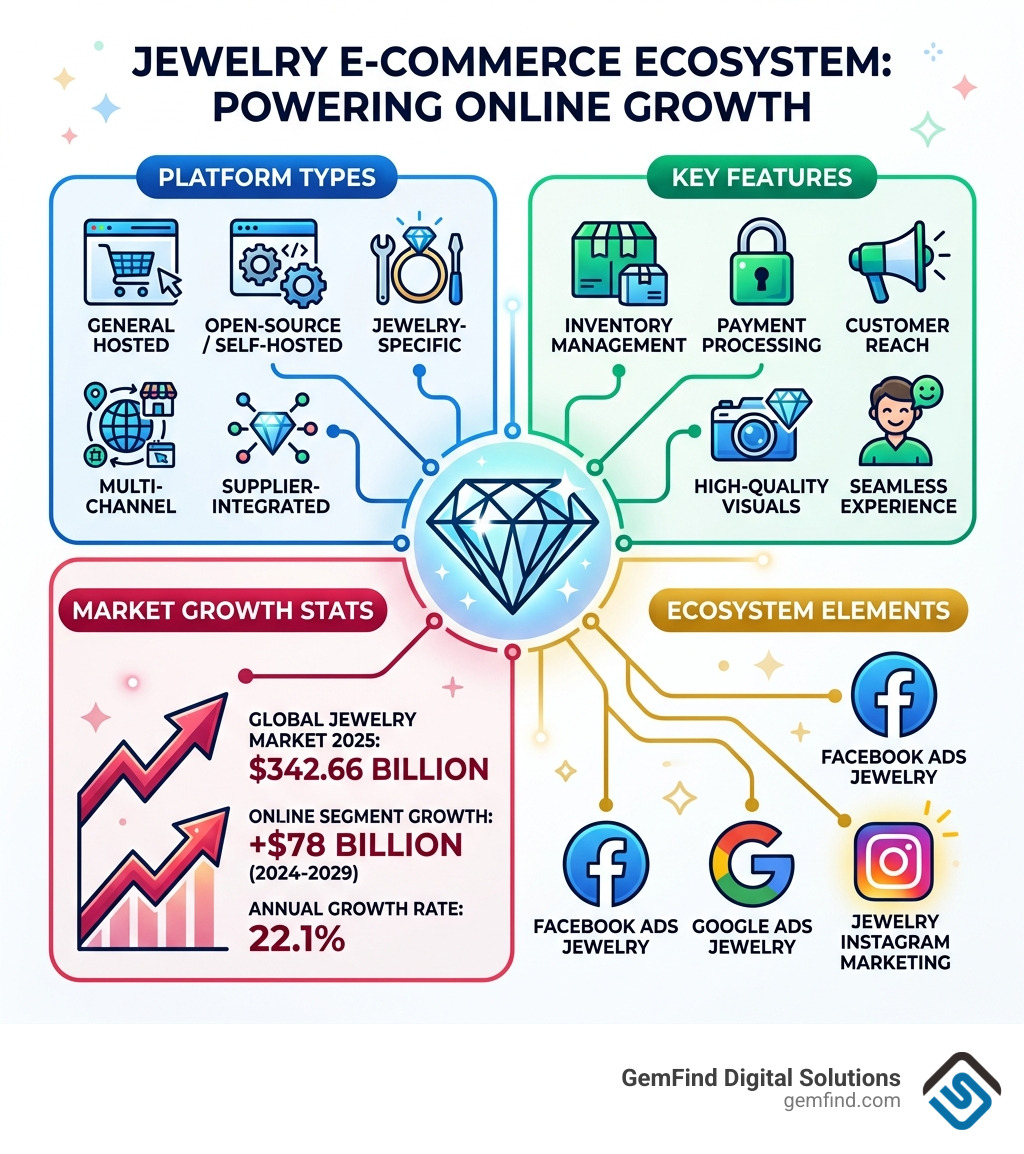
Jewelry e-commerce solutions are software platforms and tools that help jewelry retailers sell online, manage inventory, process payments, and reach customers across multiple channels.
Here are the most important options to consider:
| Solution Type | Best For | Examples |
|---|---|---|
| General hosted platforms | Small to mid-sized stores | Shopify, BigCommerce, Squarespace |
| Open-source / self-hosted | Tech-savvy stores needing full control | WooCommerce, Magento |
| Jewelry-specific platforms | Stores needing industry tools out of the box | GemFind App Suite, Custom Shopify Apps |
| Supplier-integrated tools | Stores sourcing from a single supplier | Diamond Link, Vendor Feed Integrations |
| Multi-channel middleware | Sellers on Amazon, eBay, Etsy, and more | Shopify Plus, Enterprise ERP connectors |
The global jewelry market hit $342.66 billion in 2025 — and online sales are growing fast. Technavio projects the online jewelry segment alone will grow by $78 billion between 2024 and 2029, at a 22.1% annual growth rate.
That kind of growth means one thing: more competition.
Shoppers are buying jewelry online at record rates. But they also expect a seamless experience — high-quality photos, easy customization, secure checkout, and fast answers to their questions. If your website can't deliver that, they'll find one that does.
Choosing the wrong platform doesn't just cost you sales today. It limits how fast you can grow tomorrow.
This guide breaks down what to look for, how the most popular platforms compare, and how to find the right fit for your store — whether you're just starting out or ready to scale.
I'm Anthony Arechiga, Vice President of Sales at GemFind Digital Solutions, where I've been helping jewelry retailers navigate jewelry e-commerce solutions since 2007. Over the years, I've worked with hundreds of jewelers across the country, so I understand what separates a high-converting online store from one that struggles to get traction.
Key Jewelry e-commerce solutions vocabulary:
Essential Features of Modern Jewelry E-commerce Solutions
When we look at Jewelry e-commerce solutions, we have to remember that selling a $5,000 engagement ring is fundamentally different from selling a $20 t-shirt. Jewelry is emotional, high-value, and incredibly detailed.
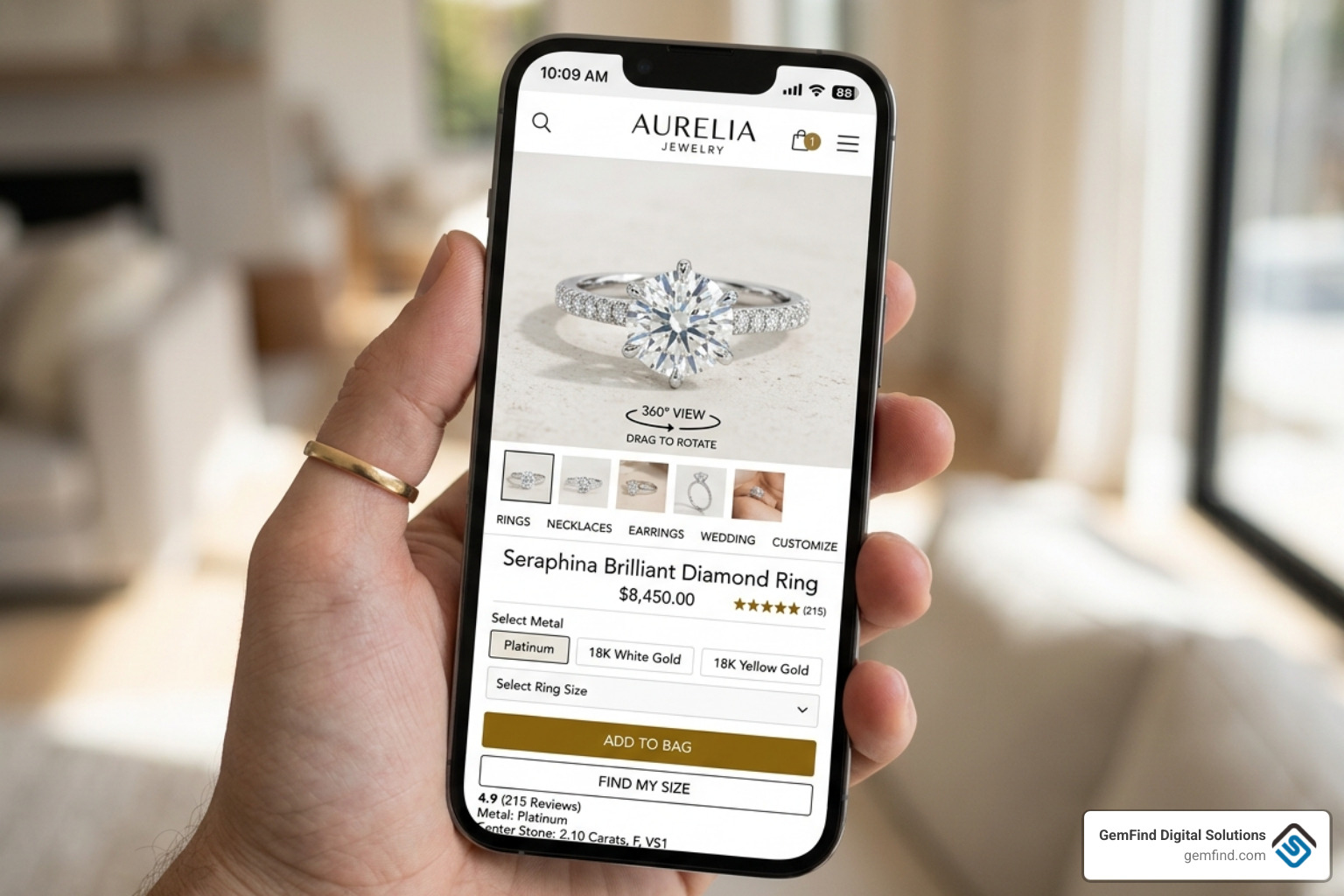
Modern solutions must handle complex product variations. For a single ring design, you might have options for 14k yellow gold, 18k white gold, platinum, and various gemstone sizes. Your platform needs to manage these "parent-child" relationships effortlessly so customers don't get confused.
User experience (UX) is the heartbeat of your site. Because customers cannot touch the jewelry, your digital storefront must compensate with high-resolution imagery and 360-degree video views. Mobile optimization is no longer optional; with a significant portion of luxury shopping happening on smartphones, your site must be fast and thumb-friendly. To dive deeper into these requirements, check out our Jewelry Online Store Complete Guide.
Real-Time Inventory and POS Integration
One of the biggest headaches for jewelers is "the double sell." Imagine selling a unique vintage necklace in your physical store at 2:00 PM, only for an online customer to buy that same "one-of-a-kind" piece at 2:05 PM because your website didn't update.
The best Jewelry e-commerce solutions offer seamless integration with Point of Sale (POS) systems like The EDGE, Logic Mate, or ARMS. This creates a "single source of truth" for your inventory. When an item sells in-store, it's instantly marked as out of stock online. This level of synchronization is why we often say Jewelry Website Design Why Industry Experts Matter for Your Business — general web developers often miss these critical industry-specific connections.
Customization Tools and Diamond Builders
Today's shoppers want to be designers. Interactive modules like "Ring Builders" or "Diamond Search" tools allow customers to choose a setting, select a loose diamond based on GIA or IGI certifications, and see the finished product in real-time.
These tools aren't just "cool features"—they are massive engagement drivers. They keep customers on your site longer and give them a sense of ownership over the piece before they even hit "add to cart." Add in options for custom engravings and virtual try-on technology (using AR to see how a watch or ring looks on their own hand), and you’ve moved from a simple catalog to a high-end digital boutique.
Comparing Hosted vs. Self-Hosted Platforms for Jewelers
Should you go with a "ready-to-wear" hosted platform or a "custom-tailored" self-hosted one? It’s one of the first big decisions we help our clients make.
| Feature | Hosted (e.g., Shopify) | Self-Hosted (e.g., WooCommerce) |
|---|---|---|
| Ease of Use | High - Drag and drop | Medium - Requires technical setup |
| Maintenance | Included - Platform handles updates | Manual - You handle updates/security |
| Security | PCI Compliance included | You are responsible for compliance |
| Customization | High (within platform limits) | Unlimited |
| Scalability | Excellent - Grows with you | Requires server upgrades |
For a more detailed breakdown of starting your journey, see our Create Jewelry Website Complete Guide.
Why Shopify is a Leading Jewelry E-commerce Solution
At GemFind, we frequently recommend Shopify because it strikes a perfect balance between power and simplicity. Shopify powers over 5.6 million stores globally, and its ecosystem is perfect for jewelers.
For larger brands, Shopify Plus offers enterprise-level features that handle massive traffic spikes (like Valentine's Day or Black Friday) without breaking a sweat. Its payment gateways are secure, and the "Shop Pay" feature makes checkout incredibly fast for returning customers. To see how this fits your brand, read our Shopify for Jewelry Stores Complete Guide.
The Flexibility of Open-Source Frameworks
If you have a very specific vision that requires "breaking the rules" of standard templates, open-source frameworks like WooCommerce (built on WordPress) offer unmatched flexibility. You have total control over your CRM, your database, and your unique branding. However, this comes with the responsibility of managing your own hosting, security patches, and plugin updates. It’s a great choice for those who want a truly bespoke digital presence and have the technical resources to maintain it.
Overcoming Challenges in High-Value Online Retail
Selling high-ticket items online comes with high-stakes risks. Fraud protection is the number one concern for jewelers moving into the digital space. One fraudulent transaction on a $10,000 diamond can wipe out weeks of profit.
Your Jewelry e-commerce solutions must be "fortified." This means having SSL certificates, full PCI compliance, and robust fraud detection tools that flag suspicious billing addresses or mismatched IP locations. Beyond tech, you need clear shipping insurance policies and transparent return processes to protect both your business and your customer. For more on building a secure site, visit Jewelry Ecommerce Websites.
Building Trust Through Visuals and Transparency
Trust is the currency of the jewelry industry. Since customers can't loop a loupe over their screen, you have to provide that "loupe-level" detail through transparency.
- Certifications: Always display grading reports (GIA, IGI) prominently on the product page.
- Authenticity: Use storytelling to explain the sourcing of your metals and stones.
- Social Proof: Customer reviews with photos are incredibly powerful for high-value purchases.
Financing and Flexible Payment Options
A $3,000 price tag can be a hurdle. "Buy Now, Pay Later" (BNPL) services and installment plans are game-changers for jewelry conversion rates. By offering financing through providers like Affirm or Klarna, or integrating familiar wallets like Amazon Pay and Google Pay, you make high-ticket items more accessible to a broader audience.
Scaling with Specialized Jewelry E-commerce Solutions
Once your store is up and running, it's time to think about growth. You shouldn't just be selling on your own website; you should be where the customers are.
Specialized Jewelry e-commerce solutions act as a "mission control" for your business. Instead of logging into five different sites to update a price, you do it once in your central dashboard, and it pushes that update to Amazon, eBay, Etsy, and your own storefront simultaneously.
Multi-Channel Selling and Marketplace Integration
Multi-channel selling is about more than just marketplaces. It's about social commerce—selling directly through Facebook Shops and Instagram Shopping. Centralized management ensures you never oversell a unique piece because the inventory is synced across every "branch" of your digital tree. Our Sell Jewelry Online Ultimate Guide covers these strategies in depth.
Automated SEO and Content Generation
To grow, you need organic traffic. But writing unique descriptions for 1,000 different pairs of earrings is a daunting task. Modern jewelry platforms often include AI-driven PIM (Product Information Management) tools that help generate SEO-friendly metadata and product descriptions. This ensures your "14k Gold Hoop Earrings" actually show up when someone searches for them on Google.
Frequently Asked Questions about Jewelry E-commerce Solutions
What is the best e-commerce platform for a small jewelry business?
For most small to mid-sized jewelers, Shopify is the top choice. It’s user-friendly, scales easily, and has the most robust support for the apps and integrations jewelers need, such as diamond builders and POS sync.
How do I prevent overselling high-value jewelry across multiple channels?
The key is real-time inventory synchronization. You need a platform or middleware that connects your website, your POS, and your marketplaces. When an item sells on Etsy, the software must instantly "zero out" the stock on your website and Amazon.
Why do jewelry stores need specific POS integrations for their websites?
General POS systems often don't understand jewelry "attributes" like metal weight, stone clarity, or ring size. An industry-specific POS integration ensures that the complex data required for jewelry is accurately reflected on your website, preventing data errors and keeping your bookkeeping clean.
Conclusion
Navigating Jewelry e-commerce solutions can feel overwhelming, but you don't have to do it alone. At GemFind Digital Solutions, we’ve spent over 25 years perfecting the art and science of jewelry retail online. As a certified Shopify and Google Partner, we specialize in creating the technical bridges—like Edge POS integrations and custom diamond builders—that turn a simple website into a powerhouse of business growth.
Ready to make your jewelry business shine online? More info about jewelry digital marketing is just a click away. Let's build something brilliant together.


