


Why Famous Jewelry Photographers Matter for Your Brand
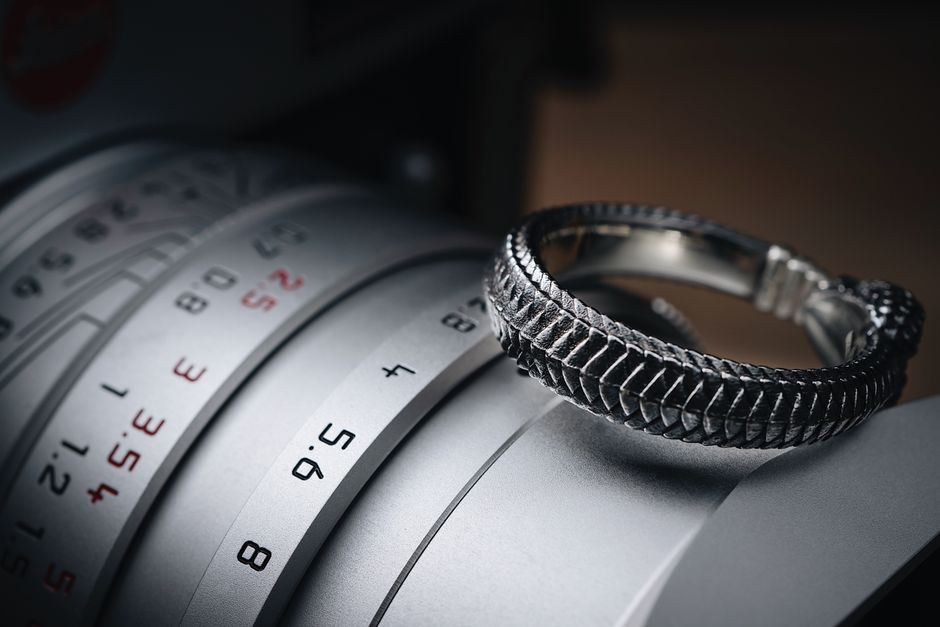
Famous jewelry photographers have the power to turn a simple ring or necklace into something that stops a customer mid-scroll and makes them click "buy."
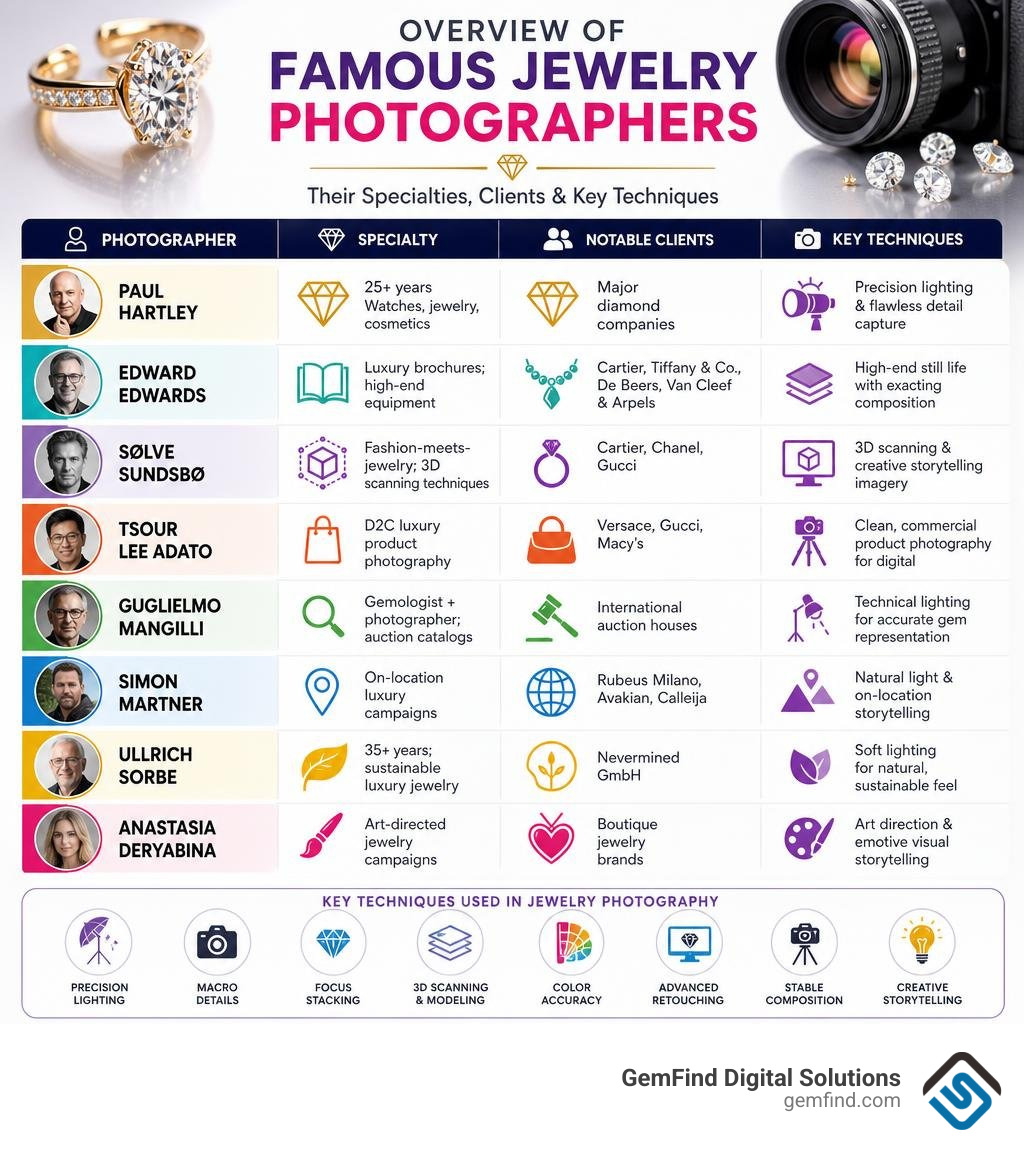
Here is a quick look at some of the most recognized names in jewelry photography today:
| Photographer | Known For | Notable Clients |
|---|---|---|
| Paul Hartley | 25+ years; watches, jewelry, cosmetics | Major diamond companies |
| Edward Edwards | Luxury brochures; high-end equipment | Cartier, Tiffany & Co., De Beers, Van Cleef & Arpels |
| Sølve Sundsbø | Fashion-meets-jewelry; 3D scanning techniques | Cartier, Chanel, Gucci |
| Tsour Lee Adato | D2C luxury product photography | Versace, Gucci, Macy's |
| Guglielmo Mangilli | Gemologist + photographer; auction catalogs | International auction houses |
| Simon Martner | On-location luxury campaigns | Rubeus Milano, Avakian, Calleija |
| Ullrich Sorbe | 35+ years; sustainable luxury jewelry | Nevermined GmbH |
| Anastasia Deryabina | Art-directed jewelry campaigns | Boutique jewelry brands |
Great jewelry photography is not just about pretty pictures. It builds trust, communicates quality, and directly drives sales. In fact, premium imagery has helped some D2C jewelry brands increase sales by over 150%.
Yet for many jewelry store owners, professional jewelry photography feels out of reach — either too technical, too expensive, or simply unfamiliar.
I'm Anthony Arechiga, VP of Sales at GemFind Digital Solutions, and after nearly two decades working with jewelry retailers on their digital presence, I've seen how the right imagery — inspired by the best famous jewelry photographers in the world — can transform an online store's performance. In the sections below, I'll break down who these photographers are, what makes them exceptional, and what every jewelry business can learn from them.
The Evolution of Jewelry Photography
Jewelry photography has come a incredibly long way since its inception. In the 19th century, capturing the sparkling essence of a gemstone on early photographic plates was an agonizingly slow, highly experimental process. Early pioneers had to contend with long exposure times and primitive emulsions that struggled to render the high contrast between polished metal and glittering gems.
As the industry moved into the 20th century, the transition to color film and large-format cameras allowed for much greater detail. Photographers relied heavily on chemical processes like E6 processing to develop color slide and transparency film. This workflow required immense patience; a photographer had to wait hours, or even days, to see if their lighting setup had successfully captured the fire of a diamond without blowing out the highlights.
The digital revolution of the late 1990s and early 2000s changed everything. Early digital studio equipment was prohibitively expensive—sometimes costing upwards of £70,000—and faced resistance from traditional printers who feared the new technology would disrupt their business models. However, the ability to shoot tethered to a monitor and instantly see the results allowed photographers to experiment without the financial anxiety of wasting physical film.
Today, in 2026, the boundaries of the medium are being pushed even further. Masters of the craft like Sølve Sundsbø are known for uniting traditional, old-fashioned photographic techniques with pioneering modern technologies. By incorporating 3-D scanning, hand-painted digital retouching, and moving images into their campaigns, these creators construct otherworldly, ethereal visuals for luxury houses like Cartier and Chanel.
Whether you are looking to create high-concept editorial art or simply focus on Enhancing Your Jewelry Stores Website With Quality Photography, understanding this evolution helps us appreciate the blend of science and art required to make precious metals shine online.
Profiles of Famous Jewelry Photographers Shaping the Industry
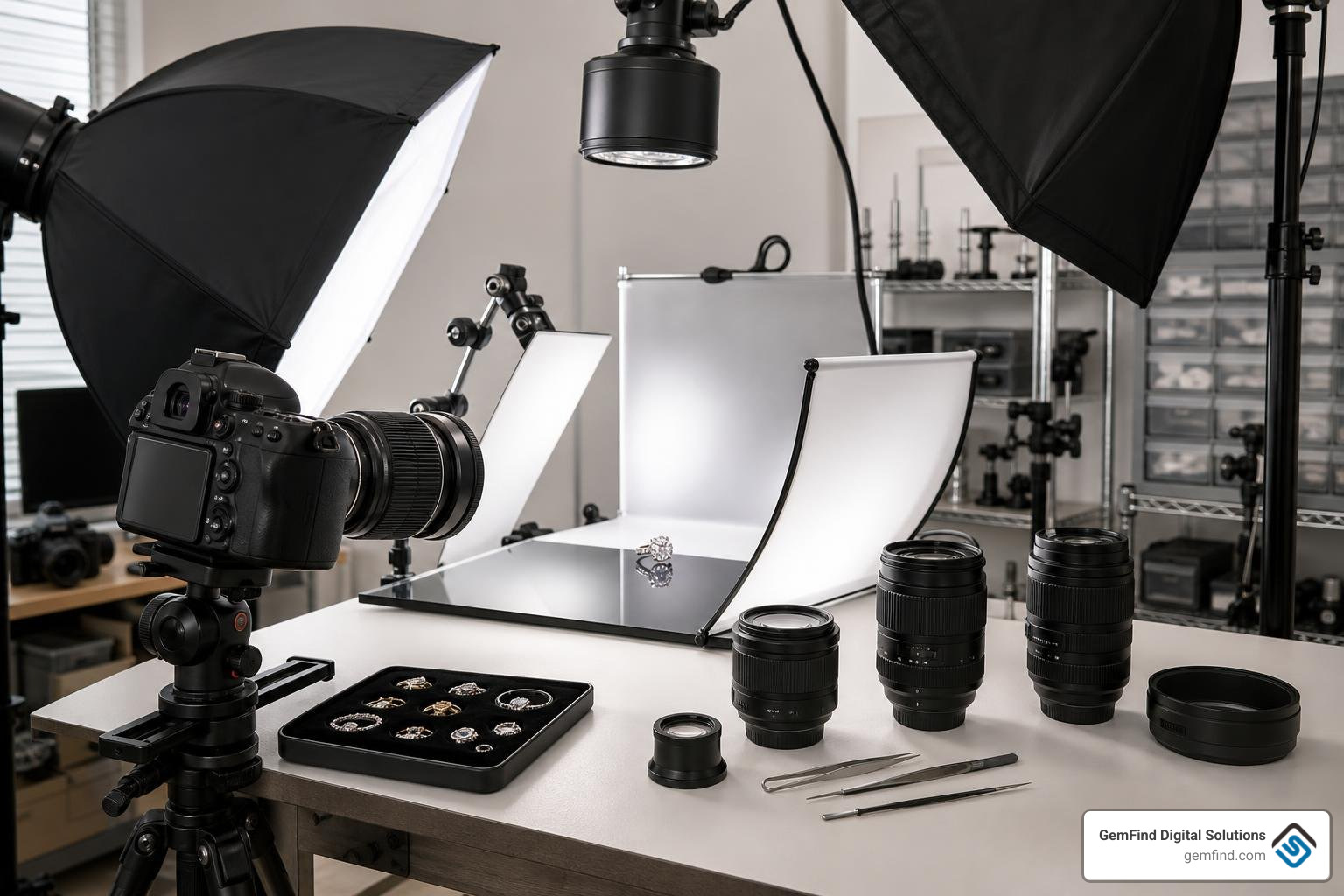
To truly understand what makes a jewelry image successful, we must look at the portfolios of the industry's leading minds. These creators have spent decades mastering the physics of light, the behavior of precious stones, and the art of luxury branding.
- Paul Hartley: A veteran who graduated with a degree in Photographic Art in 1976, Hartley has spent over 25 years specializing in jewelry, watches, and cosmetics. He transitioned to high-end digital studio setups in 2000, bringing a deep, classical understanding of light to the digital era. He is highly regarded for his meticulous approach to lighting metal surfaces so they look authentic and expensive.
- Tsour Lee Adato: Based in Miami, Tsour Lee Adato — Founder & Lead Photographer | PPS has built a reputation as a powerhouse in the direct-to-consumer (D2C) space. Since founding his studio in New York in 2015, his team has photographed thousands of luxury products, including high-profile watch campaigns for major entertainment franchises. His premium imagery has helped D2C brands achieve sales increases of over 150%, proving that commercial art and high-volume retail success go hand-in-hand.
- Guglielmo Mangilli: Operating out of Geneva, Switzerland, Guglielmo Mangilli | Jewelry Photographer | Genève, Switzerland brings a highly unique dual expertise to the field. He is both a professional photographer and a certified gemologist. This scientific background allows him to specialize in the high-precision digitization of high-value objects for private collections, valuation support, and international auction catalogs, ensuring that every gemstone's physical and optical properties are captured with absolute scientific accuracy.
- Edward Edwards: With over two decades of experience in London, Jewellery photography. Edward Edwards. London has captured everything from incredibly fragile, ancient leaf jewelry to modern crowns and tiaras. His studio is known for producing pristine imagery for legendary luxury houses like Cartier, Tiffany & Co., and De Beers. Edwards organizes his work into distinct visual themes—such as the highly requested, clean "White Theme" for contemporary lookbooks and the classic, dramatic "Black Theme" for high-impact advertising.
- Ullrich Sorbe: Based in Germany, Ullrich Sorbe . Fotograf has been self-employed as a professional photographer for 35 years, having launched his business in July 1990. Sorbe’s career includes foundational training assisting legendary still-life photographers like Reinhart Wolf. Today, he blends this classical training with modern themes, frequently photographing sustainable luxury jewelry and lab-grown diamonds made from recycled precious metals.
- Anastasia Deryabina: Based in Los Angeles, Jewelry Product Photography | Anastasia Deryabina | Los Angeles specializes in highly stylized, art-directed jewelry campaigns. Rather than focusing solely on standard catalog shots, Deryabina collaborates closely with boutique brands to build distinct visual narratives, utilizing custom props, dramatic shadows, and editorial styling to elevate the brand's luxury identity.
What Distinguishes Famous Jewelry Photographers from Generalists
You might wonder: Can’t a great wedding or portrait photographer just shoot my new ring collection?
The short answer is: they can try, but the results will likely disappoint. Jewelry photography is widely considered one of the most complex, scientifically demanding niches in the entire photographic industry.
A specialist jewelry photographer must possess a deep understanding of gemology—knowing how different cuts of stones refract light and how to position a light source to bring out the "fire" of a diamond without washing out its color. They must be masters of macro lenses, which capture tiny details but have an incredibly shallow depth of field.
Furthermore, controlling reflections on highly polished, mirrored metallic surfaces is a skill that takes years to perfect. A generalist might accidentally capture the reflection of their camera, their studio, or even themselves in the curve of a platinum band. A specialist knows exactly how to manipulate trace screens and reflectors to hide these unwanted elements while keeping the metal looking bright, clean, and three-dimensional. To understand why this specialized eye is so critical for your digital storefront, explore our insights on Why Your Website Needs A Professional Photographer.
Why Luxury Brands Collaborate with Famous Jewelry Photographers
Luxury brands do not just hire photographers to document their inventory; they hire them to establish brand authority and create an emotional connection with the consumer.
When a luxury house launches a new high-jewelry collection, they are selling a dream, a heritage, and an elite lifestyle. A famous jewelry photographer acts as a visual director who can translate that brand narrative into a single, breathtaking image. Through bespoke styling, sophisticated lighting, and an innate understanding of luxury aesthetics, these photographers create campaigns that build immense consumer trust.
For luxury brands, these images are critical assets used across billboards, print catalogs, social media, and high-end e-commerce platforms. If you are ready to elevate your own brand's presentation, you can learn how to Take Control Of Your Jewelry Photography to align your visual assets with your business goals.
Technical Mastery: Equipment and Lighting Challenges
At the highest level, jewelry photography is a battle against the physics of light and optics. The primary technical challenge is managing depth of field.
Because jewelry is small, photographers must use macro lenses and shoot from very close distances. At these close ranges, the depth of field (the area of the image that is in sharp focus) becomes paper-thin. It is physically impossible to get an entire ring—from the front diamond to the back of the band—in focus with a single shot, even if you stop the lens down.
Furthermore, camera lenses suffer from a phenomenon called diffraction when the aperture is closed too far. If a photographer tries to solve the depth of field problem by stopping down past f/11 or f/16, the overall image actually loses sharpness and becomes soft.
To overcome these optical limitations, high-end photographers use specialized gear and techniques:
- Tilt-shift lenses: These allow the photographer to tilt the lens plane relative to the camera sensor, altering the plane of sharp focus to cover more of the jewelry piece.
- Medium-format digital backs: Top-tier studios, such as Edward Edwards' studio, utilize ultra-high-resolution Leaf digital backs and Schneider optics to capture files with incredible detail, color accuracy, and dynamic range.
- High-end strobe lighting: Brands like Broncolor provide incredibly fast, consistent, and crisp light pulses that allow photographers to capture the minute details of a gemstone without color shifting.
One of the most common mistakes beginner photographers make is using commercial "light cubes" or "lighting tents." While these pop-up fabric boxes are marketed as easy, all-in-one solutions, veteran photographers like Paul Hartley warn that they are a complete waste of time. They wrap the jewelry in uniform, omnidirectional light, which completely strips the metal of its shape, makes gemstones look dull, and produces flat, uninspiring results.
Instead, professionals build custom setups using trace screens (semi-translucent diffusion sheets) and silver or white reflectors. By placing these screens close to the jewelry and moving lights incrementally behind them, the photographer can paint precise, beautiful gradients of light and shadow onto the polished metal surfaces.
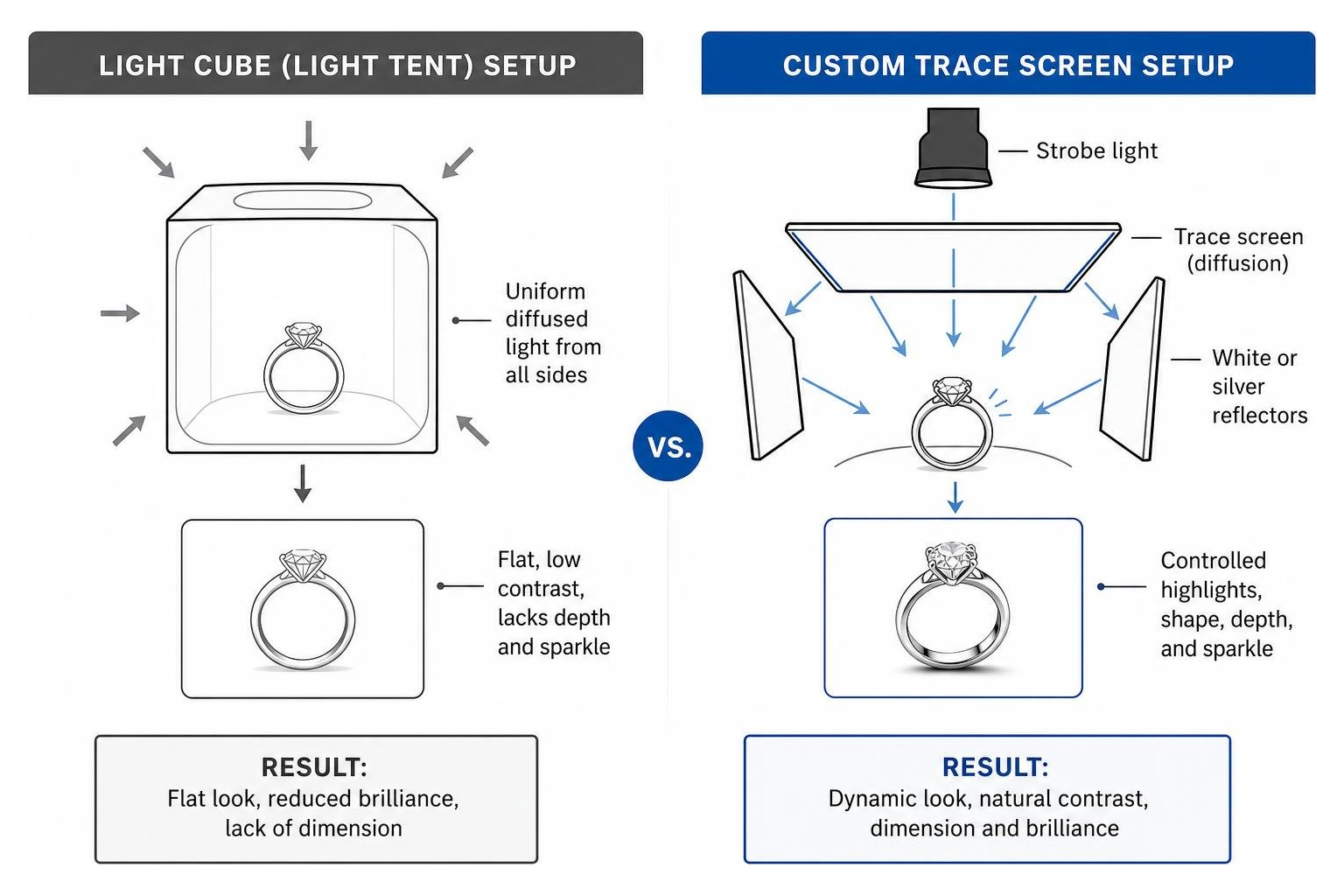
Here is a comparison of how these two approaches impact your final imagery:
| Feature / Aspect | Commercial Light Cubes | Custom Trace Screens & Reflectors |
|---|---|---|
| Light Quality | Flat, omnidirectional, and uniform. | Controlled, directional, and gradient-rich. |
| Metal Appearance | Looks dull, gray, and lacks three-dimensional shape. | Appears bright, polished, and realistically metallic. |
| Gemstone Brilliance | Strips the stone of contrast; diamonds look lifeless. | Highlights the natural "fire," facets, and depth of the gem. |
| Reflection Control | Difficult to eliminate unwanted camera or room reflections. | Highly precise; allows the photographer to place reflections exactly where they want. |
| Setup Flexibility | Rigid and highly restricted. | Highly customizable for every unique jewelry design. |
For more practical advice on setting up your physical environment, check out our guide on Tips For Taking The Best Photos Of Jewelry For Your Website.
Post-Production and Digital Retouching Techniques
In the modern digital landscape, what happens after the shutter clicks is just as important as the shoot itself. High-end jewelry photography relies heavily on sophisticated post-production techniques to achieve that flawless, hyper-realistic look seen in luxury magazines.
The most critical of these techniques is focus stacking. Because of the lens diffraction limits discussed earlier, photographers will take multiple photos of a single jewelry piece (often between 10 and 50 shots), shifting the focus point slightly from front to back with each frame. In post-production, specialized software blends these images together, extracting only the sharpest parts of each photo to create a single final image where every single facet, prong, and metal grain is in razor-sharp focus.
Other common post-production steps include:
- Reflection Correction: Digitally polishing away unwanted reflections of the camera lens, dust particles, or minor scratches that are invisible to the naked eye but highly visible under a macro lens.
- Stone Alignment and Replacement: Physical jewelry is handcrafted, meaning small side stones are occasionally slightly asymmetrical or contain minor natural inclusions. For clean e-commerce displays, retouchers will often digitally align these stones or replace them with perfectly lit, symmetrical digital versions to ensure visual perfection.
- Color Calibration and CMYK Conversion: Ensuring that the yellow gold, rose gold, and platinum colors look exactly right on digital screens, and properly converting those files to CMYK format so they do not lose their vibrant color when printed in physical catalogs.
Balancing Luxury with Budget Realities
While a high-end, custom-lit shoot by a famous photographer is the gold standard, it is often financially unfeasible for smaller jewelry businesses or e-commerce brands with thousands of items. Fortunately, there is a highly effective alternative.
Instead of spending hours building complex, individual lighting setups for every single ring, brands can use a clean, standard studio lighting setup to capture the basic shape and volume of the jewelry. They can then rely heavily on advanced post-production techniques to polish the image.
By using digital stone replacement, reflection correction, and metal smoothing in post-production, businesses can achieve a premium, luxury look for a fraction of the cost. In fact, by adopting a post-production-heavy workflow, ecommerce jewelry photography pricing can start as low as US$15 to US$30 per photo, depending on quantities and requirements.
This hybrid approach allows growing brands to maintain a high-end aesthetic on their websites without blowing their entire marketing budget on a single shoot. To explore how you can implement these cost-effective methods for your own store, take a look at our professional Jewelry Photography Services.
Frequently Asked Questions
How can small businesses achieve high-quality jewelry photography affordably?
Smaller businesses can achieve high-quality results by using a standard, consistent lighting setup (rather than adjusting lights for hours for every single piece) and relying on professional post-production retouching. Techniques like digital stone alignment, reflection correction, and metal polishing can transform a basic photo into a luxury-tier image for under $30 per shot.
What is focus stacking in jewelry photography?
Focus stacking is the process of taking multiple photos of a piece of jewelry at different focal points and combining them in post-production. This ensures that the entire item—from the front gemstones to the back of the band—is in razor-sharp focus, overcoming the natural depth-of-field limitations of macro lenses.
Why is direct lighting avoided when shooting jewelry?
Direct, harsh lighting should be avoided because highly polished metals act like mirrors, creating intense, blown-out hot spots and dark, ugly shadows. Direct light also highlights every microscopic scratch, fingerprint, and dust particle on the jewelry. Using trace screens and diffused light sources creates soft, beautiful gradients that emphasize the jewelry's shape and quality.
Conclusion: Elevating Your Jewelry Brand's Visual Presence
In the digital-first world of 2026, your website is your primary storefront, and your product images are your silent sales team. As the portfolios of the world's most famous jewelry photographers demonstrate, capturing the true beauty, craftsmanship, and luxury of a piece of jewelry requires a unique blend of scientific precision, high-end equipment, and artistic vision.
Whether you are aiming to shoot high-concept editorial campaigns or looking for budget-friendly, high-volume e-commerce solutions, investing in quality photography is the single most effective way to build consumer trust, elevate your brand authority, and drive online sales.
At GemFind Digital Solutions, we have over 25 years of specialized, industry-specific expertise helping jewelry retailers, manufacturers, and designers succeed online. As a certified Shopify and Google Partner, we provide comprehensive digital marketing, web design, and state-of-the-art tools like Edge POS integration to help you run a seamless digital business.
If you are ready to transform your online store with imagery that captivates your customers, we invite you to explore our comprehensive Jewelry Product Photography Tips or reach out to our team today to discuss how we can help you shine online!


