



Build a Jewelry Brand That Customers Trust and Buy From

Successful jewelry brand development starts with a clear promise, not a large product catalog. Define who you serve, what makes your pieces different, the price range you can support, and the quality standards customers should expect. Then build a focused collection, consistent visual identity, reliable production process, and online experience that makes buying feel simple and safe.
For a store owner, the practical path is:
- Choose a specific customer and purchase occasion, such as self-purchase, gifting, or bridal.
- Set a position that connects design, materials, price, and story.
- Launch a small, cohesive collection with a few strong hero pieces.
- Match your brand promise to manufacturing quality, product details, and sourcing.
- Turn your website, social content, packaging, and retail experience into one recognizable customer journey.
Jewelry is personal. Customers wear it to mark milestones, show identity, and celebrate themselves. That emotional value can support stronger pricing and repeat business, but only when every detail - from photography and product descriptions to stone settings and delivery - earns trust.
I am Anthony Arechiga, Vice President of Sales at GemFind Digital Solutions, where I have worked since 2007 helping jewelry businesses strengthen their digital presence, e-commerce strategy, and growth plans. My experience in jewelry brand development connects the commercial side of branding with the systems needed to attract customers and convert interest into sales.
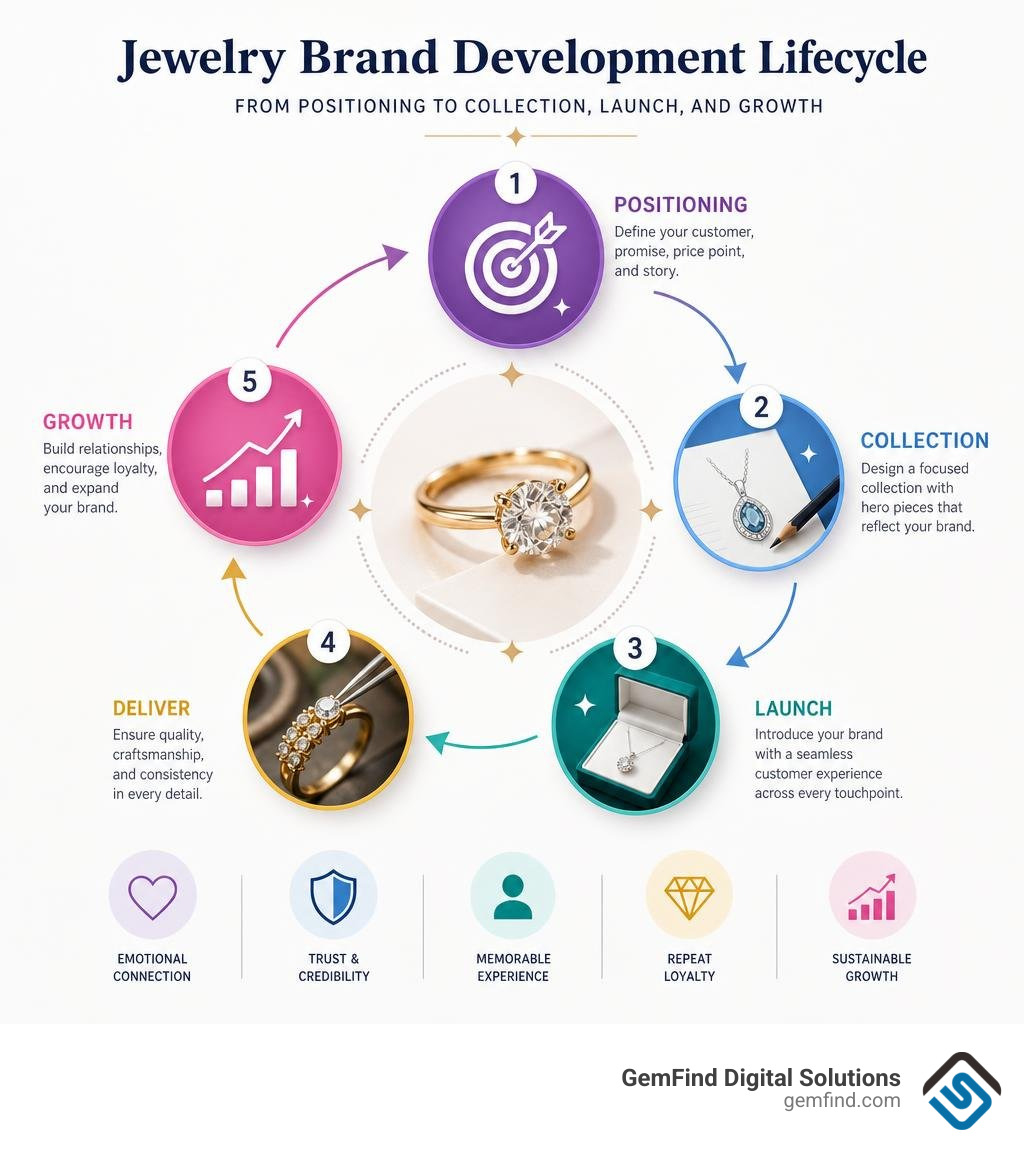
Jewelry brand development word guide:
Core Pillars of Jewelry Brand Development
A successful jewelry brand is never built on luck or design talent alone; it is treated as an enduring commercial asset. Many designers believe that crafting stunning rings or pendants is enough to attract buyers, but beauty without clear positioning is just inventory waiting on a shelf.
Your brand foundation rests on four core pillars:
- Brand Purpose: Why your company exists beyond generating a transaction.
- Commercial Positioning: Where you sit on the spectrum from affordable everyday accessories to heirloom fine jewelry.
- Target Demographics: The specific lifestyle, desires, and habits of your core buyer.
- Price Segmentation: A structured hierarchy that supports your margins while remaining credible to your audience.
When these elements align, your brand commands pricing power and shields your business from pure price wars. To lay the right groundwork early on, take note of these actionable 4 tips to strengthen your brand across modern retail channels.
Defining Positioning and Customer Demographics
A generic audience is the fastest way to dilute your brand. Trying to cater simultaneously to high-net-worth bridal shoppers, budget-conscious gift buyers, and trendy festival-goers creates mixed messaging and an unfocused catalog.
Recent retail dynamics show that branded jewelry is growing at 8.3% year-over-year—outpacing unbranded commodity jewelry by nearly double. At the same time, shifting consumer behaviors have transformed the marketplace. The female self-purchase segment, for example, grew by 58% over recent years, establishing women buying jewelry for themselves as one of the most powerful economic forces in luxury retail.
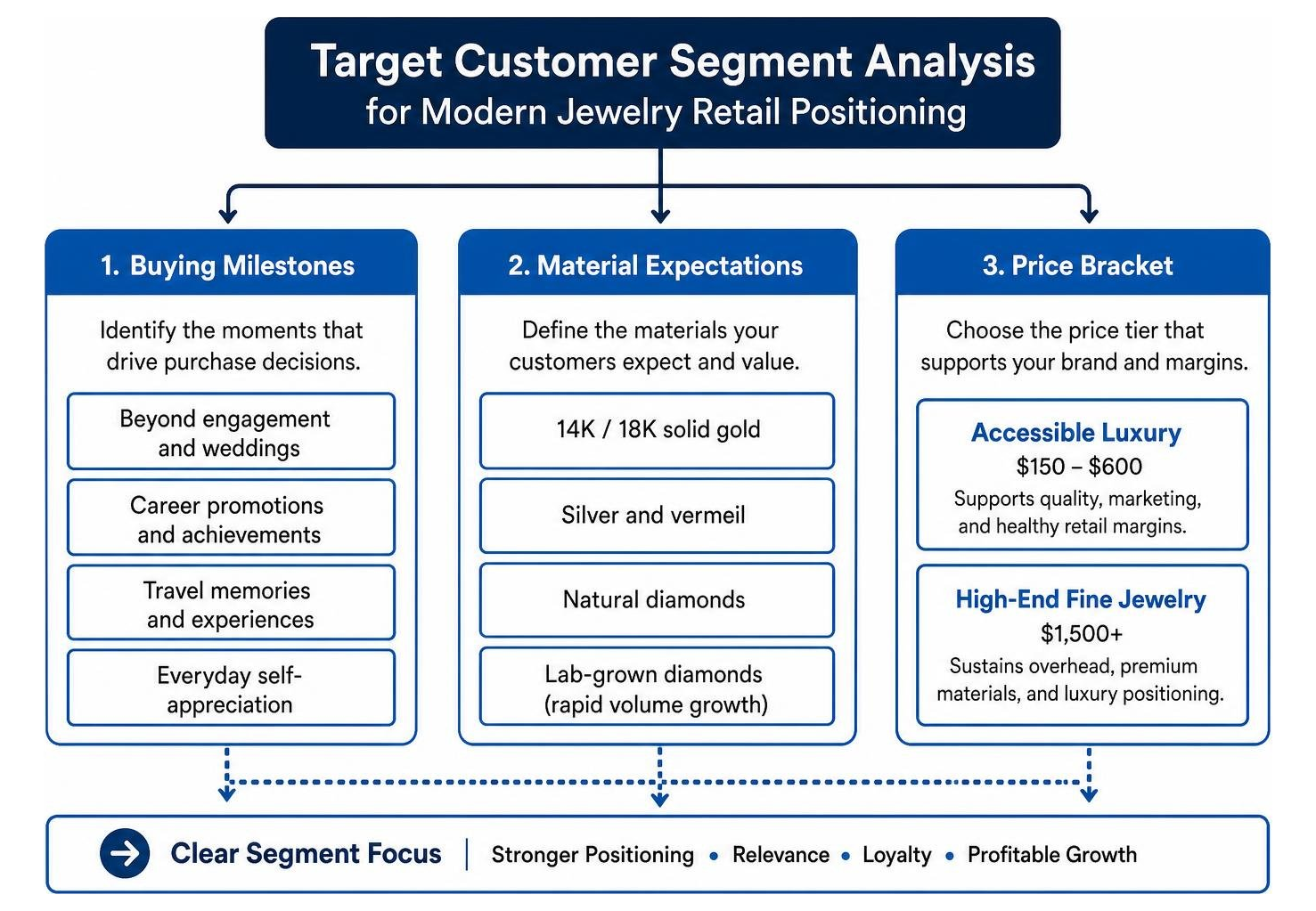
When selecting your ideal buyer, evaluate these critical dimensions:
- Primary Buying Milestones: Look beyond traditional engagement and wedding moments. Are your buyers marking personal career promotions, travel memories, or everyday self-appreciation?
- Material Expectations: Define whether you operate in 14K/18K solid gold, silver, vermeil, natural diamonds, or lab-grown diamonds. In mid-2026, lab-grown diamonds continue to experience rapid volume growth, while natural diamond fine jewelry commands higher average transaction prices.
- Price Bracket: Establish whether you offer accessible luxury ($150–$600) or high-end fine jewelry ($1,500+). Your pricing must sustain overhead, quality packaging, marketing acquisition, and healthy retail margins.
Emotional Storytelling and Narrative Architecture
Jewelry carries a heavy emotional weight. Unlike functional consumer goods, fine jewelry touches bare skin, marks lifetime milestones, and is passed down through generations.
Authentic storytelling does not mean writing a long, self-indulgent biography on an "About Us" page. Instead, great storytelling is customer-facing: it positions the customer as the hero, while your pieces serve as the symbols of their achievements, memories, and personal taste.
When you harness the impact of digital brand storytelling, your brand builds an emotional reservoir that justifies premium price points and cultivates genuine loyalty.
Designing a Cohesive Collection and Visual Identity
A strong visual identity extends far beyond an attractive logo. It is a complete visual language encompassing typography, color harmony, negative space, macro imagery, and the physical presentation of your jewelry.
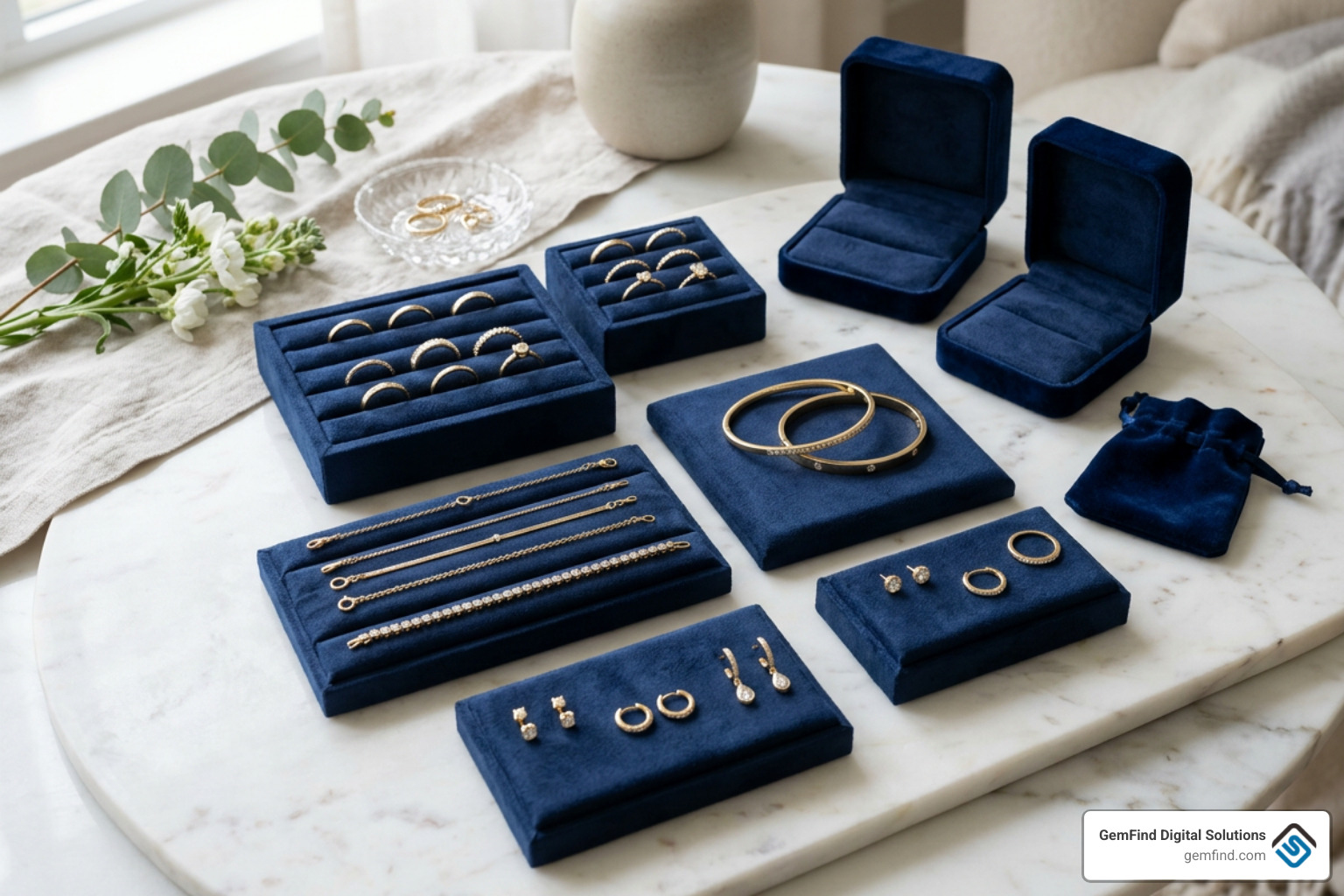
Developing a Distinctive Aesthetic Vocabulary
One of the most frequent missteps in jewelry brand creation is releasing a disconnected assortment of designs. A brand must present a signature aesthetic vocabulary—recurring motifs, distinctive prong work, specific metal textures, or unique stone cuts—that make the collection instantly recognizable.
Merchandising your pieces around style, mood, and wardrobe curation rather than raw metal weight allows shoppers to mix, match, and build a cohesive personal jewelry wardrobe over time.
| Assortment Role | Catalog Share | Strategic Objective | Price Range Target |
|---|---|---|---|
| Hero Pieces | 10% – 15% | Iconic designs that define your visual identity and capture editorial attention. | Premium ($800 – $2,500+) |
| Core Assortment | 60% – 70% | High-wearability earrings, stacking bands, and daily pendants that drive volume. | Accessible Core ($250 – $750) |
| Entry Add-ons | 15% – 20% | Accessible impulse items, chains, or charms that introduce first-time buyers. | Entry ($95 – $225) |
Packaging and the Physical Unboxing Experience
In an e-commerce landscape, the unboxing experience serves as your first tangible touchpoint. The weight of your jewelry box, the texture of the ribbon, the micro-suede pouch, and the inclusion of personalized authenticity cards all reinforce perceived value.
Moreover, sustainable packaging is no longer optional. Modern consumers demand eco-conscious, recyclable materials. Thoughtfully designed sustainable packaging can elevate perceived brand value by up to 20%, proving that environmental responsibility and luxury can sit seamlessly side by side.
Connecting Brand Strategy with Manufacturing Reality
A beautiful concept means nothing if it cannot be produced reliably, ethically, and at viable margins. Manufacturing determines your product durability, defect rates, customer return frequency, and brand reputation.
To ensure your supply chain upholds your brand promise, implement structured product development workflows early in the design cycle to track technical specifications, ethical sourcing certifications (such as RJC/COC compliance), and vendor sample approvals.
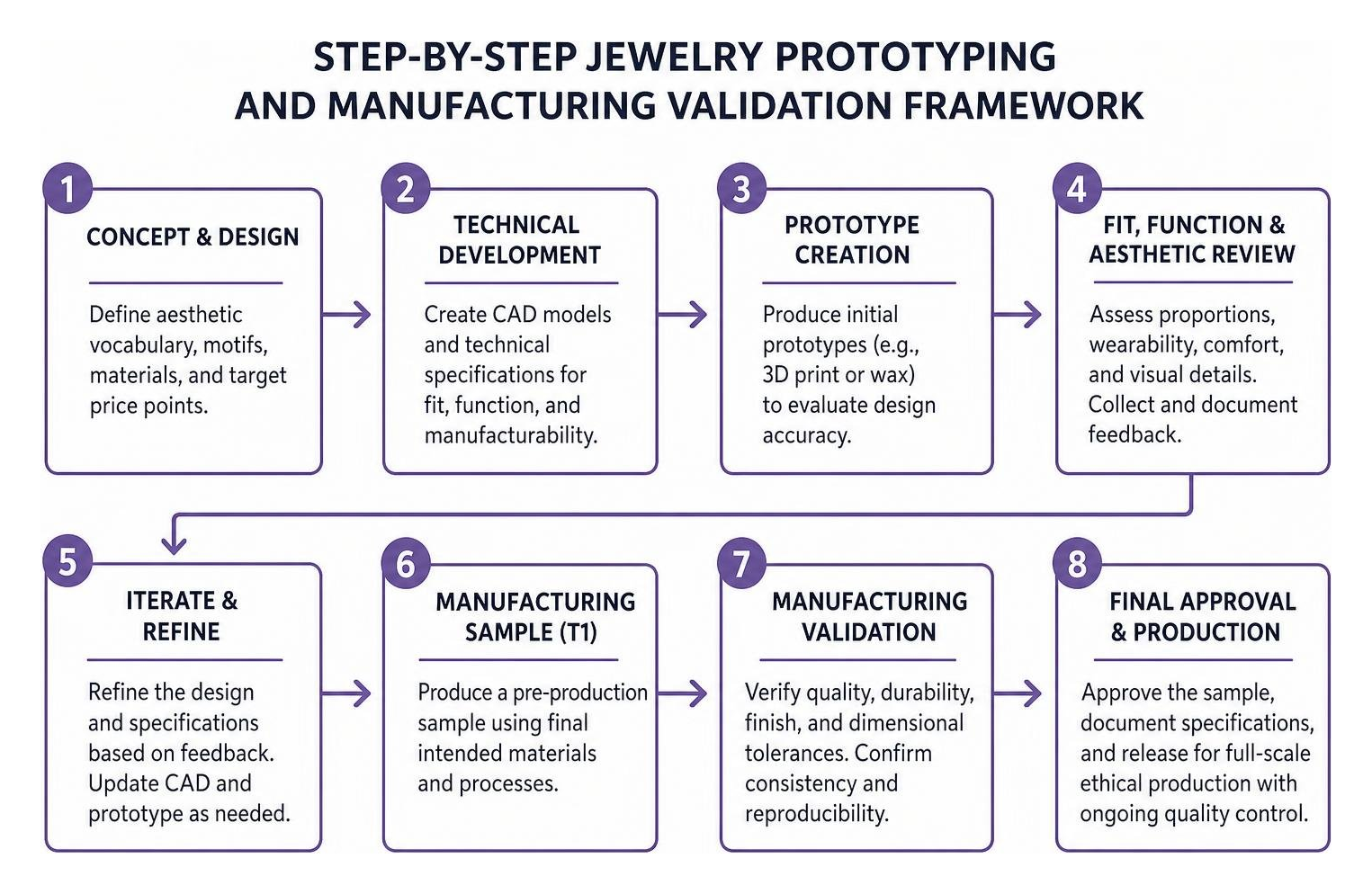
When establishing your production strategy, carefully balance the pros and cons of in-house manufacturing versus partnering with an established specialized contract manufacturer:
| Operational Dimension | In-House Studio Production | Contract OEM / Private Label Manufacturer |
|---|---|---|
| Initial Capital Expenditure | High (casting machines, lasers, bench tools) | Low (tooling and mold fees only) |
| Scalability | Limited by physical bench hours and labor | High (mass production lines with elastic capacity) |
| Quality Control (QC) | Immediate, piece-by-piece bench oversight | Requires strict tech packs and batch inspection |
| Unit Production Cost | Higher labor cost per unit at low volumes | Lower cost per piece due to bulk purchasing |
| Focus Allocation | Heavy operational and production management | Founder focuses on marketing, branding, and sales |
Integrating 3D Prototyping into Jewelry Brand Development
Bridging the gap between 2D sketches and cast metal requires modern digital product development tools. High-precision CAD modeling software like Rhino 3D allows designers to build parametric models, test stone seatings, and inspect wall thicknesses before committing precious metals to casting.
Creating high-resolution 3D resin prototypes ensures you can check real-world ergonomics—verifying that ring shanks do not pinch, pendant bails balance properly on chains, and earring posts withstand daily wear.
Avoiding Costly Production and Sourcing Mistakes
To preserve cash flow and protect brand equity, avoid these fundamental manufacturing errors:
- Under-Engineering Structural Durability: Prongs made too thin will bend, resulting in lost stones, warranty claims, and frustrated reviews.
- Ignoring Metal Loss and Scrap Rates: Polishing and casting inevitably consume gold and platinum scrap; calculate these loss factors directly into your bill of materials (BOM).
- Over-Diversifying Raw Materials: Launching with brass, silver, 10K, 14K, and 18K in a single collection divides your purchasing power and confuses your positioning. Stick to a clear material standard.
Omnichannel Execution and Go-to-Market Strategy
Today's jewelry consumer expects a seamless journey between online discovery and physical retail. Research shows that over 80% of fine jewelry purchasers conduct in-depth digital research before stepping foot in a boutique or completing a high-ticket checkout.
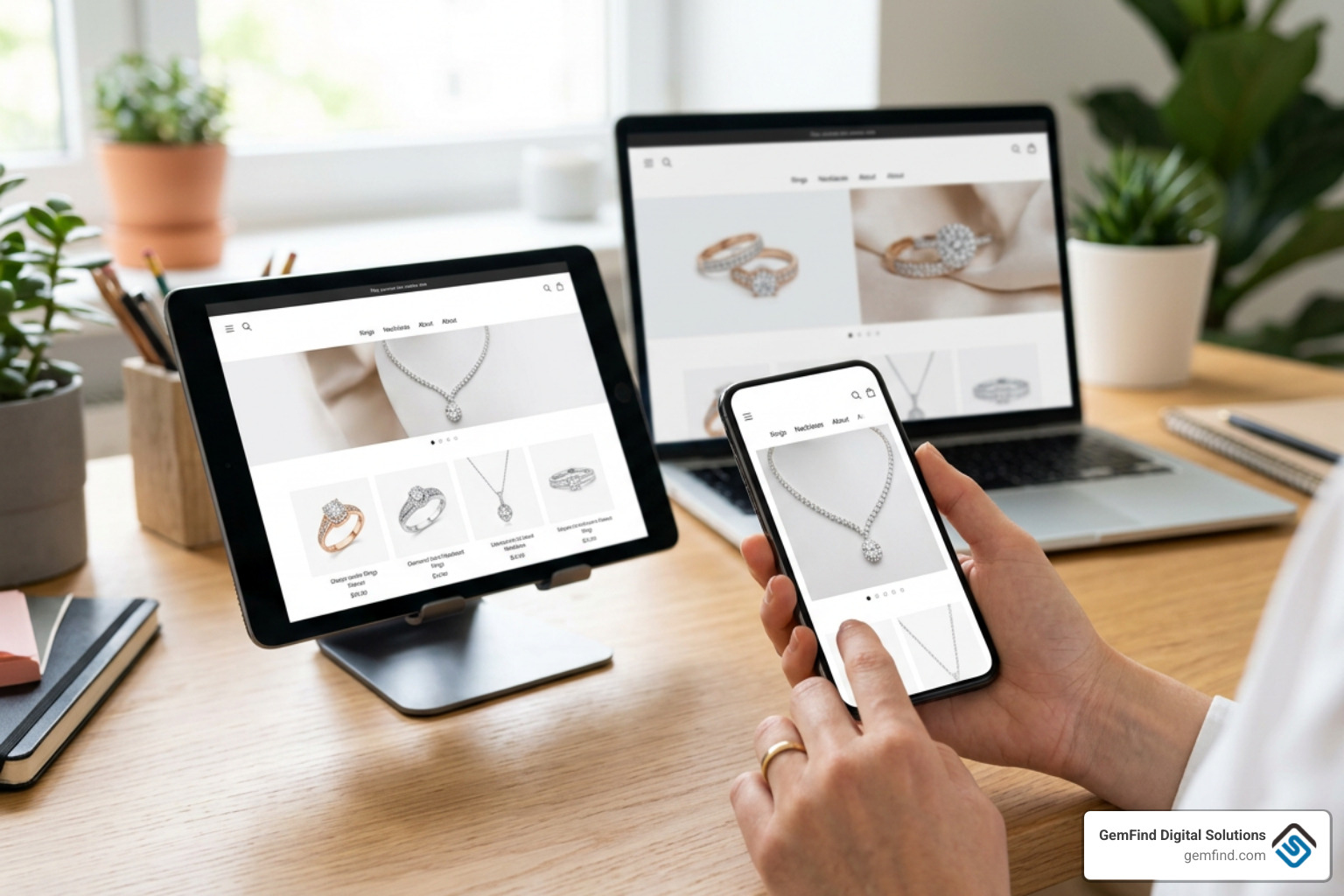
Understanding the nuances of omnichannel retail expansion allows independent brands to bridge digital ads with showroom consultations, private viewings, and responsive customer service.
High-Converting Digital Presence and E-Commerce
Selling jewelry online requires overcoming touch-and-feel hesitation through rich digital experiences:
- Macro Imagery & 360-Degree Video: Show crisp close-ups of hallmarks, clasps, pavé settings, and realistic on-model scale.
- Structured Schema Markup: Implement advanced Product and Review schema so search engines index carat weights, metal purities, and pricing for AI-driven answer engines.
- Educational Sizing Guides: Interactive ring sizers and necklace layering guides significantly reduce sizing-related return rates.
For a deeper dive into optimizing digital channels, review our jewelry brand marketing complete guide to structure high-performing acquisition campaigns.
Measuring Success and Scaling Jewelry Brand Development
As your catalog expands, maintain brand discipline through documented brand books, centralized Product Lifecycle Management (PLM) systems, and synchronized inventory across all channels.
To expand your customer acquisition profitably, explore our practical guidance on maximizing your jewelry store's branding on social media to build an active community around your collections.
Frequently Asked Questions About Jewelry Brand Development
What is the difference between a jewelry business and a jewelry brand?
A jewelry business primarily sells commodity products based on price, metal weight, or generic trends. A jewelry brand cultivates a distinct visual identity, an emotional narrative, and a loyal following. This identity gives the brand pricing power, customer loyalty, and long-term enterprise value that transcends individual product transactions.
How many pieces should be in an initial jewelry collection launch?
A focused launch of 8 to 15 cohesive pieces is ideal. This should include 1 to 2 hero items that establish your design point of view, supported by 6 to 10 versatile, highly wearable core pieces. Launching with too many designs ties up vital capital in slow-moving inventory and dilutes your brand message.
How does the choice of manufacturing partner impact brand reputation?
Your manufacturing partner directly controls finish quality, stone security, alloy purity, and delivery timelines. Subpar casting or weak settings lead to tarnishing, lost stones, high return rates, and negative reviews that permanently damage customer trust. Aligning with ethical, certified manufacturers protects your brand reputation from day one.
Conclusion
Building a successful, enduring jewelry brand is an ongoing balance of artistic vision, strategic positioning, and disciplined manufacturing. By clarifying your brand purpose, curating a tight collection, and executing a polished omnichannel digital presence, you establish the market authority needed to thrive in today's luxury landscape.
At GemFind Digital Solutions, we have spent over 25 years helping jewelry designers, manufacturers, and independent retailers build and scale profitable businesses. Explore our comprehensive digital marketing solutions to elevate your jewelry brand today.


