


Why Jewelry Marketing Strategies Make or Break Your Business in 2026

Jewelry marketing strategies are the difference between a thriving store and one that's invisible online. The global jewelry market hit $353.25 billion in 2023 and keeps growing — but a bigger market also means more competition for every customer's attention.
Here are the most effective jewelry marketing strategies to know right now:
- Define your audience and brand identity — Know exactly who you're selling to and what makes your pieces unique.
- Optimize your digital showroom — Fast, mobile-friendly website with high-quality visuals and virtual try-on tools.
- Leverage SEO and AI search visibility — Original product descriptions, schema markup, and content that ranks.
- Build a social commerce presence — Sell directly through TikTok Shop, Instagram, and Pinterest.
- Run targeted paid ads and retargeting — Re-engage visitors who didn't buy the first time.
- Automate email marketing — Cart abandonment sequences, welcome series, and segmented campaigns.
- Partner with micro-influencers — Authentic creators drive higher engagement than celebrity endorsements.
- Collect and use customer data — Reviews, surveys, and purchase history fuel smarter campaigns.
The stakes are real. Gen Z and Millennials now drive 70% of online luxury jewelry purchases. And with the 2026 median online jewelry order value sitting at $374 — rising to $527 for customized pieces — every missed connection with a potential buyer is a costly one.
I'm Anthony Arechiga, Vice President of Sales at GemFind Digital Solutions, and I've spent nearly two decades working directly with jewelry retailers on jewelry marketing strategies that drive measurable growth. In this guide, I'll walk you through exactly what's working in 2026 — from building your brand identity to converting browsers into loyal buyers.
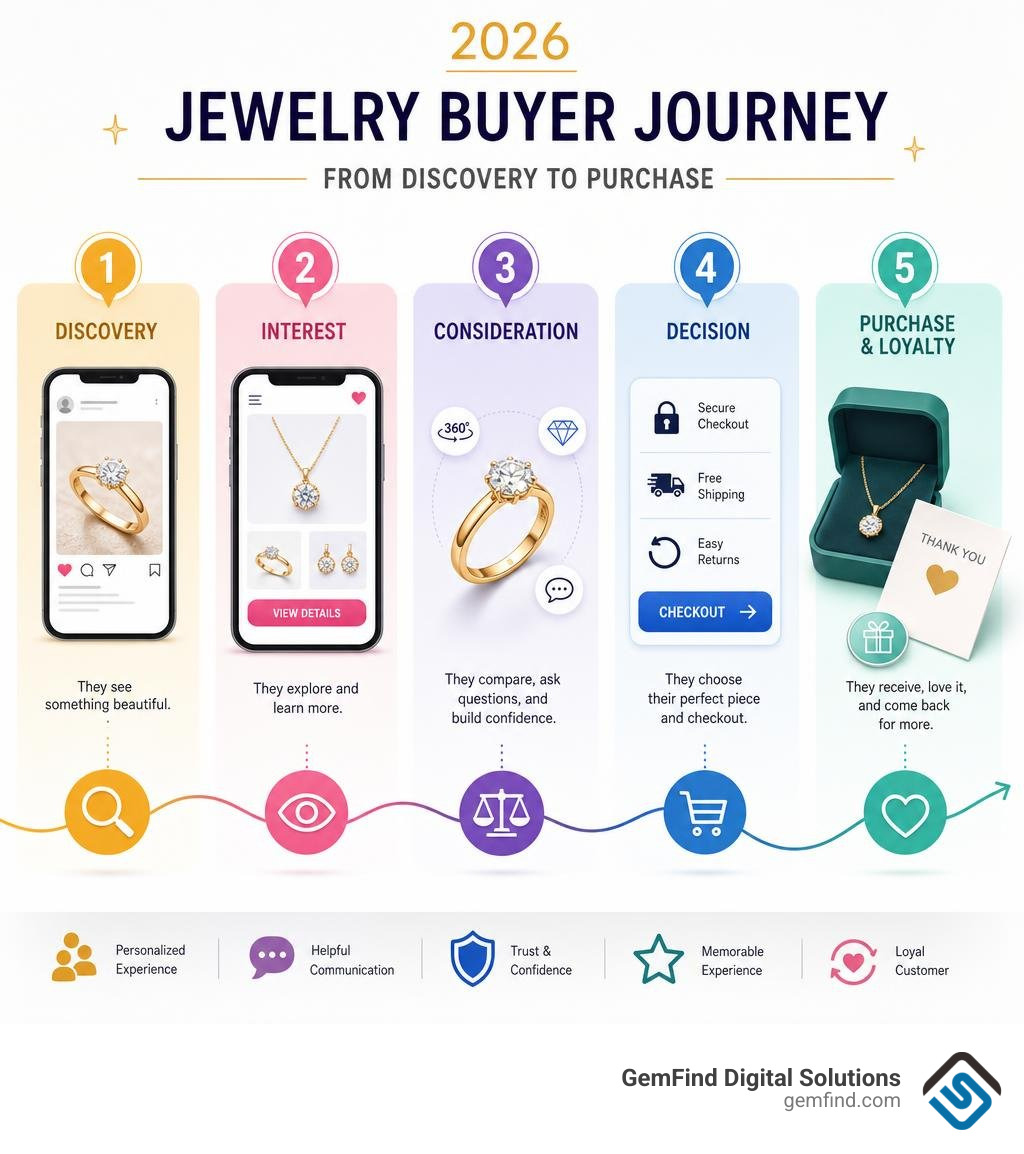
Basic Jewelry marketing strategies glossary:
Defining Your Audience and Brand Identity
Before you spend a single dollar on paid ads or write your next social media caption, you must define who you are and who you are selling to. In the jewelry industry, this is everything. Why? Because jewelry is an emotional, high-consideration purchase. In fact, 95% of purchasing decisions are made in the subconscious mind. People do not buy jewelry just because they need a piece of metal around their neck; they buy it to celebrate milestones, express love, or show off their personal style.
To build a deep emotional connection, you need a clear brand identity. We like to think of brand identity as a spectrum. Is your brand playful or serious? Modern or classic? Sporty or elegant? Defining these characteristics helps you pinpoint exactly how to speak to your customers.
As highlighted in the 2026 Luxury Jewelry Marketing Trends Report, target demographics and psychographics must go hand-in-hand. It is not enough to say your target audience is "women aged 25 to 45." You need to know what they value. Do they care about carbon-neutral lab-grown diamonds, or do they cherish the heritage and legacy of natural, mined gemstones? Once you know their values, you can craft a unique selling proposition (USP) that highlights exactly what makes your jewelry stand out—whether that is custom 3D CAD design services, sustainable materials, or artisanal craftsmanship.
Crafting a Compelling Brand Story
Every great jewelry brand is built on a story. Whether it is a multi-generational family legacy, a founder's personal journey to find the perfect gemstone, or a commitment to ethical sourcing and sustainability, your story is your secret weapon.
Consumers in 2026 are highly selective, and they want to buy from brands that align with their personal values. When you share the craftsmanship behind your pieces, the origin of your materials, or the inspiration behind a collection, you invite customers to be part of something bigger than a transaction. Make your story prominent on your website and weave it consistently through all your marketing channels.
Understanding Your Target Jewelry Customer
To find your ideal audience, you need to look at real data. Start by analyzing your existing customer data and sending out post-purchase surveys. To get the best response rates, offer a small incentive like a discount on their next purchase or entry into a prize drawing. Keep your survey questions general enough to avoid alienating people, but specific enough to understand their buying patterns.
According to our Guide to Targeting Jewelry Customers, creating detailed client personas helps you visualize your buyers. A client persona should include:
- Demographics: Age, location, career, and income bracket.
- Psychographics: Lifestyle, values, and interests (e.g., do they love travel, pets, or local art?).
- Buying Behavior: Do they buy jewelry as gifts for others, or do they self-purchase to celebrate personal milestones?
Once you have these personas, you can segment your market and tailor your messaging to speak directly to each group. For example, your messaging to a young professional looking for everyday demi-fine jewelry should feel very different from your messaging to a bridal shopper looking for a custom engagement ring.
Digital Showroom Optimization and Jewelry Marketing Strategies
Your website is your digital showroom. Just like a physical boutique, it needs to look stunning, feel welcoming, and make it incredibly easy for customers to browse and buy. If your website is slow, confusing, or hard to navigate on a phone, potential customers will walk out the virtual door. In fact, mobile devices drive over 57% of online e-commerce traffic, and 53% of visitors will leave a page if it takes longer than 3 seconds to load.
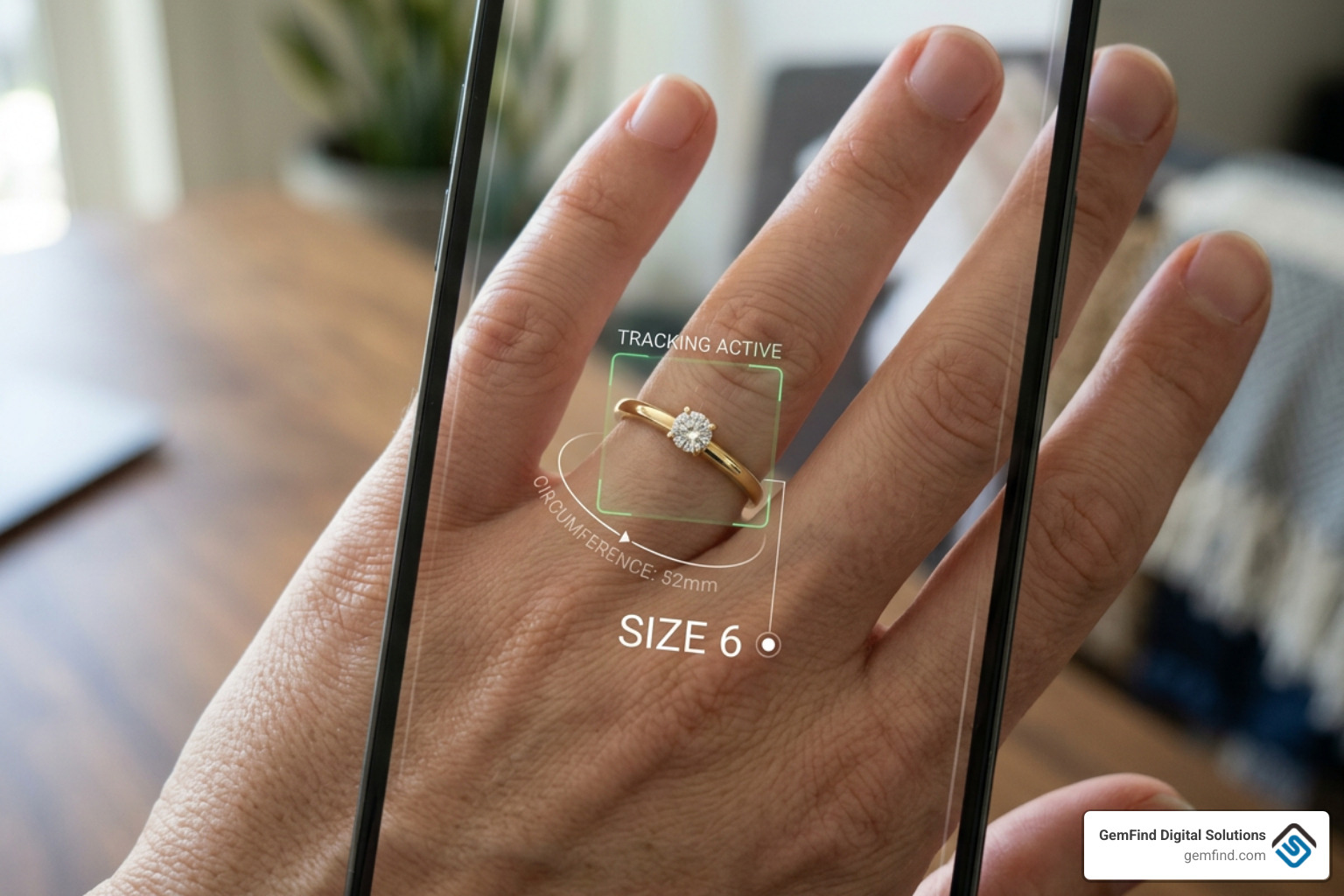
To optimize your digital showroom for conversions, focus on mobile-first design and a streamlined user experience. Your checkout flow should be as simple as possible—aim for a maximum of three steps.
Because the jewelry market has shifted significantly with the rise of lab-grown diamonds, your website must also educate and guide buyers based on their preferences.
| Feature | Natural Diamond Marketing | Lab-Grown Diamond Marketing |
|---|---|---|
| Core Message | Rarity, legacy, investment value, and natural history | Sustainability, modern technology, ESG values, and budget-friendliness |
| Pricing Strategy | Premium pricing reflecting scarcity and long-term value | Competitive pricing (often 28-58% discount vs. natural) |
| Target Audience | Traditional luxury buyers, heirloom collectors | Gen Z and Millennials, eco-conscious couples |
| Visual Focus | Heritage, classic romance, certification (GIA/AGS) | Modern design, customization, transparent ethical sourcing |
Leveraging SEO and AI Search for Jewelry Marketing Strategies
Search Engine Optimization (SEO) has evolved. In 2026, we are not just optimizing for Google's traditional search results; we are also optimizing for AI search engines like ChatGPT, Perplexity, and Google Gemini. This is called Generative Engine Optimization (GEO).
As detailed in our resource on Performance Marketing for Online Jewellery Stores, a robust search strategy requires a mix of technical precision and original content. Here is how to make sure your brand is visible:
- Implement Product Schema Markup: Ensure your Product Detail Pages (PDPs) use structured data schema (including product, offer, reviews, and aggregate ratings). Fewer than 20% of jewelry sites do this correctly, making it a massive competitive advantage.
- Write Original Descriptions: Stop using manufacturer template copy. Over 62% of jewelry sites reuse supplier descriptions verbatim, which hurts search rankings. Write original, 150+ word descriptions that combine technical specs (metal, stone size, clarity) with emotional storytelling.
-
Optimize for AI Crawlers: Make sure your
robots.txtfile explicitly allows user agents like GPTBot, PerplexityBot, and Google-Extended to crawl your site so AI search tools can recommend your products. - Claim Your Google Business Profile: For local SEO, keep your Name, Address, and Phone (NAP) data consistent across the web. Since 85% of consumers use search engines to find local jewelers, local optimization is essential.
The Power of Visuals: Photography, Video, and Virtual Try-On
Jewelry is visual, intricate, and shiny. Because customers cannot touch or try on your pieces physically when shopping online, your visuals have to do the heavy lifting. High-quality product photos are nearly twice as likely to convert than low-quality ones.
For every product, include 5 to 8 high-resolution images (minimum 1500x1500px) showing the piece from multiple angles: front, side, back, on a model for scale, and close-ups of the details.
But static photos are no longer enough. Video content is incredibly powerful—viewers retain 95% of information in videos compared to just 10% in text. Use short product videos showing how a piece catches the light or how it looks when worn.
Furthermore, Virtual Try-On (VTO) and Augmented Reality (AR) tools have crossed from "nice-to-have" to "must-have." Today, VTO adoption has crossed 67% among luxury jewelry buyers. Implementing AR try-on for rings, earrings, and necklaces can reduce return rates by 64% and boost conversion rates by up to 40%.
Omnichannel Performance: Social Commerce, Paid Ads, and Email
To build a resilient brand, you must meet your customers wherever they are. An omnichannel approach connects your website, social media channels, paid advertising, and email marketing into a single, cohesive experience.

According to the Jewelry Boutique GTM Playbook, multi-channel activation is key to hitting your revenue goals. By spreading your presence across organic discovery, paid acquisition, and direct retention channels, you create multiple touchpoints that guide a customer from their first look to their final purchase.
Social Commerce and Creator Partnerships on Instagram, TikTok, and Pinterest
Social commerce is booming. Transactions through platforms like TikTok Shop and Instagram are projected to exceed $100 billion in U.S. transactions by the end of 2026, with jewelry ranking among the top categories.
To win on social media, you need to understand how users interact with each platform:
- Instagram and TikTok: These platforms are built on visual storytelling and entertainment. Post short-form vertical videos (3 to 5 times per week) showing behind-the-scenes craftsmanship, styling tips, or unboxing experiences. (The #unboxing hashtag has over 45 billion views on TikTok alone!).
- Pinterest: Pinterest is a visual planning search engine where 70% of users discover new jewelry brands. It is especially powerful for bridal and gift-giving search terms. Interestingly, jewelry images without human faces get repinned 23% more frequently on Pinterest, as it allows users to easily imagine themselves wearing the piece.
For deeper insights into creative formats, see our guide on Jewelry Marketing & Advertising Ideas for 2026.
When it comes to influencer partnerships, do not feel like you need to hire celebrity ambassadors. Micro-influencers (creators with 10k to 50k followers) often have highly engaged, niche audiences and drive up to 60% more engagement than major celebrities. Send them samples, let them style your pieces in their own authentic voice, and use their user-generated content (UGC) across your own marketing channels.
Paid Advertising and Retargeting Frameworks
Paid advertising is about matching buyer intent with the right channel. We categorize jewelry buyers into three main buckets: bridal, gift-givers, and self-purchasers.
Our 10 Jewelry Marketing Strategies for Success outlines how to structure your paid media for maximum impact:
- Google Search & Shopping: Capture high-intent buyers who are actively searching for terms like "custom engagement rings" or "14k gold hoop earrings." Structure your ad groups tightly around style, metal, and price filters.
- Meta Advantage+ & TikTok Ads: Use these platforms to spark desire in cold audiences. Focus on creator-style video ads shot in natural window light, which feel organic and earn the user's attention in the first 1.5 seconds.
- Retargeting Campaigns: Don't let interested browsers slip away. Use dynamic product ads to show users the exact pieces they viewed on your site, and offer gentle incentives like a 10% discount to encourage them to complete their checkout.
In 2026, the smartest advertisers bid based on SKU-level contribution margin (your profit after shipping, returns, and promo codes) rather than vanity metrics like platform ROAS. This ensures that every advertising dollar spent is driving actual profitability.
Email Automation: High-Converting Jewelry Marketing Strategies
Email marketing is one of the most cost-effective tools in your marketing arsenal, boasting an average ROI of $36 to $42 for every $1 spent. When set up correctly, email and SMS automation should generate 25% to 35% of your total online revenue.
To unlock this revenue, you must implement automated lifecycle flows based on customer behavior, as noted in our compilation of Jewelry Industry Marketing Statistics:
- The Welcome Series (5-7 Emails): Introduce new subscribers to your brand story, showcase your best-selling collections, and offer a small "sign-up-and-save" incentive. A simple, well-timed welcome pop-up can drive substantial revenue.
- Abandoned Cart & Product Abandonment (3-Touch Sequence): Send highly targeted reminders to users who left items in their cart. These automated emails can achieve open rates as high as 40% and click rates up to 15%.
- List Segmentation: Group your subscribers based on their purchase history. For example, if a customer buys an engagement ring, place them in an automated sequence that introduces wedding bands a few months later, followed by anniversary and milestone reminders in the years to come.
Frequently Asked Questions about Jewelry Marketing
What is the average conversion rate for online jewelry stores?
The average conversion rate for online jewelry stores sits between 0.8% and 1.6%, which is lower than the general e-commerce average of 2.5% to 3.5%. This is because jewelry is a high-consideration, emotional purchase with a longer consideration cycle (typically 14 to 38 days from first ad exposure to purchase). To lift your conversion rate, you must build trust by displaying prominent trust signals, such as GIA/AGS grading certificates, clear return policies, and authentic customer reviews.
How much should a jewelry brand budget for digital marketing?
A healthy starting budget for an established jewelry brand is 8% to 15% of gross revenue, while startups looking to grow rapidly may need to allocate up to 20%. When building your budget, distribute your funds across paid ads (40%), influencer collaborations and content creation (30%), email/SMS marketing (10%), and search engine optimization (20%). Always track your blended Customer Acquisition Cost (CAC) and aim for a Customer Lifetime Value to CAC ratio (LTV:CAC) of at least 3:1.
Is Virtual Try-On (VTO) worth the investment for jewelry e-commerce?
Absolutely. In 2026, VTO is one of the highest-returning digital investments a jewelry store can make. Over 67% of luxury jewelry buyers use VTO before making a purchase. Brands that deploy augmented reality try-on tools typically see an 18% lift in PDP-to-conversion rates within 90 days, alongside a 64% reduction in return rates, saving thousands of dollars in reverse logistics and restocking costs.
Conclusion
Marketing your jewelry in 2026 requires a delicate balance of beautiful storytelling, high-quality visual experiences, and smart, data-driven digital strategies. By understanding your unique brand identity, optimizing your digital showroom, and showing up where your customers are searching and scrolling, you can turn casual browsers into lifetime brand advocates.
At GemFind Digital Solutions, we have over 25 years of industry-specific expertise helping jewelry brands shine online. As a trusted Shopify and Google Partner, we provide the specialized digital marketing, web design, and interactive tools (like Edge POS integration and custom diamond search apps) that modern jewelers need to succeed.
Ready to elevate your jewelry marketing and grow your business? Explore our GemFind Digital Marketing Services today, and let's build a sparkling digital strategy together.


