



Why Local SEO Services for Small Business Can Make or Break Your Shop's Growth

Local SEO services for small business are how you get your shop found by nearby customers who are actively searching for what you sell — on Google Search, Google Maps, and AI-powered results.
Here's a quick breakdown of what local SEO services typically include and what they do for you:
| What's Included | What It Does for Your Business |
|---|---|
| Google Business Profile optimization | Gets you into the Google Maps 3-Pack |
| Citation building and cleanup | Confirms your business info across the web |
| Local keyword targeting | Connects you to "near me" and city-based searches |
| Review generation strategy | Builds trust and improves rankings |
| On-page local SEO | Helps Google understand where and what you serve |
| Reporting and rank tracking | Shows you what's working and what to fix |
The numbers behind local search are hard to ignore. Nearly half of all Google searches are looking for a local business or service. A full 97% of people use the internet to find local businesses. And "near me" mobile searches have grown by 136% — meaning more customers than ever are searching from their phones, ready to buy, right now.
For a jewelry store owner, this is especially important. When someone nearby searches "jewelry stores near me" or "engagement rings in [your city]," they are not browsing — they are ready to walk in or call. If your shop doesn't show up, a competitor gets that customer instead.
That's the gap local SEO fills.
I'm Morgan Price, a backlink outreach and SEO specialist who has helped businesses build the kind of authoritative local presence that drives real foot traffic and calls — exactly what local SEO services for small business are designed to achieve. In this guide, I'll walk you through everything you need to know to put your jewelry store on the digital map.
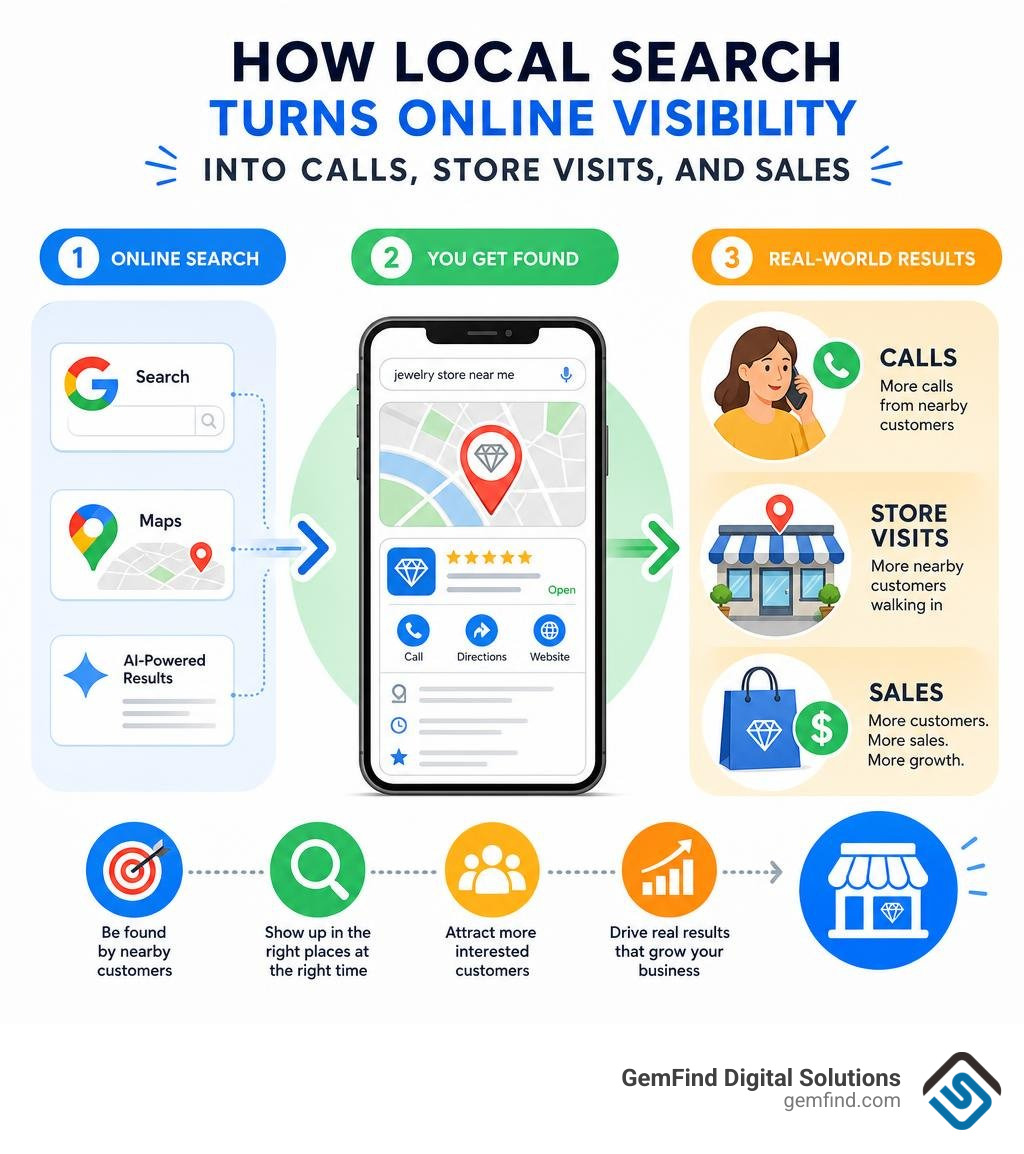
What Local SEO Is and Why It Matters for Small Businesses
When we talk about digital marketing, it is easy to get lost in a sea of acronyms. But if you run a physical storefront or serve a specific geographic region, there is one acronym you cannot afford to ignore: local SEO.
What Is Local SEO?
Local SEO (Search Engine Optimization) is the practice of optimizing your online presence to attract more business from relevant local searches. These searches take place on Google and other search engines, but they also occur on map applications and virtual assistants.
Whenever a user types in a query with local intent—such as "custom engagement rings near me" or "best watch repair in Chicago"—search engines know the user is looking for something nearby. Local SEO ensures your business is the one that pops up. It involves optimizing your Google Business Profile (GBP), building consistent local directory listings (citations), earning positive reviews, and creating location-focused website content.
How Local SEO Differs from Traditional SEO
Traditional SEO is built to help websites rank for broad, non-geographically bound queries. If you write an amazing blog post on "how to clean a diamond ring," you want anyone in the world to read it.
Local SEO, however, is hyper-focused on geographic relevance. It aims to dominate the Local Map Pack (the top three map listings displayed in Google search results) and localized organic search results.
| Feature | Traditional SEO | Local SEO |
|---|---|---|
| Primary Goal | National or global organic rankings | Local Map Pack and local organic rankings |
| Geographic Target | Broad (entire countries or globally) | Specific cities, neighborhoods, or zip codes |
| Key Ranking Signals | High-quality backlinks, domain authority, broad content | Google Business Profile, reviews, NAP consistency, local links |
| Core Search Intent | Informational or e-commerce browsing | High commercial intent, immediate physical action |
| Conversion Focus | Online sales, email signups, digital leads | Foot traffic, phone calls, local service bookings |
While traditional SEO relies heavily on broad backlinks and site-wide content authority, local SEO lives and dies by geographic markers. It proves to Google that you have a physical presence and are trusted by the local community.
Why Local SEO Is Important for Small Businesses in 2026
In 2026, the way consumers find local businesses is changing rapidly. With the rise of AI-driven search overviews and voice-activated mobile assistants, customers expect immediate, highly accurate answers.
When 82% of people use their phones to conduct "near me" searches, your business needs to be visible at the exact moment of high-intent discovery. Local SEO is highly effective because it captures users at the very end of the buying funnel. In fact, 50% of local smartphone searches lead to a physical store visit within 24 hours.
For small businesses, local SEO is the ultimate equalizer. It allows a boutique, independent jewelry store to outrank massive national chains in their own backyard. By building local trust and local relevance, you create a digital moat around your physical location. To dive deeper into this concept, read our article on How Local SEO Can Help Jewelers Attract More Customers.
The Key Ranking Factors Behind Local SEO Services for Small Business
To rank at the top of local search results, you must understand how Google’s local algorithm works. Google uses three primary pillars to determine local rankings: proximity, relevance, and prominence.
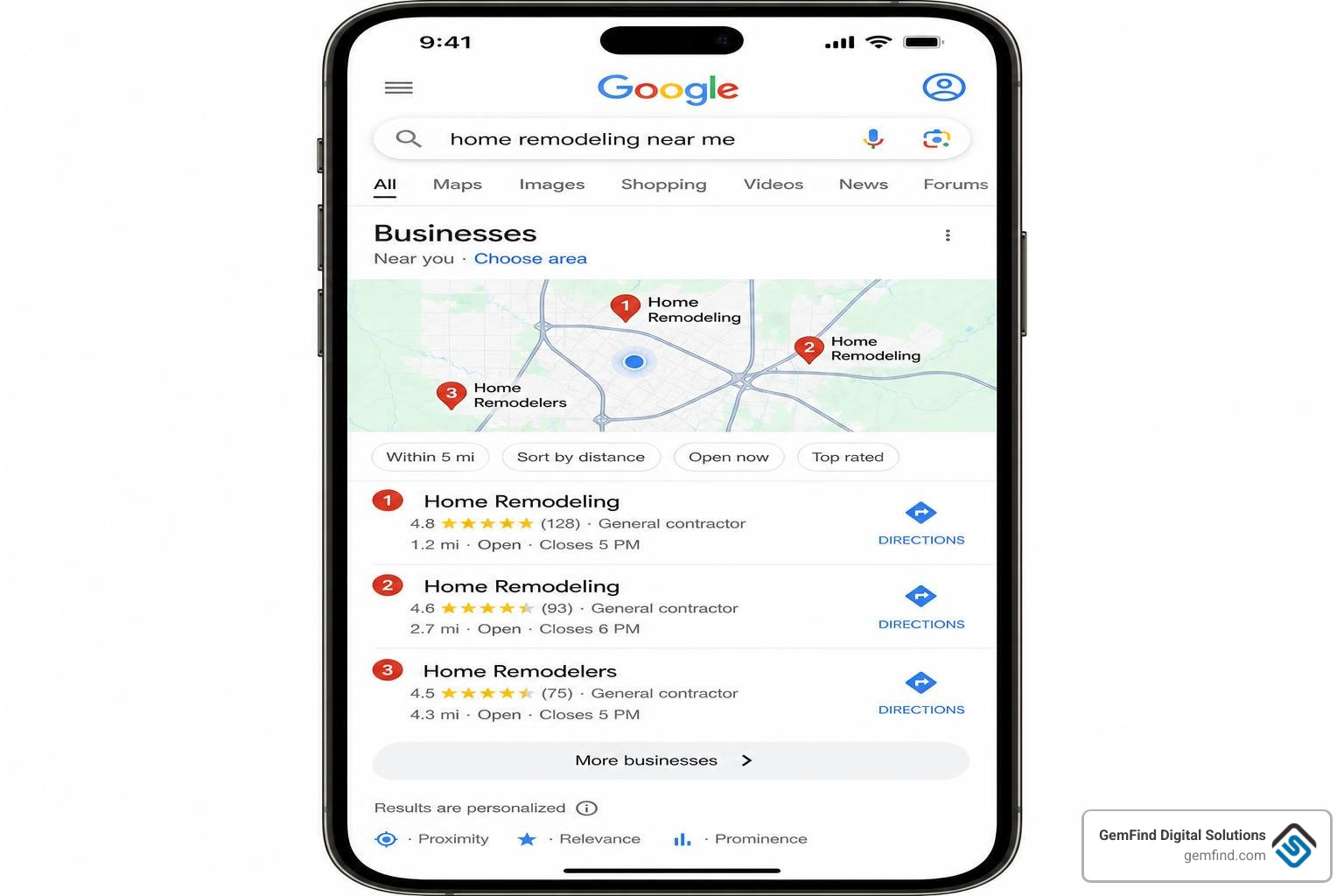
- Proximity: How close is your business to the person searching?
- Relevance: How well does your business listing match the user's search query?
- Prominence: How well-known or trusted is your business, both offline and online?
While you cannot control a searcher’s physical proximity, you have complete control over relevance and prominence. Professional local SEO services for small business focus on optimizing the following core signals to boost these two pillars:
Google Business Profile Signals
Your Google Business Profile (GBP) is the single most important ranking factor for the Local Map Pack. Google looks closely at your primary and secondary business categories, list of services, and physical address.
Keeping your profile complete, active, and thoroughly detailed sends strong trust signals to Google’s algorithm. To make sure you aren't missing any opportunities, check out our guide on how to Optimize Your Jewelry Store's Google Listing for Maximum Visibility.
Reviews, Ratings, and Reputation Signals
Online reviews serve a dual purpose: they are a direct Google ranking factor and a powerful conversion tool. Google evaluates the quantity, quality, recency, and velocity of your reviews.
A steady stream of fresh, highly rated reviews tells Google that your business is open, active, and trusted by actual customers. Additionally, reviews that naturally mention specific services (like "custom jewelry design") and your city name help search engines associate your business with those local keywords.
Citations, NAP Consistency, and Local Directories
A citation is any online mention of your business’s Name, Address, and Phone number (known as NAP). These typically appear on local directory sites, map platforms, and business databases.
Google’s algorithm cross-references these directories to verify that your business is legitimate and operating at the stated location. If your phone number is different on Yelp than it is on your website, Google gets confused, views your business as less reliable, and drops your rankings. Consistent NAP details act as a vote of confidence for your local presence.
Website and On-Page Local SEO Signals
Your website must be optimized to rank in localized organic search results beneath the Map Pack. This requires clear geographic signals built into your site's structure, including local schema markup, optimized title tags, meta descriptions, and dedicated location pages.
Technical performance is also critical—your site must load fast and look great on mobile devices, as the vast majority of local searches happen on the go. For more organic search tips, read about How to Get More Visibility of Your Jewelry Products with Organic Search Tactics.
How to Optimize Your Google Business Profile for Maximum Local Visibility
Because your Google Business Profile is the absolute foundation of local search success, optimizing it should be your top priority.
Local SEO Services for Small Business: Google Business Profile Checklist
If you are ready to claim and optimize your profile, here is a step-by-step checklist to ensure you do not miss any critical details:
- Verify Your Business: Complete Google’s verification process (usually via phone, email, or video) to gain full control of your listing.
- Standardize Your NAP: Ensure your business name, address, and phone number match your physical storefront and website exactly.
- Choose the Perfect Categories: Select your primary category with precision (e.g., "Jeweler" or "Jewelry Store") and add relevant secondary categories (e.g., "Jewelry Repair Service", "Bridal Shop").
- Write a Detailed Description: Craft an engaging 750-character business description that naturally includes your target keywords and the areas you serve.
- List Your Services and Products: Populate your services tab with detailed descriptions and use the Product Editor to showcase your physical inventory.
- Upload High-Resolution Photos: Regularly post photos of your storefront, team, and products to build trust and increase user engagement.
- Set Accurate Hours: Keep your regular business hours updated and proactively set holiday hours to avoid frustrating customers.
To make sure you have a solid grasp of the basics before you begin, take a look at our quick breakdown of Google My Business Basics.
How To Improve Google Map Rankings
Ranking in the top three spots of Google Maps—often called the "Local 3-Pack"—takes more than just filling out your profile. To truly stand out, you need to actively engage with your listing and send continuous trust signals to Google.
First, focus on a proactive review acquisition strategy. Encourage every happy customer to leave a review right after their purchase.
Second, make sure your website is tightly linked to your GBP. The landing page URL you link to from your profile should be optimized for the same local keywords you want your map listing to rank for.
Third, monitor user behavior. Google monitors how many people click to call your business, request driving directions, or message you directly through your profile. Higher engagement rates lead to higher map rankings. For a step-by-step roadmap, follow our 5 Easy Steps to Boost the Google Map Ranking of Your Jewelry Business and Get More Customers.
How Often to Update Your Profile
A set-it-and-forget-it approach does not work for local SEO in 2026. Google rewards active businesses that keep their listings fresh.
- Weekly: Post updates, promotional offers, or new arrivals using Google Posts. Upload new behind-the-scenes photos of your shop.
- Daily/As They Arrive: Respond to customer reviews (both positive and negative) and answer incoming customer questions in the Q&A section.
- Monthly: Review your product listings, update pricing or descriptions, and check your profile insights to see how customers are finding you.
The Best Local SEO Strategies for Small Businesses
To build a sustainable flow of local leads, you need a comprehensive strategy that connects your Google Business Profile, your website, and your broader online reputation.
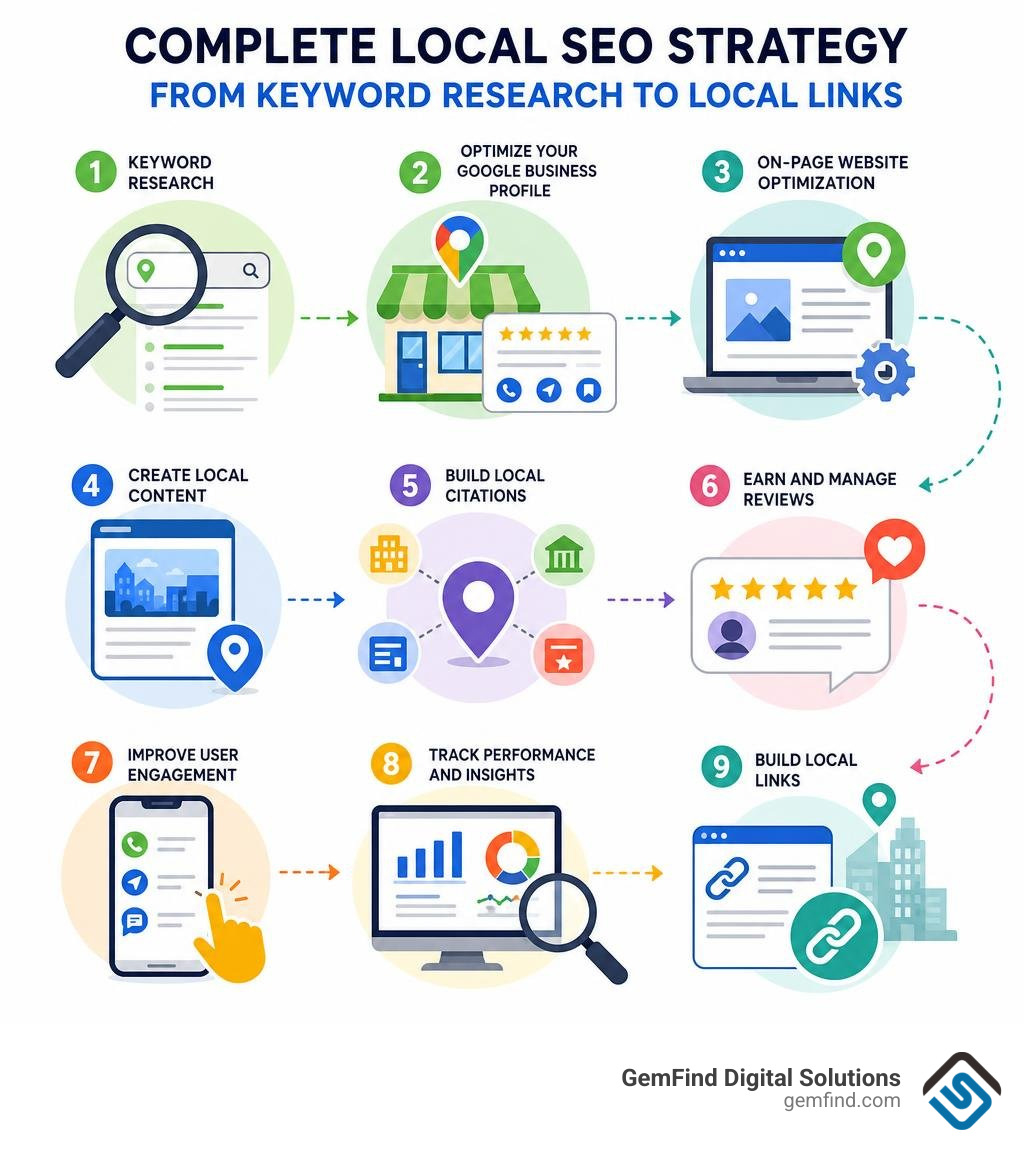
Local Keyword Research and Location-Based Content
You cannot optimize your business for local search until you know exactly what your customers are typing into search boxes. Local keyword research involves combining your core products or services with geographic modifiers.
Instead of targeting broad terms like "diamond rings," focus on high-intent local variations such as:
- "engagement rings in [City Name]"
- "best custom jeweler near me"
- "jewelry repair [Neighborhood Name]"
By targeting these long-tail, localized keywords, you attract buyers who are much closer to making a purchase decision. For a detailed guide on capturing these valuable searches, read How to Rank in Jewelry Stores Near Me Searches.
Build Local Landing Pages That Actually Help Customers
If your business serves multiple neighborhoods or cities, creating dedicated location or service-area pages is a must. These pages should not be simple copy-and-paste templates with the city names swapped out—Google easily identifies and penalizes thin, duplicate content.
Instead, build rich, helpful landing pages for each area you serve. Each page should feature:
- Unique copy detailing your services in that specific area.
- Clear Name, Address, and Phone number (NAP) information.
- An embedded Google Map pointing to your location.
- Local customer testimonials and reviews.
- Localized FAQs to address common neighborhood questions.
- Clear calls-to-action (e.g., "Book a Consultation").
Earn More Reviews Without Breaking Platform Rules
We cannot overstate the importance of customer reviews for local search. However, you must acquire them ethically. Never buy reviews, offer direct financial incentives for positive ratings, or set up "review gating" systems that block negative feedback.
Instead, build a seamless review generation process into your daily operations. Send automated SMS or email follow-ups shortly after a customer leaves your store. Train your sales staff to say, "If you loved your experience today, it would mean the world to our small business if you left us a quick review on Google!"
Always respond professionally to every review you receive. Responding to negative reviews with grace, empathy, and a solution shows potential customers—and search engines—that you care deeply about your reputation.
Strengthen Local Authority with Citations and Backlinks
While traditional link building can be incredibly difficult, local link building is much more accessible. It is all about leveraging your real-world community relationships online.
To build local authority, you can:
- Sponsor local youth sports teams, charity events, or community festivals that link back to your website.
- Join your local Chamber of Commerce and neighborhood business associations.
- Partner with complementary, non-competing local businesses (like a local bridal boutique or florist) for cross-promotional blog posts or resource links.
- Reach out to local news outlets or community blogs to share stories about your store's events or milestones.
Use Mobile, Voice, and AI Search to Capture “Best Near Me” Customers
As search engines shift from displaying simple lists of links to providing direct AI-driven recommendations, your local SEO strategy must adapt. This is where Generative Engine Optimization (GEO) comes into play. AI engines like ChatGPT, Google Gemini, and AI Overviews pull data from a wide variety of sources to recommend the "best" local businesses.
To ensure your shop is recommended by these AI systems, you must optimize for conversational, natural language queries. Use clear schema markup on your website to explicitly define your business type, location, and offerings.
Encourage your customers to use descriptive language in their reviews, as AI engines analyze review sentiment and specific phrases to validate whether your business matches a user's highly specific intent. For a deeper look at how AI is transforming local search, explore the concepts behind GEO Services | Local Presence SEO, LLC.
Costs, Timelines, Tools, and How to Choose the Right Local SEO Help
Investing in local SEO services for small business is one of the most cost-effective marketing decisions you can make. Unlike paid advertising, where your traffic stops the moment you stop paying, local SEO builds long-term equity in your digital presence.
How Much Do Local SEO Services Cost for Small Businesses?
Local SEO pricing varies widely depending on your industry, the size of your market, and the level of competition. Generally, you can expect to see pricing fall into three main tiers:
- Starter/Local Citation Cleanup ($300 – $800/month): Best for single-location businesses in low-competition areas. This tier usually covers basic Google Business Profile management, citation building, and monthly reporting.
- Growth and Active Optimization ($1,000 – $3,000/month): Ideal for businesses in competitive markets or those with multiple locations. This tier includes active on-page SEO, localized content creation, regular review management, local link building, and deeper competitor analysis. For a sense of pricing in highly competitive metropolitan markets, you can review the Best Local SEO Companies in New York 2026 | Semrush.
- Enterprise/Multi-Location ($3,000+/month): Tailored for large, multi-state franchises or highly competitive niches requiring extensive custom development, technical SEO, and massive local link acquisition campaigns.
How Long Does Local SEO Take to Show Results?
SEO is a long-term strategy, not an overnight quick fix. However, local SEO often yields faster results than traditional organic SEO.
- 30 to 90 Days: You should begin to see initial movement in your Map Pack rankings, citation accuracy, and Google Business Profile views.
- 3 to 6 Months: As Google crawls your clean citations and updated website content, you will typically see a noticeable increase in phone calls, website traffic, and store visits.
- 6 to 12 Months: Your local authority compounds. You begin to dominate local searches for your primary and secondary keywords, making it incredibly difficult for competitors to displace you.
Tools and Resources for Small Business Local SEO
If you want to track your local SEO performance or manage some aspects of it in-house, several powerful tools can simplify the process:
- Google Business Profile (Free): Your essential dashboard for managing your map listing and analyzing customer actions.
- Google Search Console & Google Analytics (Free): Crucial for tracking organic search traffic, keyword rankings, and website user behavior.
- Semrush or Ahrefs (Paid): Industry-standard platforms for in-depth keyword research, competitor analysis, and local rank tracking.
- BrightLocal or Whitespark (Paid): Specialized local SEO tools designed for citation auditing, citation building, and geo-grid rank tracking.
How Local SEO Helps Small Businesses Compete with Larger Competitors
Many small business owners assume they cannot compete with massive national retailers that have million-dollar marketing budgets. But when it comes to local search, you have a massive advantage.
Google’s local algorithm is heavily biased toward proximity and authentic local relevance. A massive national brand cannot easily replicate the deep, neighborhood-level trust that a local business builds naturally. By securing authentic reviews from actual residents, participating in community events, and optimizing your Google Business Profile with neighborhood-specific details, you can consistently outrank corporate giants in your local market.
Common Local SEO Mistakes to Avoid
To keep your rankings growing steadily, make sure you avoid these common local SEO pitfalls:
- Keyword Stuffing: Do not add extra keywords or city names to your official business name on your Google Business Profile (e.g., naming your shop "Sparkle Jewelers - Best Engagement Rings Chicago" if your legal name is just "Sparkle Jewelers"). This is a direct violation of Google's terms and can lead to a profile suspension.
- Inconsistent NAP Details: Ensure your business name, address, and phone number are formatted exactly the same way across all directories.
- Ignoring Negative Reviews: Leaving negative reviews unanswered makes your business look indifferent to customer service.
- Using Fake Addresses: Never try to rank in a city where you do not have a physical, verified storefront or an authorized service area. Google is highly skilled at detecting virtual offices and UPS store addresses.
- Falling for Cheap Spam Tactics: Avoid agencies that promise "guaranteed #1 rankings in 30 days" for $99. These providers often use spammy, automated tactics that can get your website permanently penalized by search engines.
Frequently Asked Questions About Local SEO Services for Small Business
To help you navigate your local search journey, here are answers to some of the most common questions small business owners ask:
What Is Usually Included in Local SEO Services for Small Business?
A comprehensive local SEO package typically includes an initial website and citation audit, Google Business Profile optimization, ongoing citation building and directory cleanup, localized keyword research, on-page optimization (including local schema markup), a structured review acquisition strategy, local link building, and monthly performance reporting.
Do Small Businesses Need a Physical Address to Rank Locally?
No, you do not necessarily need a physical storefront where customers walk in. If you run a service-area business (such as a mobile jewelry appraiser or a home-delivery service), you can set up a Service Area Business (SAB) profile on Google. This allows you to hide your physical home address while still ranking for the specific cities and zip codes you serve.
Can Any Agency Guarantee Google Maps Rankings?
No ethical digital marketing agency can guarantee specific rankings on Google Maps or organic search. Google’s search algorithm changes constantly, and search results are highly personalized based on a user's precise physical location and search history. Instead of guarantees, look for partners who promise transparent reporting, proven white-hat methodologies, and a consistent track record of growth.
Put Your Shop on the Digital Map Today
Building a dominant local search presence is one of the most powerful ways to secure a steady stream of high-intent customers for your small business. From optimizing your Google Business Profile to earning consistent reviews and building local backlinks, every optimization you make builds long-term digital equity for your physical storefront.
At GemFind Digital Solutions, we have spent over 25 years helping jewelry retailers, brands, and manufacturers build powerful, high-converting digital presences. As a certified Google and Shopify Partner, we specialize in crafting tailored local SEO strategies, beautiful web designs, and seamless POS integrations that turn search visibility into real, measurable revenue.
Ready to outshine your local competitors and capture more "near me" searches? Take the first step toward dominating your local market by reading our 4 Tips to Increase Your Jewelry Store's Local Visibility on Google.
To discover how we can customize a comprehensive search strategy for your unique business goals, explore our ultimate SEO Jewelry Guide for 2026 and schedule a consultation with our team of experts today.


