



Why Programmatic Advertising Best Practices Matter for Your Business

Programmatic advertising best practices can mean the difference between wasted ad spend and a campaign that consistently drives new customers to your jewelry store.
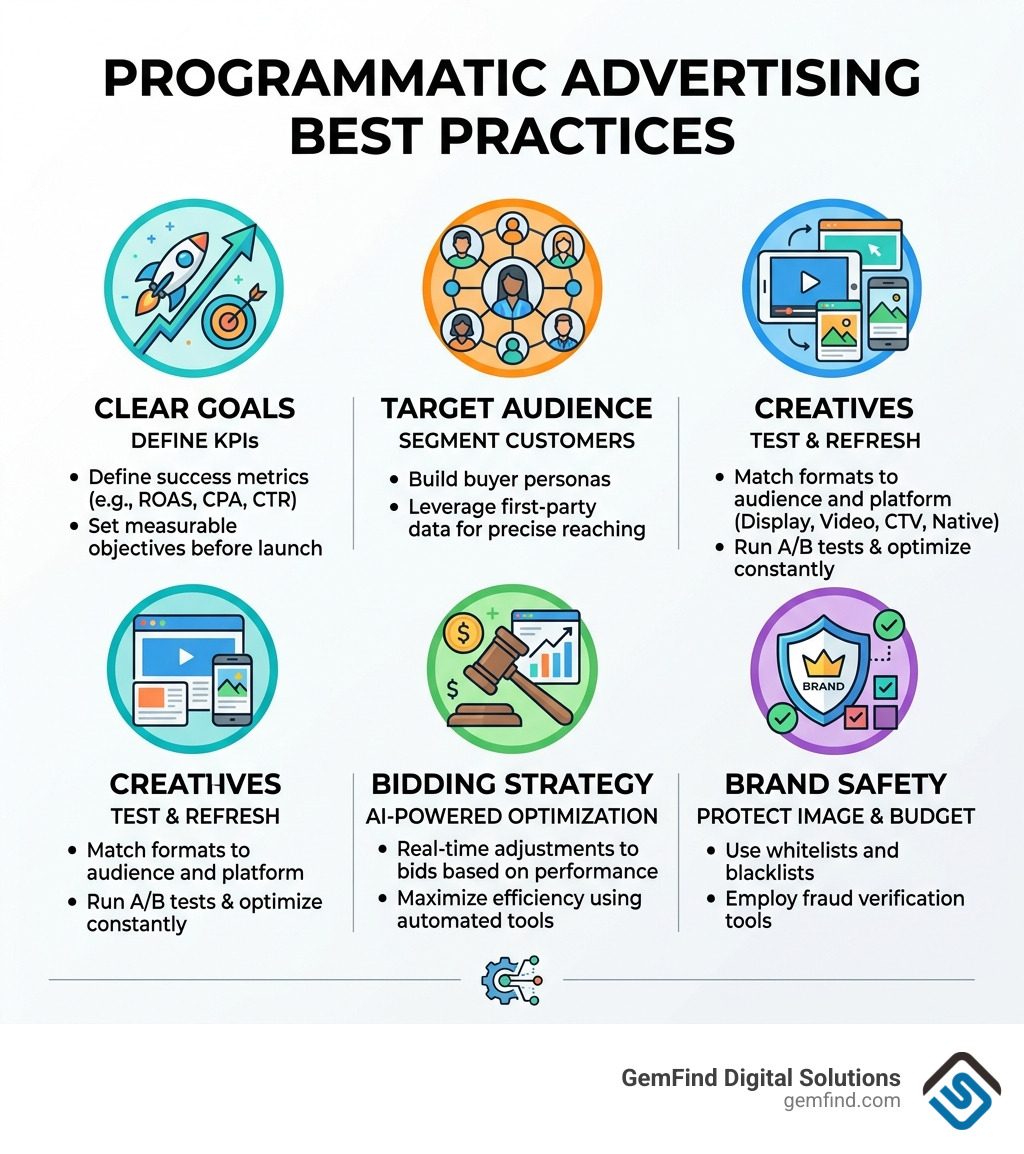
Here's a quick overview of the most important practices to follow:
- Set clear goals and KPIs - Define success before you launch (CTR, ROAS, CPA)
- Build audience segments - Use buyer personas and first-party data to reach the right people
- Choose the right ad formats - Match display, video, native, or CTV to your audience and platform
- Protect your brand - Use whitelists, blacklists, and fraud verification tools
- Optimize in real time - Adjust bids, creatives, and targeting based on live performance data
- Embrace first-party data - With third-party cookies fading out, your own customer data is gold
- Test and refresh creatives - Run A/B tests and use Dynamic Creative Optimization (DCO)
- Cap ad frequency - Avoid annoying your audience by limiting how often they see the same ad
Programmatic advertising now accounts for roughly 80% of all digital display ad spend. That's not a trend — that's the new normal. Yet many jewelry retailers still launch campaigns without a clear strategy, then wonder why results fall flat.
The good news? A structured approach fixes most of those problems.
I'm Anthony Arechiga, VP of Sales at GemFind Digital Solutions, where I've spent nearly two decades helping jewelry retailers build smarter digital marketing strategies — including programmatic advertising best practices that drive real, measurable growth. In the sections ahead, I'll walk you through exactly how to build a winning programmatic strategy from the ground up.
How Programmatic Advertising Works in 2026
To master programmatic advertising best practices, we first need to understand the machinery under the hood. In 2026, programmatic is no longer just about buying "cheap banner ads." It is a sophisticated, AI-driven ecosystem that automates the buying and selling of ad inventory in milliseconds.
The core of this system is Real-Time Bidding (RTB). Think of it as a high-speed digital auction. When a potential customer visits a website or opens an app, their browser communicates with an ad exchange. In the blink of an eye (literally less than a second), various advertisers bid on the right to show that specific user an ad. The highest bidder wins, and the ad is served.
This process involves two main sides:
- The Demand-Side Platform (DSP): This is what we use as advertisers to set our bids, target our audience, and manage our campaigns.
- The Supply-Side Platform (SSP): This is what publishers use to sell their ad space (inventory).
By 2026, this technology has expanded far beyond simple websites. We now use programmatic to buy spots on Connected TV (CTV), Digital Out-of-Home (DOOH) billboards, and even programmatic audio ads in podcasts. The use of AI has made these auctions smarter, allowing us to predict which users are most likely to convert before we even place a bid.
Strategic Foundation: Goals and Audience Targeting
We have seen many campaigns fail because they started with the "how" instead of the "why." A winning strategy must be built on a foundation of clear objectives. Are you looking for brand awareness for a new bridal collection, or are you trying to drive immediate sales for a holiday promotion?
Defining Your KPIs
Your goals determine your Key Performance Indicators (KPIs). For a jewelry brand, these typically include:
- Click-Through Rate (CTR): Are people interested enough to click?
- Return on Ad Spend (ROAS): For every dollar spent, how many dollars in jewelry sales did you generate?
- Cost Per Acquisition (CPA): How much does it cost to get a new customer into your shop or onto your site?
- Average Order Value (AOV): Are your ads attracting customers who buy high-ticket diamond rings or lower-cost silver charms?
Segmenting Your Audience
In programmatic, "spraying and praying" is a recipe for a drained budget. We recommend creating detailed buyer personas. For example, a "Proposal Planner" (someone researching engagement rings) requires a different message than a "Self-Purchasing Professional" looking for a luxury watch.
We can segment these audiences using:
- Demographics: Age, gender, and household income.
- Behavioral Data: Users who have recently visited luxury websites or searched for "best jewelers near me."
- Lookalike Audiences: Finding new people who share characteristics with your best current customers.
- Contextual Targeting: Placing ads on websites specifically about weddings, fashion, or luxury lifestyles.
Leveraging First-Party Data: Programmatic advertising best practices
As we move further into 2026, the "death of the third-party cookie" is no longer a future threat—it’s our current reality. This makes your first-party data (the info you own) your most valuable asset.
By using consent-based data from your CRM or email lists, we can build highly accurate targeting profiles. This is especially effective in Jewelry Programmatic Advertising, where high-intent data about past purchases or anniversary dates can trigger perfectly timed ads.
Programmatic advertising best practices for Creative and Formats
You can have the best targeting in the world, but if your creative is boring, no one will click. In programmatic, your ad needs to be the "bridge" between your brand and the customer's needs.

The Power of DCO and Personalization
One of the top programmatic advertising best practices is using Dynamic Creative Optimization (DCO). DCO uses real-time signals—like the user's location, the local weather, or the time of day—to change the ad's elements instantly. If it’s raining in New York, your ad could show a "Shop from Home" message; if it’s a sunny Saturday in Los Angeles, it might invite them to visit your showroom.
Choosing Your Formats
Don't limit yourself to one box. A diversified approach prevents ad fatigue:
- Video Ads: Perfect for showing the sparkle of a diamond. These perform exceptionally well on social platforms and CTV.
- Native Ads: These blend into the content of the website, making them feel less intrusive and more like a recommendation.
- Display Banners: Great for retargeting users who have already looked at a specific piece of jewelry on your site.
Mobile and Cross-Device Optimization
Your customers are constantly switching between their phones, tablets, and desktops. If your ad doesn't load instantly on a mobile device, you've lost the lead. We ensure all creatives are mobile-first, with large, readable fonts and clear Call-to-Action (CTA) buttons like "Book an Appointment" or "View Collection."
Advanced Bidding and Real-Time Optimization
Choosing how you buy your ad space is just as important as what you buy. Not all programmatic deals are created equal.
| Deal Type | Description | Best Use Case |
|---|---|---|
| Open Auction | The wild west; anyone can bid on the inventory. | Maximizing reach at the lowest cost. |
| Private Marketplace (PMP) | Invitation-only auctions for premium sites. | High-quality jewelry or fashion blogs. |
| Programmatic Guaranteed | You buy a set number of impressions at a fixed price. | Major holiday launches or brand takeovers. |
Real-Time Adjustments: Programmatic advertising best practices
The "set it and forget it" mindset is a common mistake. Successful campaigns require constant "grooming." We use real-time data to make adjustments on the fly:
- Bid Caps: If a certain website is too expensive and not converting, we lower our bid or stop bidding there entirely.
- Frequency Capping: We limit how many times one person sees your ad. Seeing an ad three times is a reminder; seeing it thirty times is an annoyance.
- Creative Refresh: If we notice the CTR is dropping, it’s time to swap out the image or change the headline to keep things fresh.
Brand Safety and Fraud Prevention Strategies
In the digital world, you have to be careful about the company you keep. You don't want your high-end jewelry brand appearing next to controversial news or low-quality content.

Protecting Your Integrity
We use a three-pronged approach to brand safety:
- Whitelists: A list of approved, high-quality websites where we want your ads to appear.
- Blacklists/Blocklists: A list of sites (like those with "fake news" or offensive content) that we explicitly avoid.
- Third-Party Verification: We partner with tools like DoubleVerify or IAS to ensure that your ads are being seen by real humans, not bots.
Ad fraud is a multi-billion dollar problem, but by following programmatic advertising best practices like monitoring traffic spikes and focusing on "viewability" (making sure the ad was actually on the screen), we can protect your investment.
Frequently Asked Questions about Programmatic Advertising
What are the most important KPIs for programmatic success?
While it depends on your goal, ROAS (Return on Ad Spend) is usually the king for jewelry retailers. However, don't ignore Attention Metrics. In 2026, we track how long a user actually looked at an ad, as this is a huge indicator of future brand loyalty.
How do I prevent ad fraud in my campaigns?
The best way to prevent fraud is to avoid the "cheapest possible CPMs." If a deal looks too good to be true, it’s probably bot traffic. Stick to trusted DSPs, use whitelists, and employ third-party verification services to monitor your traffic quality.
Why is first-party data critical in 2026?
Privacy laws like GDPR and CCPA, combined with the removal of third-party cookies, mean that you can no longer rely on other companies to tell you who your customers are. Your own data is more accurate, more compliant, and results in much higher conversion rates because it's based on real relationships.
Conclusion
Building a winning programmatic strategy isn't about clicking a few buttons and hoping for the best. It’s a blend of art and science—combining beautiful, high-quality creatives with rigorous data analysis and programmatic advertising best practices.
At GemFind Digital Solutions, we specialize in navigating this complexity for the jewelry industry. We don't just launch ads; we build systems that grow with your business. By focusing on your unique goals, leveraging your first-party data, and staying ahead of emerging trends like CTV and AI-driven optimization, we ensure your brand sparkles in the digital marketplace.
Ready to take your advertising further? Check out our Digital Marketing Pillar Page to learn more about how we can help you shine.
How To Optimize a Programmatic Ad Campaign | Gourmet Ads Essential Do's and Don'ts for Successful Programmatic Advertising Best Practices for Programmatic Advertising | AdRoll How to Build a Programmatic Advertising Strategy That Works Programmatic Advertising Strategy: The Ultimate Guide for 2026 Beyond the Bid: Advanced Strategies for Smarter Programmatic Campaigns | Hawke Media The Ultimate Guide to a Winning Programmatic Advertising Strategy The Beginner's Guide to Programmatic Advertising Creative best practices for programmatic - Precis


