

Programmatic Advertising: A Practical Way to Reach Shoppers

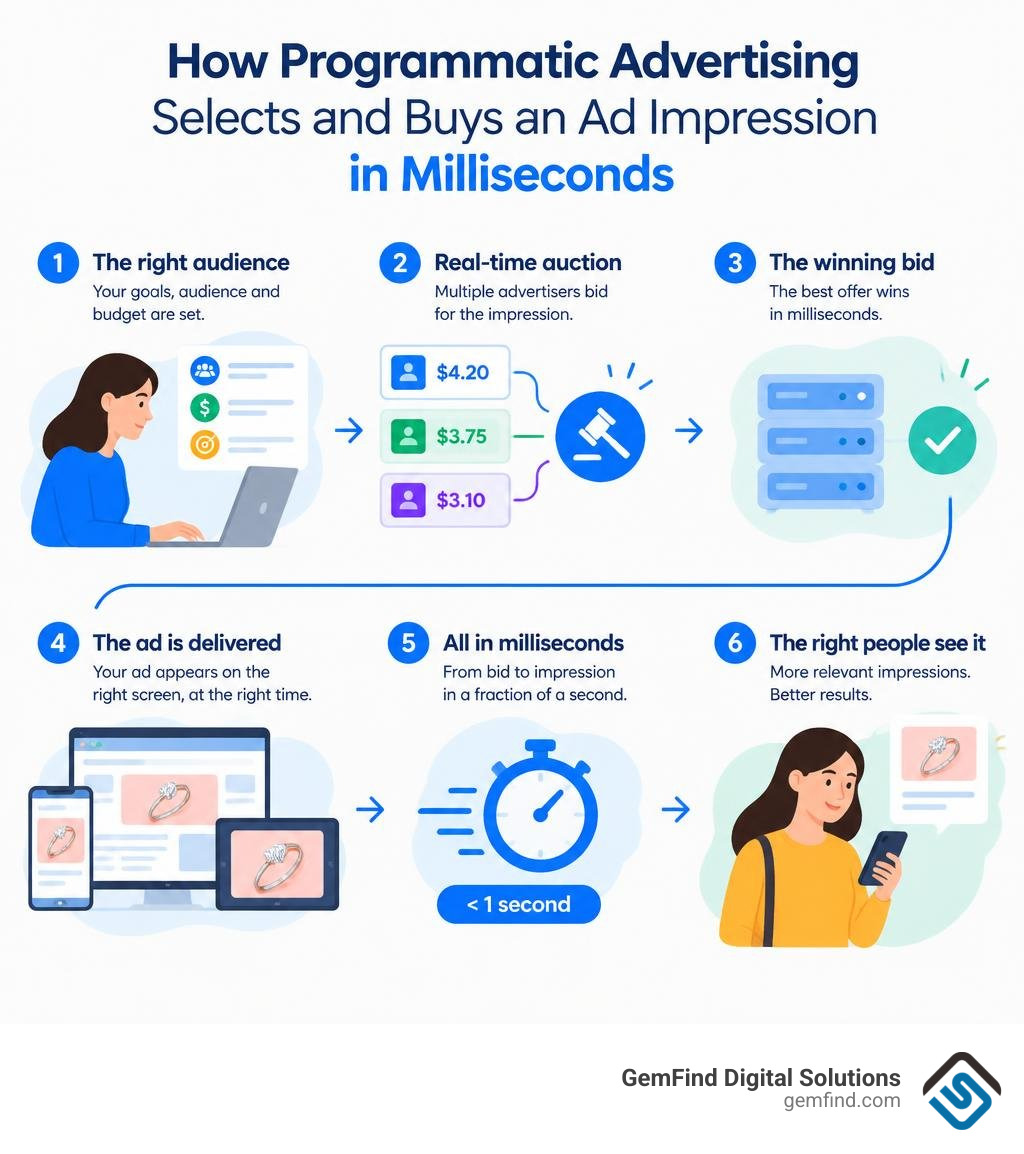
Programmatic advertising is the automated buying of digital ad space. Instead of arranging each placement with a website, a business sets its audience, budget, and goals. Software then helps choose where and when its ads appear, often by bidding for individual impressions in real time.
For a jewelry store, that could mean reaching local shoppers on websites and apps, or showing a follow-up ad to someone who viewed an engagement ring but did not buy. It can help you reach people before they search, while search ads remain useful when shoppers are ready to look for a specific product.
I'm Anthony Arechiga, Vice President of Sales at GemFind Digital Solutions. Since 2007, I've worked with jewelry businesses on digital marketing and e-commerce growth, and I'll use that experience to make programmatic advertising easier to evaluate.
What Is Programmatic Advertising and How Does It Work?
At its heart, programmatic media buying replaces manual negotiations, paper insertion orders, and back-and-forth emails with sophisticated algorithms and automated platforms. Rather than buying static ad space on a single website hoping the right customer visits, programmatic buying allows us to purchase individual ad impressions across millions of websites, mobile apps, connected TV (CTV) channels, and digital audio platforms in fractions of a second.
This transition shifts the focus from buying specific website real estate to buying relevant audiences. Instead of buying a fixed banner on a local news portal, an advertiser can serve impressions exclusively to users exhibiting high purchase intent—such as individuals researching bridal jewelry or diamond anniversary gifts—regardless of what publication or app they are currently browsing.
The Core Components of Programmatic Advertising
To understand how ad space is bought and sold automatically, it helps to understand the main pieces of technology working behind the scenes. Four key platforms connect buyers to sellers:
- Demand-Side Platform (DSP): Software used by advertisers and agencies to manage, purchase, and optimize ad inventory across multiple ad exchanges through a single interface. Modern automated media buying technology lets media buyers define target audiences, upload creatives, set maximum bids, and establish campaign parameters.
- Supply-Side Platform (SSP): Software used by digital publishers and website owners to automate the sale of their available ad inventory. SSPs allow publishers to set price floors, define minimum bidding requirements, and offer ad space to multiple ad exchanges simultaneously to maximize their revenue yield.
- Ad Exchange: The digital marketplace where DSPs and SSPs meet. The ad exchange receives inventory requests from SSPs, announces available impressions to connected DSPs, conducts lightning-fast auctions, and delivers the winning creative to the user's browser.
- Data Management Platform (DMP) / Customer Data Platform (CDP): Centralized data warehouses that collect, organize, and segment audience data from first-, second-, and third-party sources. These platforms feed rich demographic, contextual, and behavioral data into DSPs so bidding algorithms can evaluate the exact value of an ad impression before submitting a bid.
The Real-Time Bidding Auction Process
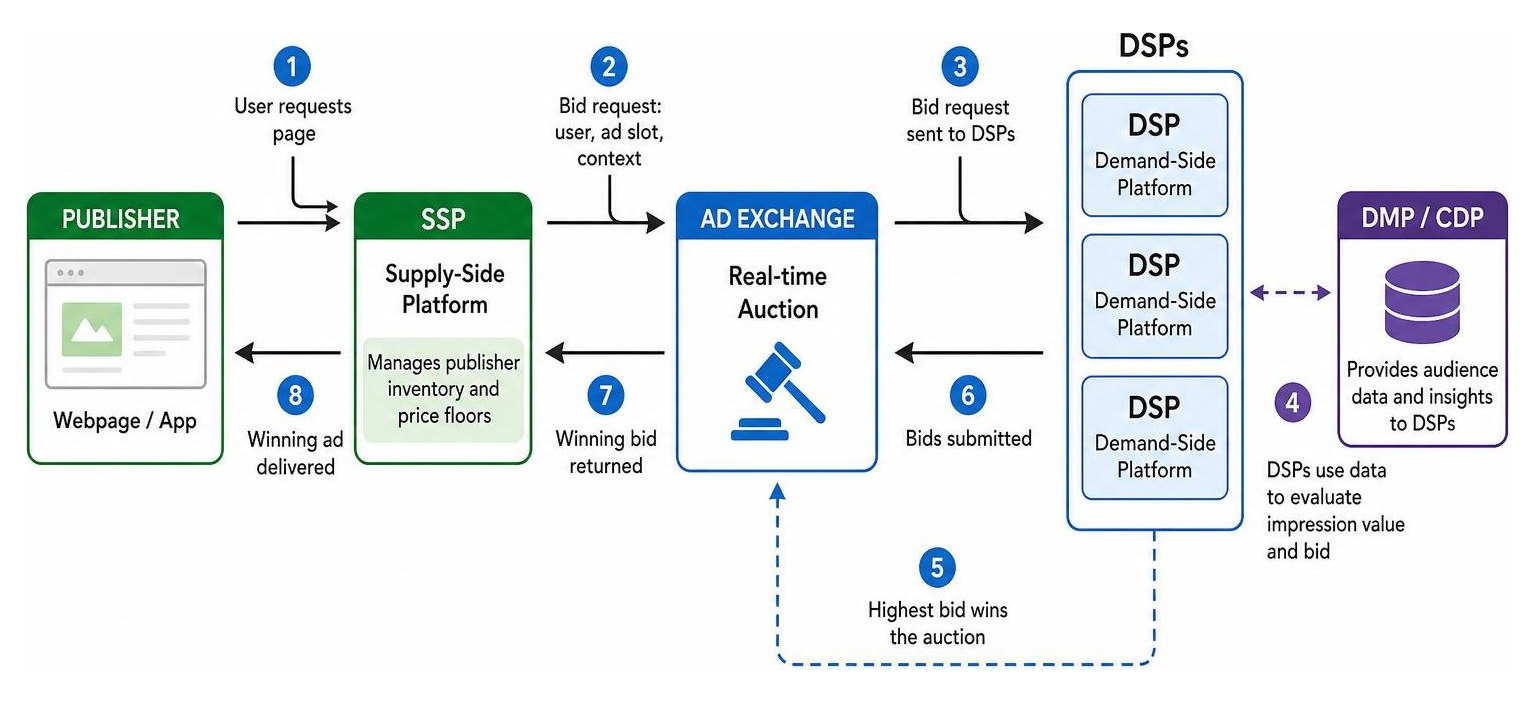
The most common transactional method within programmatic advertising is Real-Time Bidding (RTB). This dynamic auction takes place in the millisecond window between a user clicking a webpage link and the page fully rendering in their web browser (typically around 100 milliseconds).
Here is how the automated auction sequence unfolds:
- Step 1: Impression Generation: A visitor lands on a website or mobile app. As the page loads, the publisher's ad tag alerts their Supply-Side Platform that an ad unit is available.
- Step 2: Ad Request Broadcast: The SSP packages information about the impression—including the webpage URL, user location, device type, ad dimensions, and anonymized audience identifiers—and sends a bid request to the ad exchange.
- Step 3: DSP Evaluation: Connected Demand-Side Platforms analyze the incoming bid request against their active campaigns. The DSP references audience data to determine whether the visitor matches targeted criteria (for instance, a luxury jewelry shopper within 15 miles of a physical retail store).
- Step 4: Bid Valuation and Submission: Based on conversion probability and advertiser parameters, the DSP calculates the optimal bid price and submits its bid into the exchange auction.
- Step 5: Winner Determination and Ad Rendering: The ad exchange evaluates all incoming bids, selects the winning buyer, and instructs the user's browser to retrieve and display the winner's ad creative.
Programmatic Advertising vs Traditional Digital Advertising
Historically, buying digital advertising required direct human negotiation. A marketer would contact a specific publisher's sales representative, request a media kit, negotiate fixed pricing rates, manually sign an insertion order (IO), and send over static image files.
While direct insertion orders secured guaranteed real estate, the process proved cumbersome, inflexible, and prone to administrative waste. A study by The Boston Consulting Group revealed that advertising agencies often grapple with more than 25 separate inefficiencies in managing digital ad campaigns manually. In contrast, unified programmatic platforms streamline media workflows, improving operational efficiencies by up to 33%.
| Criteria | Traditional Direct Digital Advertising | Programmatic Advertising |
|---|---|---|
| Buying Process | Manual negotiations, RFPs, and static insertion orders | Automated algorithmic purchasing via DSPs and ad exchanges |
| Pricing Model | Fixed CPM agreed upon prior to launch | Dynamic pricing via real-time auctions or negotiated programmatic deals |
| Targeting Focus | Placement-centric (buying specific page locations) | Audience-centric (buying specific user profiles across channels) |
| Speed to Market | Days or weeks to draft, approve, and traffic campaigns | Real-time activation, instant creative swaps, and automated bid adjustments |
| Optimization | Manual mid-campaign adjustments through publisher reps | Continuous machine-learning optimization based on conversion data |
| Cross-Channel Reach | Fragmented across individual vendor contracts | Unified management spanning display, mobile, video, audio, and CTV |
Main Types of Programmatic Media Buying
Programmatic advertising encompasses multiple transaction structures beyond open auctions. Advertisers can choose different buying mechanisms depending on their need for pricing predictability, audience scale, and inventory exclusivity.
Real-Time Bidding and Open Auctions
The Open Auction (also known as the Open Marketplace or Public RTB) is the most widespread programmatic transaction model. In an open auction, publisher inventory is made accessible to all advertisers operating on connected DSPs.
Bidding occurs on an open exchange where supply and demand dictate real-time clearing prices. Open auctions offer virtually unlimited scale and cost efficiency, making them an ideal vehicle for broad brand awareness and top-of-funnel reach. However, because thousands of publishers participate, advertisers must maintain strict brand-safety filters, domain inclusion lists, and fraud prevention measures to safeguard where their ads appear.
Private Marketplaces and Preferred Deals
For brands seeking higher inventory control without sacrificing automation, Private Marketplaces (PMPs) offer a balanced middle ground:
- Private Marketplace (PMP): An invitation-only auction where premium publishers open selective ad inventory to a restricted group of buyers. Publishers often assign unique Deal IDs to buyers, offering priority access to high-impact ad placements before leftover impressions pass to the open auction.
- Preferred Deals: These occur when a publisher agrees to sell inventory directly to an advertiser at a negotiated, fixed CPM rate without placing the impression up for an open auction. While the price is fixed, the advertiser maintains the option to bid on individual impressions only when a matching audience profile is detected via direct inventory negotiation protocols.
Programmatic Direct and Guaranteed Deals
Programmatic Guaranteed (also referred to as Programmatic Direct) represents the complete digital convergence of direct media buying and programmatic execution. In a Programmatic Guaranteed transaction, the buyer and publisher agree on a fixed CPM price for a strictly reserved number of impressions, bypassing open-market auctions entirely.
This deal type guarantees placement on premium publisher environments (such as luxury lifestyle publications or marquee sports homepages) while retaining the automated delivery, advanced audience targeting, and centralized reporting capabilities of a modern DSP. For luxury retailers seeking exclusive positioning, exploring a dedicated programmatic direct advertising guide for 2026 provides actionable blueprints for structuring these direct agreements.
Advanced Targeting Capabilities Across the Customer Journey
The true power of programmatic media lies in its ability to deliver personalized messaging to prospective customers wherever they spend time online. By leveraging multiple layers of data, businesses can systematically guide consumers from initial brand discovery to in-store visits or online checkout.

Data-Driven Audience Targeting and Segmentation
Modern programmatic buying platforms use predictive machine learning models to profile, segment, and engage relevant consumer audiences. Advertisers can mix and match diverse targeting layers, including:
- Contextual Targeting: Multimodal AI models analyze the text, video, and image content of a webpage to place ads alongside relevant subject matter without relying on third-party tracking cookies. For instance, a diamond pendant ad can be served contextually within an article discussing fine anniversary gifts.
- Behavioral and Interest Targeting: DSPs construct audience segments based on historical browsing habits, content consumption, app usage, and purchase history.
- First-Party Data Onboarding: Businesses can securely hash and upload their existing customer relationship management (CRM) lists and POS transaction logs. This allows us to serve tailored campaigns to past shoppers or build algorithmic lookalike audiences that mirror our best customers using AI-driven targeting and bidding models.
- Demographic and Socioeconomic Filtering: Bid requests can be filtered by household income brackets, age ranges, parental status, and marital indicators to ensure marketing dollars focus strictly on qualified buyers.
Geofencing and Location-Based Targeting
Location data adds an indispensable dimension to programmatic campaigns, particularly for brick-and-mortar retailers and luxury showrooms. Hyperlocal mobile targeting allows marketers to build virtual geographic perimeters around specific coordinates:
- Competitor Geofencing: Drawing virtual boundaries around competitor locations to serve promotional messaging to active shoppers in the market.
- Event and Venue Targeting: Engaging attendees at bridal expos, charity galas, country clubs, or luxury lifestyle venues.
- Foot-Traffic Attribution: Tracking whether mobile devices that were served an ad subsequently walked into a physical retail storefront, providing clear conversion measurement.
Deploying specialized geofencing advertising for retail and luxury stores allows local businesses to dominate their immediate trade area. Furthermore, understanding how geofencing drives store visits ensures digital ad budgets directly translate into showroom consultations and physical foot traffic.
Full-Funnel Retargeting and Intent Capture
Programmatic advertising excels when orchestrated across the entire customer lifecycle. Rather than relying on a single static touchpoint, automated platforms dynamically adjust creative messaging and bidding aggression based on where a shopper sits within the decision journey.
| Funnel Stage | Primary Campaign Objective | Core Programmatic Tactics | Key Performance Metrics |
|---|---|---|---|
| Top of Funnel (Awareness) | Introduce the brand to qualified prospective buyers | Open RTB display, contextual video, Connected TV (CTV), digital audio | Impressions, Reach, Video Completion Rate (VCR), CPM |
| Middle of Funnel (Consideration) | Educate shoppers and drive high-intent website traffic | PMP deals on lifestyle sites, granular behavioral targeting, native ad units | Click-Through Rate (CTR), Cost Per Click (CPC), Time on Site |
| Bottom of Funnel (Conversion) | Recover abandoned carts and secure appointments | Dynamic Creative Optimization (DCO), CRM match, site retargeting | Cost Per Action (CPA), Return on Ad Spend (ROAS), Store Visits |
At the top of the funnel, broad contextual video and CTV introduce our brand's unique craftsmanship. As prospects visit specific product collection pages, dynamic creative optimization (DCO) automatically populates ad units with the exact items they browsed, paired with localized calls to action such as "Book a Private Consultation."
Strategic Best Practices, Costs, and Industry Challenges
While the benefits of automation are substantial, unlocking consistent return on investment requires diligent budget governance, brand-safety controls, and continuous performance optimization.
Budgeting, Cost Structures, and CPM Benchmarks
Programmatic media is primarily transacted on a Cost Per Mille (CPM) model, meaning advertisers pay a set price for every 1,000 ad impressions delivered. Standard display banner CPMs on open exchanges generally range from $0.40 to $3.00, making programmatic buying one of the most cost-effective avenues for building massive brand visibility.
However, pricing varies based on ad format and inventory exclusivity:
- Standard Display Banners: $0.50 – $3.50 CPM
- High-Impact Native Units: $2.00 – $6.00 CPM
- In-Stream Digital Video: $8.00 – $18.00 CPM
- Connected TV (CTV) / OTT: $15.00 – $35.00+ CPM
Integrating programmatic precision alongside specialized jewelry digital advertising strategies helps businesses capture high-margin purchases without overpaying for ad inventory.
Addressing Ad Fraud, Brand Safety, and Placement Control
The automated nature of open-market auctions introduces potential operational challenges that require active management:
- Ad Fraud and Invalid Traffic (IVT): Fraudulent networks use automated bot farms and hidden pixel stuffing to generate fake ad impressions. Juniper Research estimates that global digital advertising losses to fraud could reach $172 billion by 2028. Advertisers must enforce strict verification protocols using third-party fraud detection tools.
-
Brand Safety and Placement Control: In open auctions, unmonitored ads can inadvertently appear on low-quality or inappropriate websites. Implementing pre-bid brand safety filters, maintaining domain inclusion lists, and demanding
ads.txtauthorization ensures impressions serve solely on vetted, high-quality digital properties. - Supply Path Optimization (SPO): Streamlining the intermediaries between DSPs and SSPs eliminates unnecessary technology fees and ensures bids route through clean inventory paths with proven yield optimization and inventory quality.
Essential Campaign Optimization Strategies
To maximize programmatic performance, businesses should maintain a disciplined execution framework. Applying proven programmatic advertising best practices prevents wasted spend and keeps campaigns focused on core business metrics:
- Establish Explicit Conversion Goals: Define concrete primary performance indicators (such as ROAS, booked appointments, or foot-traffic lift) before launching campaigns, rather than optimizing solely for vanity metrics like raw impressions.
- Implement Frequency Capping: Set cross-device frequency caps (for example, limiting delivery to 3–5 impressions per user every 24 hours) to prevent audience ad fatigue and avoid annoying potential customers.
- Manage Whitelists and Placement Audits: Regularly audit placement reports within your DSP to prune underperforming publisher domains and direct budget toward high-converting inventory sources.
- A/B Test Dynamic Creatives: Continuously test variations of ad imagery, promotional headlines, and calls to action to maintain high engagement rates across all screen sizes.
- Align Cross-Channel Attribution: Measure programmatic performance alongside search and social channels using multi-touch attribution models to evaluate how display touchpoints influence downstream branded search volume.
Frequently Asked Questions About Programmatic Media Buying
How does programmatic media buying differ from search engine ads?
Search engine advertising (such as Google Ads) is fundamentally "pull" marketing driven by explicit user intent; it captures consumers who are actively typing specific search queries to find immediate solutions.
Programmatic advertising is primarily "push" marketing; it targets users based on their broader demographic profiles, digital behaviors, and physical locations before they sit down at a search engine bar. By introducing your brand across websites, streaming video, and mobile apps, programmatic advertising builds awareness and pipeline demand that ultimately fuels your search engine ad conversions.
What is the average CPM cost for automated display campaigns?
On open programmatic exchanges, standard display CPMs typically average between $0.40 and $3.00 per thousand impressions. Video, native formats, and high-tier Private Marketplace deals command higher CPMs ranging from $8.00 to $25.00+ due to higher user engagement rates and premium placement environments.
How do businesses prevent ad fraud in automated auctions?
Businesses prevent fraud by deploying pre-bid verification tools, utilizing DSPs with built-in machine-learning fraud detection, enforcing IAB ads.txt and sellers.json standards, and maintaining strict domain whitelists. Partnering with experienced digital media agencies ensures human oversight actively monitors campaign traffic for suspicious click spikes or bot anomalies.
Conclusion
Programmatic media buying has fundamentally revolutionized digital marketing by transforming ad placement into an automated, data-driven, and highly scalable discipline. By unifying audience segmentation, dynamic creative personalization, and omnichannel execution across a centralized technology stack, businesses can connect with their ideal customers at the exact moment of relevance.
Navigating the programmatic ecosystem requires technical expertise, deep audience insights, and continuous campaign governance. At GemFind Digital Solutions, we combine over 25 years of industry-specific digital marketing experience with cutting-edge ad tech to help luxury retailers and jewelry businesses build measurable brand equity and drive in-store sales. Explore our tailored jewelry programmatic advertising solutions and discover our complete suite of end-to-end digital growth services to elevate your brand today.


