


Why Google Ads Are a Jeweler's Best Friend
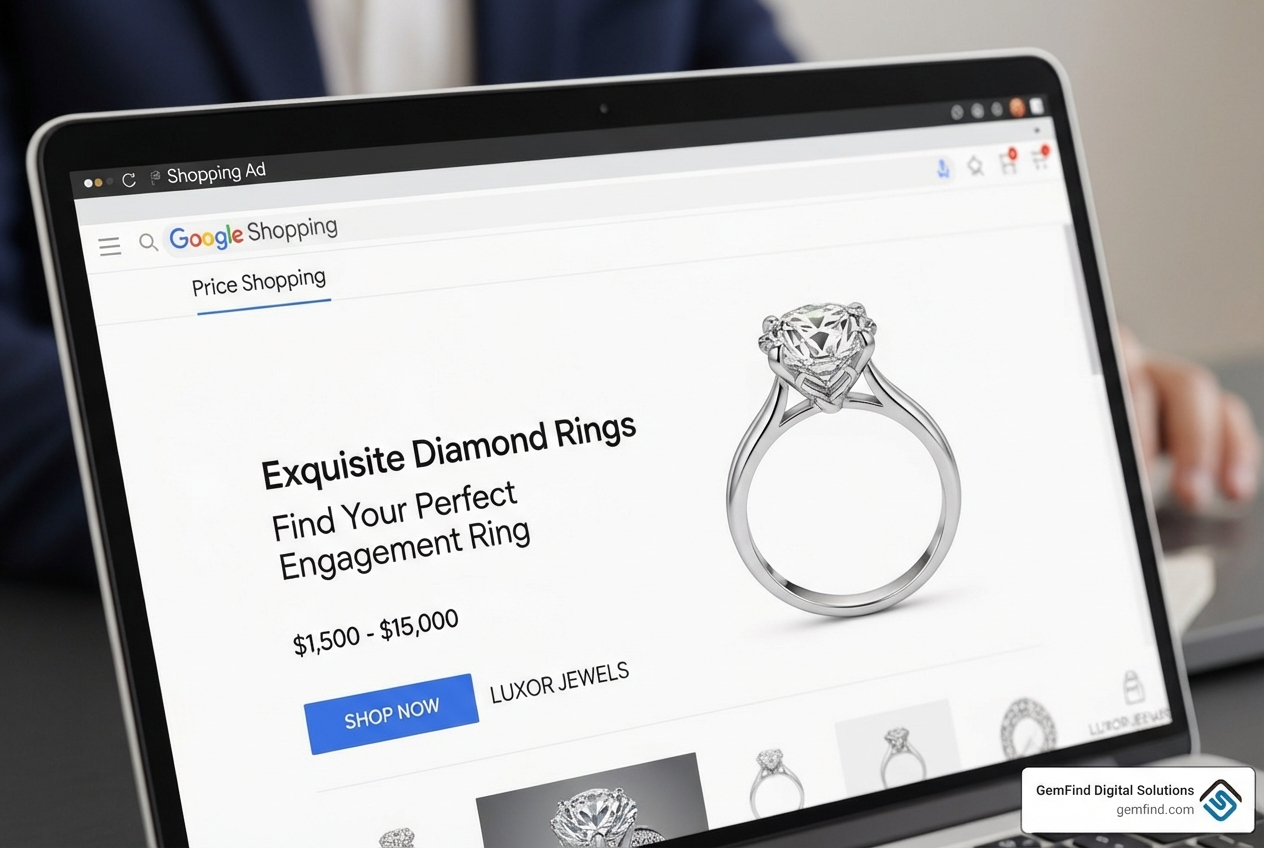
Best jewelry google ads combine stunning visuals, precise targeting, and emotionally compelling copy to turn high-intent searches into sales. The most effective jewelry ads on Google leverage Shopping campaigns with high-resolution product images, Search campaigns targeting keywords like "engagement rings" and "custom jewelry," and remarketing to re-engage browsers who didn't purchase. They use ad extensions to showcase trust signals, highlight unique selling propositions like ethical sourcing or lifetime warranties, and direct traffic to fast-loading, mobile-optimized landing pages that build confidence and urgency.
Quick Answer: What Makes the Best Jewelry Google Ads?
- Campaign Type: Shopping Ads for product findy, Search Ads for high-intent buyers, Performance Max for cross-channel reach
- Keywords: Target transactional terms ("buy diamond earrings online"), long-tail phrases ("rose gold engagement rings under $2000"), and local searches ("jewelry stores near me")
- Visuals: High-resolution images, lifestyle photography, and 360° product views
- Ad Copy: Emotion-driven headlines, social proof (reviews/ratings), and urgency drivers ("Limited Stock," "Free Shipping Ends Tonight")
- Extensions: Sitelinks to collections, price extensions, image extensions, and location extensions
- Landing Pages: Message match with ad, fast load times, clear CTAs, trust badges, and customer testimonials
The online jewelry market is cutthroat, with luxury brands, e-commerce giants, and small designers all competing for customers. However, jewelry buyers have high intent and high lifetime value. When someone searches for "custom engagement rings near me," they aren't just browsing—they're ready to buy.
Google Ads lets you reach these buyers exactly when they're searching. Unlike social media ads that interrupt someone scrolling, Google Ads captures demand that already exists. The keyword "engagement rings" alone sees hundreds of thousands of monthly searches, and advertisers collectively spend significant budgets on it because the return justifies the cost.
But jewelry is visual. A text ad can only do so much. That's why Google Shopping Ads have become the dominant format for many jewelry advertisers—they display product images directly in search results, and jewelers increasingly prioritize PLAs (Product Listing Ads) over plain text ads, especially on mobile.
The challenge isn't just getting clicks—it's building trust. Jewelry purchases are emotional and often expensive. Buyers need social proof, transparent pricing, and a seamless experience. The best jewelry google ads combine high-quality visuals, strategic keyword targeting, and landing pages designed to convert skeptical browsers into confident buyers.
At GemFind Digital Solutions, we've spent over 25 years helping jewelers build high-performing Google Ads campaigns that drive sales and traffic. The best ads aren't just about pretty pictures; they're about understanding buyer intent, using the right campaign types, and optimizing for ROI.
Laying the Foundation: Keyword and Audience Strategy
Keyword research is the bedrock of a successful Google Ads campaign for jewelers. It's about understanding what potential customers are searching for and, more importantly, the intent behind their search. Targeting the wrong keywords, like showing a diamond necklace ad to someone searching for "cheap costume jewelry," is a waste of money.
Precise keyword targeting is foundational. A mix of broad and niche keywords captures both general interest and specific buying intent. For instance, "engagement rings" gets very high monthly search volume, "jewelry" receives hundreds of thousands of searches, and "earrings" is also a heavily searched term. These statistics show the immense potential of Google Ads to reach a vast audience.
Simply targeting high-volume keywords isn't enough. We must identify the search intent—whether it's informational, comparison, or transactional—and tailor our ads and landing pages accordingly.
This meticulous approach helps us identify high-value customers who are most likely to convert, ensuring our ad spend is as efficient as possible.
Optimizing for High-Intent Searches: The best jewelry google ads keywords
Jewelry searchers typically fall into one of three intent categories:
- Transactional Intent: These are our golden geese. Users with transactional intent are ready to buy. They're searching for "buy gold earrings online," "custom engagement rings near me," or "diamond necklace sale." These keywords are often more competitive and have higher costs-per-click (CPCs), but they also yield the highest conversion rates.
- Informational Intent: These users are doing their research. They might search "how to choose a diamond ring," "types of gemstones," or "ethical sourcing jewelry." While not immediately ready to purchase, they are potential customers further down the funnel. We can target them with informative content and nurture them towards a sale.
- Navigational Intent: These users are looking for a specific brand or website. We use branded keywords to ensure we capture this traffic if it's for our brand, or to understand competitor activity.
For the best jewelry google ads, we prioritize transactional and high-intent informational keywords.
Here are some core keywords and examples of long-tail variations we target:
- Engagement rings: "custom engagement rings," "lab-grown diamond engagement rings," "vintage engagement rings NYC"
- Rings: "men's wedding bands," "promise rings for her," "stackable gold rings"
- Jewelry/Jewelry stores: "jewelry stores near me," "fine jewelry online," "unique jewelry gifts"
- Diamond: "diamond earrings studs," "loose diamonds for sale," "diamond pendants"
- Necklace: "gold chain necklace men," "pearl necklace women," "personalized name necklace"
Negative Keywords: Your Budget's Best Friend
Negative keywords are just as important as the ones you target. They prevent your ads from showing for irrelevant searches, saving money on wasted clicks. With high CPCs in the jewelry space, a strong negative keyword list is essential for budget efficiency.
Here's a list of essential negative keywords for jewelers:
- Repair: "jewelry repair," "watch repair services"
- Free: "free jewelry," "free ring sizer"
- Costume/Fake: "costume jewelry," "fake diamonds," "fashion jewelry cheap"
- DIY/How-to: "how to make jewelry," "DIY necklace," "jewelry making supplies"
- Rental: "rent wedding jewelry"
- Service-oriented: "jewelry appraisal," "pawn shop jewelry"
- Brands you don't sell: If you don't sell a specific brand, add that as a negative keyword.
Reaching the Right Buyer: Audience Targeting and Segmentation
Beyond keywords, audience segmentation is critical. It allows us to tailor messaging and creatives to resonate with specific buyer groups.
- Demographics: We segment by gender (e.g., men for engagement rings, women for fashion jewelry), age groups (e.g., 25-34 for first-time engagement ring buyers, 35-54 for high-end or custom pieces), and household income (often focusing on higher income brackets for items above $500).
- Life Events: Google allows us to target users based on significant life moments like "Getting married" or "Recently engaged." This is incredibly powerful for bridal jewelry.
- In-Market Audiences: These are users Google has identified as actively researching or planning to purchase products in specific categories, such as "Jewelry & Watches."
- Custom Audiences: We can create custom audiences based on specific search terms, types of websites visited, or apps used, allowing for hyper-targeted campaigns.
- Remarketing Lists: These lists are invaluable. They allow us to re-engage users who have previously visited our website but didn't convert.
- Gift Shoppers vs. Self-Purchasers: The motivations for these two groups are vastly different. A gift shopper might respond to "perfect gift for her" and expedited shipping, while a self-purchaser might focus on style, quality, and self-expression. Segmenting these audiences allows for highly personalized messaging.
Choosing Your Campaign: The Most Effective Google Ads for Jewelry
Google Ads offers a suite of campaign types, each with unique strengths. For jewelers, we orchestrate a mix of campaigns to capture immediate demand and build long-term brand awareness.
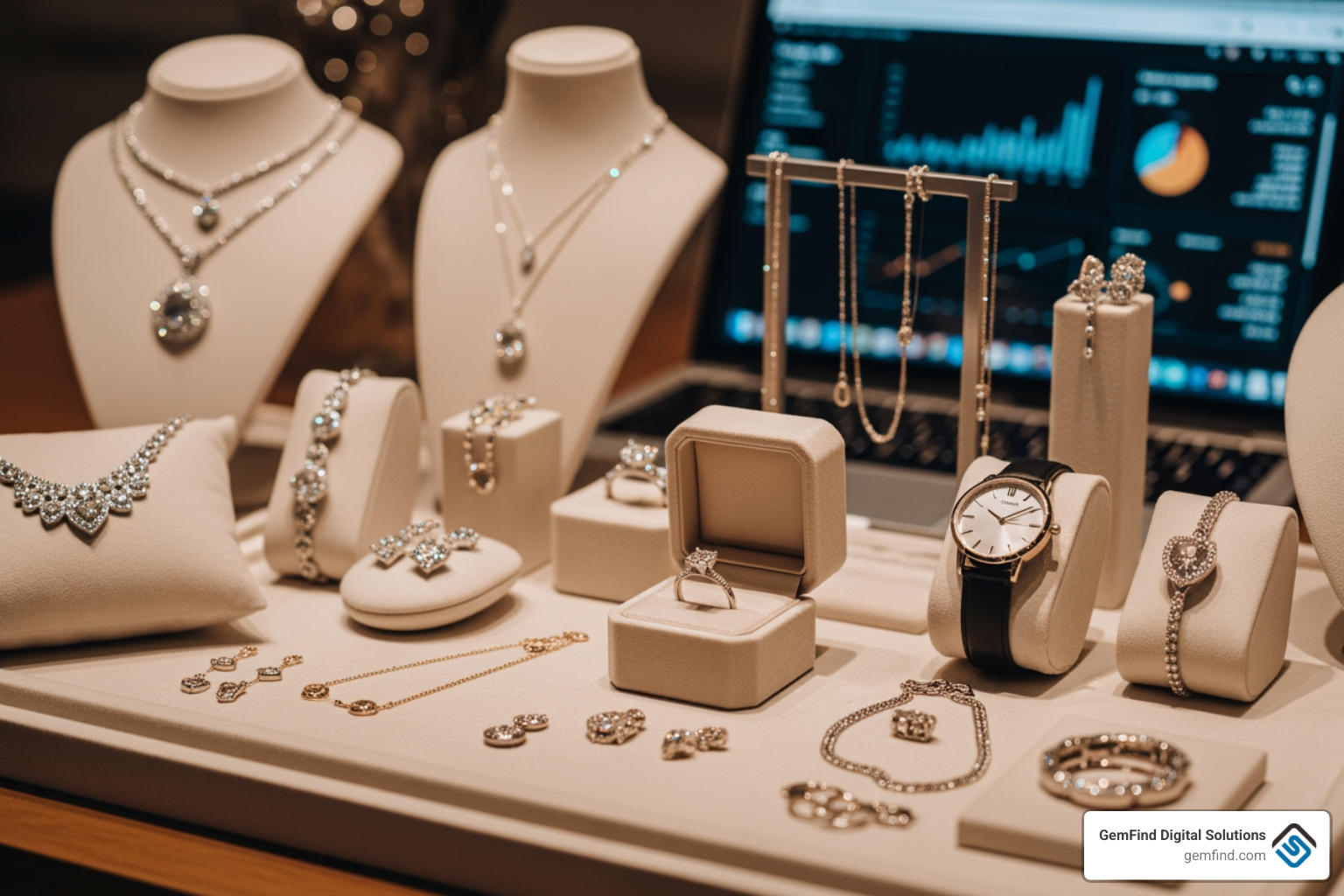
Our campaign objectives often dictate our budget allocation. For instance, if our primary goal is immediate sales, we'll heavily invest in Shopping and Search campaigns. If brand awareness is key, Display and Video-style campaigns will get more focus.
Here's a comparison of the most effective Google Ads campaign types for jewelry:
| Campaign Type | Best Use Case | Targeting Method | Key Benefit |
|---|---|---|---|
| Search Ads | Capturing high-intent buyers ready to purchase | Keywords, Audience Segments, Demographics | Directly answers user queries, high conversion intent |
| Shopping Ads | Showcasing products visually, driving e-commerce sales | Product Feed Data, Keywords, Audience Segments | Visual appeal, direct product visibility, comparison |
| Performance Max | Maximizing conversions across multiple Google channels | Goals (e.g., sales), Asset Groups, Audience Signals | Automated cross-channel optimization, broad reach |
| Display Ads | Brand awareness, visual storytelling, remarketing | Audience Segments, Interests, Placements, Remarketing | Visual impact, reach across websites, brand building |
Search & Shopping Campaigns: Capturing Active Demand
These campaigns are the workhorses of a jewelry Google Ads strategy, designed to intercept customers actively searching for your products.
- Search Ads (Text Ads): When someone types "buy diamond earrings online" or "wedding bands for men," our text ads appear directly in the search results. These ads are excellent for capturing high-intent searches because they directly answer a user's query. We craft compelling headlines and descriptions that highlight our unique selling propositions and calls to action.
- Shopping Ads (Product Listing Ads - PLAs): This is where jewelry truly shines. Google Shopping Ads display product images, prices, store names, and reviews directly in the search results. They are incredibly visual and effective, especially for a product category like jewelry. Unlike Search Ads, which rely on keywords we choose, Shopping Ads are driven by our product data feed, making feed optimization crucial. We ensure our product titles, descriptions, and attributes are detailed and accurate to help Google match our products to relevant searches.
Performance Max & Display: Building Brand and Finding New Customers
While Search and Shopping capture existing demand, Performance Max and Display help build brand awareness and find new customers.
- Performance Max (P-Max): This is Google's automated, goal-based campaign type that runs across multiple Google Ads channels (Search, Display, YouTube, Gmail, Find). For jewelry brands with robust e-commerce setups, P-Max can be a powerful cross-channel conversion engine. We provide Google with our best assets (images, videos, headlines, descriptions) and audience signals, and Google's AI optimizes for conversions. It's excellent for scaling campaigns and ensuring our message is seen wherever our potential customers are.
- Display Ads: Visually striking Display Ads keep jewelry brands in front of potential customers as they browse relevant websites or lifestyle content. These banner ads allow for rich visual storytelling, helping to build brand awareness and create an emotional connection. We use custom banners that are "on brand" and leverage behavioral targeting to show our products to users who have previously visited our site or shown interest in similar items. This also ties into remarketing, where we can re-engage users who viewed specific products but didn't purchase.
Designing Dazzling Ads: Creative, Copy, and Landing Page Best Practices
In the visual and emotional world of jewelry, ads must evoke desire, build trust, and tell a story. Success requires a combination of creative excellence, compelling messaging, and data-driven strategies. We constantly A/B test ads, visuals, and messaging to find what resonates. Mobile optimization and trust signals are non-negotiable for high-value purchases.
Crafting Compelling Ad Copy and Using Extensions
Ad copy is your chance to connect emotionally and highlight what makes your jewelry special.
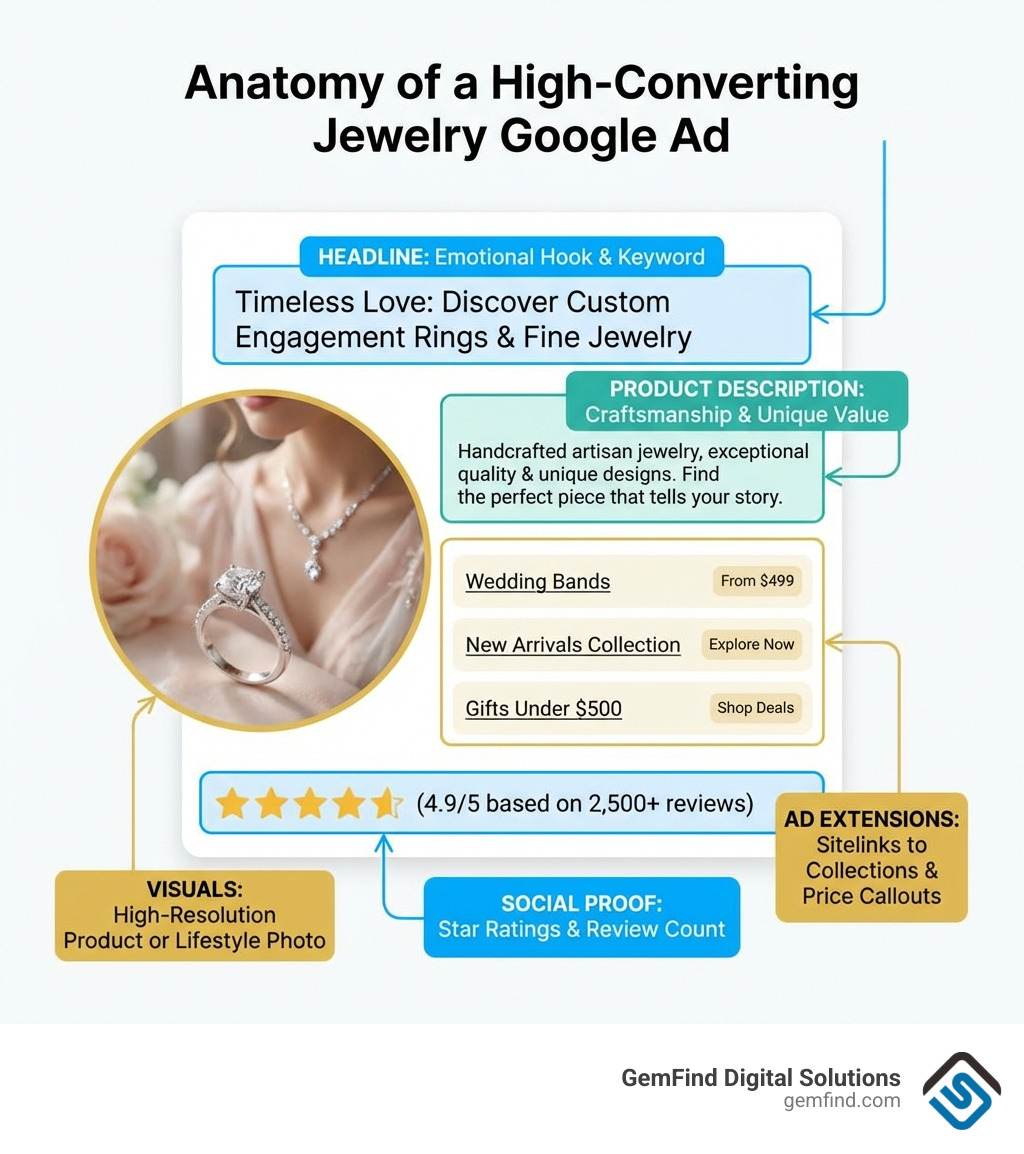
- Benefit-Driven Headlines: Instead of just "Diamond Ring," we use headlines like "Exquisite Custom Engagement Rings" or "Ethically Sourced Lab Grown Diamonds." We focus on what the jewelry does for the customer—celebrates love, expresses individuality, or offers a sustainable choice.
- Evocative Descriptions: We use descriptive language that paints a picture and reinforces our brand's unique selling propositions (USPs). This could include highlighting "flawless craftsmanship," "timeless designs," "quality of materials," or "customization options."
- Urgency Drivers: Gentle nudges can encourage quicker purchases. Phrases like "Limited stock available" or "Ends tonight" can create a sense of urgency, while "Free Shipping Ends Soon" can push an undecided buyer.
- Social Proof: Testimonials, star ratings, and review counts build immense trust. If we have a 4.9-star rating with thousands of reviews, we absolutely want to feature that in our ad copy.
-
Ad Extensions: These are the unsung heroes of Google Ads. They allow us to take up more valuable real estate on the search results page and provide additional information, increasing click-through rates.
- Sitelinks: Direct users to specific pages like "Engagement Ring Collection," "Wedding Bands," or "Customer Testimonials."
- Image Extensions: Add a compelling image right next to our text ad, enhancing visual appeal.
- Price Extensions: Clearly display prices for different products or services directly in the ad.
- Callout Extensions: Highlight key benefits like "Free Shipping," "Lifetime Warranty," or "Conflict-Free Diamonds."
- Structured Snippets: Showcase specific product features or services, e.g., "Types: Necklaces, Earrings, Bracelets, Rings."
- Location Extensions: Crucial for local jewelers, showing our address and phone number, and linking to Google Maps.
- Promotion Extensions: Highlight sales and discounts directly in the ad.
For more details on making the most of these, explore More on ad extensions.
Leveraging Visuals: Creating the best jewelry google ads with Shopping & Display
Jewelry is inherently visual, and your ads must reflect this. Poor-quality images will kill ad performance.
- High-Resolution Images: This is non-negotiable. Every image, whether for Shopping Ads or Display, must be crisp, clear, and showcase the jewelry's brilliance.
- Product Videos and 360° Views: For high-value items, videos that show the jewelry from all angles, or even on a model, can significantly boost engagement. Detailed product views build trust by providing as much visual information online as one would get in-store.
- User-Generated Content (UGC): Real customers wearing our jewelry builds authenticity and social proof. We can feature customer photos or testimonials in our Display Ads or even collect them for video ads.
- Carousel Ads: These are fantastic for cross-selling and highlighting variants. We can showcase a matching necklace, earrings, and bracelet set, or display a ring in different metal types or with various gemstones. This boosts the average order value.
Creating High-Conversion Landing Pages
The ad gets the click, but the landing page closes the deal. A disconnect between your ad and landing page is a conversion killer.
- Message Match: Our landing page must perfectly align with the ad's promise. If our ad promises "custom engagement rings," the landing page should immediately showcase custom engagement rings, not generic fine jewelry.
- Fast Load Speed: In today's impatient world, slow loading pages mean lost sales. We ensure our pages are optimized for speed, especially on mobile.
- Clear Call-to-Action (CTA): What do we want the visitor to do? "Shop Now," "Request a Consultation," "Customize Your Ring"—our CTA should be prominent and unambiguous.
- High-Quality Imagery: Just like our ads, our landing pages need stunning, high-resolution product photography and lifestyle shots.
- Pricing Transparency: For many jewelry purchases, especially high-value ones, customers appreciate clear pricing. While some luxury brands might have different strategies, generally, transparent pricing builds trust.
- Security Badges: Trust markers like "Secure Checkout" badges, SSL certificates, and recognized payment method logos reassure customers making an online purchase.
- Customer Reviews: Prominently displaying testimonials and star ratings on product pages further builds confidence.
- Financing Options: For high-ticket items, offering financing solutions can remove a major barrier to purchase and be a powerful conversion driver.
Navigating the Market: Challenges & Advanced Tactics for the best jewelry google ads
The jewelry market is seasonal, competitive, and has high-cost-per-click (CPC) keywords. With smart strategies, these challenges become opportunities.
Overcoming High Competition and Seasonality
The jewelry business is highly seasonal, with peaks during Valentine's Day, Mother's Day, and year-end holidays, leading to intense competition and higher CPCs.
- Peak Seasons: We adjust our budgets and bidding strategies aggressively during these times. CPCs can increase significantly during peak seasonal periods due to increased competition. We plan our promotions, ad creatives, and inventory well in advance to capitalize on these surges.
- Bidding Strategies: During peak seasons, we might shift to conversion-focused automated bidding strategies like "Maximize Conversions" or "Target ROAS" to ensure we're getting the most out of our increased spend. During slower periods, we can focus on building brand awareness or targeting more niche, lower-CPC keywords.
- Niche Marketing: High competition in broad categories can be mitigated by focusing on niche markets. For example, targeting "sustainable jewelry," "ethical sourcing diamonds," or "handmade artisan jewelry" can attract a dedicated audience with less competition and often higher willingness to pay. This helps us stand out from the crowd and attract customers aligned with our brand values.
The Power of Remarketing and Cross-Channel Synergy
Jewelry purchases aren't typically impulse buys; customers often visit a site multiple times before deciding. Remarketing is crucial for re-engaging these potential buyers.
- Re-engaging Visitors: Remarketing campaigns allow us to show targeted ads to users who have previously visited our website. This keeps our brand top-of-mind and nudges them closer to conversion.
- Abandoned Carts: A particularly effective remarketing strategy involves showing ads for the exact items left in a shopping cart, often with a gentle reminder or a small incentive to complete the purchase.
- Dynamic Remarketing: This takes it a step further by automatically showing users ads for the specific products they viewed on our site. It's like having a personalized salesperson following them around the internet.
- Integrating Google Ads with SEO: Google Ads data is a treasure trove for SEO. The Search Terms Report reveals long-tail keywords with buyer intent (e.g., "moissanite oval engagement ring under $2,000"). Use these terms to create content that ranks organically, creating a powerful synergy between paid and organic efforts.
- Using social media to create demand: Social channels excel at visual storytelling and creating desire. We use these channels to build brand awareness, showcase new collections, and engage with our community.
- Capturing demand with Google Search: When that desire translates into intent (e.g., someone searches for our brand or a specific product they saw on another channel), Google Search Ads are there to capture that demand and drive the conversion. This full-funnel approach ensures we're present at every stage of the customer journey.
Frequently Asked Questions about Jewelry Google Ads
Here are answers to common questions about Google Ads for jewelry:
How much should a jewelry business budget for Google Ads?
The ideal budget depends on several factors.
- Starting Budget Recommendations: For a local jeweler or a niche online store, a starting budget of $1,000–$2,000 per month can support targeted campaigns and local visibility. For broader reach or multiple product categories, $3,000–$6,000 per month is more realistic. Competitive e-commerce or luxury brands might need $10,000+ per month for comprehensive campaigns.
- Factors Influencing Cost: The jewelry market is highly competitive, leading to higher CPCs, especially for high-value keywords like "engagement rings." Branded keywords are usually less expensive, while long-tail queries might be more affordable. Shopping Ads often deliver efficient costs per click.
- Focusing on Return on Ad Spend (ROAS): Instead of focusing on raw budget, prioritize Return on Ad Spend (ROAS). If spending $1,000 yields $5,000 in sales (a 5x ROAS), the campaign is profitable. Allocate budget to campaigns and keywords with the highest ROAS.
- Scaling Based on Performance: We recommend starting conservatively, testing, gathering data, and then scaling budget based on proven performance. As campaigns become more efficient and profitable, you can confidently increase spend.
How do you measure the success of a jewelry Google Ads campaign?
Measuring success is crucial for optimizing campaigns and proving ROI. We track these key performance indicators (KPIs):
- Click-Through Rate (CTR): This tells us how many people clicked on our ad after seeing it. A high CTR indicates that our ad copy and visuals are compelling and relevant to the search query.
- Conversion Rate (CVR): This measures how many clicks turn into desired actions, like a purchase, lead form submission, or newsletter signup.
- Cost Per Acquisition (CPA): How much does it cost us to acquire one customer or one lead? We aim to keep our CPA below our target profit margin.
- Return on Ad Spend (ROAS): This is our revenue generated for every dollar spent on ads.
- Website Traffic Quality: While not directly a conversion metric, increased relevant traffic is a good indicator of ad effectiveness.
- Integrating Google Analytics: We integrate our Google Ads account with Google Analytics to get a holistic view of user behavior on our website, linking ad performance to post-click engagement and conversions.
What are the biggest mistakes to avoid in jewelry Google Ads?
Here are common pitfalls to avoid in jewelry Google Ads:
- Poor Keyword Research: Ignoring the nuances of buyer intent or failing to include long-tail keywords leads to wasted spend and missed opportunities.
- Neglecting Negative Keywords: Not adding negative keywords is like leaving money on the table. It allows ads to show for irrelevant searches, draining budget on clicks that will never convert.
- Low-Quality Images: Jewelry is visual. Using pixelated, poorly lit, or generic images for Shopping Ads or Display Ads is a surefire way to deter potential customers.
- No Conversion Tracking: If we don't know what's converting, we can't optimize. Setting up accurate conversion tracking for purchases, leads, and other valuable actions is non-negotiable.
- Mismatched Ad and Landing Page Messaging: If an ad promises a "Limited Edition Diamond Pendant Sale," but the landing page is a generic category page, users will bounce. This also negatively impacts Quality Score, leading to higher CPCs.
- Ignoring Mobile Optimization: With so many users browsing and buying on mobile, non-responsive ads and slow mobile landing pages mean lost sales.
- Not Testing and Optimizing: Google Ads is not a "set it and forget it" platform. Continuous A/B testing of ad copy, visuals, bidding strategies, and landing pages is essential for ongoing success.
Conclusion: Polish Your Strategy for Maximum Sparkle
Mastering Google Ads for jewelry is more than just spending money; it requires a strategic, data-driven approach that understands the market's nuances. The best jewelry google ads blend precise keyword targeting, smart audience segmentation, and the right campaign mix to capture demand and build your brand.
This involves crafting emotional ad copy, using stunning visuals, and ensuring landing pages provide a seamless, trustworthy experience. It's also vital to be mindful of seasonality and competition, adjusting strategies dynamically. Finally, integrate Google Ads with broader marketing efforts, using social media to create desire and Google to capture it.
In a market as competitive and emotionally driven as jewelry, continuous optimization and a deep understanding of customer behavior are paramount. That's where specialized expertise comes in. At GemFind Digital Solutions, with over 25 years of industry-specific experience, we offer comprehensive digital marketing, web design, and specialized apps crafted specifically for the jewelry industry. We're a Shopify/Google Partner, providing custom solutions like Edge POS integration and jewelry-focused tools to help your business shine online.
Ready to transform your Google Ads campaigns into a gleaming success story? Let us help you craft a strategy that truly converts.


