


Why Custom Pendant Necklace Recognition Matters for Jewelry Retailers

Custom pendant necklace recognition is the process of identifying, classifying, and describing personalized pendant necklaces — either by eye or using AI-powered image analysis tools.
Quick answer: What is custom pendant necklace recognition?
| Type | What It Means |
|---|---|
| Manual recognition | A trained jeweler identifies pendant style, metal, and stones by inspection |
| AI-based recognition | Computer vision models classify pendant images and generate descriptions automatically |
| Hallmark identification | Reading stamps like 925 or 750 to verify metal purity and origin |
| Feature extraction | Detecting specific details like engravings, gemstones, and finish type |
| Captioning models | AI generates written descriptions of pendants from photos |
Whether you sell engraved name necklaces, fingerprint pendants, or iced-out moissanite pieces, being able to accurately identify and describe what you're selling matters more than ever.
Shoppers search visually. They upload photos. They want precise product details fast. And if your store can't deliver that — a competitor will.
Research published in Applied Sciences (2025) found that neural network models can now describe jewelry pieces with over 90% captioning accuracy, using encoder-decoder architectures trained on thousands of accessory images. That's not a distant future — that's technology available today.
I'm Anthony Arechiga, Vice President of Sales at GemFind Digital Solutions, and with nearly two decades of experience helping jewelry retailers build smarter digital strategies, I've seen how custom pendant necklace recognition tools can transform the way stores attract customers and drive online sales. In the sections ahead, we'll break down exactly how these systems work — and how you can put them to use.
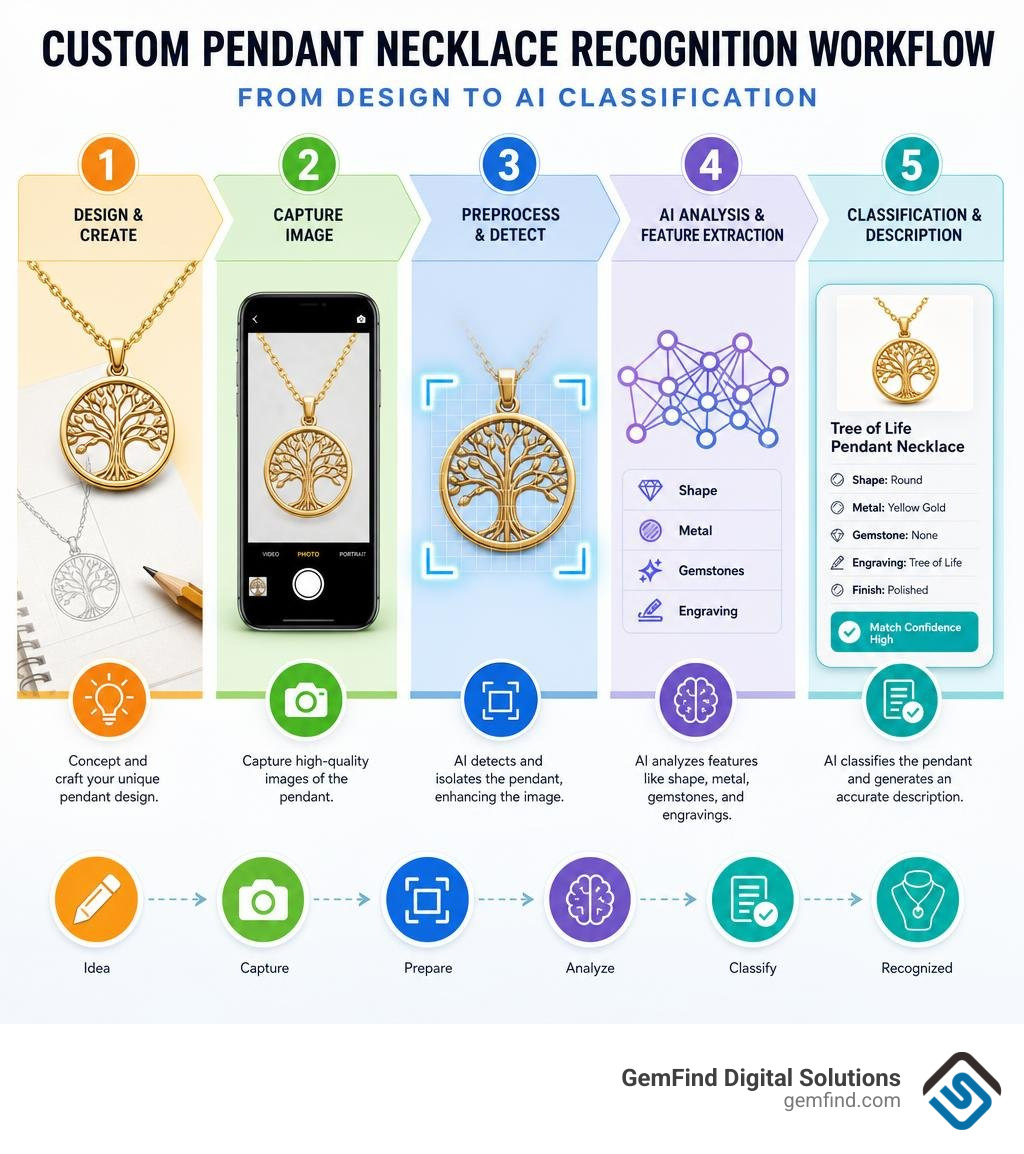
Common Types of Custom Pendant Necklaces and Design Materials

Before software can recognize a pendant, we need to define what it is looking at. Custom pendants are wonderfully personal, but that also makes them tricky to classify. A round locket, a script-name pendant, and a wax-impression fingerprint charm may all be necklaces, but visually they behave like totally different objects.
The most common custom pendant necklace categories include:
| Pendant Type | Common Design Features | Common Materials | Recognition Clues |
|---|---|---|---|
| Name pendants | Script, block letters, initials, brand words | Sterling silver, 10K, 14K, 18K gold, plated metals | Letter shapes, connected strokes, pave stones |
| Fingerprint pendants | Raised or engraved fingerprint ridges, organic shapes | Sterling silver, gold, plated silver | Ridge texture, oval or irregular surface, memorial engraving |
| Handwriting necklaces | Cut-out script based on real writing | Sterling silver, 10K or 14K gold | Irregular letter forms, thin strokes, personal message shape |
| Lockets | Hinged pendant, photo compartment, heart or oval shapes | Silver, gold, plated metal | Seam line, hinge, clasp, polished surface |
| Dog tags | Rectangular or shield-shaped metal plates | Stainless steel, silver, gold, plated metals | Flat surface, engraved text, military-inspired shape |
| Birthstone pendants | One or more colored stones | Silver, gold, gemstones, lab-grown stones | Color segmentation, stone count, prong or bezel setting |
| Iced-out pendants | Heavy stone coverage, bold names or symbols | 925 sterling silver, moissanite, diamonds, plated gold | High sparkle, dense pave patterns, thick silhouettes |
| Symbol or logo pendants | Custom shapes, icons, religious, cultural, or brand motifs | Silver, gold, enamel, stones | Unique outline, emblem structure, engraving |
A custom handwriting necklace, for example, usually depends on line quality. The pendant may be created from a clear photo of handwriting and transformed into a cut-out metal form. Recognition software must understand that the uneven script is intentional, not a defect.
A fingerprint impression pendant adds another layer of complexity. Instead of clean engraved lines, it may preserve tactile depth, texture, and slight asymmetry. That texture is part of the emotional value.
For bolder custom styles, custom chains and pendants often include large lettering, thick profiles, stone settings, and polished or plated finishes. These designs require recognition systems to separate sparkle, reflection, stone rows, and metal color without confusing glare for gemstones.
From a retailer's perspective, these product differences matter because they affect:
- Product photography requirements
- Category filters
- Search terms and SEO descriptions
- Visual search results
- Pricing logic
- Customization workflows
- Customer expectations
For example, 925 means sterling silver, with 92.5% pure silver. A 750 stamp means 18K gold, or 75% pure gold. A 950 stamp often indicates platinum purity. Recognition systems can support this kind of identification if images capture the clasp, back plate, or hallmark area clearly.
This is why a strong custom jewelry design website should not only show beautiful photos. It should organize custom pieces by material, pendant type, stone option, chain length, engraving, and finish. We also recommend reading our guide on how to showcase custom jewelry pieces on your website, because even the smartest AI has a hard time with a blurry pendant photographed on a wrinkled napkin. AI is smart. It is not magic.
Deep Learning and Computer Vision in Custom Pendant Necklace Recognition
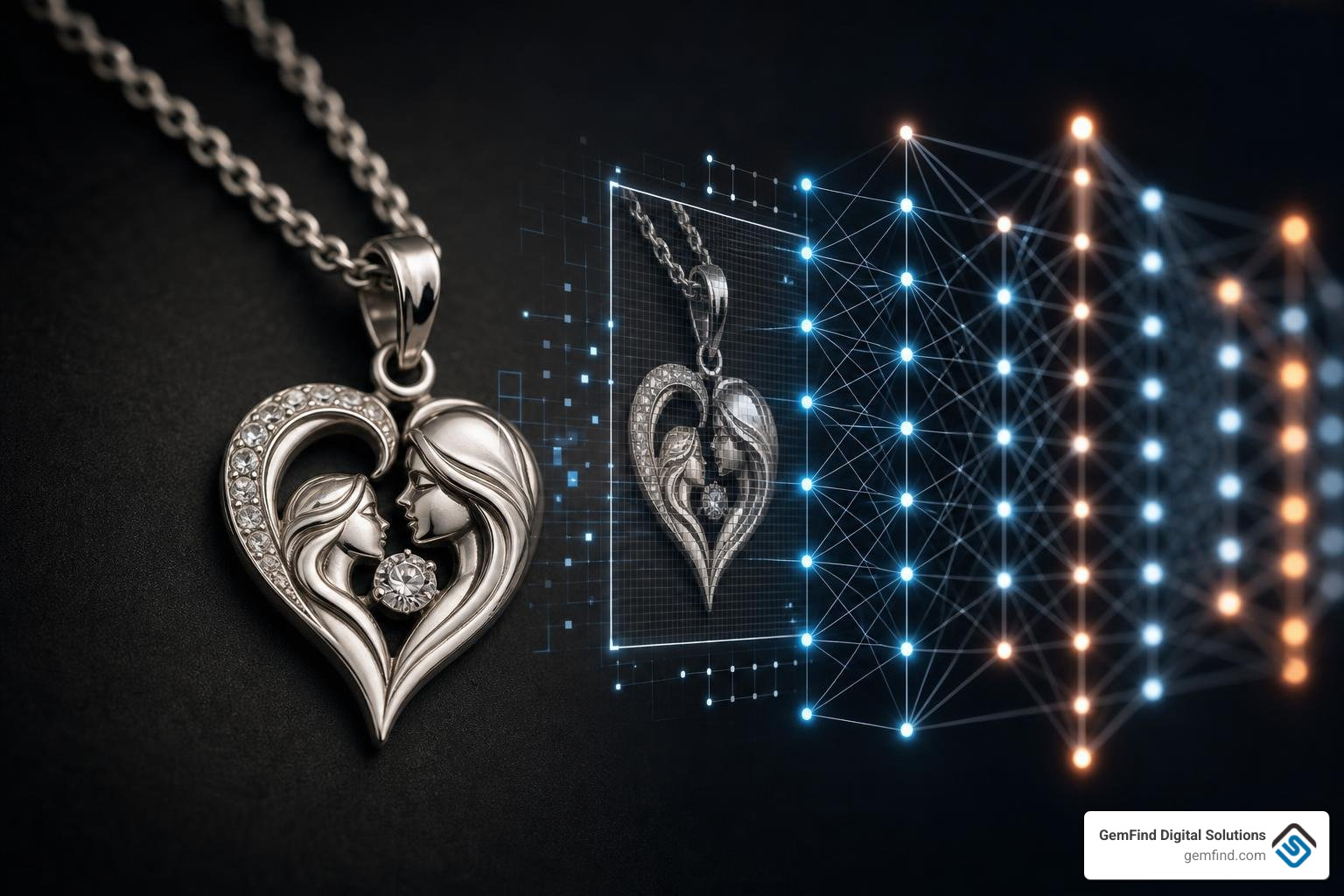
Computer vision turns pendant images into structured information. In plain English, the system learns patterns from many labeled jewelry images, then uses those patterns to identify new images.
A typical custom pendant necklace recognition pipeline looks like this:
- Image input: A shopper, retailer, or catalog team uploads a pendant image.
- Preprocessing: The system crops, resizes, brightens, and normalizes the image.
- Feature extraction: A neural network detects shapes, edges, textures, stones, and reflective zones.
- Classification: The model predicts categories such as name pendant, locket, fingerprint pendant, or birthstone necklace.
- Attribute detection: The system estimates metal color, stone presence, engraving, chain type, and finish.
- Caption generation: A language model produces a readable product description.
- Human review: Jewelers or merchandising teams verify important details before publishing.
The hard part is that jewelry breaks many normal computer vision assumptions. Pendants are reflective. Gemstones sparkle. Gold changes color under warm light. White gold, sterling silver, stainless steel, and platinum can look nearly identical in a low-quality product photo.
Common recognition challenges include:
- Lighting variation: Warm lighting can make silver look yellow; cool lighting can wash out rose gold.
- Reflections: Polished metal reflects cameras, hands, light boxes, and background colors.
- Angles: A pendant photographed flat looks different from one on a model.
- Scale: A mini initial charm and a large name pendant may appear the same size if the image is cropped.
- Occlusion: Hair, clothing, chains, or packaging can hide parts of the pendant.
- Material similarity: White metals often require hallmark or product data confirmation.
- Engraving complexity: Tiny text, cursive fonts, and shallow engraving are difficult for OCR.
- Cultural variation: Symbols may have different meanings in different communities and must be described carefully.
For custom jewelry retailers, AI recognition works best when it combines image analysis with product data. A model may infer "yellow metal," but your product catalog confirms whether it is 14K yellow gold, gold vermeil, or plated sterling silver.
Here is a practical comparison of common architectures:
| Architecture | How It Works | Strengths | Limitations | Best Use |
|---|---|---|---|---|
| CNN classifier | Uses convolutional neural networks to detect visual patterns | Strong for pendant categories and shapes | Limited natural language output | Sorting images into product types |
| CNN-RNN | CNN extracts image features; RNN or LSTM generates text | Proven for image captioning | Can struggle with long, detailed descriptions | Product captions and basic descriptions |
| CNN-LSTM with attention | Focuses on important image regions while generating text | Better for stones, engravings, and pendant details | Requires well-labeled training data | Detailed jewelry descriptions |
| Vision Transformer | Splits images into patches and learns relationships | Strong for complex visual scenes | Needs more data and compute | Advanced visual search and classification |
| Multimodal model | Combines images with text, SKUs, attributes, and metadata | More accurate in real retail catalogs | Requires clean product feeds | E-commerce search and automated merchandising |
Leveraging Image Captioning for Custom Pendant Necklace Recognition and Description
Image captioning is where recognition becomes useful for merchandising. It does not just say "necklace." It can generate something closer to:
"Sterling silver oval fingerprint pendant with raised texture, polished finish, and personalized back engraving."
That description is much more useful for shoppers, translators, catalog teams, and customer service.
The 2025 research on automatic jewelry identification used an encoder-decoder approach. The encoder, often a CNN, extracts visual features from the jewelry image. The decoder, often an RNN or LSTM, turns those features into a sentence. Attention mechanisms can improve this by helping the model focus on the pendant body, stones, clasp, or engraving area.
The research also described three useful description levels:
| Description Level | Example | Best For |
|---|---|---|
| Basic | "Name necklace" | Category labels, filters, quick tags |
| Normal | "Gold script name necklace" | Product cards, visual search results |
| Complete | "Polished yellow gold script name pendant with pave stones and adjustable chain" | Product pages, translation, accessibility text |
For jewelry retailers, this matters because one image can support many business needs:
- SEO title suggestions
- Product alt text
- Product descriptions
- Internal tags
- Visual search matching
- Accessibility support
- Translation-ready terminology
- Customer service summaries
An AI captioning model can help identify visible features such as:
- Metal color: yellow, white, rose, silver-tone
- Metal type when paired with data: sterling silver, 14K gold, platinum
- Stone presence: diamond, moissanite, colored gemstone, birthstone
- Stone setting: pave, bezel, prong, channel
- Pendant form: heart, oval, dog tag, nameplate, cross, locket
- Finish: polished, matte, oxidized, brushed
- Personalization: name, initials, date, handwriting, fingerprint, logo
- Chain style: cable, rope, tennis, box, curb when visible
However, we always recommend human verification for high-value claims. AI may recognize the appearance of a diamond-like stone, but gem identity, clarity, and certification require proper records or professional testing.
Optimizing Datasets and Metrics for Custom Pendant Necklace Recognition Models
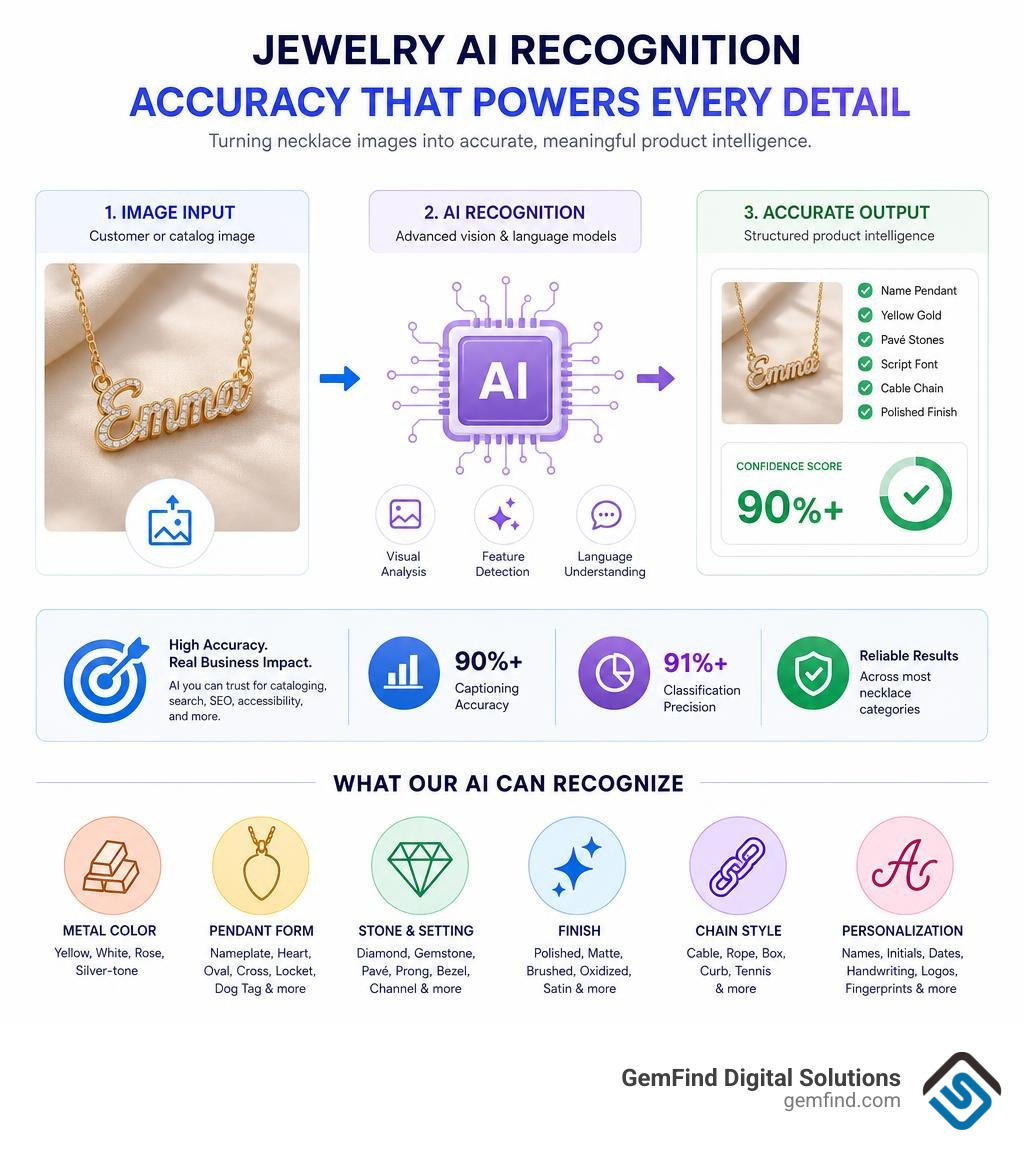
A recognition model is only as good as its training data. If the dataset contains mostly clean studio photos of plain pendants, the model may fail when a shopper uploads a necklace selfie taken in a car at sunset. Yes, it happens.
The jewelry recognition research referenced a dataset that reached 5,374 accessory images after data augmentation. The final model achieved captioning accuracy above 90%, and classification performance exceeded 91% precision, recall, and F1-score for most jewelry classes, with bracelets being a weaker class.
For pendant necklace recognition, effective datasets should include:
- Studio product photos on white backgrounds
- Model-worn necklace photos
- Close-ups of engraving and hallmarks
- Front, side, and back views
- Multiple chain lengths and pendant scales
- Different metals and finishes
- Stone and no-stone versions
- Plain, engraved, and textured surfaces
- Cultural, symbolic, and memorial designs
- Customer-uploaded images when permission is granted
Data augmentation helps models become more robust by creating controlled variations of existing images. Useful augmentation techniques include:
- Rotation to simulate different camera angles
- Brightness and contrast changes
- Random cropping
- Background variation
- Blur simulation
- Reflection and glare simulation
- Color temperature shifts
- Horizontal flipping when it does not change the meaning
- Zooming in and out
- Synthetic shadows
The best evaluation metrics depend on the task.
| Task | Recommended Metrics | Why It Matters |
|---|---|---|
| Pendant classification | Accuracy, precision, recall, F1-score | Measures whether the system identifies the correct pendant type |
| Attribute detection | Precision, recall, confusion matrix | Shows where the model confuses materials, stones, or finishes |
| Caption generation | BLEU, METEOR, ROUGE, CIDEr, human review | Evaluates how close captions are to expected descriptions |
| Search relevance | Click-through rate, conversion rate, search success rate | Measures whether shoppers actually find what they want |
| OCR engraving detection | Character error rate, word error rate, human validation | Important for personalized text and names |
| Business impact | Time saved, listing speed, return reduction | Shows whether the tool improves retail operations |
In our experience, the most useful production metric is not just model accuracy. It is trust. Retailers need to know which predictions are safe to automate and which ones need review. A confidence score can help decide whether the system publishes a description, suggests one, or asks a human to check it.
Practical Applications of Automatic Pendant Necklace Recognition
Automatic pendant recognition is not just an AI science project. It can improve the shopping journey, merchandising workflow, and even professional communication.
For e-commerce, the biggest benefits include:
- Faster product uploads: AI can suggest categories, tags, and descriptions.
- Better visual search: Shoppers can upload a pendant photo and find similar styles.
- Improved SEO: Captions and alt text help pages describe products more clearly.
- Stronger filtering: Customers can narrow results by metal, pendant type, stone, and personalization.
- More accurate recommendations: A shopper viewing fingerprint pendants can see related memorial or handwriting styles.
- Reduced support questions: Clear descriptions answer material, size, and customization questions sooner.
- Better accessibility: Image descriptions support shoppers using screen readers.
- Higher catalog consistency: Similar products use similar naming and terminology.
For corporate gifting and recognition awards, custom pendants can be used as service gifts, milestone keepsakes, team identity pieces, donor recognition items, or branded commemorative jewelry. Recognition technology helps teams keep these projects organized. A business ordering pendants for multiple departments, years, or award levels needs accurate naming, engraving records, proof images, and delivery details.
In cultural heritage, pendant recognition can help catalog symbolic jewelry, archive heirloom pieces, and support multilingual descriptions. This must be handled with care. A symbol should not be labeled casually if it has religious, cultural, or memorial meaning. AI can assist, but humans with cultural knowledge should review sensitive descriptions.
For translators and interpreters, automatic jewelry descriptions can provide quick terminology support. Instead of guessing whether a piece is a "charm," "pendant," "locket," or "medallion," the system can offer structured wording. This is especially helpful when translating catalogs, appraisals, auction descriptions, museum entries, or fashion content.
For retailers, recognition tools work best when paired with interactive shopping features. A custom jewelry try-on experience lets shoppers visualize scale and style, while a custom builder helps them make choices with confidence. We have also seen how a custom jewelry builder can boost sales by reducing friction in the design process.
Here is how a smart pendant recognition flow can work on a jewelry website:
- The shopper uploads a reference image.
- The system identifies the pendant type, such as name, initial, heart, or fingerprint.
- The site suggests matching product templates.
- The shopper chooses metal, chain length, finish, and stone options.
- The system generates a preview or design request.
- The retailer reviews and confirms production details.
- Product data flows into the order, marketing, and POS systems.
That is where recognition becomes revenue. Not in a flashy "look, AI!" way, but in a practical "we helped the customer order the right pendant without twenty emails" way.
Future Directions: Robustness, Cultural Sensitivity, and Advanced Customization
As of June 2026, pendant recognition is moving beyond simple image classification. The next generation of systems will combine 2D images, 3D models, product feeds, customer preferences, and manufacturing constraints.
Future improvements will likely focus on five areas.
First, models need better robustness. Jewelry photos are messy in the real world. Future systems should handle harsh lighting, low-resolution uploads, unusual backgrounds, motion blur, and reflective surfaces with fewer errors.
Second, recognition models need stronger material understanding. A camera alone cannot always distinguish white gold from sterling silver or moissanite from diamond. Better systems will combine visual cues with hallmark detection, SKU data, certificates, and retailer records.
Third, engraving and personalization recognition will improve. OCR for tiny curved engraving is still hard. Better models will need training on script fonts, shallow engraving, block lettering, mirrored surfaces, and curved pendant backs.
Fourth, cultural sensitivity must be built into labeling. A pendant may feature a religious symbol, family crest, memorial fingerprint, cultural motif, or personal handwriting. Automated systems should avoid overconfident assumptions and allow retailers to customize terminology.
Fifth, 3D customization will become more integrated. A shopper may upload an image, convert it into a 3D pendant concept, preview materials, and submit it for jeweler review. That workflow connects recognition, design, and production.
This is why jewelers should not think of AI recognition as a stand-alone gadget. It belongs inside a broader digital ecosystem: product catalog, custom builder, visual search, try-on tools, website merchandising, and POS integration.
For retailers planning that ecosystem, our custom jewelry design software guide is a helpful next step. And while rings are different from pendants, our complete ring builder app guide explains many of the same principles: guided choices, clean product data, visualization, and shopper confidence.
Frequently Asked Questions about Custom Pendant Recognition
How accurate are AI models at identifying custom jewelry materials?
AI models can be highly accurate at recognizing visible jewelry categories and features, especially when trained on strong datasets. In published jewelry recognition research, the final captioning model exceeded 90% accuracy, and classification metrics such as precision, recall, and F1-score exceeded 91% for most jewelry classes.
Material identification is more complicated. AI can often detect metal color, such as yellow, rose, or white. It may also recognize visual patterns associated with sterling silver, gold, or platinum. But exact material claims should be confirmed through product data, hallmarks, certificates, or jeweler review.
For example:
- "Yellow gold-tone pendant" may be inferred visually.
- "14K yellow gold pendant" should be confirmed by product data or hallmark.
- "Diamond pendant" should be supported by stone records, certification, or testing.
- "Moissanite pendant" should be verified through catalog data or documentation.
The safest workflow is AI-assisted, not AI-unsupervised. Let the model suggest. Let the jeweler confirm.
What are the main challenges in recognizing custom engraved text on pendants?
Engraved text is one of the toughest parts of custom pendant necklace recognition. Standard OCR systems are usually built for flat printed text, not tiny reflective names curved around a pendant edge.
Major challenges include:
- Curved surfaces that distort letters
- Cursive fonts and connected script
- Low contrast between engraving and metal
- Glare from polished surfaces
- Very small character height
- Partial occlusion from chains or fingers
- Custom handwriting that does not match normal font patterns
- Worn or shallow engraving
- Reflections that look like letter strokes
To improve engraving recognition, retailers should capture close-up images under diffused light, include multiple angles, and store the actual engraved text in structured product or order data. AI can help detect that engraving exists, but the exact wording should be verified before production or publication.
This is especially important for memorial jewelry, names, dates, and recognition awards. Nobody wants an AI to turn "Ann" into "Arm" on a sentimental pendant. That is a small typo with a very large emotional bill.
How can jewelry retailers implement automatic pendant recognition on their websites?
Retailers can implement pendant recognition in phases.
Start with product data. Clean categories, metal fields, stone fields, chain lengths, engraving options, and image naming conventions make recognition tools far more effective.
Next, improve photography. Use consistent lighting, multiple angles, close-ups, and uncluttered backgrounds. Capture the front, back, clasp, hallmark, and engraving zones when possible.
Then add AI features gradually:
- Internal tagging assistant for catalog teams
- AI-generated alt text and draft descriptions
- Visual search for shoppers
- Similar-product recommendations
- Upload-a-reference-image custom design requests
- Custom pendant builder integration
- POS and inventory synchronization
A strong website should connect recognition tools with real retail workflows. That includes product pages, custom design forms, checkout, lead capture, marketing campaigns, and customer follow-up.
GemFind Digital Solutions supports jewelry retailers with digital marketing, web design, specialized jewelry apps, Shopify and Google Partner experience, and jewelry-focused integrations including Edge POS integration. Because we have spent more than 25 years working specifically with the jewelry industry, we understand that a pendant is not just a SKU. It may be a memorial piece, a gift, a milestone award, or a personal identity statement.
Conclusion
Custom pendant necklaces are personal, emotional, and visually complex. That is exactly why recognition matters.
The best custom pendant necklace recognition systems combine human jewelry expertise with AI-powered image classification, captioning, product data, and careful review. They can identify pendant styles, support material and gemstone descriptions, improve visual search, speed up product uploads, assist translators, and make custom ordering easier for shoppers.
But success depends on the foundation: clean data, strong photography, thoughtful website design, and tools built for the jewelry industry.
At GemFind Digital Solutions, we help jewelry retailers bring these pieces together through digital marketing, web design, custom jewelry technology, specialized apps, and integrations that support real retail operations. If you are ready to turn pendant recognition into a better shopping experience, start with our Custom Jewelry Design Software Guide.


