



Why Luxury Jewelry Marketing Demands a Different Approach
Luxury jewelry marketing is one of the most competitive — and most rewarding — fields in retail. The global luxury jewelry market was valued at $59.60 billion in 2025 and is projected to reach $101.49 billion by 2032, growing at a CAGR of 7.9%. That growth creates real opportunity, but only for brands that know how to stand out.
Here is what effective luxury jewelry marketing looks like in practice:
- Build brand story first — buyers connect with heritage, craftsmanship, and meaning before they connect with price or product specs
- Show up in high-intent search — most luxury purchase journeys begin online, even when the final sale happens in-store
- Use social media strategically — over 80% of luxury consumers are influenced by social media before making a purchase decision
- Offer personalization — about 40% of consumers will pay more for customized pieces
- Align with values — approximately 66% of consumers prefer brands with a positive social and environmental impact
- Create seamless omnichannel experiences — connect your digital presence directly to your in-store experience
The challenge most fine jewelry store owners face is not a lack of beautiful product. It is a lack of visibility and positioning. Generic marketing tactics do not work here. Luxury buyers are intentional and research-driven. They compare craftsmanship, provenance, and brand credibility long before they walk through your door or click "add to cart."
I'm Anthony Arechiga, Vice President of Sales at GemFind Digital Solutions, where I've spent nearly two decades helping fine jewelry retailers navigate the evolving world of luxury jewelry marketing — from web design and e-commerce to full digital strategy. In the sections ahead, I'll walk you through the strategies that actually move the needle for high-end jewelry brands.
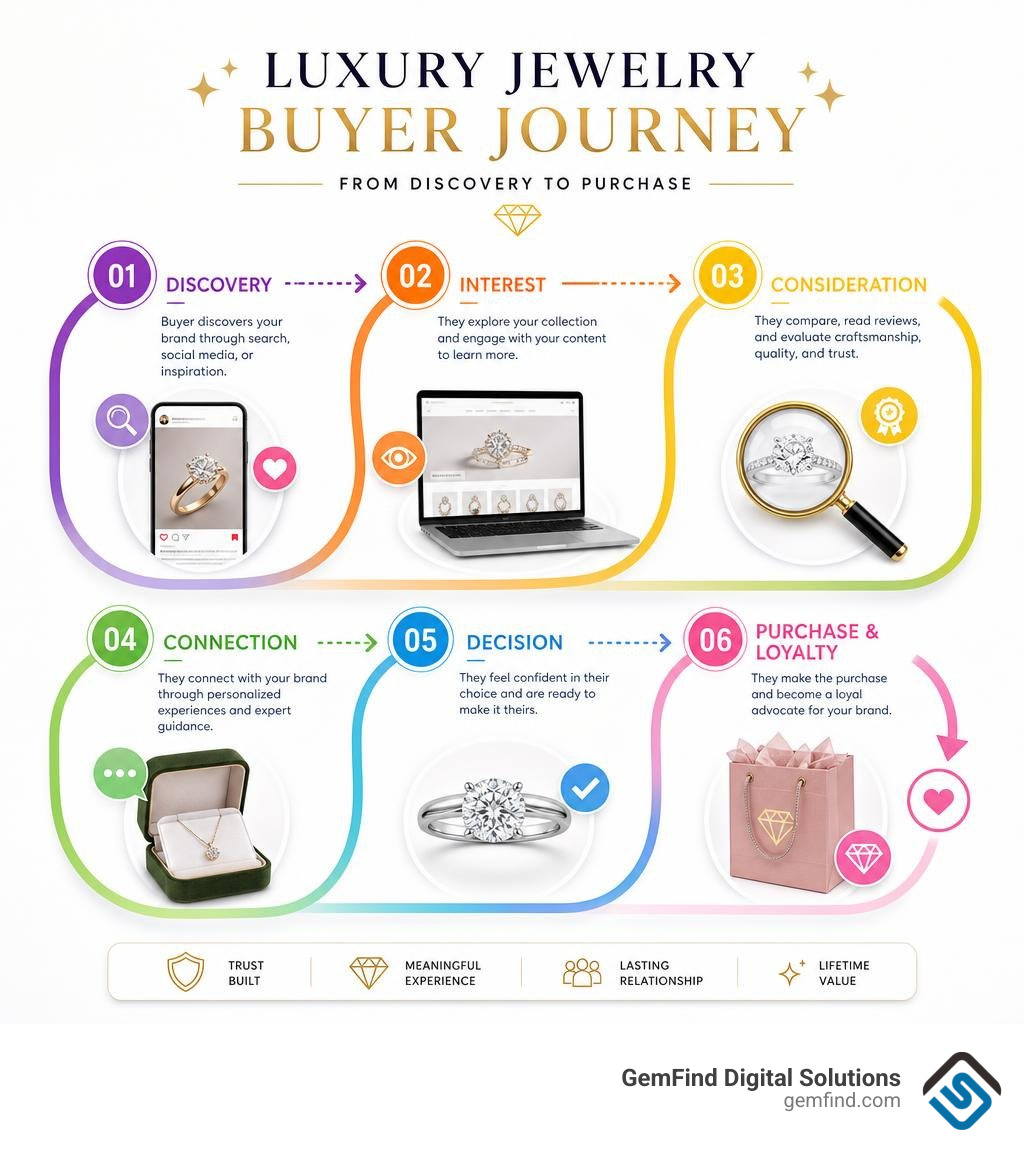
Simple Luxury jewelry marketing word guide:
Understanding the Modern Luxury Jewelry Market Landscape

As we navigate June 2026, the luxury jewelry industry is undergoing a profound transformation. While traditional heritage houses still command massive respect, consumer behaviors are shifting at a breakneck pace. According to recent market analysis in the Luxury Jewelry Market Size And Share Report, 2026-2033 , the global luxury jewelry market is projected to reach nearly $101.49 billion by 2032, propelled by rising disposable incomes, evolving lifestyle aspirations, and an increased appreciation for precious materials.
However, capturing this market requires understanding what today's affluent consumers actually value. It is no longer just about the carat weight or the metal purity. Modern luxury buyers are looking for three key elements:
- Value Preservation: Especially with gold jewelry, over 60% of consumers explicitly consider value preservation and investment hedging when making a purchase.
- Aesthetic and Cultural Resonance: Jewelry is viewed as an extension of personal identity and milestones.
- Modern Convenience: Online sales in the luxury sector are projected to exceed 25% of total sales by the end of this year, a massive leap from just 12% in 2023.
| Market Trend Indicator | Natural Diamonds / Traditional Luxury | Lab-Grown Diamonds / Eco-Conscious Luxury |
|---|---|---|
| Primary Appeal | Rarity, heirloom value, capital preservation | Sustainability, price accessibility, design flexibility |
| Demographic Core | High-Net-Worth Individuals (HNWIs), traditional collectors | Gen Z, Millennials, self-purchasing professionals |
| Sourcing Priority | Certified ethical mines, vertical integration | Recycled metals, carbon-neutral laboratory certification |
| Average Online AOV | High (often requiring hybrid virtual/in-store consultation) | Moderate-to-High (highly compatible with direct e-commerce) |
Shifting Demographics and the Self-Purchase Trend
For decades, luxury jewelry marketing was oriented almost entirely around men purchasing gifts for women. Today, that playbook is obsolete.
The rise of the female self-purchaser is one of the most powerful forces in the industry:
- Approximately 76% of jewelry industry respondents have noted a steady increase in women purchasing fine jewelry for themselves.
- 73% of female jewelry purchasers bought at least one piece of jewelry for themselves over the past two years.
- This trend is not limited to younger buyers; 45% of older generations also report regularly buying jewelry for themselves.
Additionally, younger Gen Z and Millennial buyers are driving 70% of online luxury jewelry purchases. These consumers are not waiting for "milestone gifting" moments like weddings or anniversaries to acquire high-end pieces; they purchase to celebrate career achievements, personal goals, or simply to establish their own signature style.
Ethical Sourcing and the Rise of Lab-Grown Alternatives
Sustainability is no longer a niche marketing angle—it is a baseline consumer expectation. Approximately 66% of consumers are more inclined to buy from brands that demonstrate a positive impact on society and the environment.
This values-driven mindset has accelerated the demand for:
- Transparent Supply Chains: Buyers want to know exactly which mine their gemstone came from and how the workers were treated.
- Recycled Precious Metals: Using 100% recycled gold or platinum is a major trust-builder for eco-conscious luxury consumers.
- Lab-Grown Diamonds: Brands like Pandora have fully transitioned to lab-made diamonds, attracting younger consumers who prioritize both carbon reduction and cost-efficiency.
Core Pillars of Luxury Jewelry Marketing

To succeed in this landscape, your marketing must elevate your brand's perception, emphasizing emotional value, rarity, and craftsmanship over transactional pricing. Let's look at the foundational pillars that make this possible.
The Role of Storytelling in Luxury Jewelry Marketing
If you treat your jewelry as a commodity, your customers will too. Luxury buyers do not buy gold and gemstones; they buy stories, heritage, and artistic vision.
Through The Impact of Digital Brand Storytelling, we see that high-end brands must establish a narrative that makes every piece feel like a wearable work of art. Your marketing copy should highlight the designer's intent, the meticulous selection of the gemstones, and the hundreds of hours required to handcraft the piece.
By educating your audience on these details, you naturally transition your brand out of price competition. This is why we emphasize that jewelers should aim to establish authority; when you explain the "why" behind your designs, you build the trust required for high-ticket sales. You can read more about this in our guide on Why Jewelers Should Aim to Become a Thought Leader in Their Market.
Influencer Partnerships and Cultural Storytelling
While traditional print campaigns in luxury fashion magazines still hold some prestige, social media influencers have become the primary drivers of modern luxury discovery. Over 80% of luxury consumers are influenced by social media before making a purchase decision.
The key to successful influencer marketing in the luxury space is authenticity. High-net-worth buyers immediately ignore generic, transactional sponsorships. Instead, focus on:
- Cultural Relevance: Look at how David Yurman successfully partnered with Sofia Richie Grainge. The campaign centered on a single hero collection (Sculpted Cable) and leveraged her "quiet luxury" aesthetic. The results were staggering: a 46% increase in their Instagram follower growth rate, a 3x increase in website traffic, and a 20% boost in earned media value compared to previous campaigns. You can read the full campaign breakdown in this article from David Yurman sees success with Sofia Richie Grainge in its latest campaign - Glossy .
- Micro-Influencers: For smaller luxury brands, partnering with micro-influencers who have highly engaged, design-conscious audiences often yields a much higher ROI than chasing massive celebrity endorsements.
To build a structured, high-performing influencer program for your brand, check out our comprehensive Jewelry Influencer Marketing Complete Guide.
Digital Strategies for High-End Brand Positioning
Many luxury brands worry that going "digital" will dilute their exclusivity. In reality, a polished, highly targeted digital strategy is the best way to protect your brand's prestige while scaling your revenue.
As we detail in A Holistic Approach: Crafting a Successful Digital Marketing Plan for Your Jewelry Store, digital channels should be used to capture high-intent demand and guide buyers toward personalized consultations.
Search Engine Optimization for High-Intent Buyers
SEO for luxury jewelry is not about chasing massive search volume; it is about capturing the right search intent. When a buyer searches for "bespoke emerald engagement ring" or "heirloom-quality gold cuffs," they are showing high purchase intent.
To rank for these high-value terms, your technical and content SEO must be flawless:
- Original PDP Copy: Over 62% of luxury jewelry product detail pages (PDPs) reuse supplier template descriptions verbatim. Writing original, rich descriptions of 150+ words that detail materials, design inspiration, and styling tips is one of the highest-leverage SEO investments you can make.
- Product Schema Markup: Implementing structured data is essential. It helps search engines understand your pricing, availability, and materials, ensuring your pieces show up accurately in Google Search and AI-driven search engines (like ChatGPT and Google AI Overviews).
- Local Authority: If you have physical showrooms, optimizing your Google Business Profile and local citations helps capture local affluent buyers searching for high-end jewelers in your area.
For a step-by-step roadmap to optimizing your site, refer to our guide on Crafting a Winning Digital Marketing Plan for Your Jewelry Store.
Social Commerce and Next-Gen Luxury Jewelry Marketing
Social media platforms are no longer just places for discovery—they are fully integrated e-commerce channels. Next-gen luxury brands are successfully leveraging platforms like TikTok and Instagram to shorten the buyer's journey.
For example, Carolyn Dawkins at David Yurman has spoken extensively about how the brand uses TikTok to capture younger luxury shoppers by blending heritage storytelling with raw, behind-the-scenes content that feels native to the platform. You can listen to her insights on the Next-gen gems: David Yurman’s Carolyn Dawkins is capturing luxury shoppers on TikTok podcast.
To succeed with social commerce:
- Set up Instagram Shop and TikTok Shop with fully synced product catalogs.
- Focus on short-form vertical video (under 30 seconds) showing how the jewelry moves, catches the light, and is styled in everyday life.
- Avoid overly polished, corporate commercials; authentic, founder-led or artisan-led content consistently outperforms agency-produced spots.
To master these platforms, read our updated guide on Mastering Instagram Marketing for Jewelry Stores in 2025.
High-Performance Paid Media and Retargeting
Paid advertising in luxury jewelry marketing requires extreme precision. Broad targeting and discount-heavy messaging will quickly erode your brand's premium positioning. Instead, your paid media should focus on building desire and recapturing warm audiences.
Consider this proven creative framework for scaling luxury jewelry ads:
- The Maker: Highlight the artisan, the studio, and the design process through video. This builds immediate credibility.
- The Story: Use poetic, narrative-driven copy that focuses on the emotion behind the collection (e.g., "Born of the Sea. Shaped by Time.").
- The Object: Showcase stunning, high-resolution macro photography of the jewelry itself, emphasizing the details and craftsmanship.
By structuring campaigns around collections rather than individual SKUs, your creative assets remain durable even if specific one-of-a-kind pieces sell out. This methodology has been proven to scale high-end brands to over $160K/month in ad revenue at a 7.4x ROAS without ever running a discount.
For more inspiration on building memorable paid campaigns, explore these Jewellery Marketing Campaigns That Won the Internet and align them with our recommendations on The Best Digital Marketing Strategies for the Holiday Season.
Omnichannel Experiences and Frictionless Commerce
The ultimate goal of luxury jewelry marketing is to create a seamless journey that allows the customer to interact with your brand on their own terms—whether that is scrolling on Instagram, browsing your website, or sitting in your private viewing room.
A premier example of this is Tiffany & Co. Their marketing mix successfully balances a "barbell portfolio"—which recruits new, younger clients through accessible entry-level silver and gifting pieces while protecting high jewelry prestige at the top. Their digital touchpoints are seamlessly integrated with physical experiences, most notably highlighted by their immersive flagship, The Landmark, in New York. You can study their full strategy in this analysis of the Tiffany & Co. Marketing Mix: Iconic Heritage and Global Branding - Latterly.org .
To build this level of engagement for your brand, you must focus on reducing friction at every touchpoint. For deeper insights, read about The Importance of Customer Engagement in Jewelry Marketing.
Virtual Try-On and Interactive Digital Tools
Because jewelry is highly tactile, one of the biggest barriers to online conversion is the customer's inability to visualize the scale and fit of a piece.
This is where interactive digital tools come in:
- Virtual Try-On (VTO): Utilizing augmented reality (AR) for rings, earrings, and necklaces has crossed from a novelty to a necessity. Recent data shows that 67% of luxury jewelry buyers utilize VTO before making an online purchase, and brands implementing AR see an average 18% conversion lift within 90 days.
- 3D Product Visualization: Allowing users to rotate a piece 360 degrees and zoom in on the stone settings dramatically increases buyer confidence.
- Customization Modules: With 40% of consumers willing to pay more for customized pieces, interactive custom design tools (such as ring builders) are incredibly powerful revenue drivers.
Learn how to integrate these tools into your website with our Jewelry Brand Marketing Complete Guide.
Seamless In-Store and Online Integration
To provide a true luxury experience, your digital systems must talk directly to your physical showrooms. This requires a robust CRM and clienteling strategy:
- Unified Inventory: Utilize integrations (like Edge POS) to ensure that if a piece sells in-store, it is immediately updated as "sold" online, avoiding the disappointment of double-purchases on one-of-a-kind items.
- Omnichannel Appointment Booking: Allow digital browsers to easily schedule an in-store private viewing or a virtual consultation with a dedicated brand advisor.
- Segmented Email Marketing: Email remains one of your highest-ROI channels. Instead of blast newsletters, segment your lists based on past purchase history, birthstones, and anniversary milestones. A highly personalized email campaign will consistently outperform generic marketing.
For a comprehensive guide to building these automated flows, check out our Effective Email Marketing Strategies for Jewelers: A Comprehensive Guide.
Frequently Asked Questions about Luxury Jewelry Marketing
How do luxury jewelry brands attract high-net-worth buyers?
Attracting high-net-worth individuals (HNWIs) requires a combination of highly targeted search marketing, premium content production, and exclusive clienteling. HNWIs do not respond to broad discount campaigns; they search for terms tied to specific materials, craftsmanship, and bespoke services.
To capture this audience, luxury brands must invest in high-end visual assets, authoritative educational content, and search engine optimization that targets long-tail, high-intent keywords. For a specialized approach to capturing this demographic, partnering with an experienced digital agency like GemFind can help refine your digital presence and connect with affluent buyers.
What is the projected growth of the global luxury jewelry market?
The global luxury jewelry market was valued at $59.60 billion in 2025 and is projected to grow at a compound annual growth rate (CAGR) of 7.9% from 2026 to 2032, reaching nearly $101.49 billion by 2032. This growth is primarily driven by the increasing financial independence of female self-purchasers, the expansion of e-commerce channels in the luxury sector, and rising demand in the Asia-Pacific and North American regions.
Is virtual try-on technology worth the investment for fine jewelers?
Yes, absolutely. Virtual try-on (VTO) technology directly addresses the primary friction point in online jewelry shopping: scale and fit. Brands that implement high-quality AR try-on tools report an average 18% increase in conversion rates on their product pages, along with a significant reduction in product returns. It provides a fun, interactive, and reassuring experience that modern luxury consumers expect.
Conclusion
Successfully navigating luxury jewelry marketing in 2026 requires a delicate balance of protecting your brand’s prestige while embracing modern digital innovation. From high-intent SEO and authentic influencer storytelling to interactive AR try-on tools and seamless omnichannel CRM integrations, the brands that win are those that put the consumer's experience first.
At GemFind Digital Solutions, we have spent over 25 years helping fine jewelry brands build, scale, and dominate their digital markets. As a certified Shopify and Google Partner with deep industry-specific expertise, we design custom websites, integrate Edge POS systems, and build digital marketing campaigns tailored exclusively for the jewelry industry.
If you are ready to elevate your brand’s digital positioning and drive predictable growth, we would love to connect. Explore our digital marketing services at GemFind Digital Marketing and let's discuss how we can bring your brand's unique story to life.


