


Turn Paid Search Analytics Into Better PPC Decisions

To analyze paid search performance, start with sales, revenue, and qualified leads, not just clicks. Compare those results with ad spend to find your cost per sale and return on ad spend. Then review search terms to spot wasted spend, and check which ads and landing pages bring in customers.
For a jewelry store, a popular ad is only useful if it helps sell jewelry. This guide shows you how to connect campaign data to business results and decide what to change next.
I'm Anthony Arechiga, Vice President of Sales at GemFind Digital Solutions. Since 2007, I've worked with jewelry businesses on digital growth, and I'll use that perspective to make paid search analytics easier to act on.
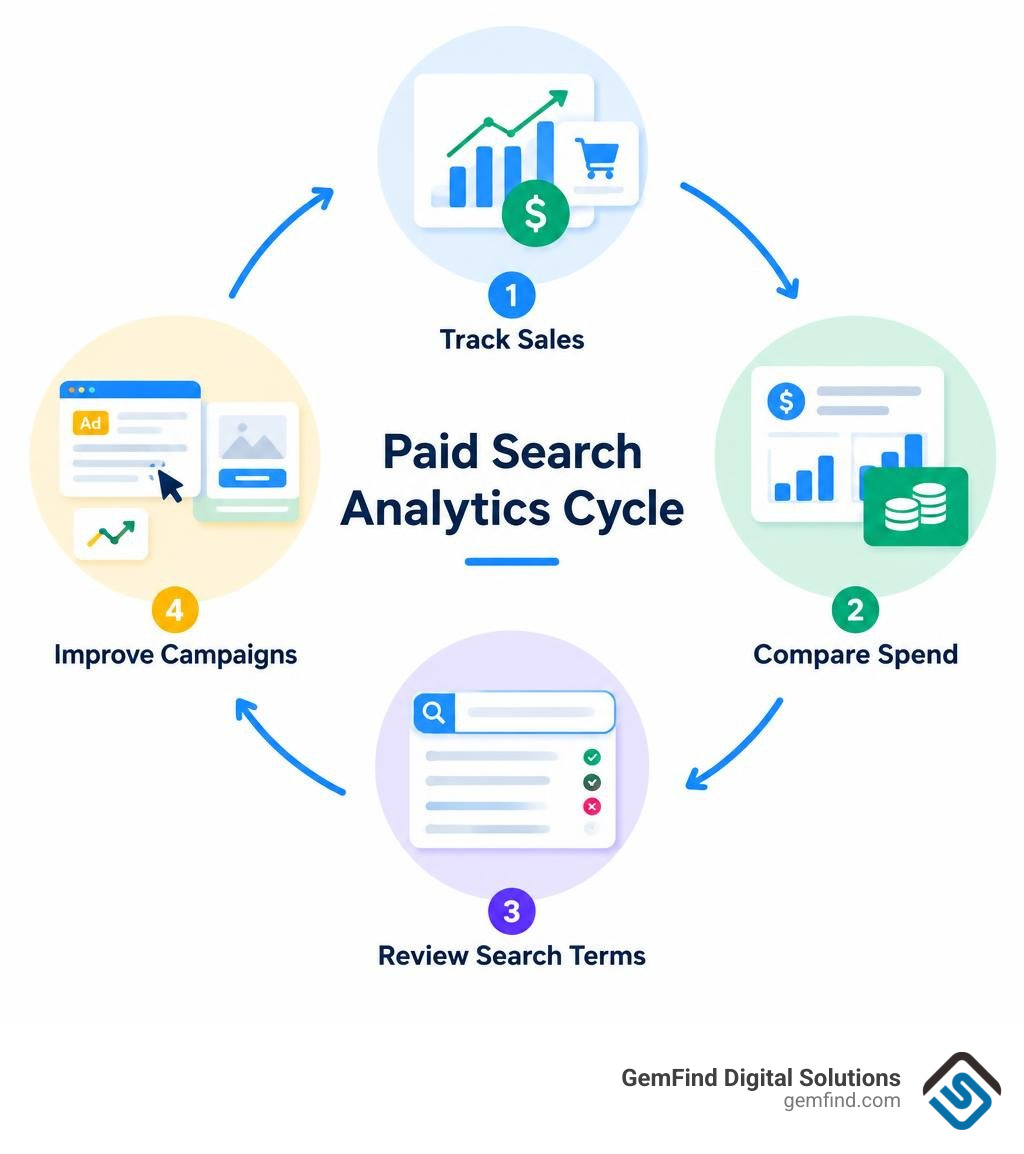
Paid search analytics terms to know:
- search engine optimisation seo
- seo services
- digital marketing seo agency
Why Paid Search Analytics Is Essential for Modern Campaign Success
Across the digital marketing landscape in 2026, search advertising remains one of the most profitable channels available, boasting an average 200% return on ad spend (ROI). However, capturing that return requires navigating massive platforms. Google currently commands nearly 92% of global search engine market share, processing upwards of 8.5 billion searches every single day. Meanwhile, the Microsoft Advertising network provides access to 686 million unique PC users globally and 109 million unique PC users in the United States, offering strong purchasing power for luxury, B2B, and bespoke goods.

Without structured paid search analytics, accounts quickly burn budget on generic visibility rather than profitable transactions. Analytics allows us to inspect competitive auction insights, pinpoint bidding inefficiencies, gauge impression share against rivals, and shift daily spend to top-performing products. Understanding the bottom-line financial impact of your advertising is vital; learning how to measure ROI on your PPC campaigns ensures that your budget produces measurable revenue rather than vanity traffic.
Establishing Key Metrics in Paid Search Analytics Beyond Surface Volume
Clicks and impressions only reveal half the story. When assessing ad delivery, we first examine Quality Score—Google's 1-to-10 diagnostic rating comprised of expected click-through rate (CTR), ad relevance, and landing page experience. High Quality Scores earn higher Ad Rank positions at lower actual costs per click (CPC). While understanding impressions on Google Ads helps you gauge market reach, long-term profitability depends on downstream efficiency metrics.
We track click-through rates (where 2% to 5% serves as a healthy baseline) and conversion rates (typically 3% to 10% across retail and service sectors), alongside strict Cost Per Acquisition (CPA) thresholds and Return on Ad Spend (ROAS) targets.
| Metric Category | Metric | Core Function | Actionable Benchmark / Target |
|---|---|---|---|
| Vanity / Surface | Total Impressions | Measures visibility and ad distribution reach | Ensure adequate volume without wasted broad reach |
| Vanity / Surface | Raw Clicks | Measures traffic volume directed to landing pages | Pair with bounce rate to confirm real traffic quality |
| Diagnostic | Quality Score (1–10) | Evaluates CTR, ad relevance, and page experience | Target 7/10 or higher to reduce actual CPC |
| Commercial KPI | Conversion Rate (CVR) | Percentage of ad clicks completing transactions or forms | Aim for 3% to 10%+ depending on price points |
| Commercial KPI | Cost Per Acquisition (CPA) | Real ad cost required to secure a qualified customer | Keep below gross margin limits per product line |
| Commercial KPI | Return on Ad Spend (ROAS) | Total revenue generated divided by ad cost | Target 300%–500%+ for profitable retail scaling |
Moving from Last-Click Attribution to Influence-Based Journey Tracking
Modern search behavior is no longer linear. The average ChatGPT or AI conversational query spans approximately 23 words, compared to just 4 or 5 words for a traditional keyword search. Buyers bounce between multiple devices, research informational queries, interact with video ads, and explore branded terms before completing a purchase.
Relying solely on last-click attribution creates significant blind spots by ignoring the top-of-funnel touchpoints that originated the customer relationship. By adopting multi-touch, data-driven attribution models, we evaluate assisted conversions and micro-moments across the entire buyer journey. Platforms like Google Analytics allow advertisers to analyze full cross-channel contributions using tools such as the Search Ads 360 performance report, ensuring that early-stage non-brand search terms receive appropriate credit for fueling final sales.
Data Integration: Connecting First-Party Data, CRMs, and Enhanced Conversions
With the evolution of Google's Privacy Sandbox and tighter browser tracking restrictions, browser-side cookies alone cannot capture every transaction. First-party data is the single most valuable asset an advertiser controls.
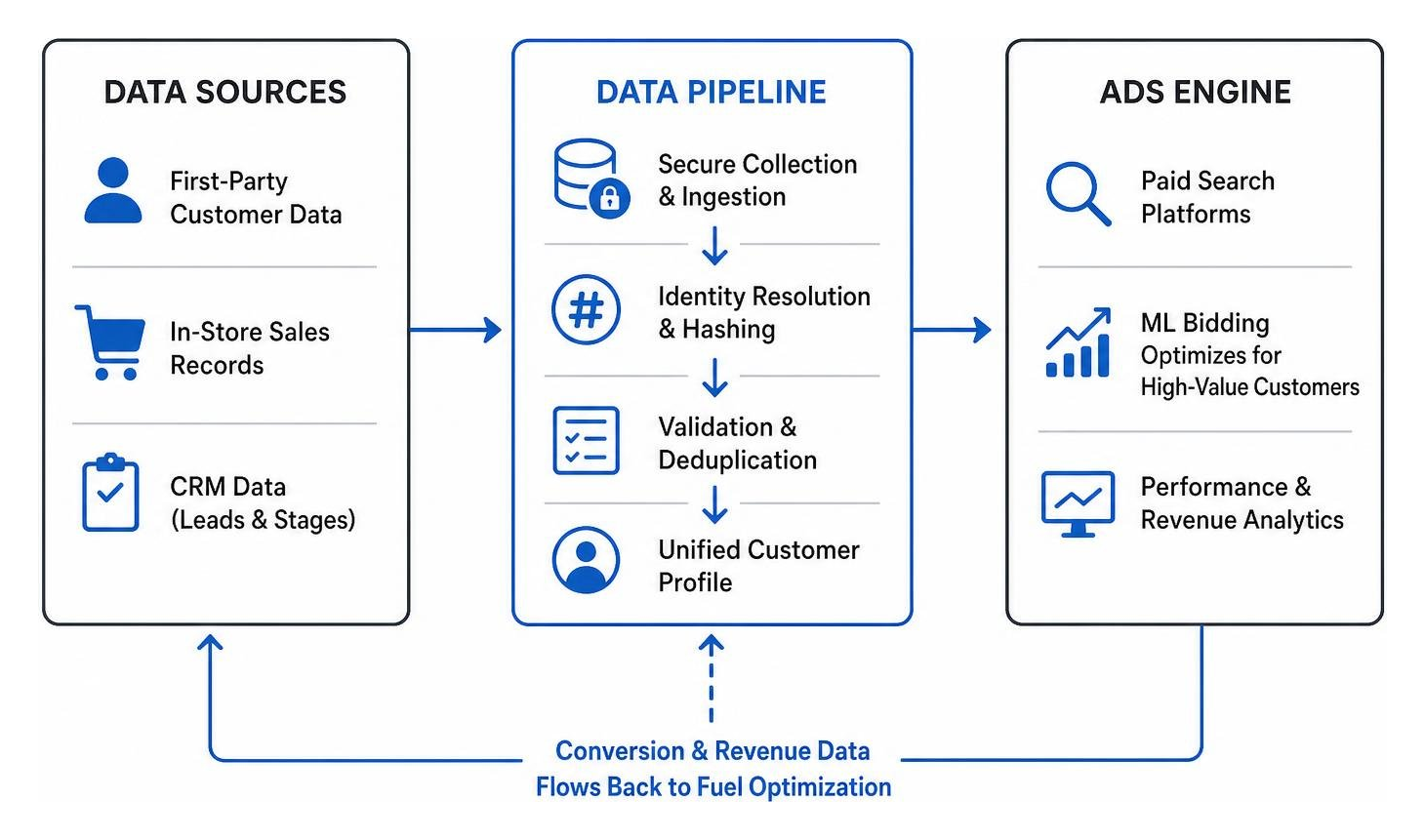
When first-party customer signals, in-store sales records, and CRM stages flow directly back into search platforms, machine learning bidding algorithms optimize for high-margin customers instead of low-intent form fills.
Technical Tracking Setup in Google Ads and GA4
Accurate data ingestion begins with robust conversion modeling and event mapping. Setting up Enhanced Conversions in Google Ads allows hashed, first-party customer data (such as email addresses and phone numbers collected on checkout or lead forms) to match securely against signed-in Google accounts.
Using Google Tag Manager alongside server-side tracking ensures your conversion events register reliably even when client-side scripts are blocked. Properly configuring your Google Analytics tracking configuration provides a solid foundation for recording critical micro-events—such as product catalog views, appointment bookings, and cart additions—before feeding those values downstream.
Feeding First-Party CRM Signals for Value-Based Bidding
A high-value consultation or diamond sale often closes days or weeks after the initial ad click. Offline conversion tracking bridges this gap by syncing CRM pipeline updates back into Google Ads via API or automated uploads.
When you pass offline lead qualification statuses and actual closed revenue to the ad engine, smart bidding transitions from standard "Maximize Conversions" to "Maximize Conversion Value." This trains the bidding engine to prioritize users with high lifetime value. To set up advanced data mapping and custom attribution pipelines, businesses frequently turn to specialized analytics services that integrate enterprise point-of-sale data with modern search architectures.
Search Term Auditing and Campaign Architecture Optimization
Search term auditing separates actual customer queries from the broad keyword targets inside your account. Monitoring the Search Query Report prevents ad spend from flowing toward irrelevant, low-intent phrases.

Analyzing Query Intent and Negative Keyword Mining
Even if your target keyword is "custom engagement rings," broad matching algorithms might match your ad to terms like "free engagement ring design software" or "cheap plastic rings." Analyzing search query reports allows you to isolate negative match candidates and prevent wasted spend before costs accumulate.
Applying negative keyword lists at both the campaign and account levels protects your ad spend. Reviewing query patterns also reveals new high-converting commercial phrases that deserve dedicated ad creative. Specialized automated workflows, such as those leveraging a search term performance node analysis, help monitor rising search themes and automate negative keyword additions at scale.
Avoiding Over-Segmentation to Maximize Machine Learning Reach
A decade ago, Single Keyword Ad Groups (SKAGs) were standard practice. In 2026, severe over-segmentation harms account performance. Modern smart bidding models require large pools of conversion data within each ad group to optimize bids effectively in real time. Fragmenting your budget across dozens of hyper-specific ad groups starves machine learning models of the data density they need.
Adopting a consolidated campaign architecture groups themed products or services together, giving automated bidding strategies the volume required to maximize reach. In-depth resources like our Google Ads optimization guide demonstrate how moving from fractured accounts to consolidated structures consistently improves conversion rates and lowers CPA.
| Campaign Architecture Dimension | Over-Segmented Structure (Legacy / SKAGs) | Consolidated Themed Structure (Modern Best Practice) |
|---|---|---|
| Data Density | Fragmented across dozens of ad groups; slow learning | High conversion volume concentrated per ad group |
| Smart Bidding Efficacy | Bidding algorithms struggle due to low data volume | Machine learning rapidly optimizes bids in real time |
| Account Management | High manual maintenance; duplicate negative lists | Streamlined management focused on creative and assets |
| Match Type Strategy | Rigid reliance on exact match keywords only | Balanced use of broad match paired with smart bidding |
| Reach & Intent Capture | Misses conversational, long-tail search queries | Captures complex, high-intent multi-word search queries |
Harnessing AI Automation and Cross-Channel Synergy
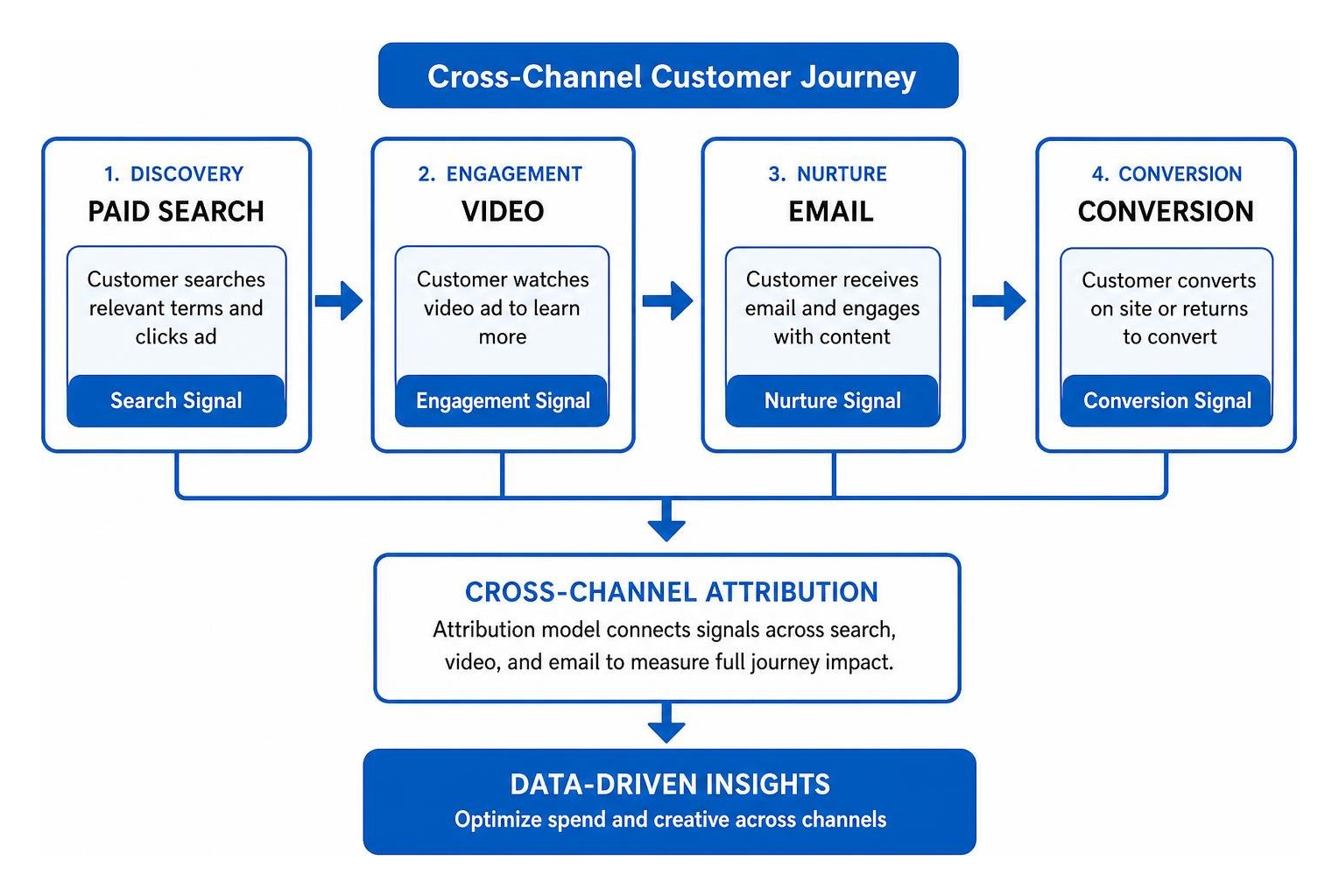
Paid search operates at its best as part of a connected multi-channel ecosystem. Google's Display Network alone reaches over 90% of global internet users, and connecting search signals with display, video, and automated messaging creates a coordinated marketing engine.
Testing AI Automation and Performance Max in Paid Search Analytics
Automated campaign types like Performance Max and AI Max for Search dynamically assemble ad assets, headlines, and landing pages to match intent across Search, YouTube, Display, and Maps. However, AI features must be tested systematically rather than adopted blindly.
When deploying automated campaigns, use experiments to measure incremental conversion lift against your standard search campaigns. Regularly review asset performance reports and apply negative keywords, URL exclusions, and brand lists to maintain control. Technical specifications for querying these asset combinations are detailed in the Google Ads API AI Max reporting documentation, which explains how headline and landing page combinations match incoming queries.
Bridging Search Ads with Video, Email, and Organic Channels
Search queries highlight immediate customer intent, making paid search data invaluable for other marketing channels:
- Organic Search Integration: Identify high-converting paid search queries that lack organic rankings, then develop targeted SEO landing pages to capture unpaid traffic.
- Video Retargeting: Retarget users who clicked high-intent search ads with storytelling video campaigns on YouTube.
- Email Automation: Align automated email drip sequences with the specific product categories prospects researched via search ads.
Tracking performance across touchpoints requires a clear tech stack. Exploring tools to measure campaign effectiveness helps ensure your reporting reflects cross-channel growth. For brands seeking hands-on strategic oversight, partner with our team for dedicated Google Ads management to synchronize your search advertising with broad commercial goals.
Building an Actionable Stakeholder Reporting Framework
Data is only valuable if stakeholders can use it to make strategic decisions. An effective reporting framework translates complex platform metrics into clear commercial insights.
Constructing Executive Dashboards and Performance Reviews
Executive dashboards built in tools like Looker Studio should present metrics in a clear hierarchy:
- Executive Level: Gross Revenue Generated, Total Ad Spend, Blended ROAS, Total Qualified Conversions.
- Operational Level: Cost Per Acquisition (CPA), Conversion Rate (CVR), Average Order Value (AOV).
- Tactical Diagnostics: Impression Share Lost to Budget/Rank, Average CPC trends, Quality Score distribution.
Diagnosing Campaign Anomalies and Budget Shifts
When performance metrics shift unexpectedly, a structured weekly auditing cadence helps you diagnose the root cause:
- Step 1: Check Search Term Reports: Identify whether unexpected spikes in spend were caused by broad match expansion into irrelevant queries.
- Step 2: Inspect Impression Share Metrics: Determine if lost impression share stems from budget constraints or declining Ad Rank (Quality Score / bid caps).
- Step 3: Analyze Competitor Auctions: Review Auction Insights to see if aggressive competitor bids are inflating market CPCs.
- Step 4: Audit Conversion Tracking Pathways: Verify that checkout forms, tag triggers, and tracking parameters are firing correctly.
- Step 5: Reallocate Daily Budget: Shift budget away from underperforming ad groups into campaigns delivering high ROAS.
Frequently Asked Questions About Paid Search Performance
What is the difference between PPC reporting and paid search analytics?
PPC reporting focuses on what happened by compiling descriptive numbers such as clicks, spend, and impressions over a given timeframe. Paid search analytics focuses on why it happened and what to do next, diagnosing performance trends, evaluating search intent, and testing strategic shifts to increase revenue.
How long should I wait before evaluating changes made by automated bidding?
You should allow at least a 14-day learning window after making major structural changes or switching bidding strategies. Smart bidding algorithms require sufficient time and conversion volume to calibrate bids. Making frequent adjustments during this initial learning phase resets the algorithm and delays optimization.
Why do reported search term clicks not always equal total campaign clicks?
Search engine privacy thresholds omit low-volume, individual search queries from public search term reports to protect user privacy. While the clicks from these queries are fully counted in your overall campaign totals, the specific query text is hidden if it does not meet minimum search volume thresholds.
Conclusion
Transforming raw search data into consistent business profit requires moving beyond surface vanity metrics. By configuring accurate first-party conversion tracking, consolidating campaign architectures, systematically auditing search terms, and connecting search intent across marketing channels, your ad budget becomes an efficient engine for revenue growth.
At GemFind Digital Solutions, we have spent more than 25 years helping businesses scale with data-driven digital strategies. Whether you need an end-to-end analytics overhaul or advanced search campaign management, explore our comprehensive 2026 search strategy to elevate your digital marketing performance today.


