


Why Every Jewelry Store Needs a Shopify Virtual Try-On App in 2026

The best Shopify virtual try-on apps for jewelry stores in 2026 are:
| App | Best For | Starting Price |
|---|---|---|
| TryOn Virtual: AR & AI Try-On | Eyewear & watches (real-time AR) | Free |
| Camweara | Jewelry, watches & accessories | $39/month |
| GenLook | Clothing & fashion | Free |
| Virtual Try Glasses | Eyewear only | Free |
| TryPoint | Fashion & apparel | Free |
| TryItOnMe | General apparel | Free |
Customers can't pick up your rings. They can't hold your necklaces up to the light. And they certainly can't try anything on before clicking "Add to Cart."
That's the core problem with selling jewelry online — and it's costing stores real money in lost sales and costly returns.
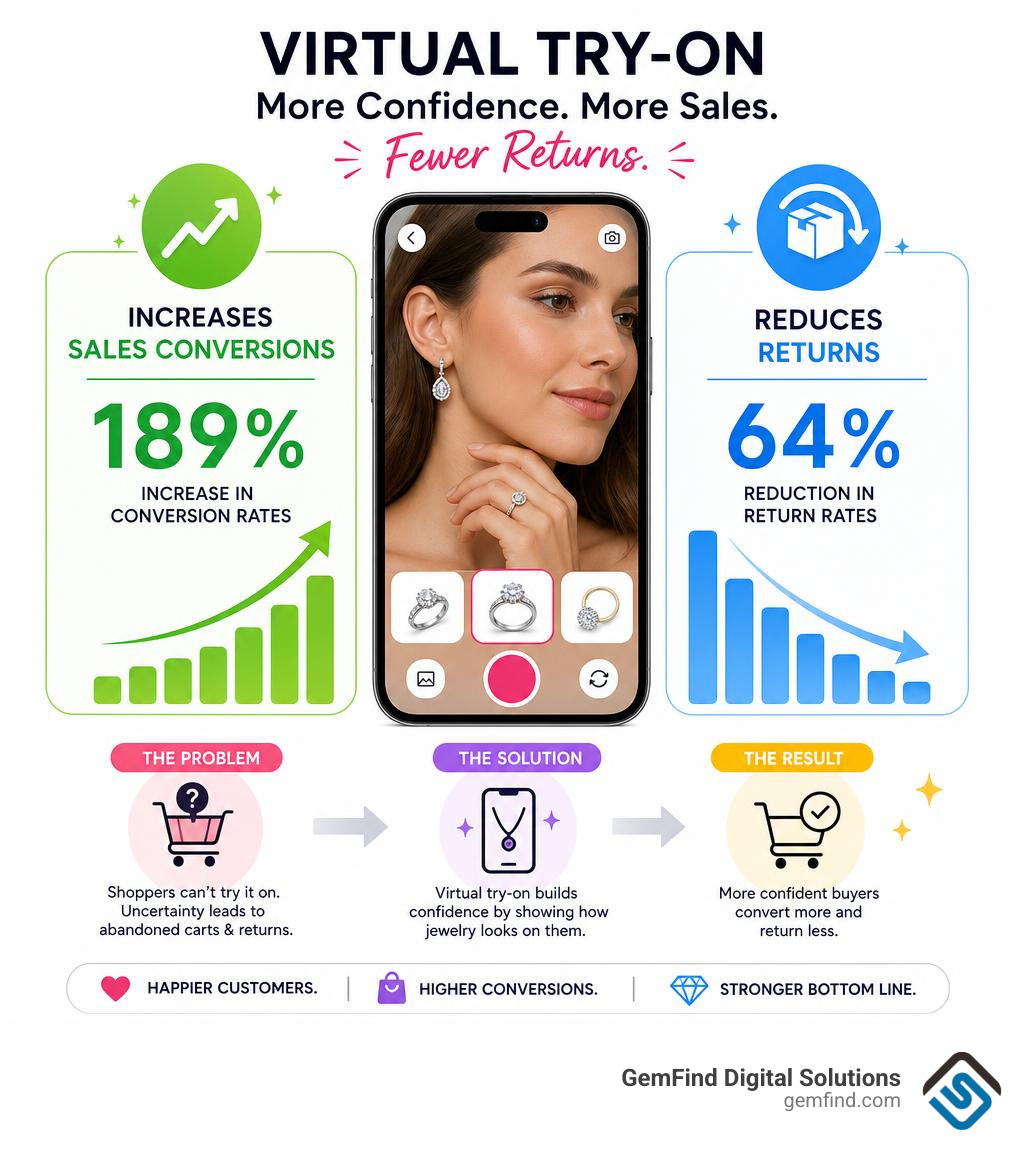
Virtual try-on technology changes that. Shoppers can now upload a photo or use their camera to see exactly how a ring, bracelet, or pair of earrings looks on them — before they buy. Retailers using this technology have seen conversion rates jump by as much as 189% and return rates drop by up to 64%.
In 2026, this is no longer a luxury feature. It's quickly becoming a standard expectation for online shoppers, especially younger buyers who want to see it before they buy it.
I'm Anthony Arechiga, VP of Sales at GemFind Digital Solutions, where I've spent nearly two decades helping jewelry retailers build stronger e-commerce experiences — including guiding stores through adopting the right Shopify virtual try-on app solutions for their specific needs. In this guide, I'll walk you through the top apps on the market so you can find the right fit for your store.
Shopify virtual try-on app terms at a glance:
Understanding Virtual Try-On Technology for E-Commerce
To make the most of this technology, we first need to understand how it works under the hood. Virtual try-on (VTO) has evolved rapidly over the last few years, transitioning from cartoonish overlays to photorealistic, real-time digital fittings.

What is a Shopify Virtual Try-On App and How Does It Work?
A Shopify virtual try-on app is an integration that allows online shoppers to preview how products look on their own bodies directly from a product page.
It generally functions in two ways:
- Real-Time Live Video Mode: The app requests access to the customer's smartphone or desktop camera. It uses advanced mapping algorithms to track the movement of their face, hands, or fingers, overlaying a 3D digital model of the jewelry in real time.
- Photo Upload Mode: The customer uploads a static selfie or a photo of their hand. The app's artificial intelligence (AI) analyzes the image, identifies the correct placement area (like the ring finger or earlobe), and realistically drapes or mounts the product image onto the photo.
For a deeper dive into how this applies to fine jewelry, check out our Virtual Try-On Jewelry Complete Guide.
AR-Based vs. AI-Based Virtual Try-On Solutions
When researching a Shopify virtual try-on app, you will encounter two primary technologies: Augmented Reality (AR) and Generative AI (GenAI).
- AR-Based Solutions: These rely on traditional 3D assets. AR is highly effective for rigid, structured objects like glasses, rings, and watches. The technology maps physical anchor points (like the bridge of a nose or the knuckle of a finger) and anchors the 3D model to it, allowing the customer to move and see the product from different angles.
- AI-Based Solutions: Instead of requiring complex 3D models, AI-based solutions utilize 2D product images and generate a new, synthesized image of the customer wearing the item. This is incredibly useful for soft goods like apparel where fabric drape and physics are difficult to replicate in traditional 3D engines, but it is also becoming popular for jewelry due to its low barrier to entry.
Which Product Categories Perform Best with Virtual Try-On?
While the technology is expanding across all of retail, certain sectors perform incredibly well with virtual fittings:
- Fine Jewelry & Watches: Rings, earrings, necklaces, and luxury watches are perfect candidates because they are highly visual, expensive, and rely heavily on scale and personal aesthetics. You can read more about this in our Try-On Jewellery Complete Guide.
- Eyewear: Glasses and sunglasses are arguably the easiest products to map, making them a staple for VTO tech.
- Apparel & Cosmetics: Clothing and makeup benefit from AI-based draping and facial tracking to match skin tones and body shapes.
The Business Benefits of Virtual Try-On for Jewelry Retailers
Implementing interactive tools is no longer just about looking "high-tech." It directly impacts your bottom line by addressing the biggest challenges of online jewelry retail: trust, sizing, and decision fatigue. For more on this, explore our guide on Interactive Tools That Help Jewelers Sell More Jewelry Online.
Boosting Conversions and Reducing Cart Abandonment
The luxury space suffers from high cart abandonment rates because buying fine jewelry is a high-consideration purchase. When shoppers can visualize a diamond ring on their own hand, their hesitation drops. Industry data shows that implementing virtual try-on features can boost conversion rates by up to 30%, with some retailers experiencing a massive 189% increase compared to traditional flat images.
To see how this works for high-value items, take a look at our article on Shopify Apps Created for Jewelers to Reach More Engagement Ring Clients.
Slashing Return Rates and Sizing Doubts
Returns are an expensive logistical nightmare. For jewelry, returns often happen because a piece looked larger, smaller, or different in color than expected. Virtual try-on tools can reduce return rates by up to 64% (with average apparel and accessory retailers reporting a consistent 20-30% drop). By giving customers a realistic sense of scale, they buy with confidence.
Interestingly, this technology isn't limited to online spaces; you can learn about in-store applications in our guide on Shopify POS Jewelry Tryon.
Enhancing Customer Engagement and Browsing Time
Engaged shoppers buy more. Virtual try-on tools act as an interactive playground, boosting customer browsing time by nearly 20%. Customers love taking screenshots of their virtual try-ons to share with friends and family for feedback, which naturally generates organic word-of-mouth marketing for your brand. Discover more engagement-focused tools in our breakdown of The Top Shopify Apps for Jewelry Stores.
Top Shopify Virtual Try-On Apps Compared
Selecting the right app depends on your product catalog, budget, and desired user experience.

Here is how the top Shopify virtual try-on apps stack up in 2026:
TryOn Virtual: AR & AI Try-On
This versatile app offers a hybrid approach, combining real-time 3D AR try-on for specific categories like eyewear and watches with AI-powered photo-based try-ons for the rest of your catalog.
- Best For: Multi-category accessory stores.
- Key Features: Real-time browser-based tracking (no downloads needed), built-in 3D model generation from flat product photos, and a strict privacy-first design that does not store customer images.
- Pricing: Free plan available (up to 100 real-time and 100 AI try-ons/month). Paid plans start at $49/month.
- App Store Link: TryOn Virtual: AR & AI Try‑On - Real-time try-on + photo-based try-on for all products | Shopify App Store
TryItOnMe: Virtual AI Try-On
TryItOnMe focuses on speed and ease of use, utilizing AI to generate realistic try-on previews in under 10 seconds.
- Best For: Quick setup and fashion apparel.
- Key Features: Automatic product image extraction, mobile-optimized interface, and a lightweight widget that integrates with a single click.
- Pricing: Free plan available (10 try-ons/month). Paid plans range from $19/month to $299/month.
- App Store Link: TryItOnMe ‑ Virtual AI Try‑On - Let customers see themselves in your products instantly | Shopify App Store
GenLook: AI Virtual Try On
GenLook is a powerhouse for fashion e-commerce, using Generative AI to realistically drape clothing on customer-uploaded photos without requiring expensive 3D assets.
- Best For: Apparel brands wanting to capture leads.
- Key Features: Email capture gates (turn try-ons into newsletter signups), seamless Klaviyo integration, and fully customizable widgets to match your brand colors.
- Pricing: Free plan available (10 monthly try-ons). Paid plans start at $19.99/month.
- App Store Link: GenLook: AI Virtual Try On - Boost sales and reduce returns with AI virtual try-on. | Shopify App Store
Virtual Try On
A highly streamlined, zero-code theme extension designed specifically for Shopify's Online Store 2.0 framework.
- Best For: Small merchants looking for a simple, budget-friendly AI try-on tool.
- Key Features: Simple merchant dashboard inside Shopify Admin, one-click installation, and realistic AI image generation.
- Pricing: Free plan available (100 generations/month). Paid plans start at a very affordable $5.99/month.
- App Store Link: Virtual Try On - AI try-on let your shoppers try your outfits in seconds. | Shopify App Store
Virtual Try Glasses
An AI-powered app built specifically for eyewear visualization, allowing customers to try on and adjust glasses in real time.
- Best For: Eyewear brands.
- Key Features: Advanced facial mapping, support for both 2D images and 3D models, and interactive adjustment controls for the user.
- Pricing: Free plan available (up to 5 products). Paid plans start at $40/month.
- App Store Link: Virtual Try Glasses - Visualize Glasses in Real-time with our AI-based Try-On App. | Shopify App Store
TryPoint: AI Virtual Try-On
Powered by advanced Google-backed diffusion AI models, TryPoint is built specifically for fashion brands that require high-fidelity rendering, including back-view try-ons.
- Best For: High-end apparel, swimwear, and outerwear.
- Key Features: Preserves intricate garment details (prints, stitching, textures), supports back-view try-ons, and integrates with VideoPoint to create shoppable try-on videos.
- Pricing: Free plan available (20 try-ons). Paid plans start at $19.99/month, or a pay-as-you-go model at $0.29 per try-on.
- App Store Link: TryPoint - AI Virtual Try-On for Shopify Fashion Stores
Choosing the Right Shopify Virtual Try-On App for Your Jewelry Store
Not all virtual try-on apps are created equal, and a tool that works perfectly for a t-shirt brand might fail miserably when trying to render the delicate facets of a diamond engagement ring.
To help you choose, let's explore some of the must-have features specifically for jewelry stores in our guide: Boost Sales with These Must-Have Shopify Apps for Jewelers.
Key Criteria for Selecting a Shopify Virtual Try-On App
When evaluating your options, keep these four factors in mind:
- Rendering Realism: Fine jewelry relies on sparkle, metal reflection, and accurate scaling. If the app makes your $5,000 diamond ring look like a flat sticker, it will hurt your brand image. Look for apps that support high-quality 3D rendering or advanced AI detailing.
- Device Compatibility: Over 80% of virtual try-on interactions happen on mobile devices. Ensure the app works flawlessly on both iOS and Android browsers without requiring external app downloads.
- Asset Requirements: Does the app require you to upload 3D CAD files for every SKU, or can it generate a try-on experience using your existing 2D product photography?
- Customer Support: Look for developers with highly rated customer support to assist with widget positioning and theme integration.
For a comprehensive strategic look, read our Shopify for Jewelry Stores: Complete Guide.
Integration Ease and Store Performance Impact
Many merchants worry that adding complex AR or AI scripts will slow down their website, hurting their SEO and user experience.
To prevent this, look for modern apps that utilize Shopify App Embeds (compatible with Online Store 2.0 themes). These apps load asynchronously, meaning the virtual try-on widget loads in the background after your main page content has already loaded, keeping your page speed fast and optimized.
You can see examples of well-optimized storefronts in our showcase of Shopify Jewelry Store Examples.
Analytics, Insights, and Limitations
A great try-on app doesn't just display products — it gathers valuable first-party data. Look for apps that provide an analytics dashboard tracking:
- Which SKUs are tried on most frequently.
- The conversion rate of users who interact with the try-on tool vs. those who don't.
- Email signups generated through try-on gates.
However, be aware of the limitations. Traditional AR requires 3D assets, which can cost anywhere from $100 to $300 per SKU to create if you don't already have CAD files. If you have a massive catalog of unique, estate, or custom pieces, an AI-based photo-upload app may be a more cost-effective choice.
For expert advice on handling these technical setups, read our Shopify Expert Jewelry Stores: Ultimate Guide.
Future Trends Shaping Virtual Try-On in 2026
As we move through 2026, several exciting advancements are making virtual try-on even more powerful for Shopify merchants:
- Hyper-Realistic Light Estimation: Modern WebAR can now detect the lighting environment of the user's room and adjust the reflections on digital gold, platinum, and gemstones in real time, making the virtual jewelry look incredibly lifelike.
- Generative AI Hybrid Models: Retailers are increasingly using hybrid models where AI automatically converts standard 2D flat photos into interactive 3D assets on the fly, eliminating the high cost of 3D modeling.
- Omnichannel Retail Integration: Merchants are bridging the gap between online and offline by using QR codes in physical showcases, allowing in-store shoppers to digitally try on pieces that may not currently be in stock at that physical location.
Frequently Asked Questions about Virtual Try-On Apps
How do virtual try-on apps handle customer photo privacy and data security?
Most reputable Shopify virtual try-on apps prioritize a privacy-first design. Real-time AR apps typically process the video feed directly within the user's web browser, meaning no video data is ever sent to or stored on external servers. For photo-upload apps, look for developers that explicitly state they use temporary cloud processing and do not permanently store or sell customer photos.
Do virtual try-on apps slow down my Shopify store's loading speed?
Not if you choose the right one. Modern apps use Shopify App Embeds that load asynchronously. This ensures the try-on widget does not block your page from loading, preserving your site speed, mobile performance, and search engine optimization (SEO).
Is 3D asset creation required for all virtual try-on apps?
No. While traditional real-time AR apps (like those for glasses or rings) perform best with 3D models, many modern AI-powered apps can generate highly realistic try-on images using only your existing 2D product photos. This makes it easier and much more affordable for growing jewelry brands to adopt the technology.
Conclusion
Offering a virtual try-on experience is one of the highest-ROI investments a modern jewelry retailer can make. It bridges the gap between digital convenience and the tactile confidence of an in-store fitting, helping you convert hesitant browsers into lifelong customers.
At GemFind Digital Solutions, we bring over 25 years of specialized jewelry industry expertise to help you navigate the digital landscape. As a certified Shopify and Google Partner, we don't just build websites — we build complete digital experiences tailored to jewelers, from custom web design and digital marketing to seamless Edge POS integrations and interactive tools.
Ready to elevate your online store and implement the perfect virtual try-on solution for your jewelry brand? Explore GemFind Apps or reach out to our team today to get started!


