



How Iconic Engagement Ring Ad Campaigns Shaped the Way We Buy and Think About Rings

Engagement ring ad campaigns have done something most marketing efforts only dream of — they didn't just sell a product, they invented a tradition.
Here are the most iconic campaigns and what made them work:
| Campaign | Brand | What Made It Work |
|---|---|---|
| "A Diamond is Forever" | De Beers (1947) | Linked diamonds to eternal love; created a cultural norm |
| "Two Months' Salary" | De Beers (1930s) | Gave buyers a spending benchmark; invented a "rule" |
| "Return to Tiffany" | Tiffany & Co. (1960s) | Made luxury accessible to younger buyers |
| Alhambra Collection | Van Cleef & Arpels (1968) | Minimalist icon worn by fashion legends |
| "Worth the Wait" | De Beers x Signet (2024) | Targets Zillennials with personal growth storytelling |
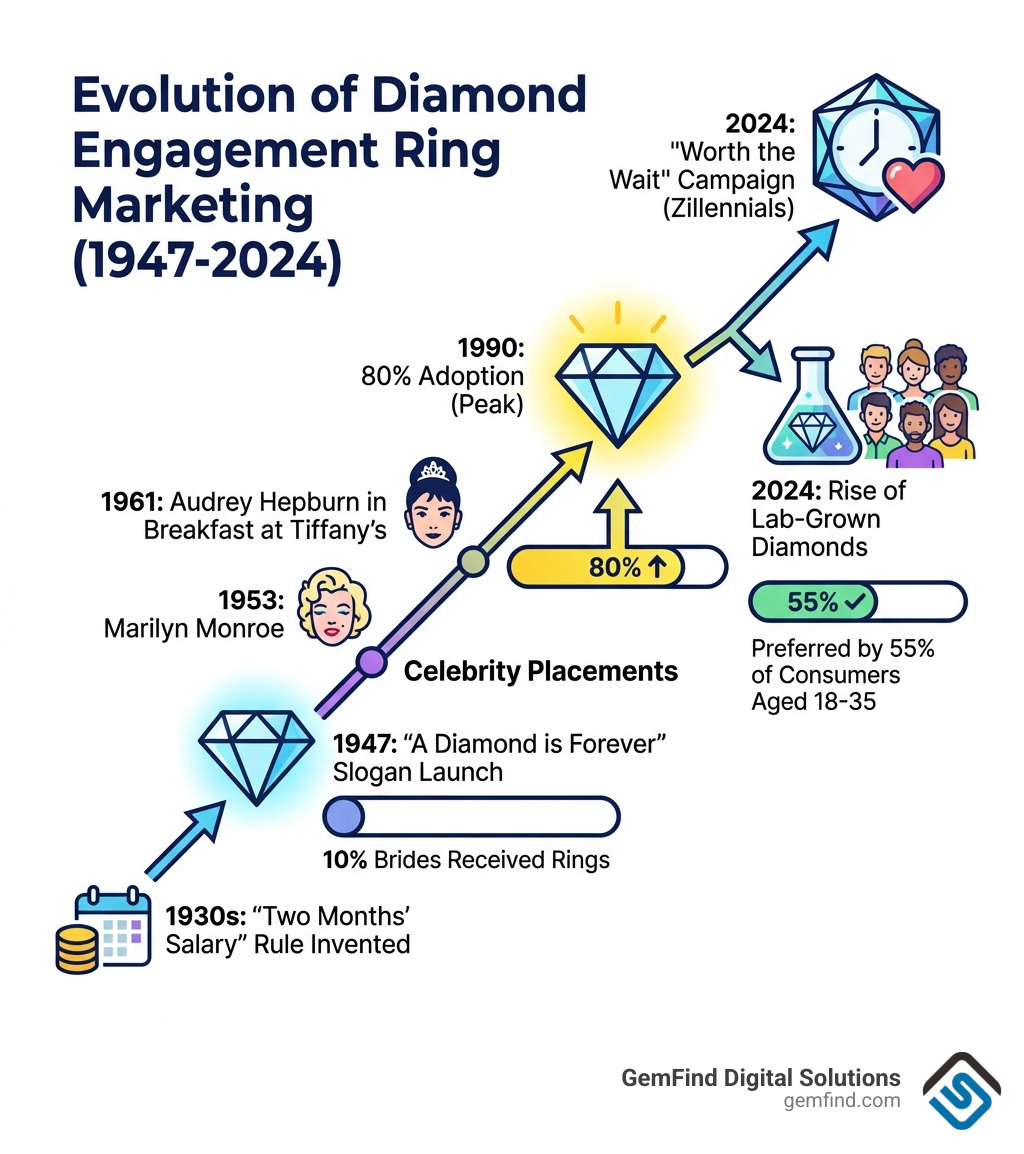
Before 1947, diamond engagement rings were rare. By 1990, 80% of first-time brides received one. That shift didn't happen by accident — it was engineered through some of the most effective advertising in history.
These campaigns worked by tapping into emotion, culture, and human psychology. They didn't just advertise rings. They sold love, status, and forever.
Whether you're a jeweler looking to grow your store or a marketer studying what works, understanding these campaigns reveals powerful lessons about how advertising can reshape consumer behavior at a cultural level.
I'm Anthony Arechiga, VP of Sales at GemFind Digital Solutions, where I've spent nearly two decades helping jewelry retailers craft digital strategies — including campaigns that draw on the same emotional and cultural triggers that made these iconic engagement ring ad campaigns so effective. I'll break down what made each campaign work and how you can apply those lessons to your own marketing today.
The De Beers Legacy: Inventing the Modern Engagement Ring
When we talk about engagement ring ad campaigns, we have to start with the "Big Bang" of jewelry marketing. In the late 1930s, the diamond industry was in a precarious spot. The Great Depression had crushed luxury spending, and diamonds were seen as the playthings of the ultra-wealthy, not a necessity for the average couple.
Enter Mary Frances Gerety, a young copywriter at the N.W. Ayer & Son agency. In 1947, she scribbled four words that would change the world: "A Diamond is Forever." This wasn't just a catchy line; it was a psychological masterstroke. By linking the physical durability of a diamond to the emotional concept of eternal love, De Beers convinced the public that a diamond was the only appropriate vessel for a marriage proposal.
The History of the De Beers campaign shows how they meticulously built a monopoly on both the supply and the narrative. They didn't just want people to buy diamonds; they wanted people to never sell them. By framing diamonds as family heirlooms that should be kept "forever," they effectively removed second-hand diamonds from the market, maintaining artificial scarcity and keeping prices high.
The success was staggering. Between 1939 and 1979, De Beers’ wholesale diamond sales in the US skyrocketed from $23 million to $2.1 billion. Their advertising budget grew alongside this success, jumping from $200,000 to $10 million a year.
The Impact of the "Two Months' Salary" Rule
Perhaps the most brilliant (and controversial) part of the De Beers strategy was the invention of a spending benchmark. We’ve all heard it: "An engagement ring should cost two months' salary."
The "tradition" of spending several months' salary was entirely manufactured. In the 1930s, the initial campaign suggested one month's salary. By the 1980s, it had evolved into two months. This is a classic example of "price anchoring." By giving consumers a specific number, De Beers removed the guesswork and replaced it with a social obligation. It turned a financial decision into a test of a man's love and success.
| Year | % of Brides Receiving Diamond Rings |
|---|---|
| 1940 | 10% |
| 1990 | 80% |
This rule worked because it provided a "behavioral trigger." It gave the buyer a quantifiable way to prove their commitment. Even today, while many couples are moving away from rigid rules, the psychological "anchor" of high spending remains a major factor in the industry.
Cultural Icons and the Power of Celebrity Endorsements
While De Beers was building the foundation, Hollywood was building the dream. We often see how movies and stars can turn a brand into a global aspiration.
Marilyn Monroe’s performance of "Diamonds Are a Girl’s Best Friend" in the 1953 film Gentlemen Prefer Blondes is perhaps the most famous piece of "unintentional" advertising in history. When she sang that "men grow cold as girls grow old, but these rocks don't lose their shape," she reinforced the "forever" narrative De Beers was pushing. Her iconic pink dress and diamonds became a visual shorthand for luxury and desire.
Then came Audrey Hepburn in Breakfast at Tiffany’s. The movie didn't just feature jewelry; it made the store itself a sanctuary. To Holly Golightly, Tiffany’s was a place where "nothing bad could happen." This film cemented the allure of the Tiffany blue box and the idea that even a small purchase (like the ring from a Cracker Jack box that they had engraved) carried the weight of the brand’s prestige.
Hollywood’s Role in Popularizing Engagement Ring Ad Campaigns
The integration of jewelry into pop culture has continued for decades. From the entire Tiffany store being rented out in Sweet Home Alabama to James Bond films like Diamonds Are Forever, the industry has used cinema to show that diamonds are statements of power, romance, and status.
Other brands used similar strategies to create "icons."
- Cartier Panthère: Starting in 1914, the panther became a symbol of "untameable femininity" and post-war freedom.
- Bulgari Serpenti: The history of Bulgari's snake motif shows how the brand used the symbol of power and seduction to capture the attention of icons like Elizabeth Taylor during the filming of Cleopatra.
These campaigns worked because they didn't just show a product; they associated the jewelry with the most interesting and powerful people in the world.
Modern Strategies for Zillennial Engagement Ring Ad Campaigns
Today, the landscape is shifting. "Zillennials" (the micro-generation between Millennials and Gen Z) have different priorities. They value authenticity, personal growth, and relationship dynamics that don't always follow the traditional "linear" path.
To address this, De Beers and Signet (the parent company of Kay, Zales, and Jared) recently launched the Signet and De Beers "Worth the Wait" launch in late 2024. This campaign is a fascinating evolution of the "forever" narrative.
Instead of focusing solely on the wedding day, "Worth the Wait" focuses on the journey. It highlights real-world couples who have gone through milestones like moving in together, merging finances, or even breaking up and reconciling. The campaign draws a parallel between the billions of years it takes for a natural diamond to form and the time and resilience it takes to build a modern relationship.
We see this as a pivot toward "emotional storytelling" that resonates with a generation that is getting engaged later in life. For more on how to adapt these themes, check out The guide to selling engagement rings with digital marketing.
Visual and Emotional Techniques for Social Media
The way we see engagement ring ad campaigns is just as important as the message.
- Vertical Video: With over 60% of purchases made from smartphones, ads must be optimized for mobile. Vertical formats on TikTok and Instagram Reels are now the standard.
- High-Contrast Imagery: On a crowded social feed, visuals need to "stop the scroll." Using high-contrast photography and bold statements helps rings stand out.
- Facebook Messenger Ads: With 133 million users on Messenger, brands are using direct messaging to start personal consultations. We’ve found that A guide to organizing Facebook ads for jewelry stores is essential for jewelers trying to navigate this space.
- User-Generated Content (UGC): 91% of millennials trust online reviews as much as friends. Seeing "real" people wearing the rings builds a level of trust that high-fashion photography can't always achieve.
The Shift Toward Ethics and Alternative Gemstones
A challenge to traditional diamond marketing is the rise of alternatives. Today, only 45% of consumers aged 18-35 prefer natural diamonds, while 55% prefer lab-grown diamonds.
Why the shift?
- Price: Lab-grown diamonds are at least 30% cheaper than natural ones.
- Ethics: Modern couples are highly concerned with supply chain transparency and "conflict-free" certifications.
- Moissanite: Often highlighted as a superior ethical alternative, moissanite is harder than most gems (9.25-9.5 on the Mohs scale) and significantly more affordable.
Contemporary engagement ring ad campaigns are now leaning heavily into these "sustainability narratives." Brands are focusing on traceability and the "journey" of the stone to ensure it aligns with the customer's values. If you're looking to reach this demographic, we've compiled 23 tactics to reach more bridal customers that focus on these modern values.
How Contemporary Brands Differentiate Their Engagement Ring Ad Campaigns
Brands like Blue Nile and Brilliant Earth have revolutionized the industry by focusing on "the online experience." They offer:
- Bespoke Design: Allowing customers to build their own ring online.
- Social Proof: Prominently displaying thousands of customer reviews and photos.
- Inclusive Marketing: Targeting the LGBT market and diverse couples to reflect the modern world.
- Virtual Consultations: Bringing the expertise of a jeweler to the customer’s living room.
To compete in this space, knowing How to target jewelry buyers on Facebook is a game-changer. It allows smaller retailers to reach specific niches with the same precision as the big brands.
Frequently Asked Questions about Engagement Ring Marketing
How did the "two months' salary" rule start?
It was a marketing tactic created by De Beers in the 1930s (initially as one month's salary) to give men a clear spending benchmark. It was designed to increase the perceived value of diamonds and link financial sacrifice to the depth of one's love.
Why is "A Diamond is Forever" considered the best slogan of the 20th century?
It successfully linked a product's physical attribute (hardness) to a human emotion (eternal love). It also discouraged the reselling of diamonds, which helped maintain high market prices by creating artificial scarcity.
How are lab-grown diamonds changing modern engagement ring advertising?
They are forcing traditional diamond miners to focus on the "rarity" and "billion-year journey" of natural stones. Meanwhile, lab-grown ads focus on "more sparkle for your budget" and "ethical transparency," appealing to the price-conscious and eco-conscious Zillennial and Gen Z demographics.
Conclusion
The history of engagement ring ad campaigns is a masterclass in how to build a brand that lasts. From De Beers' invention of a global tradition to modern campaigns that celebrate the "messy" but beautiful journey of real-life relationships, the core lesson remains the same: Jewelry is an emotional purchase.
At GemFind Digital Solutions, we’ve spent over 25 years helping jewelers navigate these cultural shifts. As a Shopify and Google Partner, we don't just provide tools; we provide the industry-specific expertise needed to make your brand shine in a digital world. Whether it's Edge POS integration or specialized apps that let your customers "build their own" dream ring, we are here to help you grow.
Ready to create a campaign that stands the test of time? Explore GemFind's digital marketing services today and let's start building your legacy.


