


How to Estimate a Diamond Ring Price
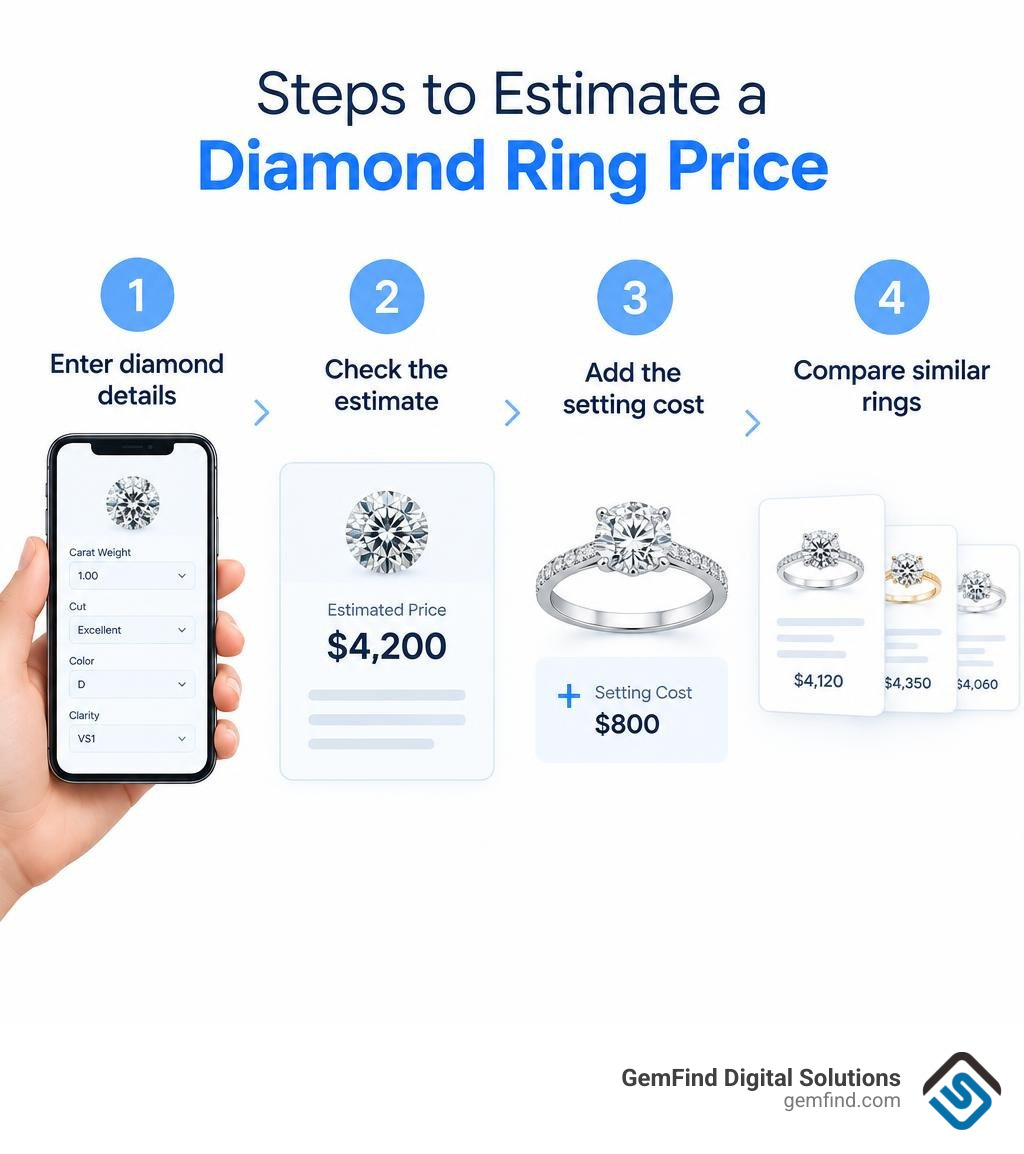
To use a diamond ring price calculator, enter the diamond’s carat weight, cut, color, and clarity. Add its shape, grading report, and whether it is natural or lab-grown if the tool asks. Check what the result covers: many calculators estimate the loose diamond, not the finished ring. Add the setting cost to build a ring budget, then compare prices for similar diamonds. Treat the result as a starting point, not a guaranteed price or resale offer.
I’m Anthony Arechiga, Vice President of Sales at GemFind Digital Solutions. Since 2007, I’ve worked with jewelry businesses on digital tools and online sales, giving me a practical view of how a diamond ring price calculator can help shoppers compare prices.
Similar topics to diamond ring price calculator:
How a Diamond Ring Price Calculator Evaluates Market Data
Modern digital diamond calculators are powered by data aggregation engines that analyze live inventories from hundreds of global suppliers. Rather than relying on static retail markups, sophisticated tools cross-reference market pricing indices, wholesale feeds, and real-time pricing data models to determine the current replacement value of a loose stone.
Pricing algorithms continuously ingest thousands of daily transactions to establish median asking prices. By processing this data through statistical modeling, a digital calculator establishes a baseline valuation for any combination of gemological attributes.
Key Inputs Needed for an Accurate Diamond Ring Price Calculator Estimate
To generate an accurate valuation, an estimation algorithm requires verified grading report parameters. The primary data inputs include:
- Diamond Shape: Round brilliant, oval, princess, emerald, cushion, radiant, pear, marquise, or asscher.
- Carat Weight: Precise metric weight measured to two decimal places.
- Color Grade: Official grading scale from D (colorless) to Z (light tint).
- Clarity Grade: Inclusion assessment from Flawless (FL) to Included (I3).
- Cut Quality: Proportions, polish, and symmetry ratings.
- Grading Laboratory: Certification source (such as GIA or IGI).
Consumers and retailers alike can browse verified loose diamond inventories using a comprehensive Diamond Search Engine to see how these baseline parameters correlate with real-world inventory pricing.
Why Price per Carat Scales Non-Linearly
One common misconception in diamond buying is that diamond pricing increases linearly with weight. In reality, price per carat increases exponentially as stones get larger.
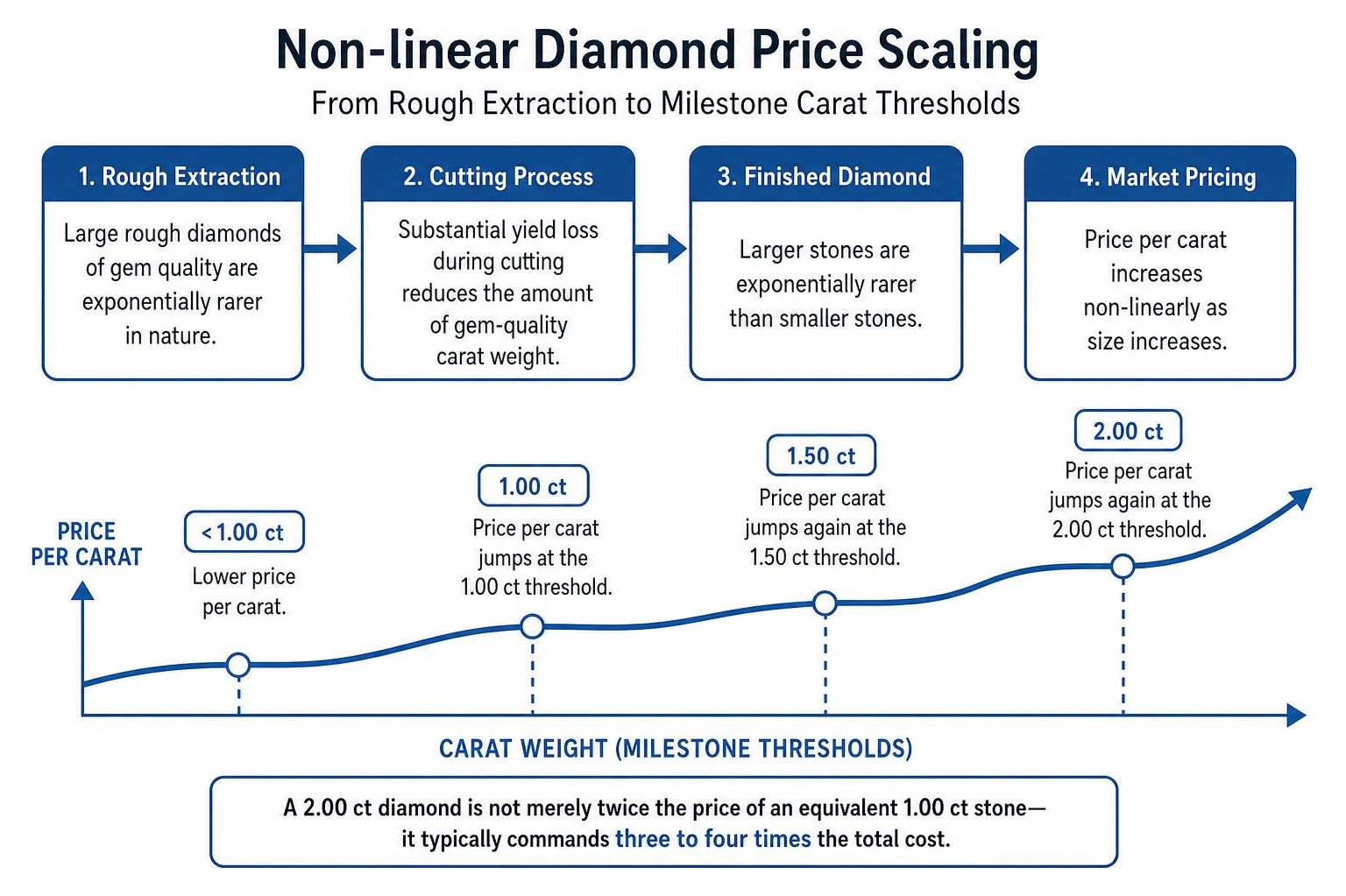
Large rough diamonds of gem quality are exponentially rarer in nature than small crystals. Because yield loss during cutting is substantial, a 2.00 ct diamond is not merely twice the price of an equivalent 1.00 ct stone—it typically commands three to four times the total cost. When a stone crosses major milestone thresholds (such as 1.00 ct, 1.50 ct, or 2.00 ct), the price per carat jumps sharply. You can explore these volume and weight dynamics in depth with our Diamond Carat Weight Calculator.
The 4 Primary Factors Every Pricing Algorithm Measures
Every digital price simulator structures its baseline valuation around the traditional 4Cs framework established by the Gemological Institute of America (GIA). However, pricing algorithms weight each attribute differently based on market demand and rarity.
| Attribute | Primary Impact on Value | Market Price Variance Range | Key Consumer Consideration |
|---|---|---|---|
| Cut | Light return, brilliance, fire | 30% to 40% | Maximizes visual sparkle; never compromise below Excellent/Very Good |
| Carat | Physical weight, rarity tier | Exponential scaling | Crossing "magic weights" causes dramatic price cliff jumps |
| Color | Whiteness, absence of tint | Up to 60%+ (D vs H) | Near-colorless grades (G–H) offer optimum price-to-performance value |
| Clarity | Absence of internal inclusions | 20% to 50% | Target "eye-clean" stones (VS2–SI1) to avoid paying for invisible purity |
Cut Grade and Light Performance Proportions
Cut quality has the single greatest impact on a diamond's beauty and optical performance. A diamond with perfect color and clarity will appear dull and lifeless if cut too shallow or too deep, as light escapes through the pavilion rather than reflecting back through the crown.
Variations in table percentage, crown angle, pavilion depth, and optical symmetry create price fluctuations of 30% to 40% within the exact same carat, color, and clarity tier. Premium precision-cut diamonds command significant market premiums because they deliver superior light return, scintillation, and fire.
Carat Weight and Milestone Threshold Pricing
Carat weight measures physical mass, where 1.00 carat equals exactly 0.20 grams. The global diamond trade relies on milestone pricing tiers known as "magic weights": 0.50 ct, 0.70 ct, 0.90 ct, 1.00 ct, 1.50 ct, 2.00 ct, and above.
A natural diamond weighing 0.98 ct costs significantly less per carat than a stone weighing 1.01 ct of identical color and clarity, despite having a virtually indistinguishable visual diameter. Savvy shoppers utilize price calculators to identify stones just below these threshold boundaries to maximize visual spread while avoiding steep market premiums.
Color Grading and Tint Valuation
The GIA color grading scale ranges from D (completely colorless) to Z (noticeable light yellow or brown tint). As color grades descend, market prices drop rapidly due to the relative abundance of tinted rough.
For example, a 1.00 ct round brilliant diamond graded D color and IF clarity can be priced over 60% higher than an otherwise identical stone graded H color and IF clarity. Understanding subtle shifts across grades is essential when balancing budgets; reviewing a detailed Diamond Color Grade Comparison helps buyers identify the near-colorless sweet spot (G to I), which faces face-up white when set in bridal jewelry.
Clarity Ratings and Inclusion Placement
Clarity measures the purity of a diamond under 10x magnification, spanning from Flawless (FL/IF), Very Very Slightly Included (VVS1/VVS2), Very Slightly Included (VS1/VS2), Slightly Included (SI1/SI2), down to Included (I1/I2/I3).
Pricing models heavily discount stones with visible imperfections located directly under the center table facet. In contrast, stones with microscopic inclusions dispersed along the outer girdle earn higher market valuations because they remain completely "eye-clean" to the unaided observer.
Secondary Variables That Can Shift Calculator Estimates by 30% or More
While the 4Cs establish a diamond's theoretical baseline, physical inspection nuances and unmodeled characteristics routinely cause real-world transaction prices to deviate 15% to 30% from basic calculator estimates.
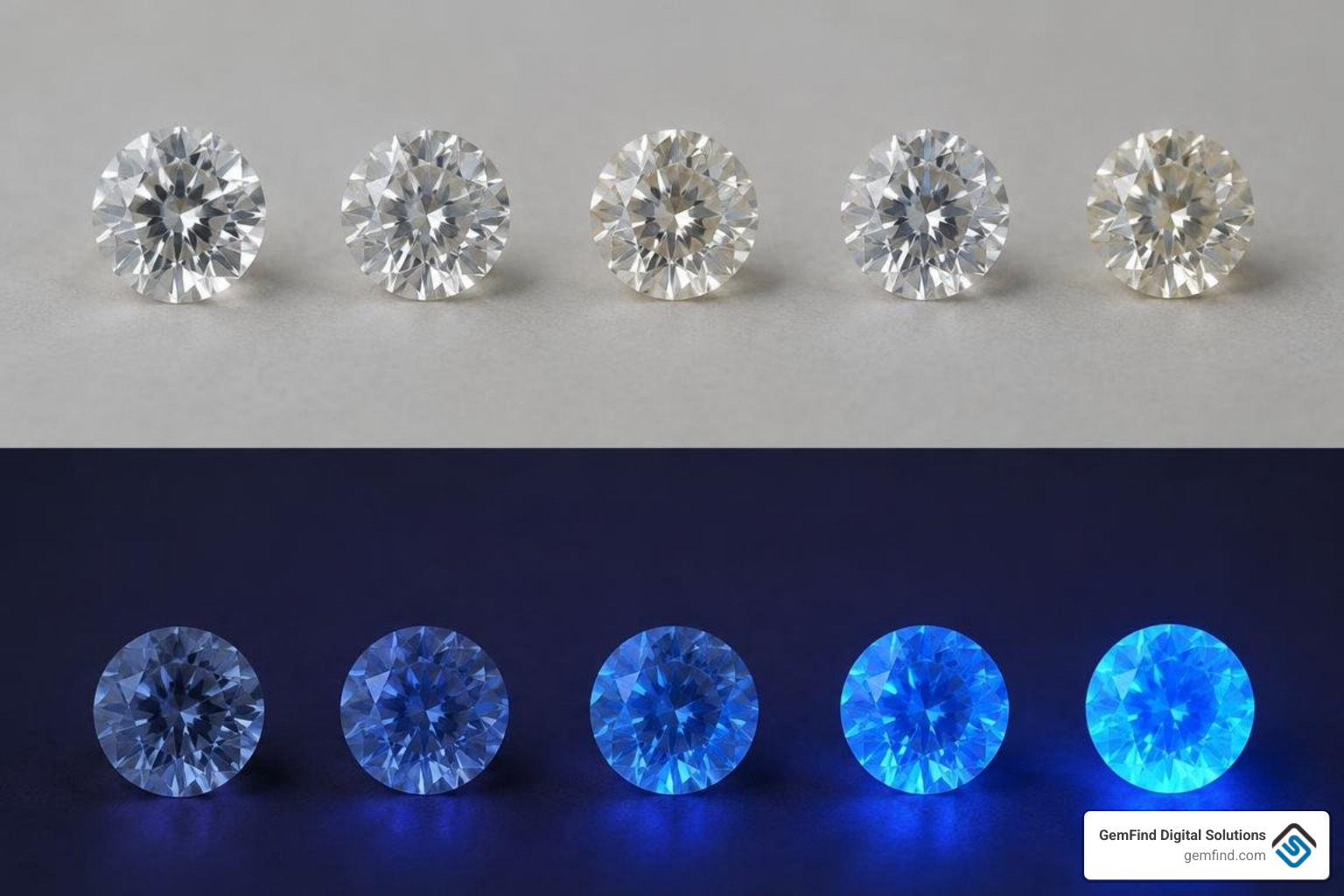
Fluorescence and Material Transparency
Fluorescence is a diamond’s tendency to emit a soft glow when exposed to ultraviolet (UV) light, most commonly blue. In lower color grades (I to M), medium blue fluorescence can actually improve face-up appearance by neutralizing faint yellow tones, occasionally adding a slight price premium.
However, in high-color stones (D through H), strong or very strong fluorescence can cause the diamond to appear milky, hazy, or oily in direct sunlight. Because of this risk, strong or very strong fluorescence devalues diamonds with a color grade between D and H by 15% to 25%.
Certification Laboratory Strictness
Not all grading certificates carry equal credibility in the wholesale and retail markets. The Gemological Institute of America (GIA) and the American Gem Society (AGS) maintain the strictest, most scientifically repeatable grading standards worldwide.
Secondary or commercial laboratories often apply more lenient grading thresholds. A diamond graded "F / VS1" by an unvetted laboratory might only achieve an "H / SI1" if re-examined by the GIA. As a result, diamonds bearing strict GIA or AGS reports trade at market premiums, while loosely graded certificates are sold at steep percentage discounts.
Fancy Shape Multipliers and Length-to-Width Ratios
Round brilliant diamonds command the highest price per carat across all shape categories. Cutting a round diamond from rough crystal wastes roughly 60% of the original octahedral material.
Fancy shapes (such as ovals, emerald cuts, radiants, and cushions) retain significantly more rough yield during cutting, allowing cutters to price them 15% to 25% lower per carat than equivalent rounds. However, fancy shapes must adhere to optimal length-to-width ratios; elongated stones that exhibit severe optical extinction—such as prominent "bow-tie" shadows across center facets—trade at substantial discounts.
Retail, Wholesale, and Resale: Interpreting Your Calculator Results
When analyzing diamond valuation tools, it is crucial to recognize which tier of the supply chain the estimate represents. Consumers comparing pricing estimates must account for retail operating costs, jewelry setting craftsmanship, and supply chain margins.
| Market Tier | Pricing Structure Relative to Retail | What the Number Represents |
|---|---|---|
| Retail Asking Price | 100% (Baseline) | Full consumer price including setting, certification, warranty, and retailer markup |
| Wholesale Value | 30% to 40% below Retail | The price jewelers and diamantaires pay suppliers on trading networks |
| Consumer Resale / Liquidation | ~50% of lowest online Retail | Cash liquidation offer from jewelers, pawnbrokers, or C2B buying platforms |
The wholesale price of a loose diamond typically sits 30% to 40% below the retail price because wholesale trades carry no storefront overhead, consumer marketing expenses, or financing costs. When reselling a diamond ring, consumers generally receive around 50% of the lowest available retail price for an equivalent loose stone, as secondary buyers must factor in profit margins, re-certification costs, and holding liquidity risks.
Natural vs. Lab-Grown Diamond Price Divergence
The pricing landscape for lab-grown diamonds has diverged sharply from natural mined diamonds over the past several years. Chemically, physically, and optically identical to mined diamonds, lab-grown diamonds are produced using High Pressure High Temperature (HPHT) or Chemical Vapor Deposition (CVD) processes.
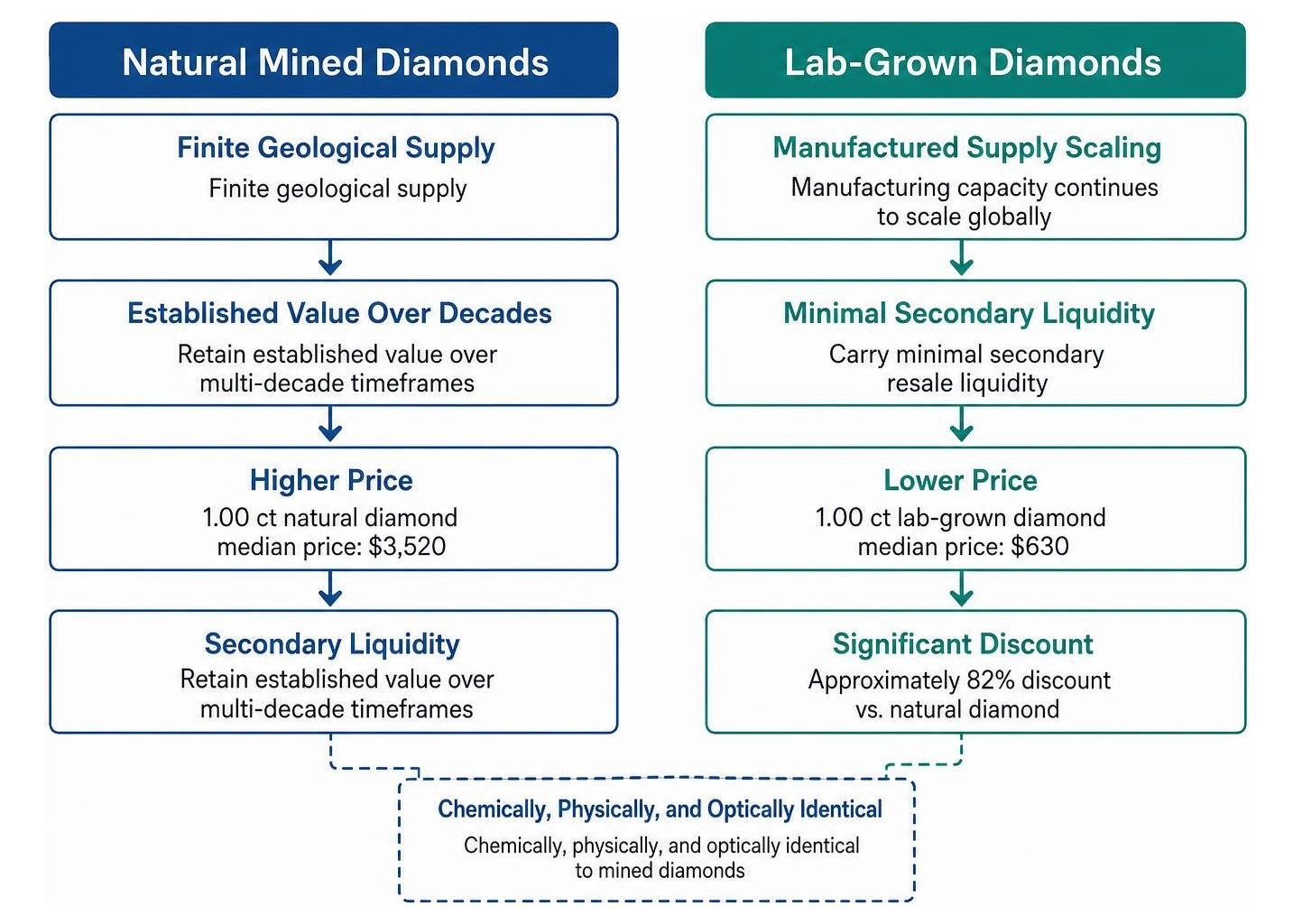
As of November 2026, a 1.00 ct natural diamond carries a median price of approximately $3,520, whereas an equivalent 1.00 ct lab-grown diamond costs roughly $630—an 82% discount. Because lab-grown manufacturing capacity continues to scale globally, lab-grown stones carry minimal secondary resale liquidity, whereas natural diamonds retain established value over multi-decade timeframes due to finite geological supply.
How to Use a Diamond Ring Price Calculator for Smarter Ring Shopping
An accurate price calculator is one of the most powerful budgeting tools available to modern jewelry shoppers. By establishing an empirical value for the center diamond, buyers can accurately allocate their total engagement ring budget between the center gemstone and the precious metal mounting.
When planning a ring purchase, we recommend allocating roughly 75% to 85% of your total budget toward the certified center stone and 15% to 25% toward the custom setting and master setting labor. To understand setting craftsmanship, precious metals, and digital purchasing strategies, consult our Jewelry Online Store Buying Guide.
Frequently Asked Questions About Diamond Ring Price Calculators
How accurate are diamond ring price calculators?
Most algorithmic diamond price calculators provide a reliable median market estimate based on aggregated wholesale and retail listings. However, real diamonds routinely trade 15% to 30% above or below these median numbers based on factors algorithms cannot see, such as exact inclusion placement, cut precision, fluorescence, and certificate strictness.
Why do two diamonds with identical 4Cs specs have different prices?
Two stones with identical grades on paper can look completely different in person. Differences in light performance (table/depth proportions), presence of fluorescence, inclusion color and location (e.g., a white crystal on the girdle versus a black carbon speck under the table), and grading laboratory consistency can cause price gaps of thousands of dollars.
How much is my diamond ring worth for resale?
When liquidating or selling a diamond ring on the secondary market, expect offers around 50% of the current lowest retail market price for an equivalent loose diamond. Retail jewelers buying from the public must account for inventory holding costs, re-polishing, re-grading fees, and wholesale replacement alternatives.
Conclusion
A digital diamond ring price calculator transforms what was once an opaque, confusing purchasing process into a transparent, data-driven experience. Understanding how algorithms evaluate cut precision, threshold carat boundaries, color saturation, and clarity characteristics empowers shoppers to make informed purchasing and valuation decisions.
For independent retail jewelers and e-commerce brands, integrating advanced visualization and digital pricing tools directly into your storefront bridges the gap between consumer research and confident purchasing. At GemFind Digital Solutions, we have spent over 25 years building specialized digital marketing, website development, and cloud-based applications tailored specifically to the jewelry industry.
Explore how our interactive ring builder technology seamlessly integrates live diamond data feeds and custom 3D design tools into modern e-commerce websites.
Anthony Arechiga
Vice President of Sales, GemFind Digital Solutions


