



How Engagement Ring Marketing Shaped One of the World's Biggest Traditions
Engagement ring marketing is the set of strategies used by jewelry brands, retailers, and diamond producers to influence how consumers think about, shop for, and spend on engagement rings.
Here is a quick snapshot of how it works and why it matters:
- It created a tradition — The diamond engagement ring was not a timeless custom. It was built from scratch by a single ad campaign in the 1940s.
- It drives massive spending — The average U.S. engagement ring now costs around $6,750, and total global consumer diamond sales reached approximately $100 billion in 2024.
- It is evolving fast — Younger buyers, lab-grown diamonds, AI-powered search, and e-commerce are forcing brands to rethink everything.
- It affects your store — Understanding how this market was built — and where it is going — directly shapes how you attract and convert bridal customers today.
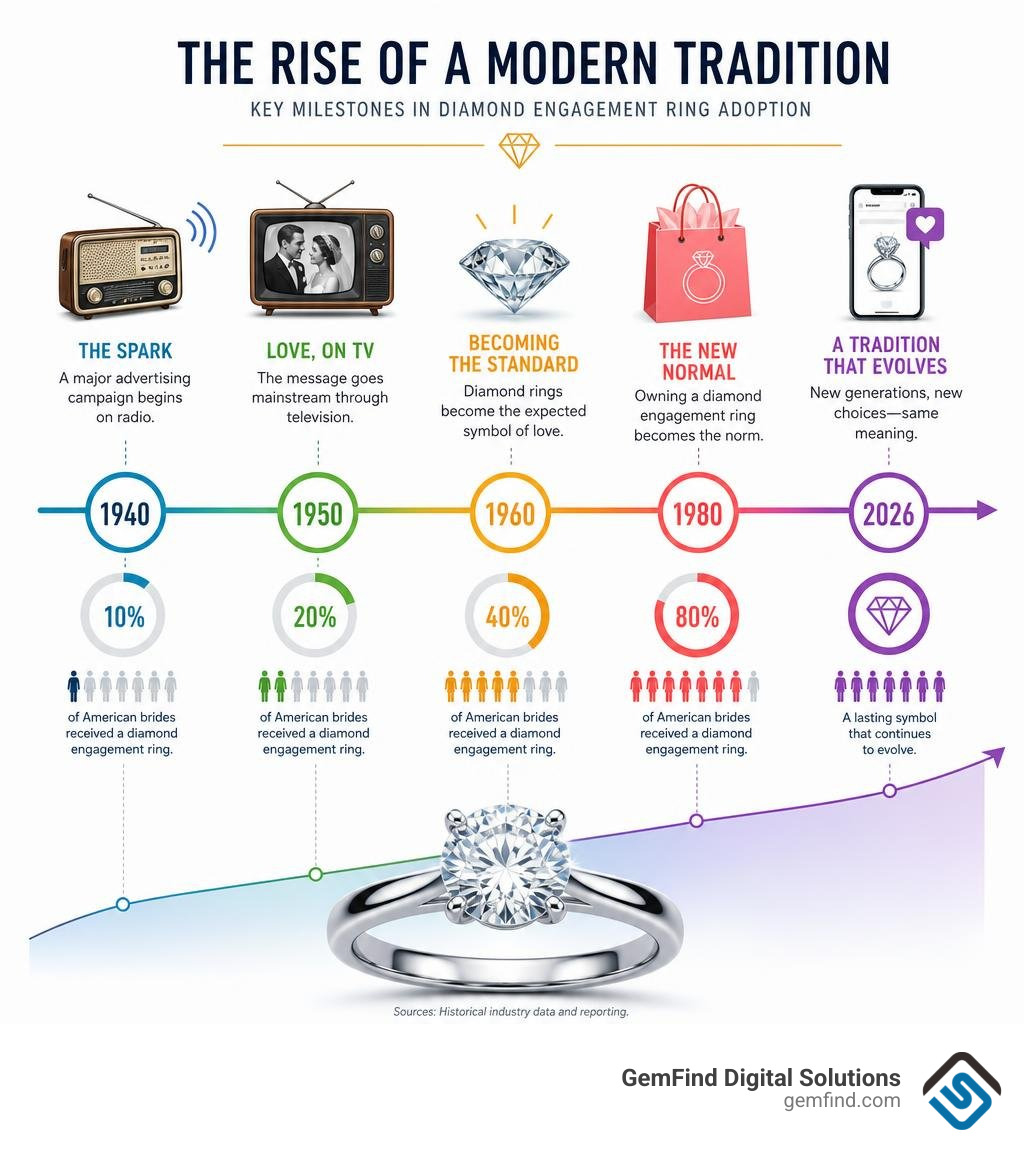
Picture this: before 1940, only about 10% of American brides received a diamond engagement ring. By 1980, that number had climbed to 80%. That shift did not happen by accident. It happened because of one of the most effective marketing campaigns in modern history — and the lessons it teaches are still shaping bridal retail today.
I'm Anthony Arechiga, Vice President of Sales at GemFind Digital Solutions, where I've spent nearly two decades helping jewelry retailers grow through smarter digital marketing and e-commerce strategies — including the highly competitive world of engagement ring marketing. In the sections ahead, I'll walk you through how this market was built, how it is changing, and what your store can do to keep up.
Must-know Engagement ring marketing terms:
- Jewelry marketing strategies
- Luxury jewelry marketing
- Increase jewelry sales
The Genesis of the Diamond Myth: De Beers and N.W. Ayer
To understand modern engagement ring marketing, we have to go back to the late 19th and early 20th centuries. Before diamonds became the default choice, proposals looked very different. If a man gave a ring at all, it was often a simple gold band or set with colorful gemstones like rubies, sapphires, or emeralds.
That all changed with the discovery of massive diamond mines near the Orange River in South Africa during the 1860s. Suddenly, a gem that had been genuinely rare was flooding the market. Fearing that a massive influx of supply would crash the value of their product, Cecil Rhodes and his associates consolidated these independent mining operations into a single entity: De Beers.
By controlling approximately 90% of the world's diamond supply by 1900, De Beers operated as a textbook monopoly. They stockpiled diamonds to create an illusion of artificial scarcity, carefully regulating how many diamonds entered the market to keep wholesale prices high. However, by the time the Great Depression hit in the 1930s, diamond sales were in a freefall. The company needed to do more than just control supply; they had to manufacture a massive, unbreakable consumer demand.
To achieve this, De Beers turned to the American advertising agency N.W. Ayer & Son. Together, they set out to link diamonds with the deepest, most permanent human emotion: love. You can read more about this fascinating corporate history in The history of diamond engagement rings | National Geographic and explore further context on Why Diamonds Are the Standard for Engagement Rings.
How De Beers Invented the Modern Engagement Ring Tradition
The strategy N.W. Ayer designed was brilliant because it did not focus on selling a physical rock. Instead, they sold an idea, a dream, and a social expectation. They wanted to convince young men that a diamond was the only acceptable symbol of true commitment, and young women that their worth was directly tied to the size of the diamond on their finger.
To pull this off, the agency launched a multi-pronged cultural engineering campaign:
- Celebrity Product Placement: They placed stories and high-profile photographs in newspapers and magazines showing movie stars and socialites wearing massive diamond rings.
- Fashion and Media Influencers: They hired fashion designers and trendsetters to talk on radio shows and write columns about the "new trend" of diamond engagement rings.
- The "Diamond Lady" Lectures: They sent Gladys Babson Hannaford (affectionately known as the "Diamond Lady") to tour high schools and colleges across the United States. She gave lectures on diamond history and care, subtly planting the seed in young minds that a diamond ring was a psychological necessity for marriage.
This strategy was incredibly successful. The campaign was eventually exported globally. For example, in Japan, where diamond engagement rings were practically non-existent, a targeted campaign launched in the 1960s helped adoption skyrocket from less than 5% in 1960 to 60% by 1981. This brilliant global rollout is detailed in How the diamond engagement ring was invented – and sold around the world.
The Psychology Behind 'A Diamond is Forever'
In 1947, an N.W. Ayer copywriter named Frances Gerety wrote four simple words on a piece of paper before going to bed: "A Diamond is Forever."
That single line, later named the top advertising slogan of the 20th century by Ad Age, completely revolutionized the industry. The phrase did two things perfectly:
- It linked diamonds to eternity: It associated the physical durability of the stone with the emotional permanence of marriage.
- It prevented resale: If a diamond is "forever," you never sell it. This was a critical business tactic for De Beers. By discouraging consumers from selling their old jewelry back into the market, they prevented a secondary market from emerging, which would have competed with their newly mined stones.
To make sure consumers spent big, the marketing campaigns also invented pricing guidelines. In the 1930s, De Beers advertisements suggested spending one month's salary on a ring. By the 1980s, they had successfully pushed that cultural mandate even further, asking: "How can you make two months' salary last forever?"
While some critics point out that the diamond engagement ring was essentially a massive marketing ploy, as discussed in The diamond engagement ring was a marketing ploy (and a huge ..., there is no denying its legendary success.
The Evolution of Engagement Ring Marketing in the Digital Age

Fast forward to July 2026, and the landscape of engagement ring marketing looks vastly different. While the emotional core of the purchase remains the same, the way consumers research, shop, and buy has migrated online.
Online platforms now account for approximately 25% to 30% of all engagement ring sales, with that percentage showing steady annual increases. Today's bridal buyer does not just walk into a local brick-and-mortar store empty-handed. They spend weeks, sometimes months, researching styles, settings, and stone types online before ever making contact with a jeweler.
For independent retailers, this means having a strong web presence is no longer optional. To capture these high-value leads, you must know How to sell more bridal jewelry on your website. This involves carefully Merchandising your jewelry stores website for bridal season and implementing specific digital strategies to How to maximize sales on your jewelry stores website during bridal season.
Shifting Demographics: How Millennials and Gen Z Redefine Luxury
The modern consumer pool is dominated by Gen Z and "Zillennials" (the micro-generation born between 1993 and 1998). These younger buyers do not buy into traditional luxury marketing the same way their parents did. They are highly skeptical of corporate monopolies, deeply concerned with ethical sourcing, and far more budget-conscious.
When marketing to these younger demographics, we see several key factors driving their purchasing decisions:
- Ethical and Environmental Concerns: They want to know where their stones came from, favoring transparent supply chains or lab-grown alternatives.
- Affordability and Financial Pragmatism: They are less willing to go into heavy debt for a ring, preferring to allocate funds toward travel, homes, or experiences.
- Bespoke and Alternative Aesthetics: Traditional round-cut solitaires are sharing the spotlight with unique shapes, colorful gemstones, and vintage-inspired designs like the Boho chic engagement ring.
- Social Media Influence: Platforms like Instagram, TikTok, and Pinterest are where they find design inspiration, making digital aesthetics incredibly influential in their decision-making process.
To stay relevant, jewelers must keep up with these rapidly changing Engagement ring trends 2024 and align their marketing messages with modern values.
The Rise of Lab-Grown Diamonds and E-Commerce Disruption
Perhaps the biggest disruption to the traditional diamond market is the meteoric rise of lab-grown diamonds (LGDs). Chemically, physically, and optically identical to mined diamonds, lab-grown stones are often up to 90% cheaper. This massive price difference has allowed younger couples to buy much larger center stones for a fraction of the cost.
This shift has forced marketers to segment their messaging. Here is how the marketing angles for natural and lab-grown diamonds compare today:
| Marketing Dimension | Natural Diamonds | Lab-Grown Diamonds |
|---|---|---|
| Core Value Proposition | Rarity, geological history, long-term value retention | Affordability, modern technology, ethical appeal |
| Target Audience | Traditionalists, luxury buyers, older millennials | Budget-conscious Gen Z, eco-conscious buyers |
| Key Messaging | "One in a million," "Forged by nature over billions of years" | "More sparkle for your budget," "Modern, smart luxury" |
| Price Point | High premium, viewed as an investment | Highly accessible, allows for larger carat sizes |
Modern Campaigns: Adapting to the Zillennial Mindset
As the market shifts, major industry players are launching new campaigns to protect their market share and appeal to younger demographics. If you want your jewelry store to succeed, studying how these retail giants market can help you craft your own Engagement ring ad campaigns and navigate our Engagement ring ads guide 2026. For a complete overview, check out The guide to selling engagement rings with digital marketing.
'Worth the Wait' and the Return to Natural Storytelling
To combat the rising popularity of lab-grown diamonds, De Beers and Signet Jewelers (the world's largest diamond retailer) joined forces to launch a major natural diamond marketing campaign titled "Worth the Wait."
This campaign is highly strategic. Instead of ignoring the longer dating timelines of modern Zillennial couples, the campaign embraces them. It draws a parallel between the geological journey of a natural diamond—formed deep within the Earth under immense pressure over billions of years—and the personal growth journey of modern couples who take their time to build a strong foundation before getting engaged.
To support this massive campaign, Signet trained over 20,000 sales associates to educate consumers on the unique attributes of natural diamonds. The campaign features emotional, long-form video spots showcasing diverse, real-world couples navigating modern relationship milestones like moving in together, merging finances, and even reconciling after a breakup.
You can read the official announcements and industry insights regarding this landmark campaign here:
- Signet and De Beers launch captivating new natural diamond marketing campaign: ‘Worth the Wait’ – De Beers Group
- De Beers, Signet aim to boost mined diamonds demand - MINING.COM
- NATURAL DIAMONDS - Signet and De Beers launch natural diamond marketing campaign: "Worth the Wait" .
As a jeweler, you can take inspiration from this by using 23 tactics to reach more bridal customers and understanding the complex psychology of She browses and he buys bridal personas and how to sell them jewelry.
Personalization and Interactive Engagement Ring Marketing
One of the most effective ways to capture today's digital-first buyer is through interactive customization. Modern couples do not want a cookie-cutter ring; they want to design something that tells their unique love story.
This has made online ring builders a critical sales tool. By allowing users to choose their setting, metal type, and specific center stone in real-time, you remove the friction from the online buying process. If you want to implement this on your website, check out our guides on how to Create your own engagement ring, read our Complete ring builder app guide, and explore our specialized Engagement ring builder app.
The New Frontier: AI and the Future of Bridal Retail
Just as e-commerce disrupted brick-and-mortar retail, Artificial Intelligence is now transforming how consumers research high-ticket items like engagement rings. To stay ahead, jewelers must adopt modern Inbound marketing strategies for reaching more engagement ring clients, learn how to Create a consistent flow of engagement ring clients with inbound marketing, and utilize 5 ways to capture more sales during bridal season with digital marketing.
How AI Search is Changing Engagement Ring Marketing
More and more young consumers are bypassing traditional Google searches entirely. Instead of typing "best jewelers near me" and clicking through paid ads, they are asking conversational AI platforms like ChatGPT and Perplexity AI complex, highly specific questions:
- "What is the difference in durability between platinum and white gold for a daily wear ring?"
- "Explain the pros and cons of buying a lab-grown diamond versus a natural sapphire."
- "Help me find a jeweler in Chicago that specializes in vintage-style filigree settings and has great reviews."
This shift toward "zero-click searches" means your website content needs to be optimized for AI search engines. To be cited as a trusted source by these AI models, your website must feature clear, well-structured, and highly informative content that directly answers real consumer questions.
Ethical, Legal, and Economic Realities of the Modern Ring
Beyond marketing, there are several real-world legal and economic factors that modern jewelry retailers must understand:
- The Legal Status of the Ring: In most U.S. states, an engagement ring is legally considered a "conditional gift." If the wedding is called off, the condition of the gift (marriage) has not been met, meaning the ring legally must be returned to the giver, regardless of who ended the relationship.
- The Economics of Stress: Interestingly, scholarly research has shown a correlation between highly expensive engagement rings (over $2,000) and higher rates of early divorce. Researchers suggest this is often due to the long-term financial stress and debt associated with overspending on the ring.
- The Ethical Consumer: Buyers today expect proof of ethical sourcing. Displaying a commitment to conflict-free sourcing, such as adherence to the Kimberley Process, is no longer just a legal necessity—it is a core part of your brand's marketing message.
Frequently Asked Questions about Engagement Ring Marketing
How did De Beers make diamond engagement rings a tradition?
De Beers partnered with the N.W. Ayer advertising agency in the late 1930s to link diamonds with eternal love. Through strategic celebrity product placements, lectures in high schools, and the iconic "A Diamond is Forever" slogan, they transformed a luxury commodity into a mandatory cultural symbol of commitment.
What is the 'Worth the Wait' campaign?
"Worth the Wait" is a joint marketing campaign launched by De Beers and Signet Jewelers targeting Zillennial couples. The campaign connects the long geological formation journey of natural diamonds with the modern relationship journey of couples who take their time to grow together before getting engaged.
How is AI changing how people buy engagement rings?
AI tools like ChatGPT and Perplexity are replacing traditional Google search. Consumers use these conversational platforms to research diamond quality, compare natural vs. lab-grown options, and get personalized local jeweler recommendations, bypassing traditional search ads entirely.
Conclusion
From the brilliant monopoly tactics of De Beers in the 1940s to the AI-driven, highly personalized landscape of July 2026, engagement ring marketing has always been about selling more than just jewelry—it is about selling a dream, a promise, and a memory.
To thrive in today's competitive digital market, independent jewelers need more than just beautiful inventory. They need a seamless, omnichannel digital experience that combines high-quality web design, interactive tools like ring builders, and data-driven marketing.
At GemFind Digital Solutions, we have spent over 25 years helping jewelry retailers navigate these changes. As a certified Shopify and Google Partner, we provide the specialized digital marketing, web design, and interactive apps you need to connect with today's tech-savvy bridal buyers.
Ready to elevate your store's digital strategy and capture more bridal sales? Let's build something beautiful together. Visit our GemFind Digital Marketing Blog to explore our services or schedule a consultation today!


