


How to Compare Engagement Rings Sets

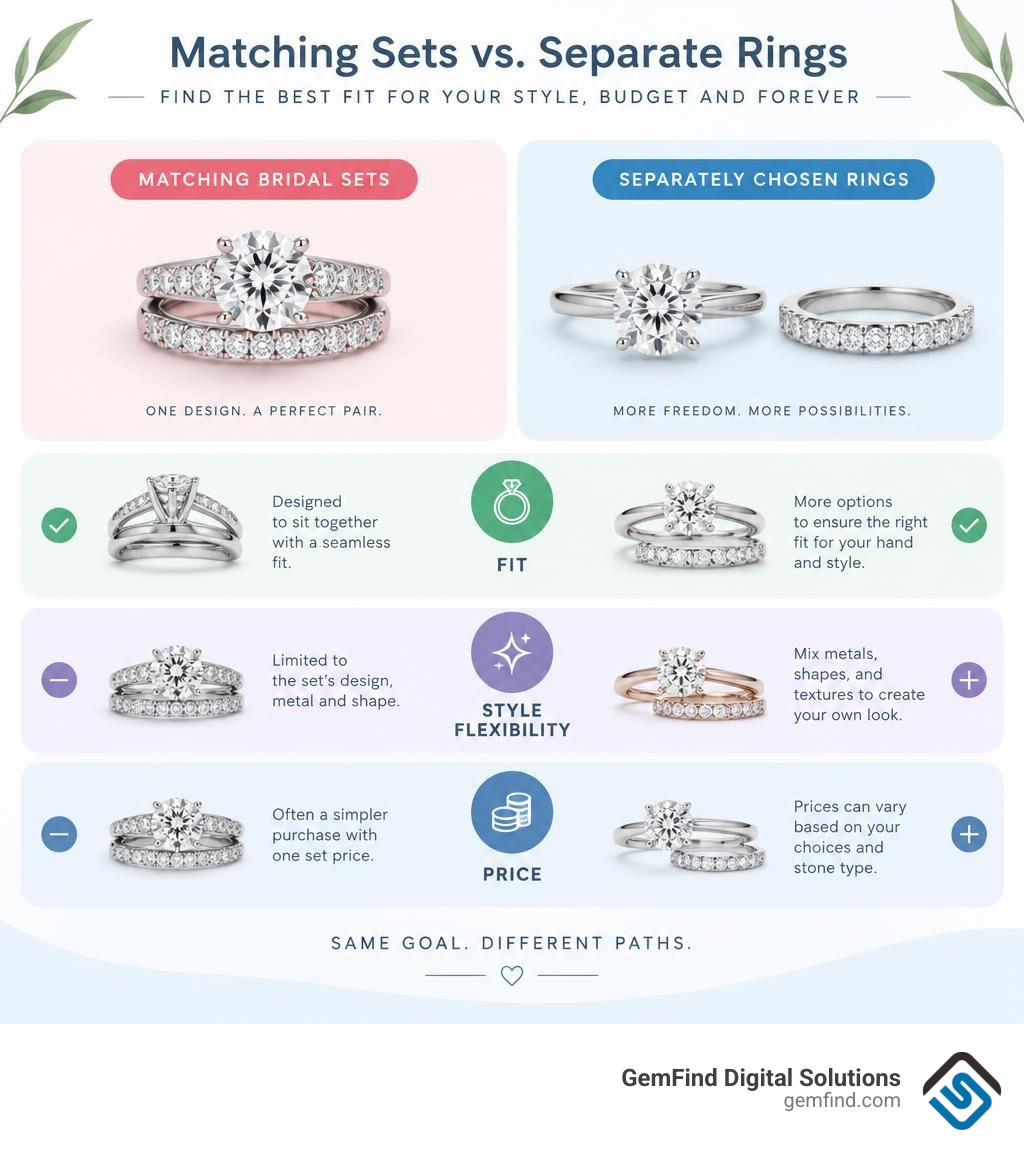
Start with fit, then compare style and price. A bridal set pairs an engagement ring with a wedding band designed to sit together. A matching two-piece set makes that pairing easy; buying the rings separately gives you more freedom to mix metals, shapes, and textures. Neither choice is better if the bands rub, leave an unwanted gap, or feel too wide when worn together. Among the many engagement ring sets available today, the best one is simply the one that fits comfortably as a stack.
For jewelry retailers, that is the key to a useful comparison: show customers how each pair looks and fits as a stack, not just how each ring looks alone. Include the price and stone type for both rings so shoppers can compare the full purchase.
I'm Anthony Arechiga, VP of Sales at GemFind Digital Solutions, where I've helped jewelry retailers grow their digital presence since 2007. That experience shapes how I approach shoppers comparing different engagement ring sets: give them clear choices and enough detail to buy with confidence.
Understanding Bridal Sets vs. Buying Rings Separately
When modern couples begin their bridal journey, one of the earliest decisions is whether to invest in a factory-coordinated bridal set or curate an engagement ring and wedding band separately. Today, nearly 80% of ring recipients are actively involved in the selection process. While proposals remain heavily concentrated between Thanksgiving and Valentine's Day (accounting for nearly 40% of annual proposals), research begins months prior.
A pre-designed bridal set eliminates the friction of finding a wedding band that matches the head height, shank curvature, and diamond spacing of the primary ring. When rings are crafted as a cohesive unit, the wedding band sits completely flush against the engagement ring setting, preventing awkward gaps and uncomfortable friction.
Conversely, purchasing rings independently allows you to design your wedding band to match unique personal aesthetics or mix vintage heirlooms with contemporary bands. However, standalone pairings often require custom adjustments to avoid structural collisions between the center stone's basket and the band's prongs.
| Feature / Factor | Coordinated Bridal Sets | Buying Rings Separately |
|---|---|---|
| Silhouette Fit | Engineered flush fit with zero gap | May require curved or contoured bands to sit flush |
| Metal Wear | Uniform wear rate and matching alloy luster | Potential for uneven abrasion if metals differ in hardness |
| Purchasing Efficiency | Single-step decision; guaranteed compatibility | Multi-step search; requires trial-and-error pairing |
| Design Flexibility | Cohesive, uniform aesthetic | High personalization; mix metals, shapes, and textures |
| Overall Cost | Often packaged with bundled cost savings | Separate pricing per ring; custom alterations may add cost |
Types of Sets: Matching, Three-Piece, and Couples Rings
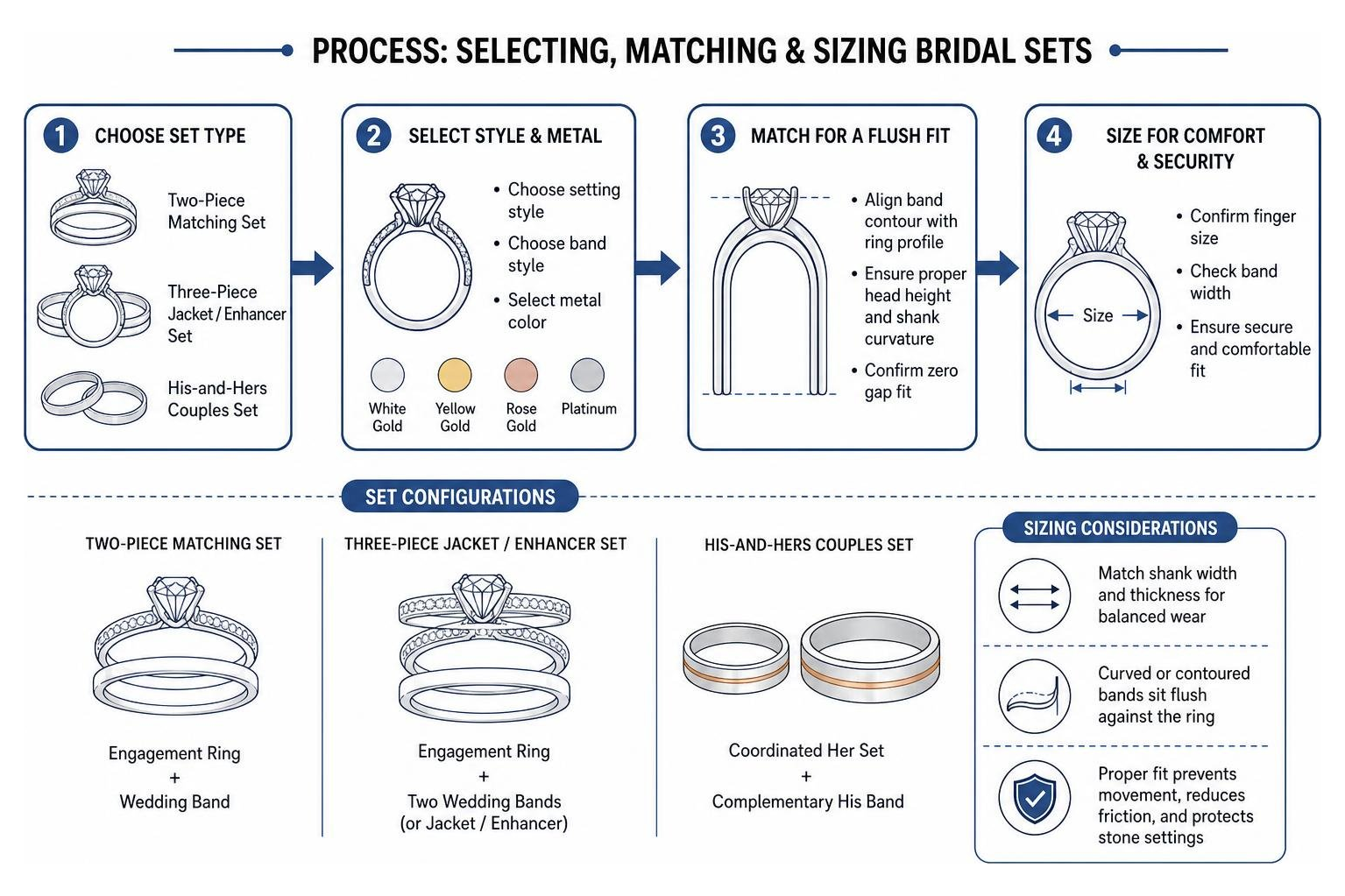
The market offers several configurations tailored to different styling needs:
- Two-Piece Matching Sets: The traditional standard, featuring an engagement ring paired with a contour or straight band engineered with identical metal profiles and pavé styles.
- Three-Piece Jacket / Enhancer Sets: These feature an engagement ring flanked by dual wedding bands or a nesting "jacket" that locks around both sides of the center stone, creating a symmetrical, high-carat frame.
- His-and-Hers Bundles: Coordinated packages combining her bridal stack with a complementary groom's band. Modern options, such as a rose gold and tungsten couples set, use shared design motifs—like brushed finishes or matching rose gold accents—to unite both partners' rings without requiring identical silhouettes.
The Advantages of Selecting a Curated Bridal Pair
Choosing a curated pair prevents long-term structural issues. When unmatched rings sit together, diamonds set along the edge of a band can rub directly against the prongs of the engagement ring basket. Over time, diamond-on-metal abrasion wears down the prongs, increasing the risk of stone loss.
Retailers utilize tools like our bridal set ring creator to present unified sets where metal shanks match in width, thickness, and profile. This cohesive design ensures both rings distribute daily mechanical wear evenly across the finger.
Exploring Modern Engagement Ring Sets and Matching Styles
Modern bridal stacks balance classic elegance with modern architecture. Today's brides gravitate toward organic flow, stackable curves, and clean geometric lines.

Designers frequently incorporate sustainable engagement ring options, combining recycled precious metals with responsibly created gems to meet modern environmental standards.
Popular Silhouettes: Halo, Solitaire, and Vintage Aesthetics
- Interlocking Solitaires: Minimalist center stones perched on high-profile basket settings, allowing straight eternity bands to slide directly beneath the gem.
- Twisted Pavé and Ribbons: Bands with flowing, intertwined diamond strands that symbolize shared paths, often framing brilliant center stones or complementing halo engagement ring settings.
- Vintage and Halo Formats: Detailed milgrain borders, filigree scrollwork, and geometric halos inspired by Art Deco architecture, as explored in our vintage style engagement rings guide.
- Nature-Inspired and Bohemian: Asymmetrical cluster configurations, leaf motifs, and chevron arcs that deliver an earthy, boho chic engagement ring aesthetic.
Mixing Metals and Textures in Modern Sets
Strict rules requiring matching metals across the bridal stack have shifted. Blending a platinum engagement ring with a 14K yellow gold band creates depth and highlights the white brilliance of the center stone against warm golden accents, a trend highlighted in our eternity band engagement guide.
When mixing metals, keep the metal hardness in mind. Platinum is denser than 14K gold; over years of constant contact, an unpinned platinum ring can wear down an adjacent yellow gold band. Choosing rings with complementary profiles minimizes movement and metal friction.
Center Stones and Materials: Diamonds, Moissanite, and Alternative Gems
Recent industry data highlights changing consumer priorities: the average engagement ring spend has settled at $4,600, while the average center stone size has grown to 1.9 carats. Modern couples prioritize visual presence, cut quality, and overall value.
Choosing Metals and Gemstones for Engagement Ring Sets
A bridal set must withstand decades of continuous daily wear. Evaluating stones based on the Mohs Hardness Scale ensures the ring stack retains its brilliance without scratching or chipping.
| Gemstone / Material | Mohs Hardness | Refractive Index (Brilliance) | Common Use Cases | Relative Price Tier |
|---|---|---|---|---|
| Natural Diamond | 10.0 | 2.42 | Heirloom bridal sets, classic solitaires | Premium ($$$$) |
| Lab-Grown Diamond | 10.0 | 2.42 | High-carat modern sets, fancy shapes | Accessible Luxury ($$) |
| Moissanite | 9.25 | 2.65 – 2.69 | High-fire modern & vintage sets | Budget to Moderate ($) |
| Sapphire | 9.0 | 1.76 – 1.77 | Accent stones, alternative center gems | Moderate to Premium ($$ to $$$) |
| Moss Agate / Opal | 6.5 – 7.0 / 5.5 – 6.5 | 1.45 – 1.54 | Bohemian, non-traditional rings | Budget ($) |
For shoppers seeking vibrant fire and durability at an accessible price point, moissanite offers exceptional value. Options like the marquise moissanite bridal set in solid 14K yellow gold use V-shaped chevron bands to cradle elongated gems, while twisted eternity bands pair moissanite centerpieces with hypoallergenic solid gold mounts for timeless everyday elegance.
Lab-Grown vs. Natural Diamonds in Curated Sets
Lab-grown diamonds have transformed the bridal marketplace, representing 61% of all engagement ring center stones. Because lab diamonds share the exact chemical, optical, and physical properties of mined diamonds, couples achieve larger carat sizes and higher clarity ratings (such as F color and VS2 clarity) within standard budgets.
Independent jewelers and bridal retailers showcase both lab-grown and natural diamond bridal pairings in their showcases and digital catalogs. This variety gives shoppers complete control over sourcing preferences, carat weight, and budget allocation.
Sizing, Customization, and Proper Ring Care
Sizing, Fit, and Maintenance for Engagement Ring Sets
Sizing a bridal set differs from sizing a single, slim solitaire. When two or three bands are stacked together, they cover more surface area on the finger, creating a tighter fit.
- Width Compensation: When stacking two rings with a combined width exceeding 4mm to 5mm, consider ordering one quarter to one half size larger than your single-band measurement.
- At-Home Measurement: Use physical plastic ring sizers over string or paper strips, and take measurements in the evening when fingers are at their true size.
- Prong Care: Schedule annual prong checks with a jeweler. While mild soap, warm water, and a soft-bristled brush safely clean diamonds, gold, and moissanite at home, ultrasonic cleaners should be used cautiously on pavé settings, as rapid vibrations can loosen small accent stones.
Personalization and Digital Design Features
Bridal customization is now an everyday expectation for modern couples. Digital tools like our custom diamond ring builder make it simple for couples to visualize, customize, and finalize bespoke pairings.
Retailers use these digital platforms to offer custom inside-band engravings, secret birthstone flush mounts, and contoured band shaping via 3D CAD modeling. With a complete ring builder app guide, businesses can guide couples through interactive design steps, helping them design their own wedding rings with confidence.
Frequently Asked Questions About Bridal Sets
What is the traditional way to wear an engagement ring and wedding band set?
Traditionally, the wedding band is placed on the left ring finger first, sitting closest to the heart, with the engagement ring stacked directly on top. During the wedding ceremony, brides often switch their engagement ring to their right hand so the wedding band can be placed smoothly onto the left finger, moving the engagement ring back to the stack afterward.
Can you mix different metal types within the same bridal set?
Yes. Mixing metals adds visual contrast and modern dimension to your bridal stack. Pairing a white gold or platinum engagement ring with a yellow gold eternity band creates an eye-catching two-tone look. To ensure balanced wear over time, choose metals of similar durability or select rings with flush-fitting profiles that minimize daily friction.
How do you find the correct ring size when purchasing a bridal set online?
Order a physical ring sizing kit to measure your finger throughout the day. If the combined width of your stacked bridal set is 5mm or wider, consider sizing up by a quarter to a half size. Additionally, check that your retailer provides clear sizing exchange policies before ordering.
Conclusion
Finding the ideal bridal set is about balancing physical comfort, everyday durability, and personal style. Whether you choose an interlocking lab-grown diamond halo set, a vintage-inspired moissanite chevron duo, or a two-tone stack, selecting rings that align in profile ensures a lifetime of comfortable wear.
While digital research drives early discovery, 64% of engagement rings are still finalized in-store, underscoring the importance of seamless omnichannel shopping. At GemFind Digital Solutions, we have spent more than 25 years helping independent jewelers bridge the digital and physical worlds. To discover how our specialized web tools, POS integrations, and marketing solutions can elevate your jewelry business, explore the guide to selling engagement rings with digital marketing and connect with our team today.
— Anthony Arechiga, GemFind Digital Solutions


