

Find Competitor Ads With a Facebook Ad Library Search

To run a facebook ad library search, open the Meta Ad Library, choose your country and All ads, then search for a competitor's Facebook Page or a term such as "engagement rings." Filter the results by platform or media type, and check each ad's start date, message, and creative.
For a jewelry store, this can reveal which offers and styles other advertisers are testing. A long-running ad is worth studying, but it is not proof that the ad makes money. Look for ideas you can adapt to your own customers, not ads to copy.
I'm Morgan Price, a strategic backlink outreach specialist with experience researching digital marketing sources and building ethical editorial links. I bring that research-first approach to this facebook ad library search guide, starting with a simple workflow you can use today.
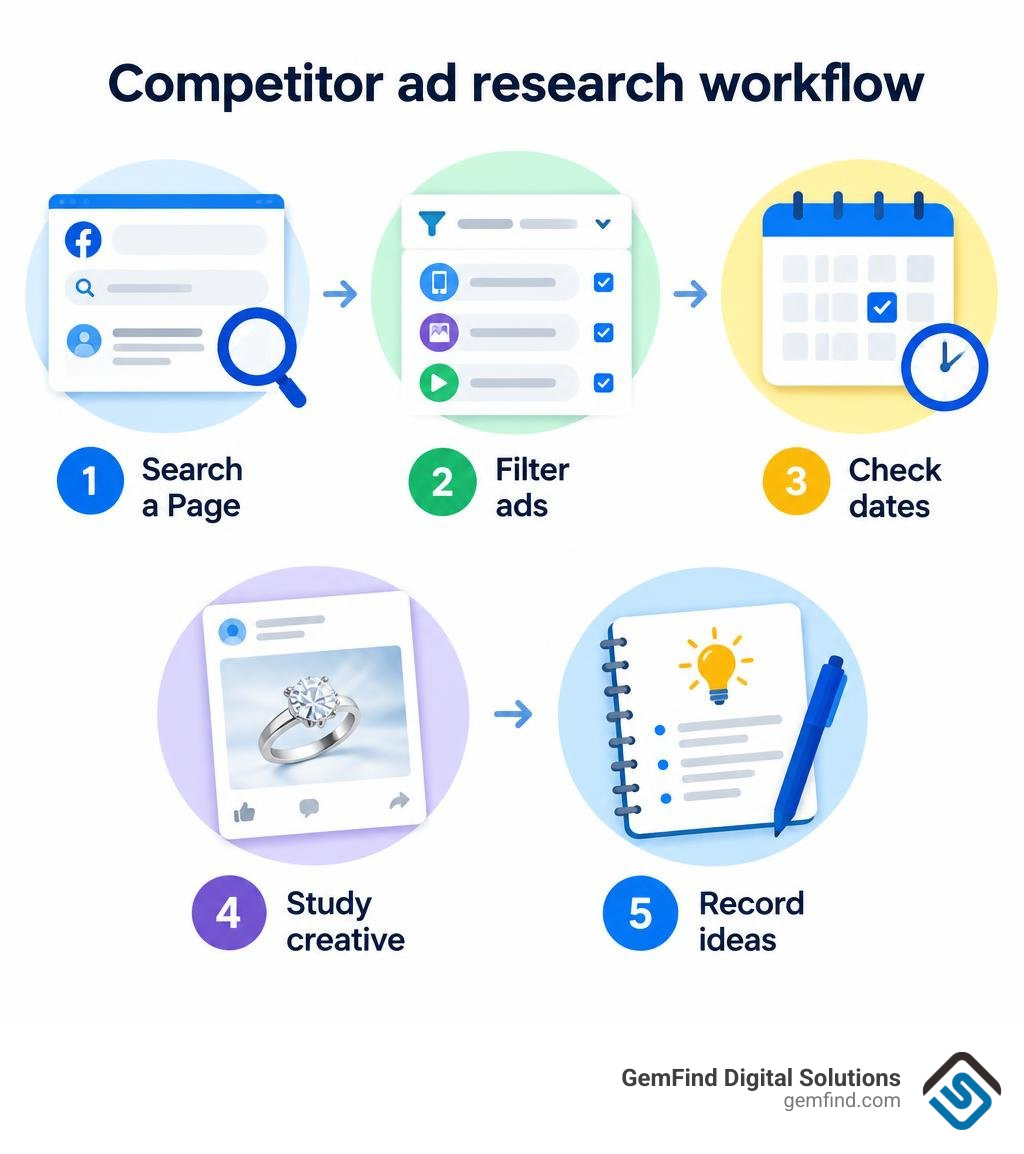
Facebook ad library search vocab explained:
Understanding the Meta Ad Library and Its Capabilities
Meta platforms—including Facebook, Instagram, WhatsApp, Messenger, and Threads—reach approximately 3.54 billion daily active users, representing roughly 42% of the global population. As of 2026, about 86% of digital marketers leverage Facebook and 79% utilize Instagram to scale their brands. With 70% of all businesses and nearly 78% of small-to-medium retailers investing in paid social campaigns, the digital advertising landscape is fiercely competitive.
Originally established in May 2018 and fully deployed in March 2019 to provide public transparency around electoral marketing following regulatory scrutiny, the Meta ad repository has evolved into an indispensable competitive intelligence asset. Today, approved researchers and marketers can review public ad records or leverage specialized Meta Ad Library tools to understand broader market movements.
Accessing the Ad Database
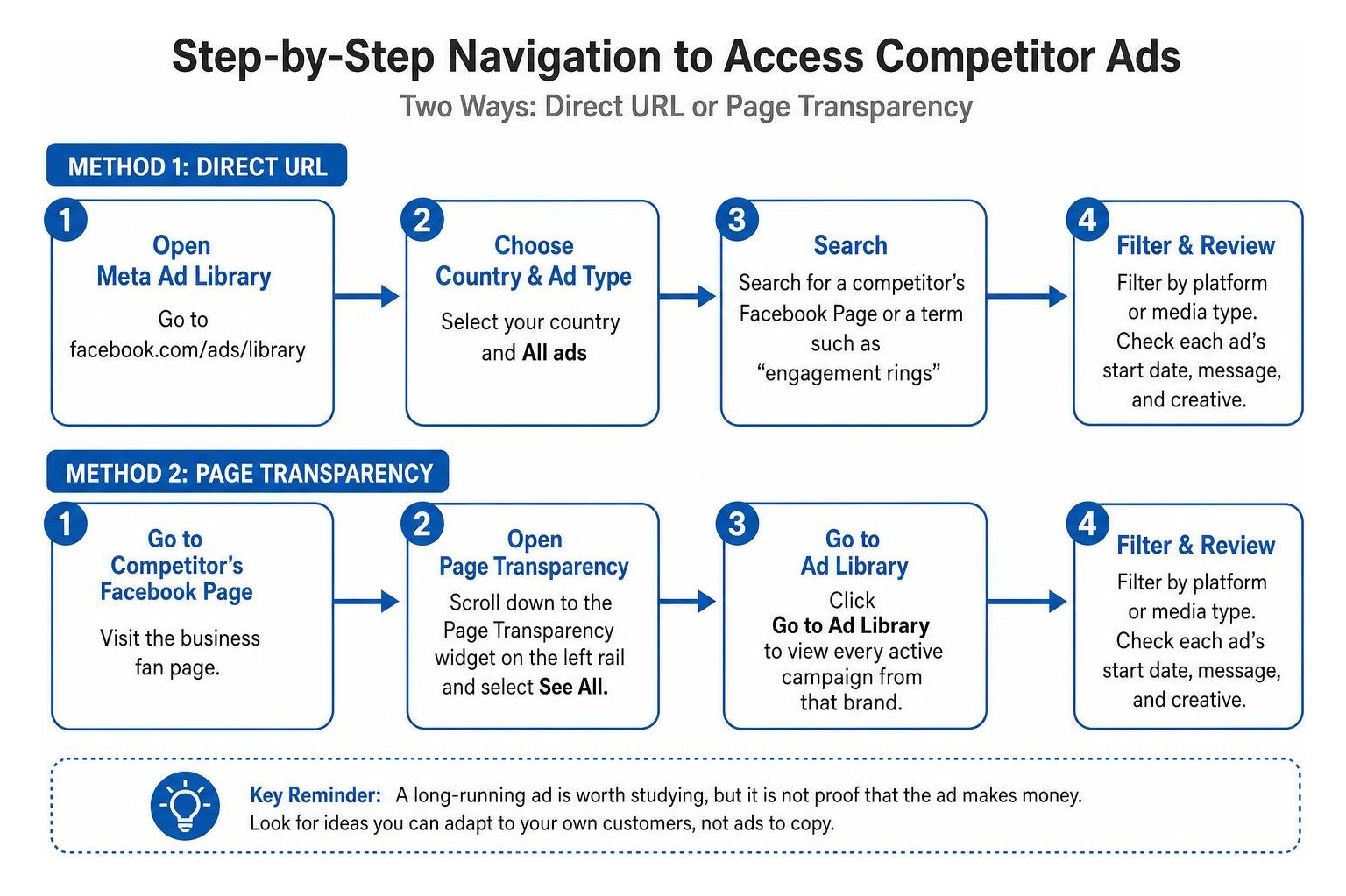
There are three direct methods to access ad database listings:
-
Direct Web Navigation: Navigate directly to the web portal at
facebook.com/ads/library. You can search across various countries and categories without needing to log in. - Facebook Page Transparency: Visit any business fan page on Facebook, scroll down to the Page Transparency widget on the left rail, select See All, and click Go to Ad Library to instantly view every active campaign from that exact brand.
- In-Feed Ad Inspection: When you see an ad while scrolling your personal feed, click the three-dot menu icon on the top right corner of the post and select Why am I seeing this ad? to jump directly into the brand's profile.
What Data You Can and Cannot See
Understanding the distinction between standard commercial ads and social-issue campaigns is critical for setting realistic research expectations.
| Data Dimension | Commercial / Retail Ads | Social Issue & Political Ads |
|---|---|---|
| Creative Assets | Full access (Images, Videos, Carousels, Dynamic copy) | Full access |
| Ad Copy & Headlines | Visible primary text, headlines, descriptions, CTAs | Visible text, disclosures, disclaimer entities |
| Flight Dates | Start date visible; disappears once paused | Start date and complete historical flight dates |
| Archival Duration | Active only (1-year retention in EU/UK regions) | 7-year mandatory archive regardless of active status |
| Spend Metrics | Hidden (Estimated reach only via regional EU tools) | Exact spend brackets publicly displayed |
| Targeting Criteria | Hidden (Placement & high-level geography visible) | Detailed demographic, age, and regional delivery metrics |
Commercial advertisers do not get access to direct conversion rates, Return on Ad Spend (ROAS), or exact backend custom audience setups. However, using the public signals available allows you to infer strategy, messaging hierarchy, and creative investment accurately.
How to Execute an Advanced Facebook Ad Library Search
Running a basic keyword query often returns thousands of irrelevant results. Structuring queries properly transforms an overwhelming wall of ads into a targeted swipe file. When orchestrating comprehensive paid social initiatives, aligning ad research with our Meta Ads Management Complete Guide ensures your competitive analysis directly informs your campaign builds.
Advanced Operators for Facebook Ad Library Search
To pinpoint specific product categories or campaign hooks, utilize structured search parameters:
-
Exact Phrase Matching: Enclose specific terms in quotation marks (e.g.,
"lab grown diamond engagement ring") to eliminate broad-match noise and filter out loose word associations. -
Boolean OR Operators: Use uppercase
ORto combine related search queries (e.g.,"custom jewelry" OR "bespoke necklaces") to study multiple messaging angles across a category simultaneously. - Advertiser Name Queries: Search by exact brand name rather than general keywords when conducting direct competitor deep-dives to ensure you capture 100% of their active variants.
Optimizing Filters for Facebook Ad Library Search
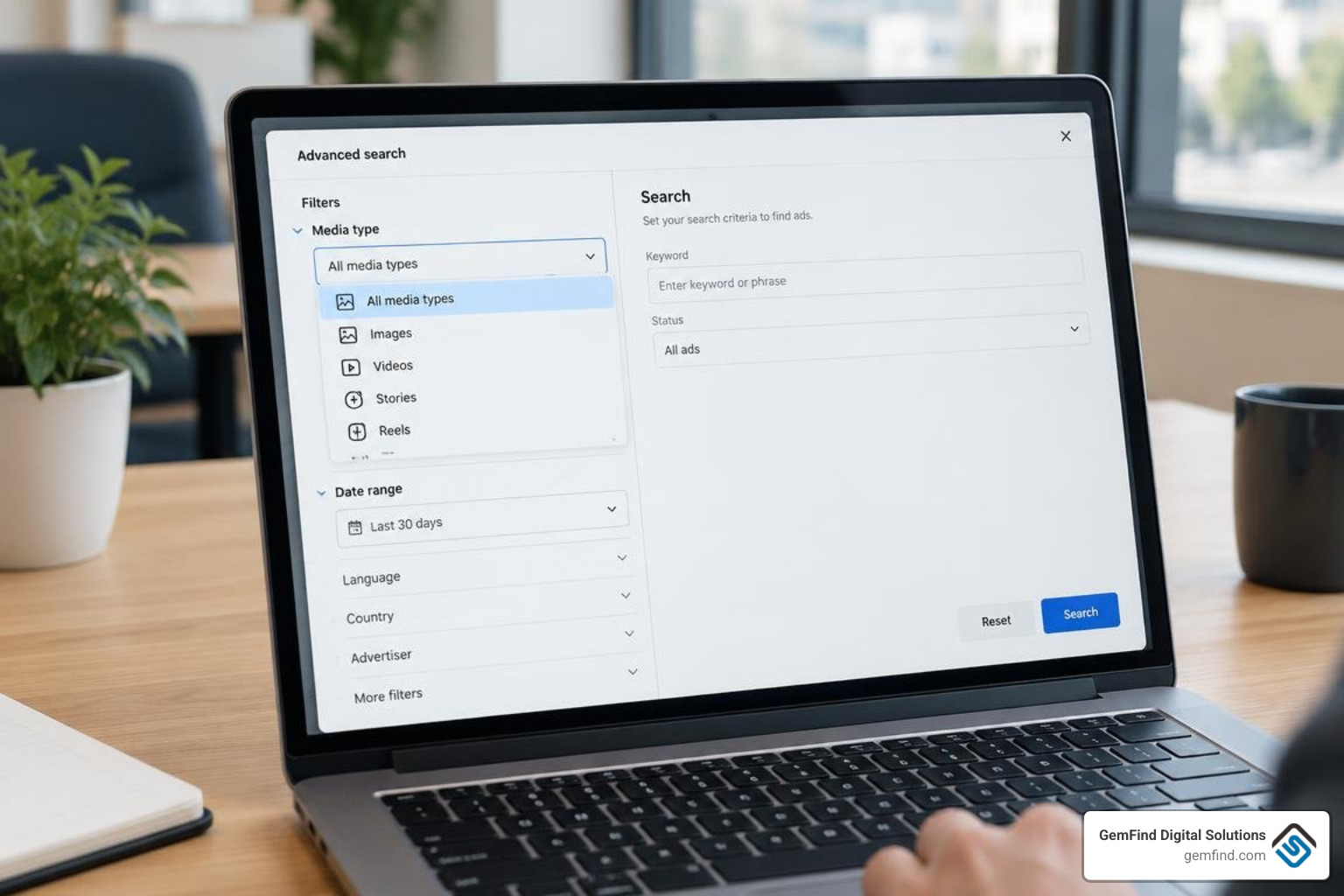
To refine high-volume search results, combine these core filter dimensions:
- Platform Selection: Filter specifically across Facebook, Instagram, Messenger, or Audience Network. Isolating Instagram helps you evaluate visual storytelling formats, while reviewing Facebook highlights longer-form, direct-response copy variations.
- Media Types: Segment results by Images, Memes, Videos, or Multi-image/Carousels to analyze which visual formats dominate your niche.
- Language Filtering: Focus solely on your target demographic’s native language to prevent multi-region campaigns from cluttering your dashboard.
- Date Ranges: Sort by oldest start dates to instantly isolate evergreen creative assets from newly launched direct-response experiments.
Reverse-Engineering Winning Competitor Strategies
With average ad costs running around $0.87 per click and $16.06 per thousand impressions (CPM), testing creative blind wastes valuable capital. Analyzing proven formats lets you build a strategic creative blueprint without burning testing budget on unvalidated ideas. To structure high-performing creative funnels tailored for luxury and specialty retail, review our guide to running successful Facebook ad campaigns.
Identifying Evergreen and High-Performing Creatives
Because commercial ad spend is hidden, longevity is your primary indicator of profitability. Digital media buyers do not continue paying for losing ads.
- The 90-Day Benchmark: If an ad has been actively delivering impressions for 90 days or longer, it is almost certainly generating a positive return for the business.
- Creative Iteration Volume: When an advertiser runs 10 to 15 slight visual variations of the exact same headline and copy angle, they have found a winning message and are actively working to stave off ad fatigue.
- Active Testing Volume: Large brands maintain dozens of live ads simultaneously, separating their ad catalog into recent experiments (launched within the last 30 days) and proven core revenue drivers (running 90+ days).
Deconstructing Ad Copy, Angles, and Visual Hooks
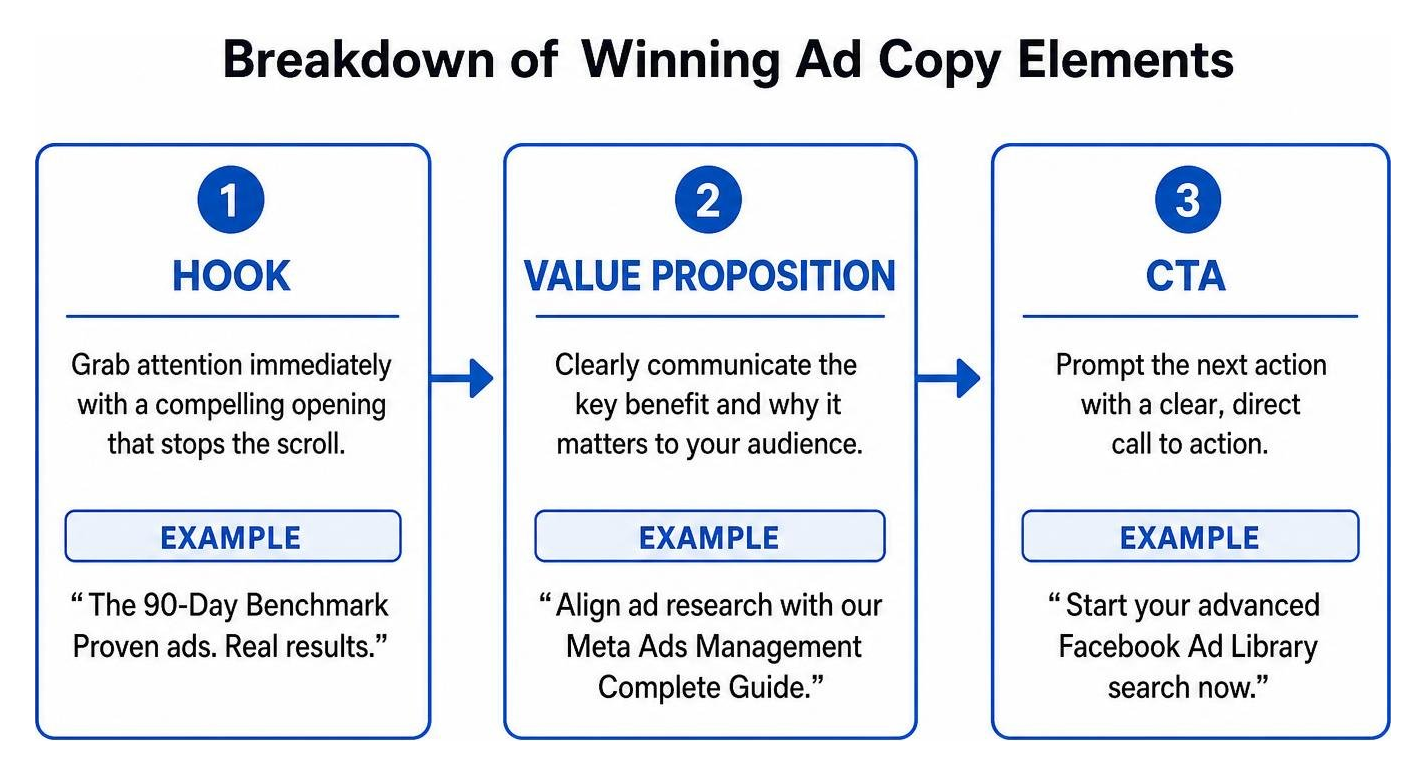
When studying top competitor creatives, break them down into four structural components:
- First-Sentence Hooks: Analyze the opening line of the primary text. Are they leveraging negative emotional pain points, bold claims, social proof, or educational curiosity?
- Value Propositions: Note whether the ad highlights custom craftsmanship, flexible financing terms, sustainability, or express shipping.
- Visual Triggers: Examine the first three seconds of video creatives or the visual layout of static images. Are they using user-generated content (UGC), high-gloss studio product videos, unboxing reels, or educational infographics?
- Call-to-Action (CTA) Framing: Identify whether the destination trigger uses "Shop Now," "Book an Appointment," "Claim Offer," or "Learn More."
Understanding these core triggers is essential when learning how to target luxury buyers on Facebook with tailored messaging.
Analyzing Cross-Platform Placements and Funnels
Competitors frequently tailor their messaging depending on where the user encounters the brand. Reviewing placement breakdowns reveals how advertisers customize assets for Meta Ads Manager Instagram campaigns, shifting from long-form educational copy on Facebook desktop feeds to , 9:16 vertical video reels on Instagram.
Always click the ad destination link to trace the entire user flow:
- Does the ad drop users on a generic home page, an organized collection page, or a dedicated direct-response landing page with custom financing options?
- Are they using interactive ring builders, lead capture quizzes, or instant checkout mechanisms?
Strategic Opportunities and Pitfalls to Avoid
Uncovering high-performing competitor creative allows you to spot gaps in the market, build predictable seasonal strategies, and steer clear of common research traps.
- Analyze Creative Testing Velocity: High-growth retail advertisers test multiple fresh ad creatives monthly. Monitor your direct competitors bi-weekly to observe how quickly they cycle in new concepts.
- Build Seasonal Campaign Playbooks: Search competitor pages during major shopping holidays (such as Valentine's Day, Mother's Day, and Q4 holiday sales) to log their promotional calendars, bundled offers, and discount structures.
- Identify Influencer and Creator Partnerships: Use the ad repository to view creator partnerships and branded content whitelisting ads, which reveals which macro or micro-influencers generate real traction in your niche.
- Avoid the Duplicate Trap: Never copy an ad word-for-word or steal digital assets. Plagiarism harms brand equity, risks intellectual property claims, and ignores the fact that an ad's success relies heavily on backend funnels, brand reputation, and custom retention systems like remarketing ads on Facebook.
Frequently Asked Questions About Meta Ad Search
Can you see competitor ad spend in the Meta Ad Library?
No. Exact ad spend, impressions, CPC, and ROAS data are not published for commercial retail ads. You can only view exact expenditure figures for political, election, and social-issue campaigns. However, ad runtime and active iteration volume serve as reliable proxies for commercial profitability. In the UK and EU, regional transparency disclosures under the Digital Services Act (DSA) also provide general reach estimates.
How long do commercial ads stay in the Facebook Ad Library?
Standard commercial ads remain visible in the ad library only while they are actively running. Once an advertiser pauses or deletes a campaign, the ad typically disappears from standard search within 24 hours. The exception is the European Union and UK, where the Digital Services Act mandates that ads remain searchable in an archive for one full year after receiving their last impression.
Why are some competitor ads missing from search results?
If a competitor's ads do not appear, it is usually due to:
- Indexing Latency: Newly published ads can take up to 24 hours to index across the transparency database.
- Country Filter Constraints: The search country dropdown may be set to a region where that advertiser is not currently delivering impressions. Ensure you set your country selector to "All" or the specific geographic market the brand targets.
- Browser Extensions: Aggressive local ad blockers and privacy extensions can interfere with the ad library interface. Disabling ad blockers or testing the search in an incognito window often resolves display issues.
Conclusion
Conducting a regular facebook ad library search takes the guesswork out of paid social advertising. By tracking competitor longevity, isolating high-converting hooks, studying cross-platform placements, and understanding full funnel flows, you can build a predictable, data-driven creative pipeline.
At GemFind Digital Solutions, we bring over 25 years of dedicated digital marketing and web design expertise to the jewelry industry. As certified Shopify and Google Partners, our team develops comprehensive paid acquisition architectures—from Edge POS integrations to high-converting creative funnels.
Explore our complete guide to the Facebook Ads Library to sharpen your competitive intelligence, refine your creative strategy, and scale your brand's digital presence today.


