

The Strategic Value of Ad Transparency in Modern Paid Media

To lower customer acquisition costs with Meta Ad Library research, start by searching competitor brand names or category keywords, then filter for active, long-running creatives to identify winning hooks and offers. Audit the post-click landing pages behind those ads to see how competitors align messaging from click to checkout, and use those observations to structure your own ad tests. This practical workflow turns public ad transparency data into a repeatable method for reducing CAC before you spend budget on unproven creative.
Rising ad costs across digital platforms make creative research essential for healthy margins. When building campaigns inside Meta Business Suite Ads Manager, testing blind concepts leads directly to creative fatigue and burned budgets. Ad transparency bridges the gap between guesswork and calculated market intelligence, allowing media buyers to understand market sentiment and customer preferences before launching new ad sets.
Public ad repositories provide a direct look into competitor messaging, creative formats, and promotional angles. Instead of spending thousands of dollars testing whether your audience prefers educational carousels or lifestyle videos, you can evaluate proven category patterns in advance. This pre-launch competitive analysis shortens your testing phase and protects your return on ad spend from the start.
| Research Dimension | Manual Social Feed Tracking | Ad Transparency Repository Research |
|---|---|---|
| Completeness | Fragmented; relies on luck and personal algorithm feeds | Comprehensive; reveals every active ad variation across regions |
| Efficiency | Hours spent scrolling and taking sporadic screenshots | Rapid search by brand name, keyword, or page identifier |
| Historical Data | Lost once an ad stops appearing on personal feeds | Retains active messaging and long-term regulatory archives |
| Creative Scope | Limited to ads served directly to your user profile | Full access to all creative formats, copy variations, and URLs |
Reviewing transparency data allows you to spot gaps in competitor strategies. If competing retailers rely entirely on generic discount banners, you can test video storytelling, styling tips, or educational craftsmanship content to capture higher-intent shoppers at a lower cost per acquisition.
How to Use the Meta Ad Library for High-ROI Competitor Research
Accessing market intelligence begins at the official Ad Library search hub. This open database catalogs commercial and issue-based advertisements across Facebook, Instagram, Audience Network, and Messenger, giving advertisers complete transparency into live market positioning.
Core Search Filters and Navigation in the Meta Ad Library
To conduct effective research, apply specific parameters rather than running vague, broad queries:
- Country Selection: Select your primary target market to see regionally active ads and observe localized promotional strategies.
- Ad Category: Choose "All Ads" for standard commercial products or specific categories like Employment or Financial Products when auditing specialized sectors.
- Search by Advertiser or Keyword: Search exact brand names to view a competitor's complete active catalog, or use keyword queries like "custom engagement rings" to spot broader market trends across multiple emerging players.
- Platform Breakdown: Filter placements to see how brands adapt their messaging between Facebook and dedicated Meta Ads Manager Instagram campaigns.
- Media Type: Isolate video assets, static images, or meme-style graphics to examine distinct creative formats and pinpoint which assets receive the heaviest investment.
Identifying Winning Ad Formats and Messaging Angles
A competitor running dozens of active ads usually indicates active creative testing and significant ad spend allocation. Group their catalog by core messaging angles:
- The Hook: What visual element, text overlay, or headline stops the scroll in the first three seconds?
- The Core Offer: Are they highlighting flexible financing, complimentary cleanings, seasonal discounts, or custom design consultations?
- The Proof: How do they incorporate customer reviews, unboxing clips, user-generated content, or media mentions to build trust?
When managing your assets in Meta Business Manager, structure creative tests around these observed angles while maintaining your unique brand voice and distinct value proposition.
Step-by-Step Blueprint for Analyzing Competitor Campaigns to Lower CAC
Extracting actionable data requires a structured analysis workflow rather than casual browsing. Follow this process to turn transparency data into lower acquisition costs:
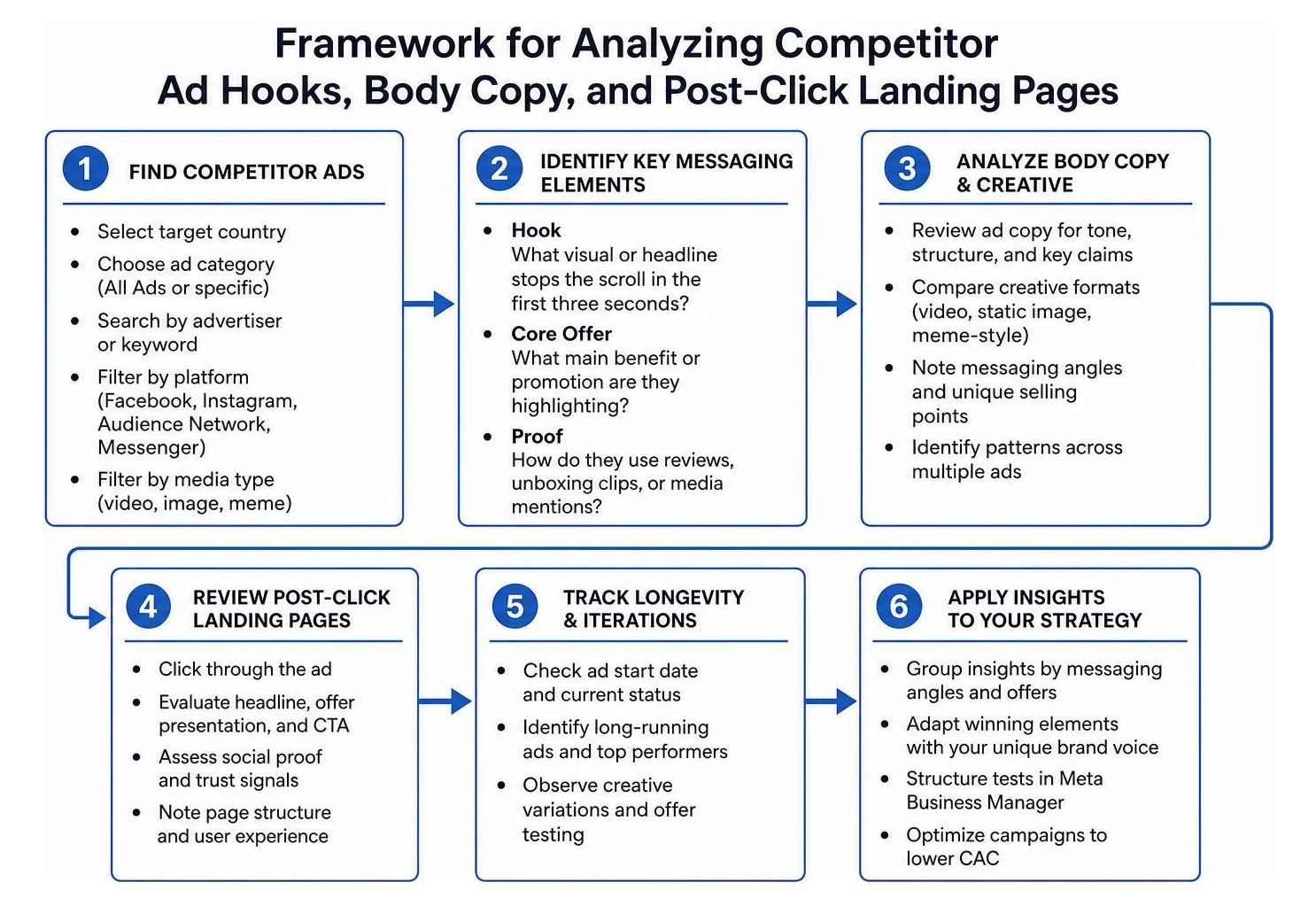

Using a detailed Meta Ads Management Complete Guide helps translate these creative discoveries into structured campaigns that maximize return on ad spend and prevent budget waste.
Tracking Ad Longevity, Creative Iterations, and Offer Testing
Ad launch dates reveal testing patterns and ongoing budget allocation. An ad that launched several months ago and remains active suggests the advertiser continues to allocate budget toward it profitably, making it a proven creative benchmark in your niche.
When you notice a brand running five slight variations of the same video with different opening headlines or thumbnail images, you are witnessing active hook testing in real time. Take note of these variations to structure your own tests more efficiently, especially when referencing A Guide to Organizing Facebook Ads for Jewelry Stores for campaign structure, ad set hierarchy, and budget control.
Auditing Landing Pages and Post-Click Conversion Paths
Creative is only half of the acquisition equation; the post-click experience determines whether traffic converts into revenue. Click through on active ads to review competitor post-click experiences:
- Does the landing page headline directly match the ad copy promise and visual tone?
- Are they routing traffic to a broad collection page or a dedicated product landing page optimized for immediate checkout?
- How prominent is the call-to-action above the fold across mobile and desktop devices?
- Are payment plans, security badges, and customer guarantees clearly visible near the checkout button to reduce friction?
Aligning your messaging from visual hook to checkout helps eliminate drop-offs and improves conversion rates across your entire funnel. For industry-specific funnel optimization, consult our Facebook Ads Jewelry Complete Guide.
Programmatic Research: Querying Developer Endpoints and Data Feeds at Scale
Manual searches work well for periodic checks, but monitoring dozens of brands across multiple regions benefits from automated data feeds. Developers and data analysts can pull ad transparency records directly via public endpoints outlined in the Ad Library API documentation.
Primary query parameters include:
-
search_terms: Keyword phrases or specific brand terms. -
ad_reached_countries: ISO country codes (e.g.,US,GB). -
ad_active_status: Filter byACTIVE,ALL, orINACTIVE(for available archives). -
ad_delivery_date_minandad_delivery_date_max: Target specific seasonal timeframes. -
media_type: Restrict responses toIMAGE,VIDEO, orMEME. -
publisher_platforms: Isolate channels such asfacebookorinstagram. -
limit: Control batch record sizes per response payload.
Technical Capabilities and Parameters of the Meta Ad Library API
Programmatic queries return JSON payloads detailing creative copy, page identifiers, platform placements, and publication timestamps. Developers building custom dashboards often use modern tools like the Meta Ads Library SDK, a type-safe TypeScript package running on Node.js 18+ that simplifies query construction:
- Authentication: Requires a verified Facebook Access Token linked to a developer application.
- Fluent Query Construction: Chain filters together with helper methods to set countries, keywords, and field lists.
-
Field Customization: Request only necessary keys—such as
id,page_name,ad_creative_bodies, andad_snapshot_url—to keep payload sizes manageable.
Rate Limits, Pagination, and Regional Data Retention Policies
Working with programmatic endpoints requires managing platform constraints:
- Rate Limits: Standard client connections often enforce limits around 200 calls per hour. Use caching and backoff logic to avoid query throttling.
- Pagination: Results are returned in pages up to a maximum of 500 records per response. Use cursor-based pagination or async iteration to stream large datasets without memory issues.
- Data Retention Windows: Political and social issue ads remain archived worldwide for seven years. In the European Union, regulatory requirements provide a one-year public archive across all commercial ad types. Outside of regulated archives, commercial ads are generally discoverable only while actively running.
Frequently Asked Questions About Competitor Ad Research
What types of ads can you search in the public repository?
You can search all active commercial ads currently running across Facebook, Instagram, Messenger, and Audience Network worldwide. Special categories—including political and social issue campaigns, housing, employment, and financial products—are also cataloged and retain historical records based on regional transparency laws.
How does data retention differ between standard ads and political campaigns?
Standard commercial ads outside the EU are only visible while their status is active; once an advertiser turns them off, they disappear from general public search results. In contrast, political and issue-based ads remain accessible in a public, searchable archive for seven years globally, complete with spend ranges, impression estimates, and demographic delivery breakdowns.
What are the main limitations of relying solely on transparency libraries?
The public repository does not display backend performance metrics such as conversion rates, click-through rates, exact return on ad spend (ROAS), or specific custom audience targeting (such as lookalike models or customer email lists). It shows what an advertiser is presenting to the market, not how profitably those campaigns are performing.
Conclusion
Competitive research is an ongoing discovery process, not a one-time audit. By regularly checking competitor creative angles, testing unique value propositions, and aligning your landing page experiences, you can eliminate wasted spend and scale customer acquisition profitably.
Ready to turn your market research into high-converting campaigns? Continue mastering competitor ad intelligence through the Facebook Ads Library to sharpen your creative strategy and drive scalable business growth.


