


Choose a Jewelry App That Solves a Real Store Problem

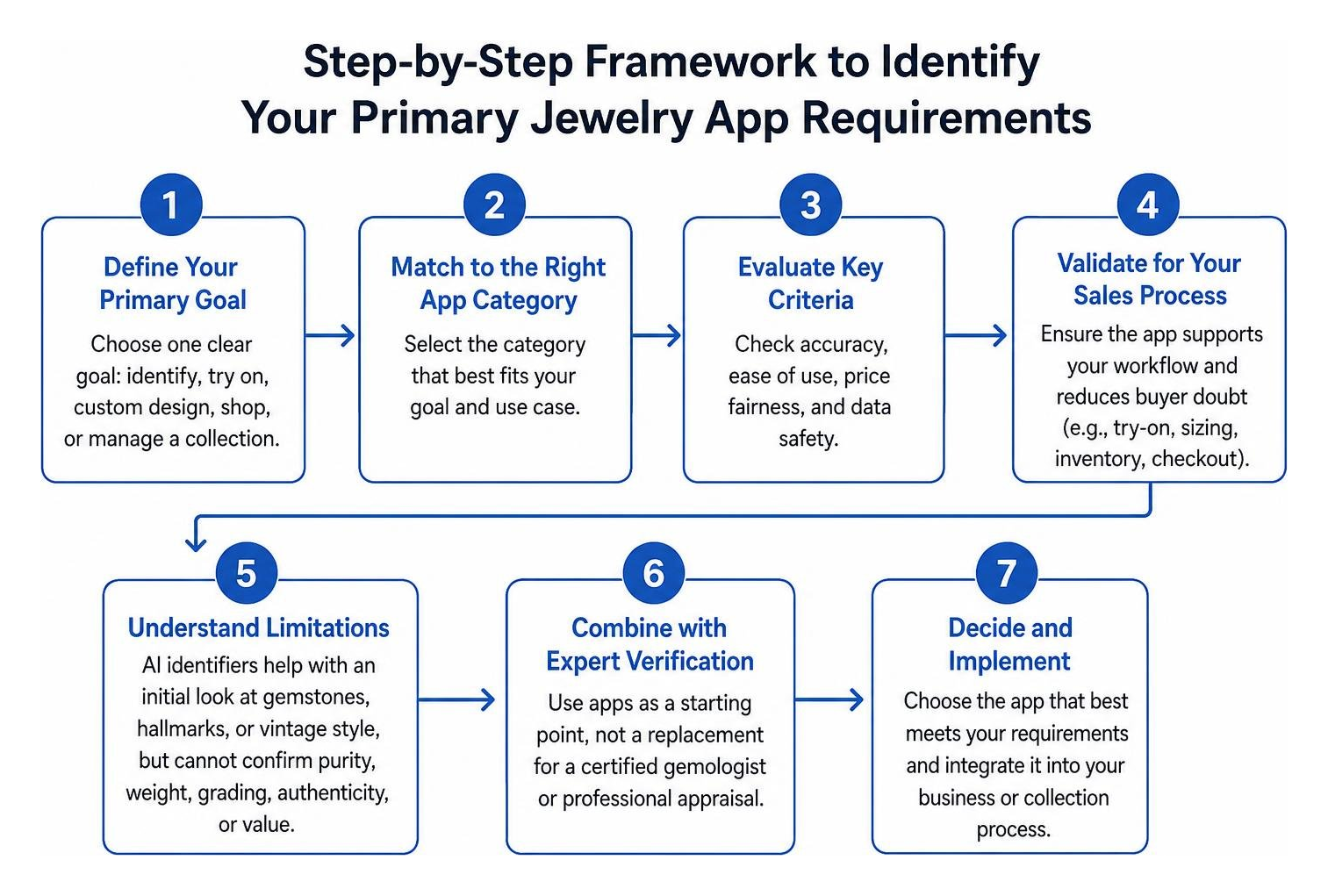
The best jewelry app depends on the job you need it to do. Start by choosing one clear goal: help shoppers try on pieces, support custom design, identify estate jewelry, sell inventory online, or manage a collection. Then test whether the app is accurate enough, easy to use, priced fairly, and safe with customer and product data.
For jewelry retailers, the strongest option is rarely a standalone novelty tool. Look for an app that fits your sales process and helps reduce buyer doubt - such as virtual try-on, ring sizing, appointment booking, live inventory, or a smooth path from browsing to checkout.
AI identifier apps can be useful for an initial look at a gemstone, hallmark, or vintage style. But a phone photo cannot confirm metal purity, carat weight, diamond grading, authenticity, or an insurance value. Treat these tools as a helpful starting point, not a replacement for a certified gemologist or professional appraisal.
I am Anthony Arechiga, Vice President of Sales at GemFind Digital Solutions, where I have worked since 2007 helping jewelry businesses improve their websites, e-commerce, and digital sales strategy. I have seen that the right jewelry app can turn mobile interest into qualified conversations, stronger customer confidence, and more online revenue.
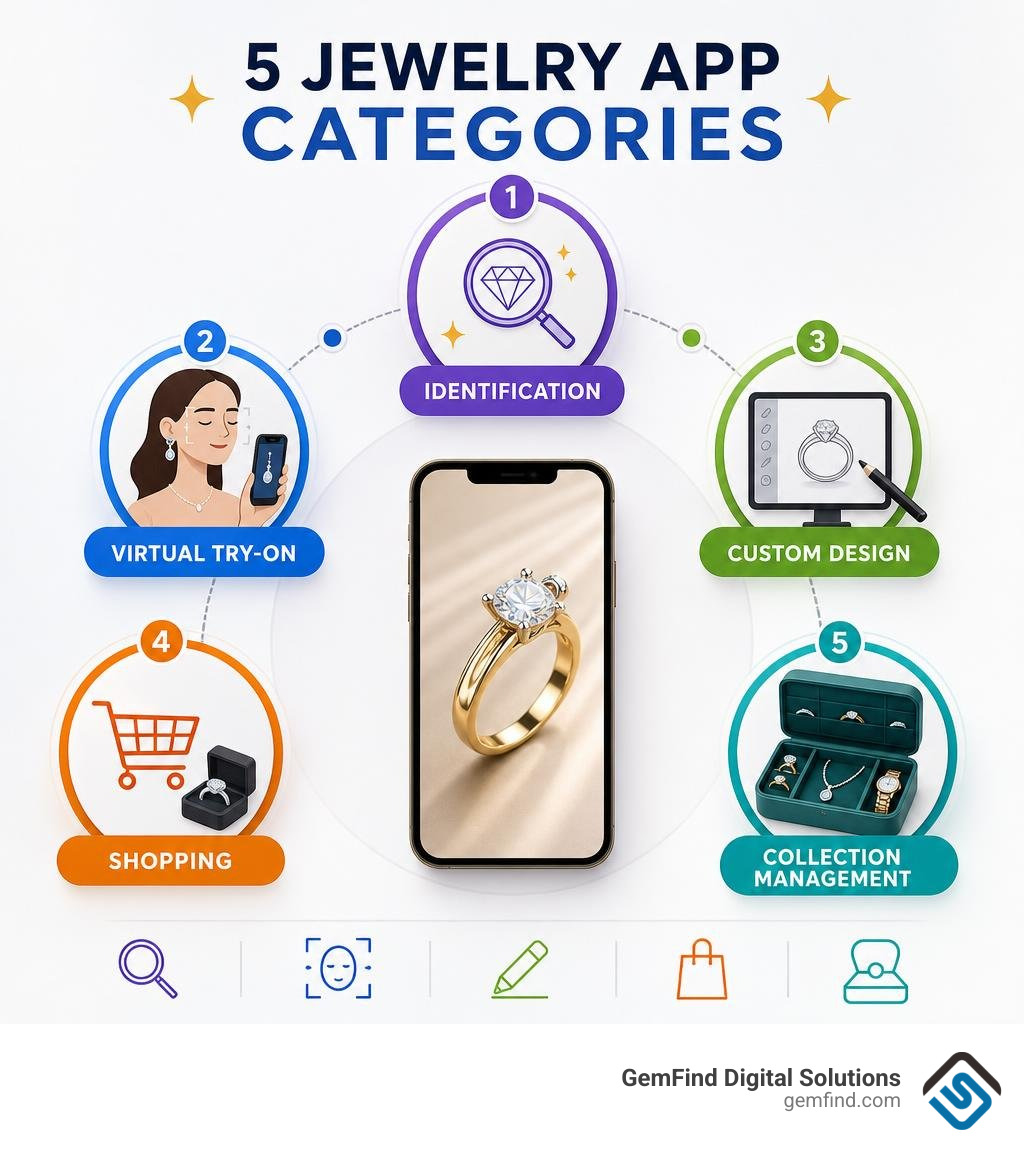
1. Identify Your Core Goal Across the Main App Categories
Finding the right mobile software starts with understanding what you want the platform to accomplish. In August 2026, the mobile market provides distinct tools built for everyday consumers, vintage collectors, and retail jewelers. Exploring our Best Apps for Jewelry Guide 2026 highlights how specialized digital tools streamline everything from loose stone sourcing to complete showcase presentation.
Choosing an AI Jewelry App for Gemstone and Hallmark Identification
AI-powered visual scanners have become popular among estate liquidators, hobbyists, and antique jewelry shoppers. These applications use computer vision algorithms trained on thousands of jewelry photographs to classify gemstone cuts, detect period design motifs, and decode metal stamps.
For instance, the Sparkle - Jewelry Identifier App - App Store holds a 4.9 out of 5 rating across 38 ratings on the App Store. It focuses on scanning gemstones, crystals, and diamonds while helping users decode faded stamps on vintage gold and platinum. Similarly, Jewelry Identifier : Jewelio - App Store - Apple maintains a 4.3 out of 5 rating across 190 reviews, assisting users in sorting estate pieces and saving scan histories. Another popular Android tool, Jewelry Identifier: Appraisal, has recorded over 50,000 downloads and 2.52K reviews on Google Play.
These apps help flag potential materials when sorting through mixed estate boxes or examining unlabelled vintage pieces. However, their visual analysis cannot match physical bench testing.
Selecting Virtual Try-On and Custom Creation Platforms
Digital visualization tools bridge the confidence gap for online buyers who want to know how a piece looks before purchasing. Interactive tools like our Shopify Virtual Try On App allow shoppers to visualize ring settings and gemstones directly on their own hands in real time.
Consumer mobile tools have embraced single-photo artificial intelligence mapping. The JewelryAI: Try on any jewelry App - App Store uses uploaded selfies and portraits to simulate how necklaces drape across the collarbone and how gemstones catch ambient light.
For bespoke manufacturing, platforms like Jewelify: Custom AI Jewelry App - App Store hold a 5.0 out of 5 rating from early users by translating written style prompts into visual concepts that independent artisans can bid on. When integrated into retail websites via tools like our Custom Diamond Ring Builder, shoppers gain complete control over settings, metal purities, and center stones.
Exploring Mobile Retail and Live Market Trackers
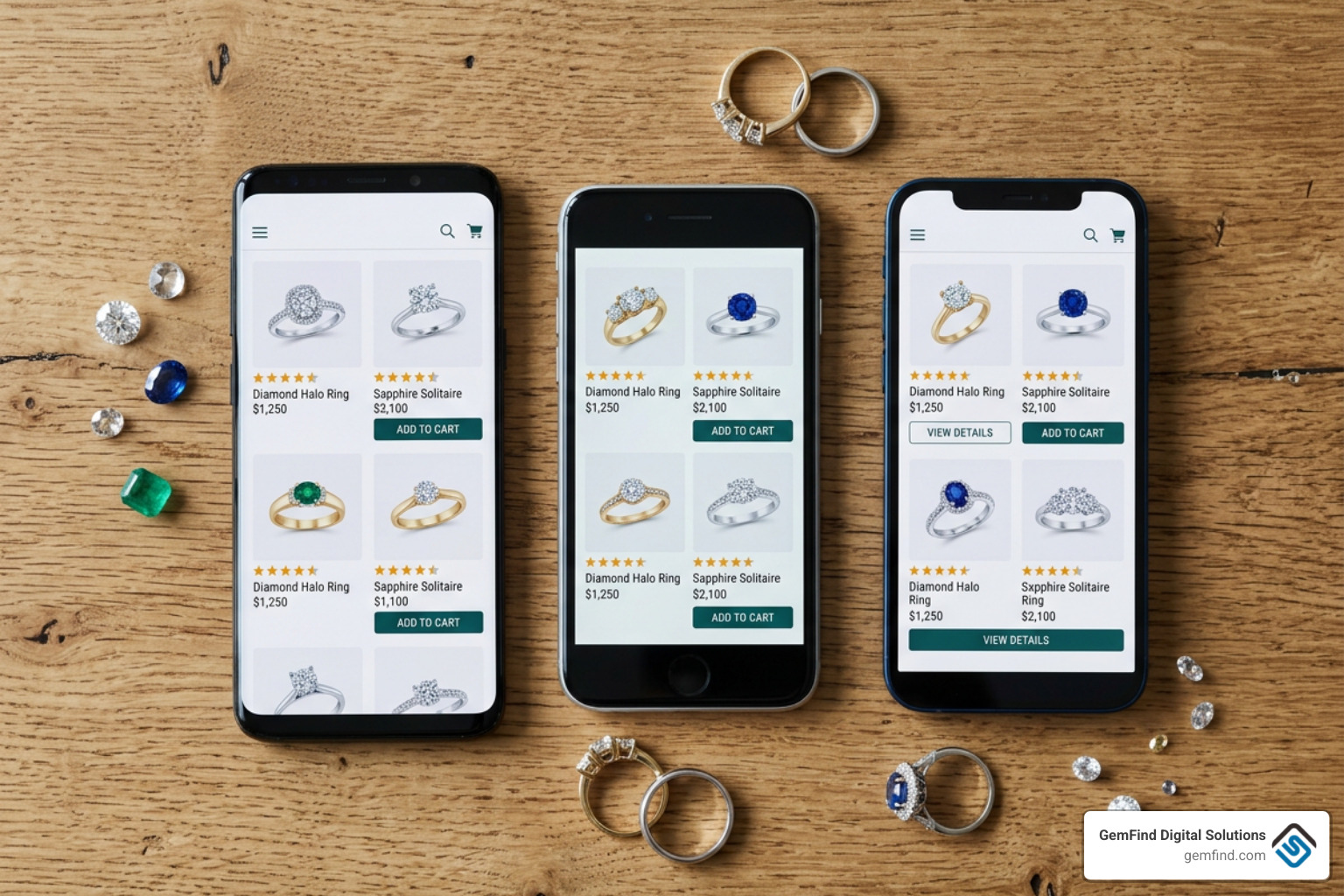
For full-scale mobile commerce, dedicated shopping applications deliver catalog browsing, order tracking, and live commodity pricing. Our guide to Shopping Apps for Jewelry explores how retail brands leverage mobile storefronts to cultivate long-term customer loyalty.
Leading mobile retailers demonstrate the power of combining e-commerce with fintech features. For example, the Tanishq Jewellery Shopping - Apps on Google Play application boasts over 5 million downloads and a 4.7 out of 5 rating from 157,000 reviews. It incorporates live daily gold rate tickers for 18K, 22K, and 24K purities alongside digital gold investment portals and showroom appointment scheduling.
2. How to Evaluate Accuracy and Pricing in a Modern Jewelry App
When testing jewelry software, you must evaluate both functional accuracy and transparent billing terms. Many consumer identifier apps offer brief introductory periods before recurring charges begin.
| App Name | Primary Function | iOS / Android Rating | Pricing Structure | Key Features |
|---|---|---|---|---|
| Jewelio | AI Stone & Ring Scanner | 4.3 / 5 (190 reviews) | $5.99/wk, $39.99/yr, $49.99 Lifetime | AI photo scan, scan history log, style detection |
| Sparkle | Hallmark & Gem Identifier | 4.9 / 5 (38 reviews) | $5.99/wk, $29.99 - $39.99/yr | Hallmark decoding, portfolio valuation, stone ID |
| Jewelry Identifier: Appraisal | Estate Valuation & AI ID | 4.7 / 5 (App Store) / 50K+ DL | 3-day trial, then ~$7/wk | Diamond vs CZ detection, marketplace price check |
| JewelryAI | AR / AI Virtual Try-On | Not Publicly Listed | $6.99/wk, $49.99/yr | Single-photo neck/hand mapping, lookbook vault |
| Jewelify | Custom AI Design Hub | 5.0 / 5 (2 reviews) | Token bundles ($9.99 - $119.99) | Text-to-jewelry generation, artisan bidding |
| Tanishq Shopping | Omnichannel Retail | 4.7 / 5 (157K reviews) | Free (Retail E-Commerce) | Live gold ticker, AR try-on, savings schemes |
Understanding Visual AI Capabilities and Limitations
Visual AI models analyze surface geometry, facets, color, and luster from digital images. They excel at recognizing broad design eras—such as Art Deco, Victorian, or Mid-Century motifs—and naming common gemstone cuts like radiant, marquise, or emerald cuts.
However, computer vision has clear limitations:
- Artisan Misidentification: One-of-a-kind, handcrafted, or mixed-media artisan pieces often get misclassified by algorithms as generic, mass-produced items.
- Lighting Distortions: Glare, reflections, and poor focus can cause artificial intelligence to confuse genuine diamonds with cubic zirconia, white sapphire, or glass.
- Hidden Hallmarks: Phone cameras struggle to capture microscopic, worn maker marks stamped on the inner shanks of vintage rings without dedicated macro lenses.
To achieve the best results with visual scanners, take clear, multi-angle photos under balanced white lighting and input known details like total weight or metal type into the search parameters.
When to Rely on a Jewelry App vs. a Certified Appraisal
A mobile app should serve only as a preliminary discovery tool. Mobile software cannot replace the physical testing performed by a certified gemologist.
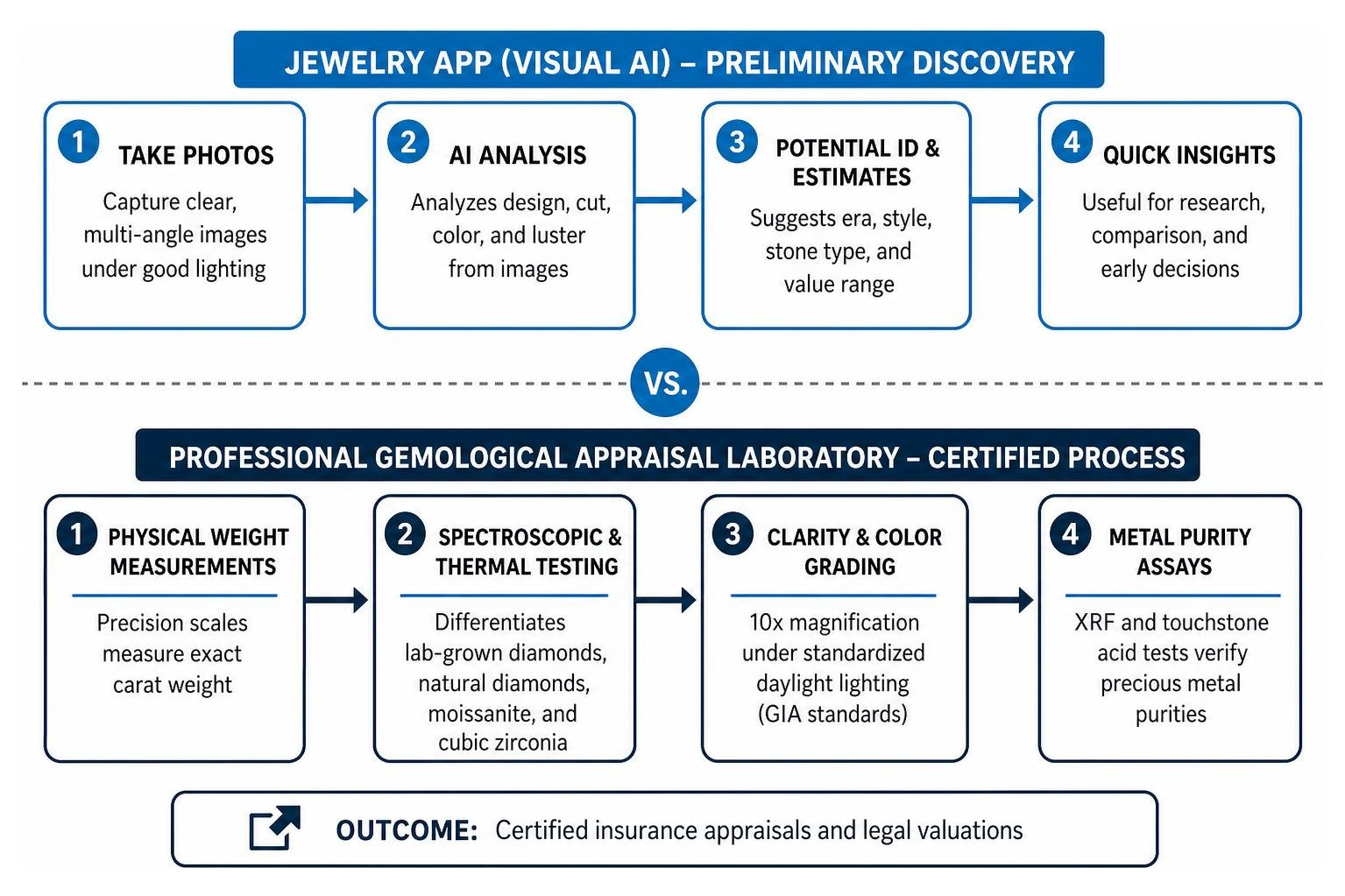
Certified insurance appraisals and legal valuations require specialized laboratory instrumentation:
- Physical Weight Measurements: Precision scales measure exact carat weights that visual camera tools can only guess.
- Spectroscopic & Thermal Testing: Gemological tools differentiate lab-grown diamonds, natural diamonds, moissanite, and cubic zirconia based on thermal and optical properties.
- Clarity and Color Grading: GIA grading standards require 10x magnification under standardized daylight lighting environments.
- Metal Purity Assays: X-ray fluorescence (XRF) and touchstone acid tests verify precious metal purities that phone cameras cannot measure.
Use mobile identifier apps for cataloging personal curiosity and preliminary style research, but always rely on certified appraisals for insurance policies, estate settlements, or major purchases.
3. Test Interactive Customization and Virtual Try-On Features
Interactive shopping features keep users engaged by letting them visualize custom designs before making a commitment. Exploring our Virtual Try On Jewelry Complete Guide explains how augmented reality reduces buyer hesitation.
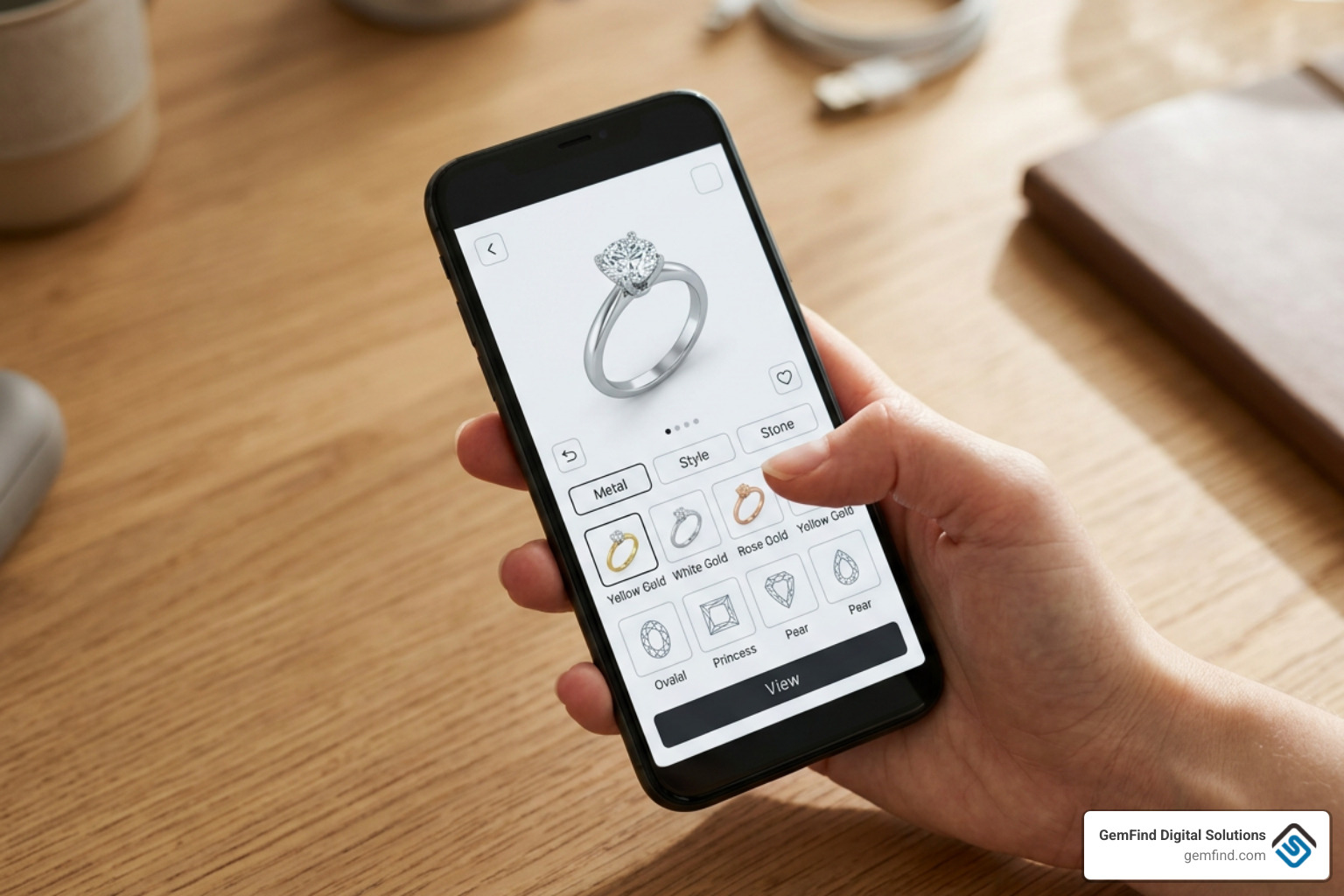
Modern 3D configurators enable shoppers to build personalized pieces step by step. Our Custom Jewelry Design Software Guide details how jewelers can offer bespoke design tools on their digital storefronts without complex manual workflows.
Seamless E-Commerce and Diamond Inventory Integration
For jewelry business owners, consumer-facing apps must connect directly to live supplier inventories and point-of-sale systems. Standalone design tools fall short if customers cannot order the specific loose stones or mountings they configure.
We build tailored, jewelry-specific e-commerce tools that integrate smoothly into modern retail platforms:
- Live Diamond Sourcing: The Diamond Search App for Shopify provides shoppers with filterable access to thousands of certified natural and lab-grown diamonds with real-time pricing and grading certificates.
- Interactive Ring Customization: Our Ringbuilder App for Shopify lets shoppers pair their chosen diamond with their preferred setting in a simple, guided workflow.
- Omnichannel Inventory Synchronization: The Diamondlink App for Shopify connects dealer inventories directly to your store, ensuring prices and availability remain accurate across your entire digital catalog.
4. Inspect Data Security, Privacy Policies, and User Ratings
Because jewelry involves high-value assets and sentimental heirlooms, reviewing data protection practices is essential before uploading your collection details to any digital vault.
When evaluating an application's security and reputation, examine these factors:
- Data Privacy Classifications: Review App Store privacy labels to see whether your personal contact details, device identifiers, and location data are shared with third-party advertisers.
- Encrypted Portfolio Backups: If using an app to catalog your private collection, ensure the platform provides secure cloud storage and allows you to export your data into structured PDF inventory sheets.
- Billing Transparency: Check recent user reviews on Google Play and Apple's App Store. Be cautious of applications that make trial cancellations difficult or hide weekly fees behind unclear payment screens.
- App Store Update Regularity: Frequent updates indicate that developers actively fix software bugs, maintain server connections, and improve computer vision algorithms.
Frequently Asked Questions About Choosing a Jewelry App
Can a mobile jewelry identifier app replace a professional appraisal?
No. Mobile jewelry identifier apps are designed for preliminary reference, educational discovery, and personal collection management. They cannot physically verify metal purity, determine gemstone authenticity, measure precise carat weights, or grade clarity under 10x magnification. Official insurance policies, estate distributions, and legal valuations require formal documentation from a certified gemologist or professional jewelry appraiser.
How accurate are smartphone apps at distinguishing real diamonds from cubic zirconia?
Smartphone apps rely on visual computer vision models that analyze surface light reflections, faceting patterns, and luster. While algorithms can flag visual similarities, camera images cannot measure thermal conductivity, electrical resistance, or specific gravity. Genuine diamonds, lab-created diamonds, moissanite, and cubic zirconia can appear nearly identical in phone photos, making physical gemological testing necessary for definitive confirmation.
What subscription models do most jewelry apps use?
Consumer jewelry identification and styling apps commonly use recurring weekly subscriptions ranging from $5.99 to $6.99 per week, often following a 3-day free trial. Many also offer discounted annual subscriptions (between $29.99 and $49.99 per year) or one-time lifetime access passes ($49.99). Custom AI design applications often use credit bundle packages (such as 100 to 2,000 credits) to fund design renderings.
Conclusion
The ideal jewelry application depends on whether you are an estate collector cataloging vintage pieces, a consumer trying on new styles, or a retail jeweler driving omnichannel sales. Visual AI scanners provide an accessible starting point for exploring unfamiliar hallmarks and gemstone cuts, while AR try-on and custom ring creators make online shopping interactive and engaging.
At GemFind Digital Solutions, we have provided tailored digital marketing, custom web design, and specialized software tools to the jewelry industry for over 25 years. As a certified Google and Shopify Partner, we develop solutions—including seamless Edge POS integrations and interactive ring builders—that help independent retailers connect with modern shoppers. To scale your brand's digital presence and convert mobile interest into showroom visits, explore our jewelry online store complete guide today.


