


Why Shopify Plus App Development Is the Growth Lever Enterprise Brands Can't Ignore

Shopify Plus app development is the process of building custom applications that extend Shopify Plus beyond its out-of-the-box capabilities — giving enterprise brands precise control over checkout, integrations, automation, and business logic that generic App Store solutions simply can't deliver.
Here's the quick answer if you're evaluating custom app development:
| Question | Short Answer |
|---|---|
| What is it? | Building apps specifically for your Shopify Plus store, tailored to your workflows |
| Who needs it? | Brands with complex ERP, CRM, B2B, or checkout requirements |
| How long does it take? | 8–16 weeks for standard builds; 4–6 months for complex enterprise projects |
| What does it cost? | $15,000–$50,000 (basic) to $150,000+ (enterprise-grade) |
| What's the alternative? | Stacking multiple public apps — which creates performance drag and data silos |
| Key platform fact | Shopify releases new API versions every 3 months; each is supported for one year |
There are over 16,000 apps across the Shopify ecosystem. That sounds like a lot of options — and it is. But for brands running complex operations, the reality is that no single off-the-shelf app was built around your specific order logic, your pricing rules, or your back-office systems.
When off-the-shelf tools stop fitting, teams do one of two things: they bolt on more apps (creating sprawl and risk), or they build something purpose-made.
This guide covers how to do the second thing well.
I'm Anthony Arechiga, VP of Sales at GemFind Digital Solutions, where I've spent nearly two decades helping jewelry retailers navigate e-commerce technology — including the move to Shopify Plus and the Shopify Plus app development decisions that come with it. Throughout this guide, I'll share what actually works for brands in the jewelry space and beyond, so you can make confident decisions about building, buying, or partnering.
Basic Shopify Plus app development glossary:
- Shopify Plus checkout customization
- Shopify Plus performance optimization
- Shopify Plus order management
Shopify Plus app development: when enterprises should build custom apps
In the current May 2026 landscape, the Shopify App Store is more crowded than ever. While there are 6,943 apps officially listed in the marketplace, the total number of apps across all categories exceeds 16,000. For an enterprise brand, this abundance can actually be a trap.
Choosing between a public app and custom Shopify Plus app development isn't just about features; it's about ownership and fit. Public apps must pass a rigorous 100-checkpoint review to be listed, but they are designed for the "average" merchant. Custom apps, however, bypass the public approval process for immediate installation and are built exclusively for your store's unique DNA.
| Feature | Public Shopify Apps | Custom Shopify Plus Apps |
|---|---|---|
| Distribution | Available to all merchants | Exclusive to your store |
| Approval | 100-checkpoint Shopify review | Immediate installation |
| Logic | Generic/Configurable | Fully Bespoke |
| Maintenance | Handled by vendor | Handled by your team/agency |
| API Access | Standard | Potential access to gated Plus APIs |
What makes Shopify Plus app development different from standard app selection
When we talk about Shopify Plus app development, we are moving away from "template tweaking" and into the realm of technical architecture. Standard app selection involves finding a tool that does most of what you want. Plus development involves building exactly what you need.
On the Plus tier, we have access to advanced features like expansion stores (up to nine at no extra subscription cost), higher API rate limits, and specialized partner access. This allows us to build apps that handle high-volume B2B workflows, complex multi-store inventory syncs, and unique business logic that would break a standard public app.
When off-the-shelf apps stop working for enterprise brands
We often see "app sprawl" where a merchant has 20+ apps installed. This creates operational drag. Data becomes siloed because the "Loyalty App" doesn't talk to the "Custom ERP Integration App."
Off-the-shelf solutions often require manual exports or "bridge" tools like Zapier just to keep data moving. When your team spends more time managing the tools than the business, you've reached the limit of the App Store. Furthermore, public apps can impact your storefront speed; if an app decreases your performance by more than 10 points, it risks losing its "Built for Shopify" status, but by then, your conversion rate has already taken the hit.
The best use cases for custom Shopify Plus apps
Custom development shines when you need to synchronize Shopify with enterprise-grade back-office systems. This includes:
- ERP/CRM/PIM Sync: Real-time data flow between Shopify and systems like NetSuite, Microsoft Dynamics, or Salesforce.
- Order Routing: Complex logic for multi-warehouse fulfillment.
- Jewelry Workflows: Integrating live diamond feeds or specialized POS systems like Edge.
- Loyalty Logic: Building a program that spans both online and physical retail locations.
For more specialized insights, check out our guides on Shopify Plus order management and Shopify Plus loyalty programs.
Core architecture for scalable Shopify Plus app development
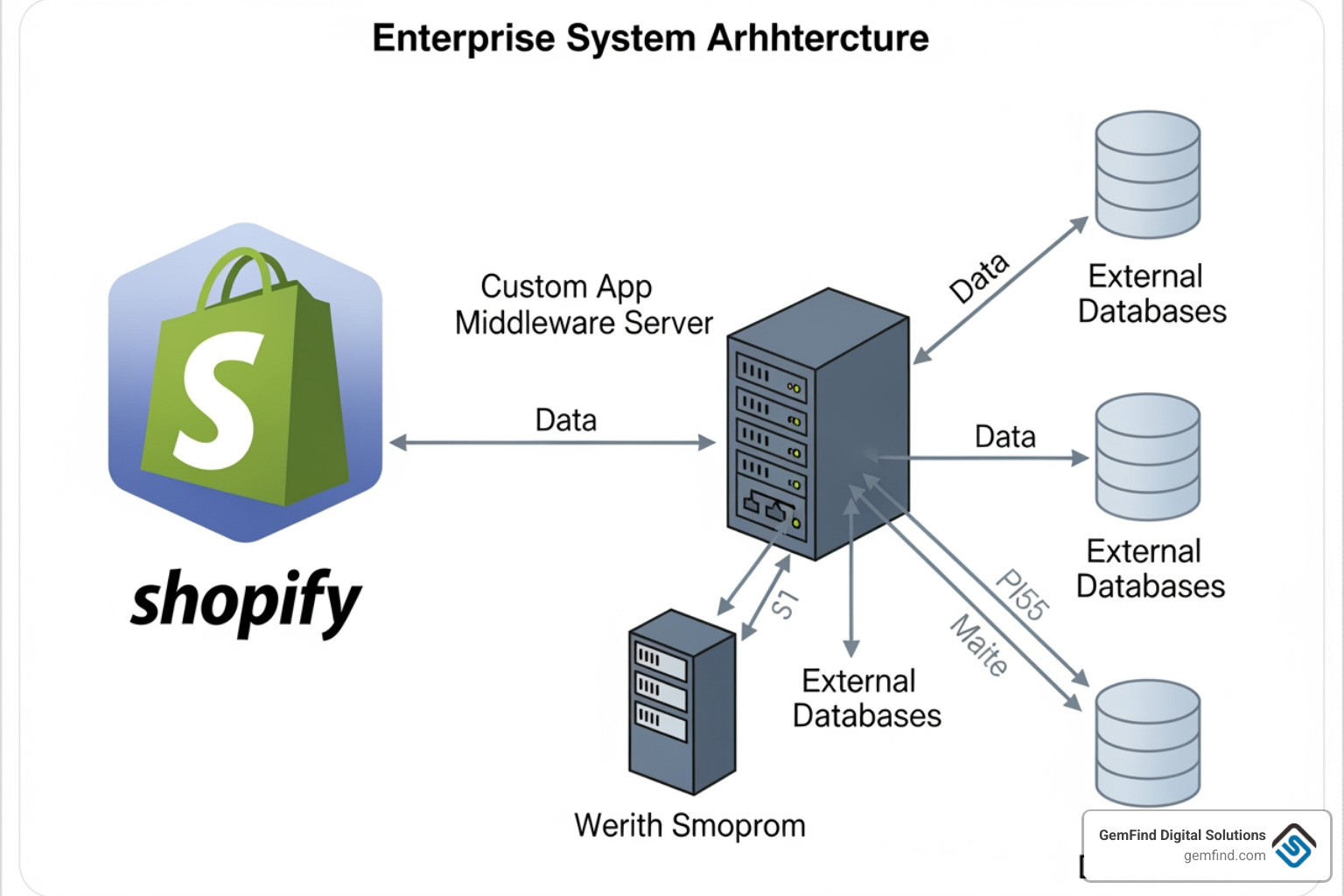
Building a custom app for an enterprise brand requires an API-first mindset. We don't just write code; we design a system that can handle the scale of a brand doing $100M+ in revenue. This usually involves a microservices architecture where the app is modular, making it easier to maintain and scale independently.
Building secure and maintainable Shopify Plus app development workflows
Modern Shopify Plus app development leverages the Shopify Dev Docs and tools like Shopify CLI 3.0. We use App Bridge, a JavaScript library that allows our custom apps to feel native within the Shopify Admin. Security is paramount; we implement "least privilege" scopes, ensuring the app only accesses the data it absolutely needs. For enterprise clients, we maintain full code ownership and use CI/CD (Continuous Integration/Continuous Deployment) pipelines to ensure every update is tested before it hits the live store.
Performance, scale, and API version management
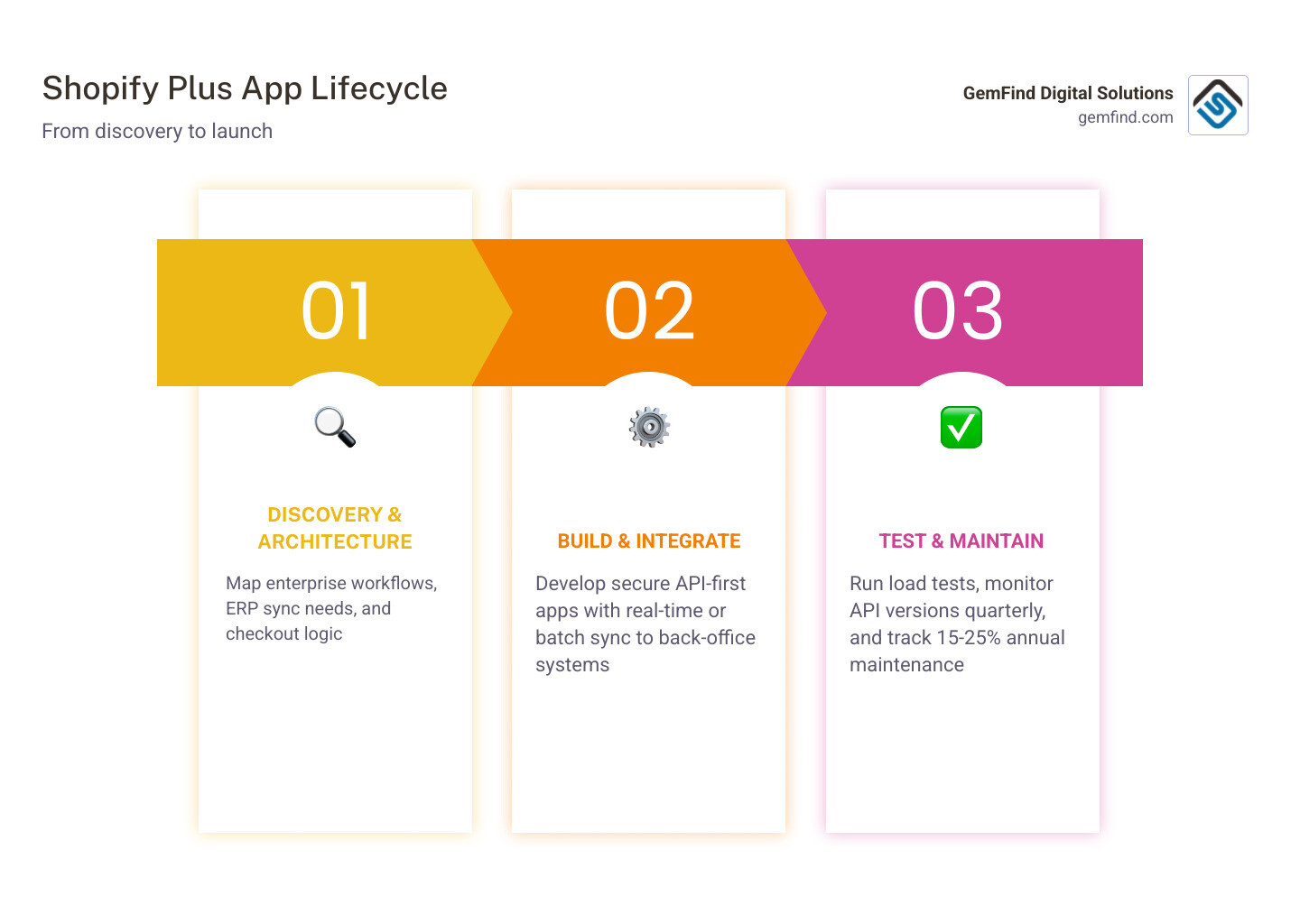
Shopify is a moving target—in a good way. New versions of Shopify APIs are released every three months. Each version is supported for exactly one year. This means your Shopify Plus app development team must have a maintenance plan to update the app at least once a year to avoid breaking changes.
We prioritize GraphQL over REST for its efficiency, especially for bulk operations. To ensure we don't hit rate limits during high-traffic events like Black Friday, we use intelligent caching and job queues. To maintain a high-quality experience, apps should not decrease storefront speed by more than 10 performance points.
Data models and failure handling for enterprise commerce
In enterprise commerce, we have to decide who "owns" the data. Usually, the ERP is the source of truth for inventory, while Shopify is the source of truth for orders. Our apps act as the intelligent bridge. We build in "dead-letter queues" to handle failed syncs—if the ERP goes down, the app stores the order data and retries automatically once the system is back online. This ensures 99.9% uptime targets are met.
Enterprise integrations: connecting Shopify Plus with ERP, CRM, PIM, and finance systems
For large brands, Shopify Plus is rarely a standalone island. It’s the "head" of a much larger body consisting of ERPs, CRMs, and Product Information Management (PIM) systems.

How to integrate Shopify Plus apps with back-office systems
We typically use a middleware layer for these integrations. This layer handles:
- Transformation Rules: Converting Shopify's data format into something your ERP understands.
- Field Mapping: Ensuring "SKU" in Shopify matches "Item_ID" in your back office.
- Conflict Resolution: Deciding what happens if a customer updates their address in the CRM and on Shopify at the same time.
Common enterprise integration patterns and examples
A classic example is the Customer 360 view. When a high-value jewelry client logs in, a custom app can pull their "wishlist" from the PIM and their "purchase history" from the physical store (via POS integration) to show personalized recommendations. We also handle complex tax calculations and payment reconciliations that standard apps often struggle with.
Multi-store and international considerations
Enterprise brands often utilize Shopify Plus multi store capabilities to manage different regions. A custom app can act as a "Global Governance" tool, allowing you to push pricing updates or new product descriptions to 10 different regional stores simultaneously. This is a massive time-saver for brands going through Shopify Plus migration services.
Security, compliance, and platform constraints every team must plan for
Security isn't a "feature"—it's a requirement. When building apps that handle sensitive customer data (PII), we must adhere to strict standards. Shopify has a Certified Technology Partner Program that sets the bar for what enterprise-grade apps should look like, including third-party security assessments.
Security and privacy requirements for custom apps handling sensitive data
Custom apps handling Level 2 PII (Personally Identifiable Information) require specific permissions and data retention policies. We implement:
- Encryption at rest and in transit.
- Secret rotation for API keys.
- Audit logs to track who accessed what data and when.
Partner programs, gated features, and development environment limitations
Some Plus features are "gated." As noted in the Shopify Community, developers often face hurdles accessing certain checkout features without official Partner status or specific expansion store permissions. We navigate these by using sandbox environments that mirror your live Plus environment as closely as possible.
Checkout and payment extensibility rules
Gone are the days of editing checkout.liquid. Modern Shopify Plus app development uses Checkout Extensibility. This allows us to build UI extensions and extensions for payments that are upgrade-safe. You get the customization you need without the fear of your checkout breaking during a platform update. This is a core part of any Shopify Plus checkout customization strategy.
Costs, timelines, testing, and selecting the right development partner
Building an enterprise app is an investment, not an expense. In 2026, the costs reflect the complexity of the modern commerce stack.
Typical cost ranges and delivery timelines in 2026
- Basic Custom Apps ($15k - $50k): Simple integrations or single-purpose automation tools. Timeline: 8–12 weeks.
- Intermediate Apps ($50k - $150k): Multi-system integrations (e.g., Shopify to ERP + CRM) with custom logic. Timeline: 3–5 months.
- Complex Enterprise Apps ($150k+): Headless middleware, global multi-store governance, or high-volume B2B portals. Timeline: 6+ months.
Note: Budget 15–25% of the initial cost for annual maintenance to cover Shopify API updates and hosting.
Testing and launch best practices for enterprise Shopify apps
We never "test in production." Our process includes:
- Unit & Integration Testing: Ensuring the code works.
- UAT (User Acceptance Testing): Ensuring the tool works for your team.
- Load Testing: Simulating thousands of concurrent users to ensure the app doesn't crash.
- Rollback Plan: Always having a way to revert to the previous state in seconds.
For more on keeping your store fast during these builds, see our guide on Shopify Plus performance optimization.
How to evaluate a Shopify Plus app development agency or partner
When selecting a partner, look for architecture evidence. Don't just ask if they can code; ask how they handle ERP failure scenarios or API rate limits. For brands in specialized niches, like jewelry, industry expertise is vital. At GemFind, we understand that a diamond isn't just a "SKU"—it's a complex data object with certifications and unique attributes that require specialized handling.
Frequently Asked Questions about Shopify Plus app development
How long does Shopify Plus app development usually take?
A standard custom app usually takes 8 to 16 weeks. This includes discovery, design, development, and a rigorous QA period. More complex projects involving multiple legacy systems can take 4 to 6 months.
What does Shopify Plus app development cost for enterprise brands?
While simple apps start around $15,000, most enterprise-grade integrations fall between $50,000 and $150,000. The main drivers of cost are the number of integration points and the complexity of the business logic.
Can custom apps replace multiple public apps on Shopify Plus?
Yes! In fact, consolidation is a primary reason brands choose custom development. We can often replace 3–5 separate public apps with one custom tool, reducing your monthly app fees, improving site speed, and ensuring your data stays in one place.
Conclusion
The move to Shopify Plus app development represents a shift from being a "store owner" to being a "technology leader." By building custom solutions, you remove the "glass ceiling" of the App Store and create a commerce engine that is perfectly tuned to your business goals.
Whether you are looking to integrate a complex ERP, launch a global multi-store strategy, or build a unique experience for Shopify Plus for jewelry brands, GemFind Digital Solutions has the 25+ years of expertise to guide you.
Ready to build your competitive advantage? Schedule a consultation with our Shopify Plus experts today


