



What You're Actually Paying for Shopify Plus Pricing Plans in 2026

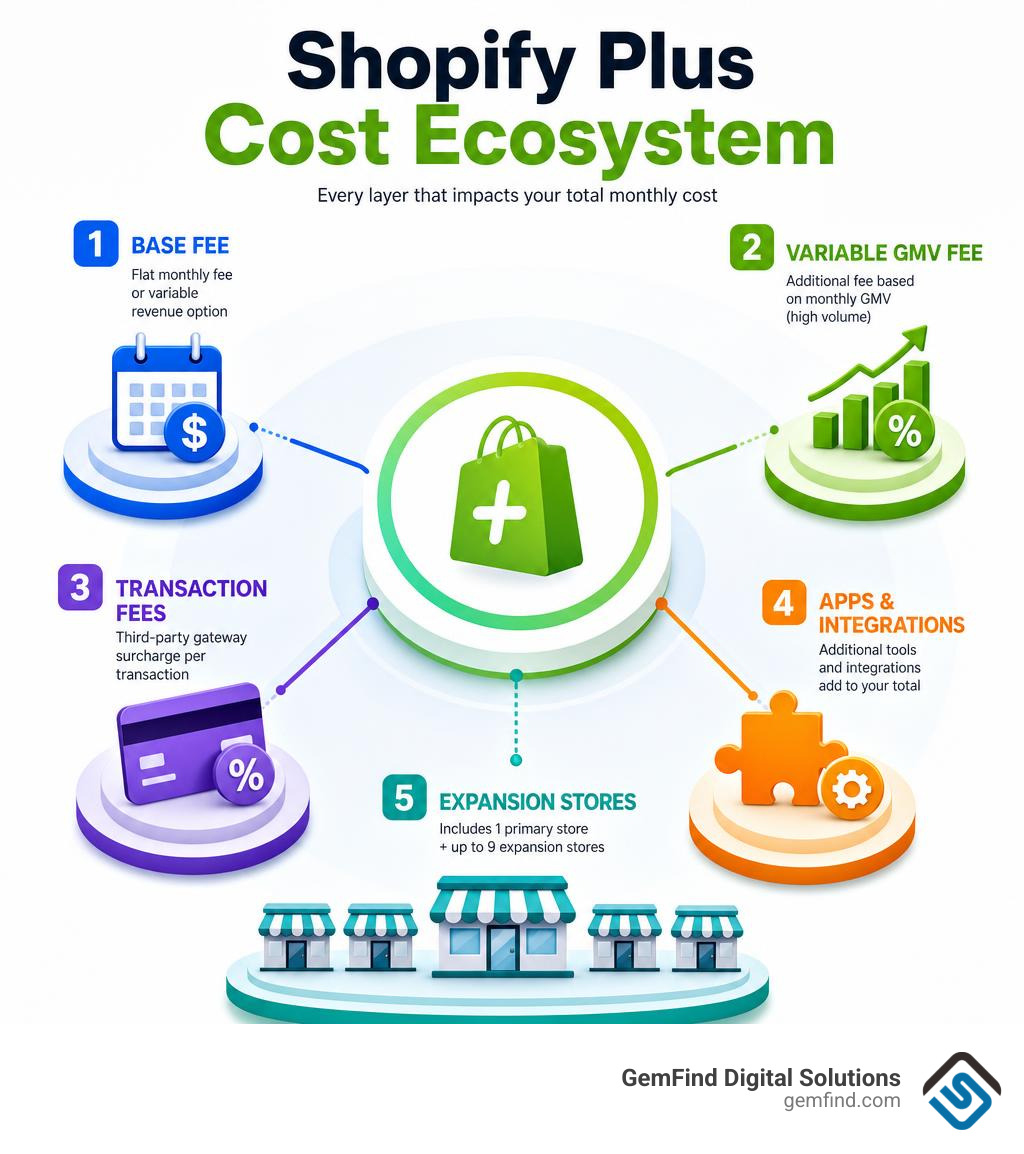
Shopify Plus pricing plans are structured around two main options: a flat monthly fee or a variable fee based on your revenue.
Here's a quick snapshot of what to expect:
| Plan Term | Base Monthly Fee | Variable Fee (high volume) | Third-Party Gateway Surcharge |
|---|---|---|---|
| 1-year term | $2,500/month | ~0.40% of GMV | 0.20% |
| 3-year term | $2,300/month | ~0.35% of GMV | 0.20% |
| Variable threshold | — | Kicks in ~$800K/month GMV | vs. 0.6% on Advanced |
Key facts at a glance:
- Includes 1 primary store + up to 9 expansion stores
- Unlimited staff accounts (vs. 15 on standard plans)
- Credit card processing via Shopify Payments: ~2.15% + $0.30 per transaction (US)
- Real monthly cost including apps and fees: typically $5,000–$25,000+
But the base fee is just the starting point. Apps, themes, custom development, and integrations can easily double or triple your total monthly spend — and that's what most merchants don't see coming.
Whether you're running a high-volume jewelry store or managing multiple storefronts, understanding every layer of cost is what separates a smart investment from a budget surprise.
I'm Anthony Arechiga, VP of Sales at GemFind Digital Solutions, where I've spent nearly two decades helping jewelry retailers navigate e-commerce technology decisions — including evaluating Shopify Plus pricing plans for brands ready to scale. In this guide, I'll break down every fee, flag the hidden costs, and help you decide if Plus is the right move for your business.
Simple guide to Shopify Plus pricing plans:
- Shopify Plus checkout customization
- Shopify Plus migration services
- Shopify Plus performance optimization
Decoding the Core Shopify Plus Pricing Plans in 2026

When we look at the big picture, the platform fee is often the most predictable and controllable cost component of your e-commerce platform. However, many growing brands get stuck trying to understand how Shopify transitions you from a standard subscription model to an enterprise-grade contract.
With standard Shopify plans, you pay a flat monthly rate regardless of your sales volume. With Shopify Plus, the licensing structure matures to match your growth. The platform utilizes a hybrid pricing model that starts as a flat fee but can transition into a variable, revenue-based fee once your store hits enterprise-level sales volume.
This model ensures that you only pay for the massive bandwidth and priority infrastructure you actually consume during peak periods. To get a complete view of how these elements balance out, we can look at the Shopify Plus pricing breakdown for 2026 to plan our annual budgets accurately.
The Base Monthly Subscription Fee for Shopify Plus Pricing Plans
The base cost to access the Shopify Plus ecosystem is determined by your commitment length. In May 2026, Shopify offers two primary term options:
- 3-Year Term: $2,300 USD per month. This option is highly recommended for established brands looking to secure the lowest possible platform overhead while planning their long-term growth.
- 1-Year Term: $2,500 USD per month. This shorter commitment offers more flexibility for rapidly evolving brands but carries a slightly higher monthly premium.
Depending on your business's legal location, these base rates will be billed in local currencies. For example, Canadian merchants typically see base pricing starting around $3,400 CAD per month on a 3-year term or $3,650 CAD per month on a 1-year term. In Japan, standard pricing is positioned around 368,000 JPY per month for the 3-year term and 398,000 JPY per month for the 1-year term.
While these subscription fees represent the "floor" of your platform costs, they guarantee 99.99% uptime and the ability to process over 10,000 checkouts per minute. For a deeper look at the foundational cost structures, you can read the Shopify Plus Pricing in 2026: Complete Cost Breakdown for Growing Brands.
Understanding the Variable Platform Fee and GMV Thresholds
Once your brand scales past a certain sales volume, Shopify Plus pricing plans shift from the flat monthly fee to a variable revenue-based model. This variable fee is calculated as a small percentage of your Gross Merchandise Volume (GMV) processed each month.
The threshold where this variable pricing kicks in is generally around $800,000 USD in monthly GMV (roughly $9.6 million annually). Below this threshold, you simply pay your flat $2,300 or $2,500 monthly subscription.
When your monthly GMV crosses the $800,000 mark, your monthly platform fee is calculated using the following variable percentages:
- 0.35% of GMV for merchants on a 3-year contract.
- 0.40% of GMV for merchants on a 1-year contract.
For instance, if your jewelry store generates $1,000,000 in GMV during a busy holiday month like December, and you are on a 3-year contract, your platform fee for that month would be $3,500 ($1,000,000 x 0.0035) instead of the $2,300 base fee.
The Fee Ceiling: For massive enterprise brands, there is also a maximum monthly platform fee ceiling of $40,000. This ceiling only becomes relevant once a Direct-to-Consumer (D2C) brand reaches approximately $11.43 million in monthly GMV, ensuring that ultra-high-volume brands can cap their platform licensing costs.
Transaction Fees and Payment Processing Rates

Beyond the platform license, transaction and payment processing fees are where high-volume merchants stand to save the most money — or lose it if they aren't careful. Because transaction fees are directly tied to every customer checkout, even a fractional percentage reduction can save your business thousands of dollars annually.
For high-end, high-ticket industries like fine jewelry, optimizing these transaction paths is a critical step in preserving your profit margins. To see how optimizing your checkout flow impacts conversions, read our guide on Shopify Plus Checkout Customization.
Credit Card Processing Rates with Shopify Payments
If you use Shopify Payments as your primary payment processor, you do not pay any additional transaction fees to Shopify. Instead, you only pay highly competitive credit card processing rates.
In the United States, the standard credit card processing rates for Shopify Plus merchants are:
- Domestic Visa & Mastercard: 2.15% + $0.30 per transaction.
- American Express (Amex): 3.15% + $0.30 per transaction.
These rates are significantly lower than standard Shopify plans (which charge up to 2.9% + $0.30 on the Basic plan). For international transactions and cross-border sales, currency conversion fees and regional card rates will apply depending on the customer's country.
Using Shopify Payments also unlocks local payment methods like Shop Pay, which has been shown to convert up to 15% better than other checkouts. To review the official list of payment features and regional processing details directly from the source, check out the Shopify Plus pricing page.
Surcharges for Third-Party Payment Gateways
We know that some businesses, particularly those with complex multi-channel setups or existing merchant accounts, prefer to use third-party payment gateways (like Authorize.Net or custom merchant processors). If you choose not to use Shopify Payments, Shopify charges a small transaction fee surcharge to cover the security and infrastructure costs of routing transactions through external gateways.
On Shopify Plus, this third-party gateway surcharge is only 0.20% per transaction.
To put this in perspective, let's look at how this compares to standard Shopify plans:
- Basic Plan: 2.0% third-party gateway fee
- Shopify Plan: 1.0% third-party gateway fee
- Advanced Plan: 0.6% third-party gateway fee
- Shopify Plus: 0.2% third-party gateway fee
This difference represents a massive cost savings for high-volume stores. For example, if your store processes $1,000,000 in monthly GMV through a third-party gateway, you would pay $6,000 in surcharges on the Advanced plan. On Shopify Plus, you would only pay $2,000. That single operational optimization saves your brand $4,000 a month — more than offsetting the base cost of the Plus subscription itself!
Hidden and Additional Costs Beyond the Base Subscription
When mapping out your total cost of ownership (TCO), it is a mistake to only look at the base subscription fee. In our experience, the platform fee typically represents only 20% to 40% of a merchant's true monthly e-commerce spend.
To run a highly competitive, fast-loading, and customized online store, you must budget for external tools, design assets, and deep backend integrations. To understand how to keep your site running at peak efficiency while managing these added elements, explore our tips on Shopify Plus Performance Optimization.
App Stack and Premium Theme Expenses
No enterprise store runs on out-of-the-box features alone. The average Shopify Plus merchant runs between 15 and 20 apps to handle specialized tasks like advanced subscription models, loyalty programs, and personalized email marketing.
- App Stack Costs: While basic apps might cost $9 to $49 a month, enterprise-grade apps (such as advanced search tools, product customizers, or loyalty platforms) often charge premium rates on Plus. A typical Shopify Plus merchant should budget between $1,000 and $3,000+ per month for their total app stack.
- Premium Themes: A high-quality premium theme from the Shopify Theme Store typically costs a one-time fee of $250 to $400. While this is a minor upfront cost, most enterprise brands will heavily customize these themes using custom liquid and CSS to match their unique brand identity.
- API Limits: Fortunately, Shopify Plus supports up to 500% higher API call limits compared to standard plans. This means your apps and custom integrations can sync data ten times faster without bottlenecking your storefront's loading speeds.
Multi-Store Expansion and Localization Costs
For brands expanding globally or operating distinct wholesale and retail storefronts, multi-store management is incredibly efficient on Shopify Plus.
- 9 Free Expansion Stores: Your Shopify Plus subscription includes your primary storefront plus up to 9 expansion stores at no additional licensing cost. These expansion stores can be used for internationalization (e.g., localized languages, content, and currencies for European or Asian markets) or to run a dedicated B2B channel. For a strategic breakdown of how to structure these storefronts, see our guide on Shopify Plus Multi Store.
- Additional Stores: If your brand requires more than 10 total storefronts, you can easily add more expansion stores for approximately $300 USD per month each.
- Localization: While the licensing for these expansion stores is included, keep in mind that you may still need to budget for localized marketing, regional translation apps, and separate inventory management tools for each market.
Comparing Shopify Plus to Lower-Tier Plans
To help you visualize the operational differences between Shopify's top tier and its standard plans, we have compiled a direct comparison of the key features and limits that impact scaling brands.
| Feature / Limit | Shopify Basic | Shopify (Grow) | Shopify Advanced | Shopify Plus |
|---|---|---|---|---|
| Monthly Subscription | ~$29 - $39 / mo | ~$105 / mo | ~$399 / mo | $2,300 - $2,500 / mo |
| Third-Party Gateway Surcharge | 2.0% | 1.0% | 0.6% | 0.20% |
| Staff Accounts | 2 | 5 | 15 | Unlimited |
| Inventory Locations | Up to 10 | Up to 10 | Up to 10 | Up to 200 |
| API Rate Limits | Standard | Standard | Double Standard | 10x Standard |
| Checkout Customization | None (Standard) | None (Standard) | None (Standard) | Deep Extensibility |
| Native B2B / Wholesale | No | No | No | Yes (Included) |
If you are currently on a standard plan and want to map out your transition, Shopify provides an official step-by-step walkthrough via Shopify Plus vs Shopify: How to Upgrade - Shopify Canada.
When Does Upgrading to Shopify Plus Pricing Plans Make Financial Sense?
Many growing brands generating between $50,000 and $500,000 in monthly sales sit in a "gray zone" where upgrading to Plus is a strategic question rather than an obvious financial necessity. Upgrading too early can drain valuable capital that could be used for marketing, while upgrading too late leaves money on the table in the form of high transaction fees and operational inefficiencies.
Generally, the transition to Shopify Plus pricing plans makes clear financial sense when:
- Your transaction fee savings offset the subscription cost: On transaction fees alone, the break-even point sits around $475,000 to $500,000 per month in sales volume if you are using a third-party gateway. At $1,000,000 in monthly sales, the Advanced plan would cost you significantly more in transaction surcharges than the flat-rate Shopify Plus license.
- You are running multiple brands or international stores: If you are paying for three or four separate Shopify Advanced subscriptions to support localized international sites, consolidating them under a single Shopify Plus agreement immediately reduces your software overhead.
- You require advanced operational automation: If your team is spending dozens of hours each week manually processing wholesale orders, managing complex inventory across multiple warehouses, or routing data to an external ERP, the native automation tools in Plus (like Shopify Flow and Launchpad) will quickly pay for themselves in saved labor costs.
To explore this decision framework through real-world merchant data, read the analysis in Is Shopify Plus Worth It for Growing Stores? (2026) | Talk Shop.
Frequently Asked Questions about Shopify Plus Costs
What is included in the Shopify Plus base monthly fee?
The base monthly fee of $2,300 or $2,500 includes full access to Shopify's enterprise-grade infrastructure. This includes unlimited staff accounts, up to 200 physical inventory locations, and 10 total online stores (1 main store + 9 expansion stores).
Additionally, you get exclusive access to advanced native tools like Shopify Flow (for workflow automation), Launchpad (for scheduling flash sales and product releases), Shopify Audiences (to lower customer acquisition costs on major ad networks), and native B2B functionality that allows you to sell wholesale and retail from a single platform. For a detailed breakdown of core features across all tiers, consult the Plan features - Shopify Help Center.
Can you negotiate Shopify Plus contract terms?
Yes, contract terms can often be negotiated during your initial sales discussions, particularly if you are committing to a 3-year term. Merchants can sometimes negotiate the specific GMV threshold at which the variable platform fee kicks in, or secure bundled discounts on premier Shopify-backed services.
It is always best to work with an experienced Shopify Partner who can help you structure your contract negotiations to align with your projected growth phases.
How much does it cost to migrate to Shopify Plus?
The cost of migrating to Shopify Plus varies widely based on your current platform and the complexity of your data. If you are upgrading from Shopify Advanced, the migration is incredibly smooth and cost-efficient, typically ranging from $10,000 to $30,000 for theme adjustments, checkout extensibility setup, and app audits.
However, migrating from legacy platforms like Magento or WooCommerce to Shopify Plus typically ranges from $50,000 to $250,000+ because it requires extensive database migration, custom API integrations, and a complete rebuild of your frontend design. To learn more about how we handle this process seamlessly for retail brands, check out our Shopify Plus Migration Services.
Conclusion
Navigating Shopify Plus pricing plans doesn't have to be overwhelming. When you break down the numbers, the platform offers an incredibly cost-effective, scalable, and powerful solution for high-growth brands. By reducing transaction fees, unlocking native B2B tools, and providing the infrastructure to support millions of dollars in sales, Shopify Plus frequently delivers a rapid return on investment.
At GemFind Digital Solutions, we bring over 25 years of specialized jewelry industry expertise to the table. As a certified Shopify Partner, we don't just build beautiful websites — we create integrated digital ecosystems. Whether you need to connect your online storefront to your in-store Edge POS system, optimize your high-ticket checkout flow, or launch a dedicated wholesale channel, we design custom solutions tailored to your unique business needs.
To see how we help luxury and retail brands scale effortlessly, read our guide on Shopify Plus for Jewelry Brands.
Ready to take your e-commerce operations to the next level without the budgeting headaches? Get in touch with our team of experts on our GemFind Shopify Plus Page today, and let's map out your path to scalable growth!


