



Why Virtual Try-On Apps Matter for Digital Retail
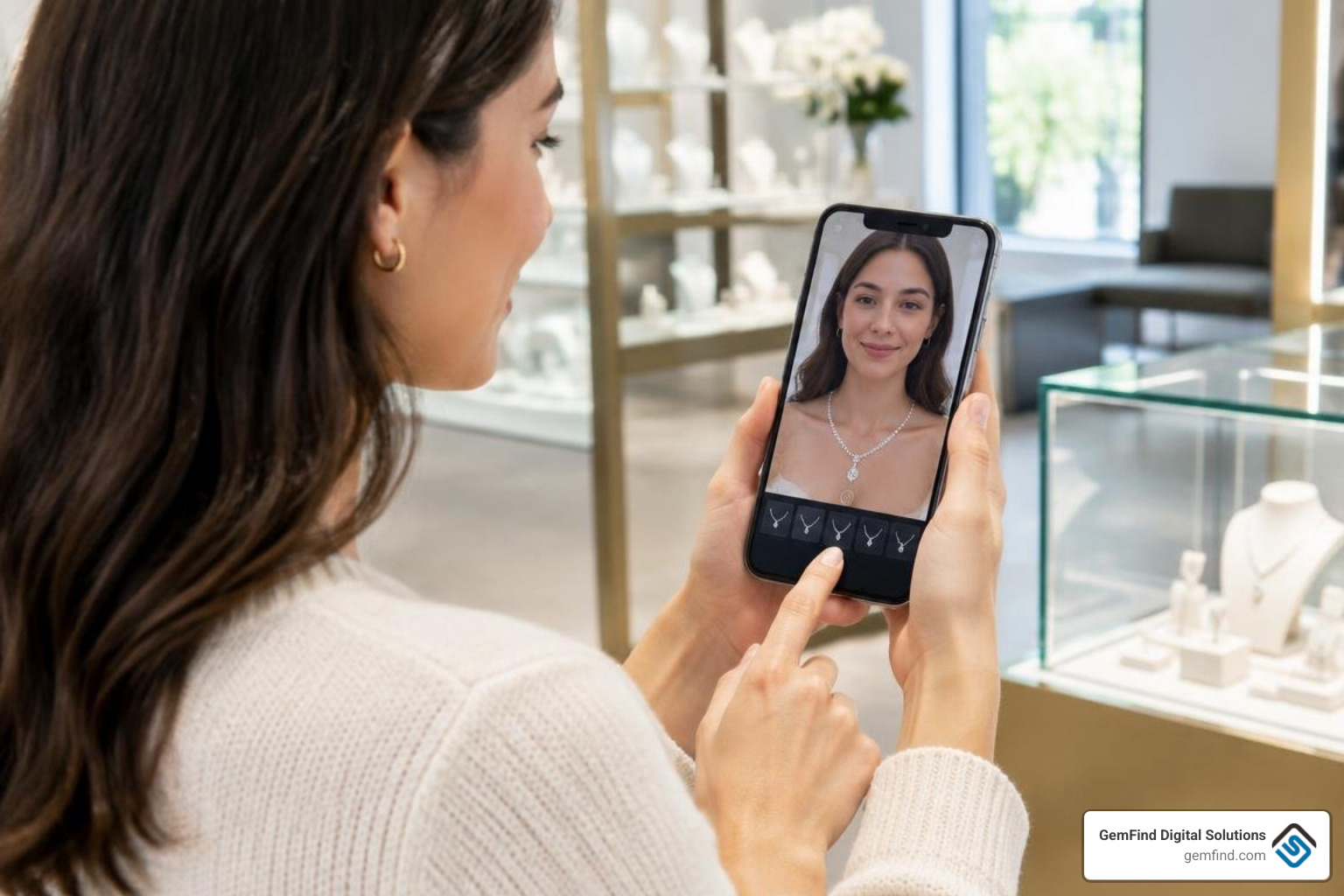
Virtual try-on apps let shoppers preview products on their own image or through a live camera before they buy. The best options use AI, augmented reality, or both to show clothing, eyewear, jewelry, and other accessories with less guesswork. For a jewelry retailer, this can mean letting a visitor see how a ring, necklace, or pair of earrings may look before they commit to a purchase.
This guide compares the leading types of virtual try-on apps and what to look for, including:
- Photo-upload tools that create a realistic preview in seconds.
- Live camera tools that track movement in real time.
- Store-ready platforms that connect to e-commerce product pages.
The opportunity is clear: online apparel return rates can reach 30%, often because customers are unsure about fit or appearance. Virtual fitting will not replace touching a fabric or trying on a ring in person, but it can build confidence, keep shoppers engaged longer, and help retailers reduce avoidable returns.
I am Anthony Arechiga, Vice President of Sales at GemFind Digital Solutions, where I have helped jewelry businesses grow through e-commerce, web design, and digital marketing since 2007. My experience with virtual try-on apps is grounded in helping retailers evaluate the digital tools that make high-consideration jewelry purchases easier online.
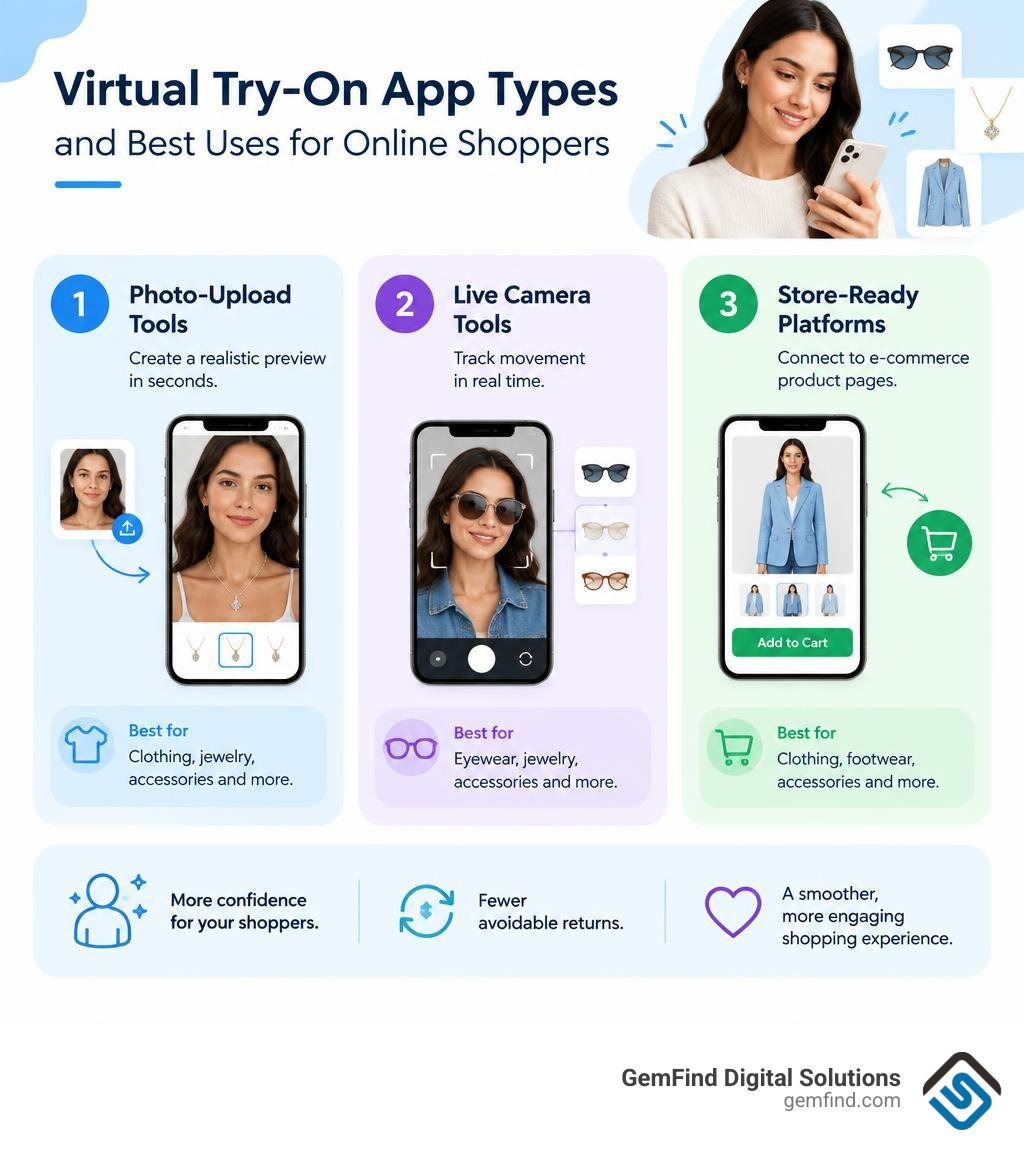
Virtual try-on apps terms simplified:
How Virtual Try-On Apps Transform the Digital Shopping Experience
The fundamental friction in e-commerce has always been the inability to try before buying. For decades, digital retail relied on static product photography displayed on studio models whose proportions rarely matched those of the shopper browsing the site. Modern virtual try-on technology bridges this gap using advanced computer vision, generative diffusion models, and real-time physics simulations.
Instead of generic 2D sticker overlays, modern AI models map the precise geometry of garments and luxury accessories directly onto a shopper's personal image or video feed. Contemporary generative AI pipelines achieve a rapid 10–15s processing time, rendering intricate textures, lighting falloffs, and body contours with remarkable fidelity. Shoppers can see how a piece drapes over their natural silhouette while maintaining an impressive 98% drape accuracy and 99% color match across various display settings.
Understanding how web applications can help your UX allows merchants to integrate interactive try-on experiences that load seamlessly, eliminating checkout hesitations without introducing interface lag.
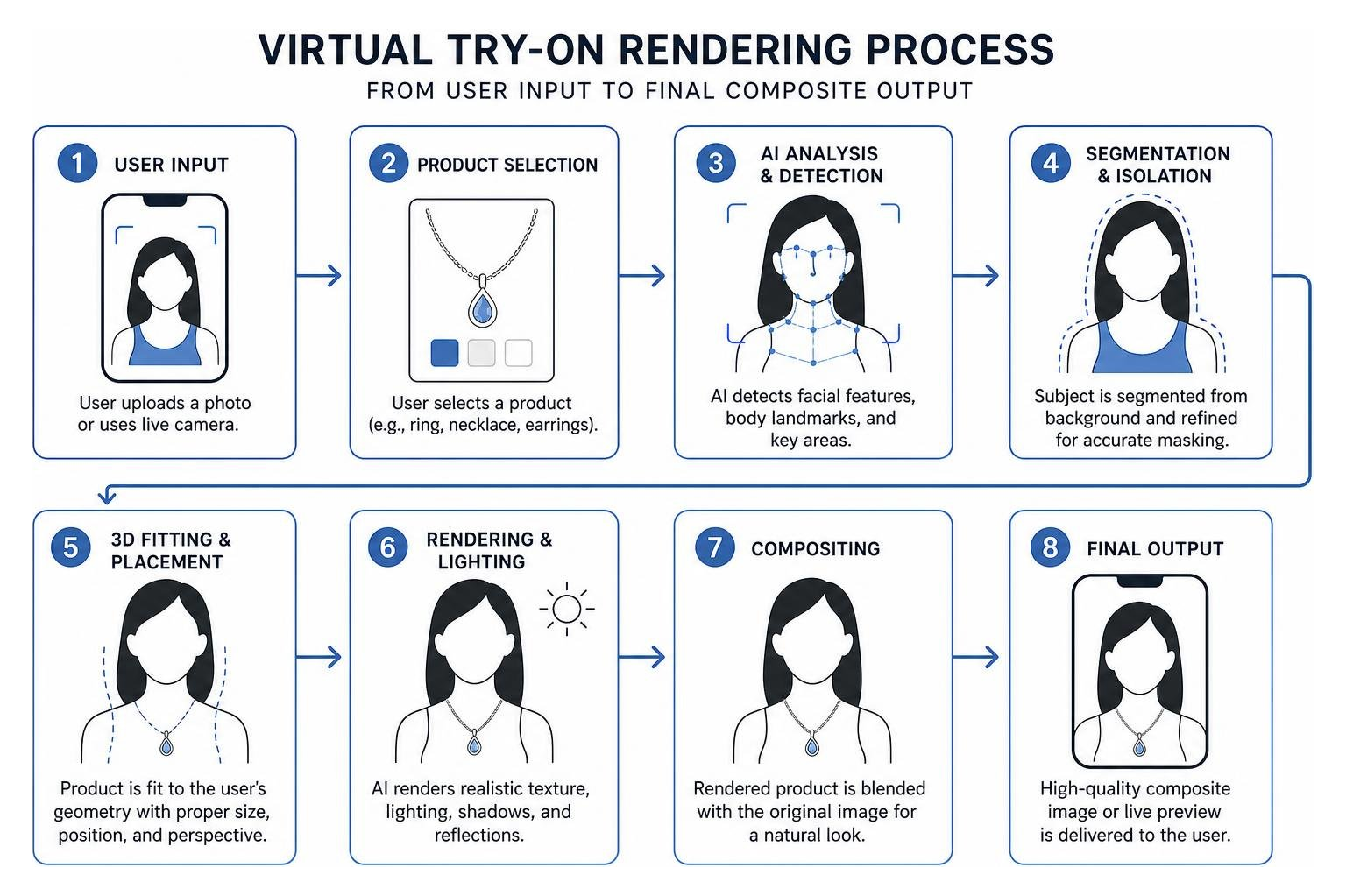
Photo-Upload vs. Live Video Virtual Try-On Apps
The market for virtual fitting tools splits into two primary modalities: static photo-upload engines and live video streams.
- Photo-Upload Solutions: A shopper uploads a single well-lit full-body image or selfie. The system uses deep diffusion algorithms to segment the user's silhouette, isolate background elements, and generate a photorealistic composite image of the garment or piece worn naturally. These tools excel in this space, delivering ultra-high-resolution static previews.
- Live Video Solutions: Using real-time computer vision and tracking models, live engines process video feeds frame-by-frame. These platforms eliminate the need to upload a still photo by tracking natural body movements, showing how fabric shifts or how a ring glints as a customer turns their hand.
Live sessions encourage deep product exploration, resulting in a 7.8 min average time in a session as consumers fluidly test multiple styles in sequence.
Fitting and Rendering Accuracy in Virtual Try-On Apps
Precision is the primary requirement for shopper confidence. Early iterations of virtual fitting software suffered from floaty, misaligned assets that looked pasted onto the screen. Modern AI platforms employ skeletal landmark tracking and multi-point contour analysis to calculate proportional scale relative to the user's distance from the lens.
| Feature / Metric | Photo-Based AI Try-On | Live AR Video Stream |
|---|---|---|
| Typical Latency | 10–15s Processing time | Real-time (~1.5s initial load) |
| Drape Accuracy | 98% Drape Accuracy | Dynamic physics simulation |
| Color Fidelity | 99% Color match | Real-time environmental reflection |
| Primary Input | Single static photo / selfie | Continuous camera video stream |
| Best Used For | High-res lookbooks, tailored apparel | Eyewear, jewelry, rapid browsing |
By accounting for ambient lighting, shadow distribution, and skin tone preservation, modern virtual try-on solutions give shoppers a true-to-life visualization of fit and texture before they proceed to checkout.
Key Benefits and Product Categories in Modern Virtual Fitting
Traditional retail benchmarks reveal that roughly 30% of online clothing gets returned, creating severe inventory bottlenecks and massive reverse logistics expenses. Virtual try-on apps directly mitigate this issue. Retailers implementing robust try-on experiences consistently record 20–35% fewer returns, with several specialized categories reporting up to 50% fewer returns overall.
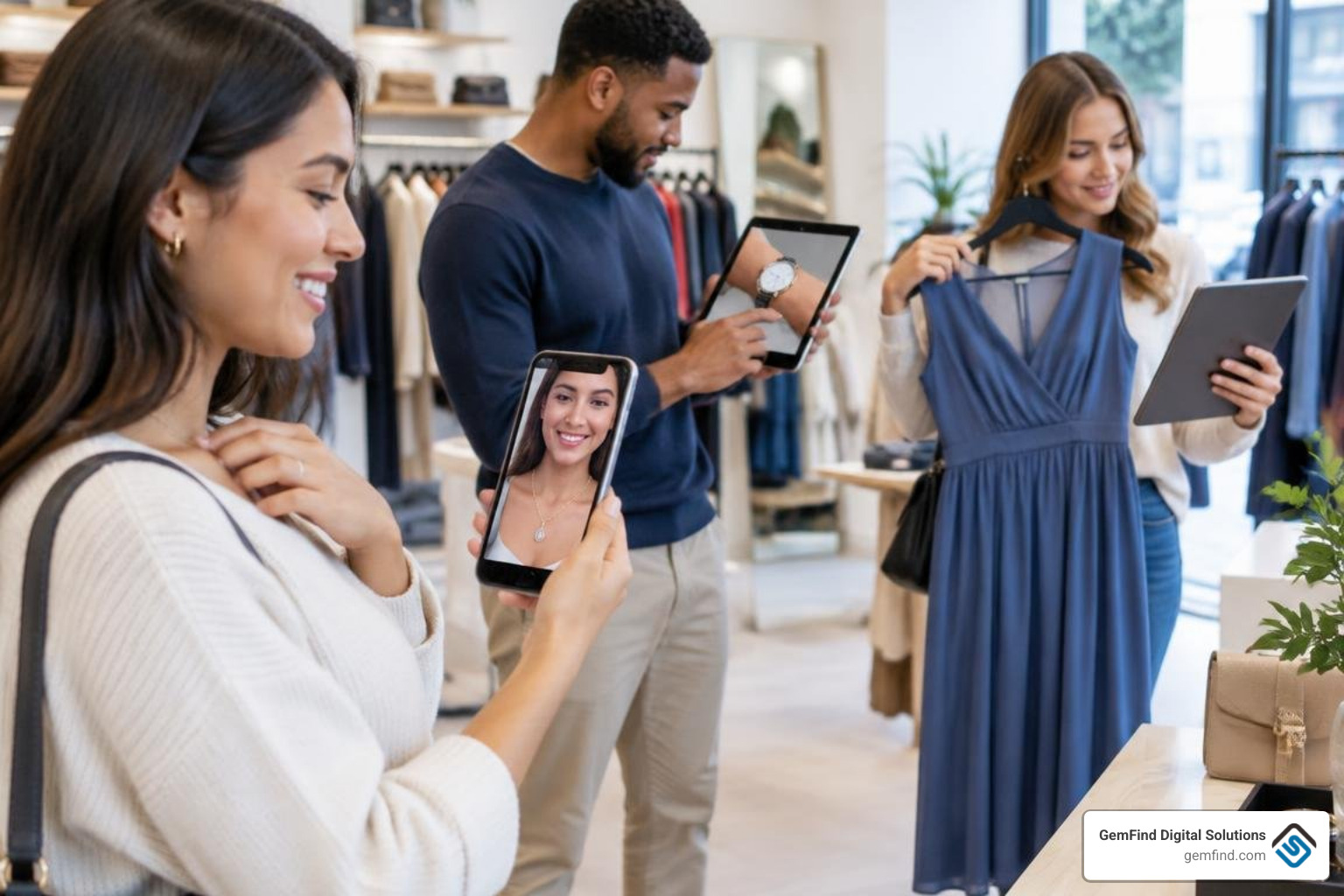
Beyond risk reduction, virtual fitting serves as a powerful revenue driver:
- Conversion Acceleration: Retailers observe up to 65% conversion lift when try-on capabilities are active on product pages.
- Cart Intent: Approximately 1 in 9 shoppers who tried a garment on went on to add to cart during that same visit.
- Deeper Catalog Discovery: Engaging interfaces encourage style discovery, with 3 in 4 shoppers going past the first item they came for to try on secondary recommendations.
Deploying specialized interactive tools that help jewelers sell more jewelry online ensures that high-intent visitors remain engaged throughout their decision-making process.
Apparel, Eyewear, and Footwear Solutions
Apparel remains the largest digital category utilizing virtual fitting rooms. Modern platforms allow multi-garment layering, letting users test how jackets sit over blouses, or how specific trouser cuts complement footwear. Comprehensive virtual try-on platforms support everything from tops and hats to hairstyles, eyewear, and temporary body art.
Because these tools account for fabric elasticity and silhouette drape, shoppers no longer need to order multiple sizes with the intention of returning the ones that fail to fit—a habit that previously inflated merchant logistics costs.
High-Value Luxury and Jewelry Applications
Luxury items demand a higher degree of visual accuracy than casual apparel. When a customer considers a diamond engagement ring or a sapphire necklace, a flat overlay will not suffice; the digital asset must accurately convey scale, metal sheen, diamond brilliance, and the physical contour of the wearer's hand.

Implementing dedicated augmented reality jewelry tools allows retailers to showcase genuine light refraction across precious stones and metallic luster across platinum, yellow gold, and rose gold settings. Utilizing an augmented reality ring try-on guide 2026 framework ensures that finger-tracking algorithms preserve natural knuckle alignment and ring proportions, transforming online luxury browsing into a confident buying experience.
Implementation, Privacy, and Technological Limitations
Deploying virtual fitting solutions requires balancing seamless front-end user experience with strict data protection standards. Because virtual try-on involves biometric elements—such as facial features, hand contours, and body measurements—consumer trust hinges entirely on transparent data governance.
Technical Integration and Retailer Pricing Models
Modern virtual try-on technology integrates into e-commerce ecosystems through lightweight software development kits (SDKs), JavaScript widgets, and custom APIs. Whether building on major e-commerce platforms or enterprise headless stacks, storefronts can add try-on buttons directly beneath the primary product gallery.
For high-end merchants, combining AR widgets directly with in-store systems via jewelry AR POS integration allows sales associates to present endless digital catalogs on showroom tablets. Custom jewelry ecommerce websites can implement these solutions through tiered SaaS models, ranging from starter subscriptions with monthly try-on quotas to enterprise licenses handling tens of thousands of real-time rendering requests daily.
Data Security and Image Privacy Standards
To maintain consumer confidence and adhere to strict privacy laws like GDPR, top-tier try-on applications adopt privacy-by-design architectures:
- Zero Training Retention: User images and biometric data are never used to train generalized AI models.
- Transient Sessions: Real-time camera feeds are processed in device memory and purged immediately upon session completion.
- End-to-End Encryption: Uploaded photos are secured during transit and storage, with consumers retaining full control to delete their assets instantly.
While the visual realism of virtual fitting has improved dramatically, merchants must remember that digital try-on cannot replicate tactile feedback, such as fabric weight, breathability, or ring band comfort. Combining try-on tools with detailed sizing charts provides the most balanced customer experience.
Frequently Asked Questions About Virtual Try-On Technology
Can virtual try-on apps work with any online store?
Yes. While native store widgets provide the most seamless experience, universal consumer apps and browser extensions allow shoppers to paste any product image URL or upload garment photos directly. Retailers can also implement lightweight API connectors and deep-linking buttons that allow shoppers on native mobile apps to launch instant try-on sessions directly from their product detail pages.
How do virtual try-on apps help reduce product returns for retailers?
Virtual try-on tools address the leading root cause of apparel and luxury returns: the gap between shopper expectation and reality. By allowing customers to view photorealistic drape, true color matching, and accurate scale on their own body contours before buying, merchants consistently achieve 20–35% fewer returns, helping cut return rates in half for highly tailored product categories.
Is virtual try-on completely accurate to real-life garment fit?
Modern AI rendering achieves up to 98% drape accuracy and 99% color fidelity under standard lighting conditions. However, virtual fitting is a visual preview rather than a physical tailoring guarantee. It accurately shows how a piece sits, aligns, and coordinates with skin tones, but it cannot communicate fabric texture, stretch resistance, or tactile weight. Pairing try-on tools with precise size charts yields the highest customer satisfaction.
Conclusion: The Future of Virtual Fitting in Digital Commerce
Virtual try-on apps have transitioned from experimental novelty tools into essential conversion engines for modern digital storefronts. As visual fidelity reaches photorealistic levels and processing times drop to seconds, shoppers increasingly expect to preview items on their own bodies before completing a checkout.
At GemFind Digital Solutions, we have spent over 25 years helping jewelry retailers navigate technological shifts with tailored web design, seamless POS integrations, and strategic growth campaigns. If you are ready to modernize your storefront and boost conversion rates, explore our expert digital marketing solutions for retailers to turn your digital showroom into an engaging, high-performing sales channel.


