



What Is Augmented Reality Ring Try-On (And How Does It Work)?

Augmented reality ring try-on is a technology that lets shoppers virtually place a digital ring on their finger — using a smartphone camera, uploaded hand photo, or a model hand — without visiting a store.
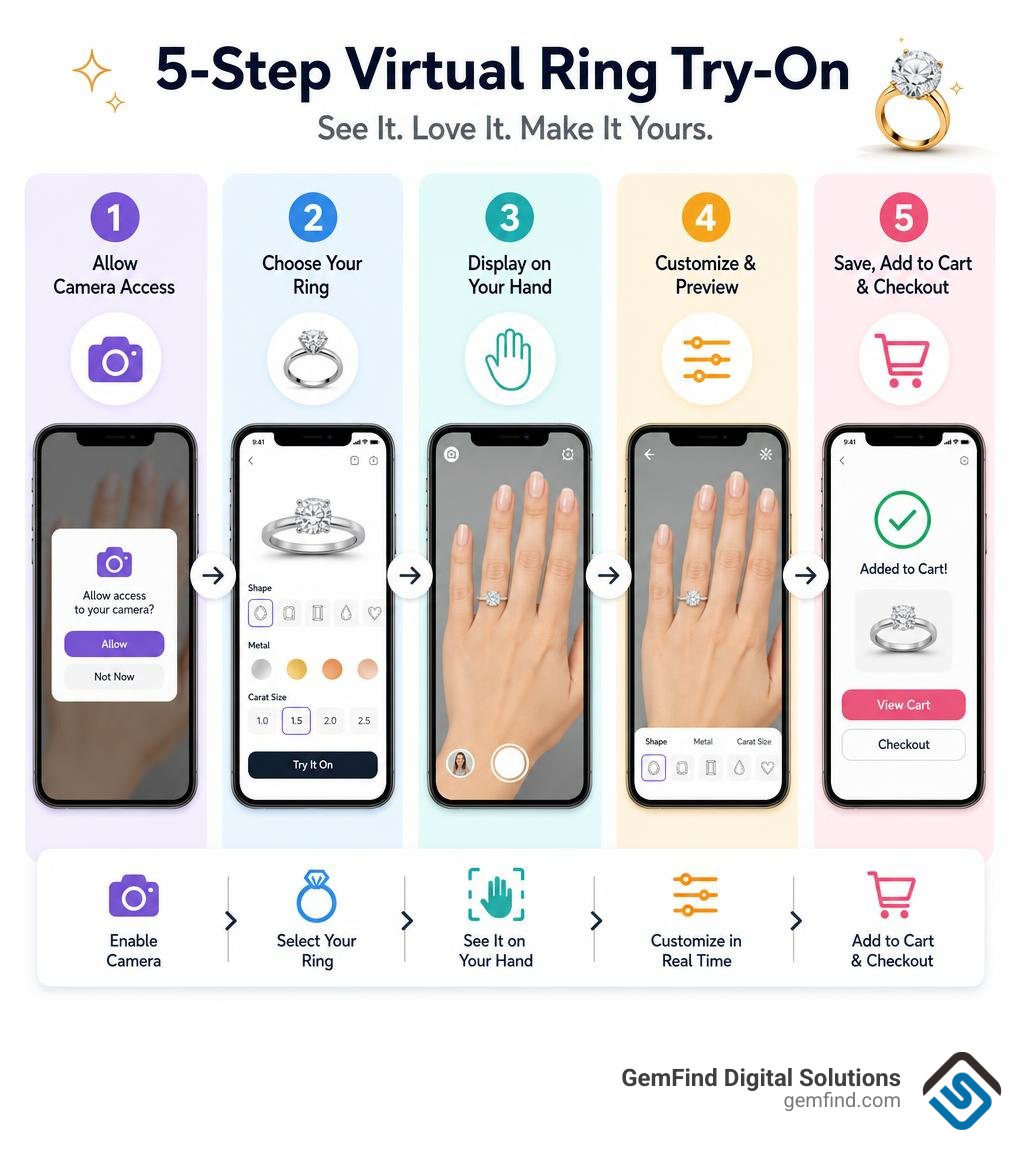
Here's how it works in a nutshell:
- Visit a jeweler's website or app on your phone
- Tap the "Virtual Try-On" button on a ring product page
- Upload a photo of your hand or use your live camera
- The tool overlays a realistic 3D ring onto your finger
- Adjust diamond shape, carat size, and metal type in real time
- Save, share, or add to cart
That's it. No appointment. No travel. No pressure.
This matters more than ever for jewelry store owners. The global jewelry e-commerce market is on track to reach $31.9 billion, and customers increasingly expect to visualize products before they buy. In fact, 35% of shoppers say they would buy more online if virtual try-on were available — and brands using AR are 41% more likely to be viewed by customers.
For engagement rings especially, the stakes are high. Rings are personal, emotional, and expensive — and a 15% return rate due to poor sizing is a real cost of doing business without better visualization tools.
I'm Anthony Arechiga, VP of Sales at GemFind Digital Solutions, and I've spent nearly two decades helping jewelry retailers grow their online presence — including guiding brands through the adoption of augmented reality ring try-on technology. In this guide, I'll walk you through exactly how to use it to drive more confident buyers and fewer returns.
Key augmented reality ring tryon vocabulary:
Why You Should Use Augmented Reality Ring Tryon for Your Engagement
Shopping for an engagement ring can feel a bit like performing open-heart surgery in front of a live studio audience. There is a lot of pressure, high emotional stakes, and a nagging fear of making the wrong choice. Traditionally, this meant spending weekends driving from showroom to showroom, squinting under harsh fluorescent lighting, and dealing with sales pitches.
With an augmented reality ring tryon experience, that entire dynamic shifts.
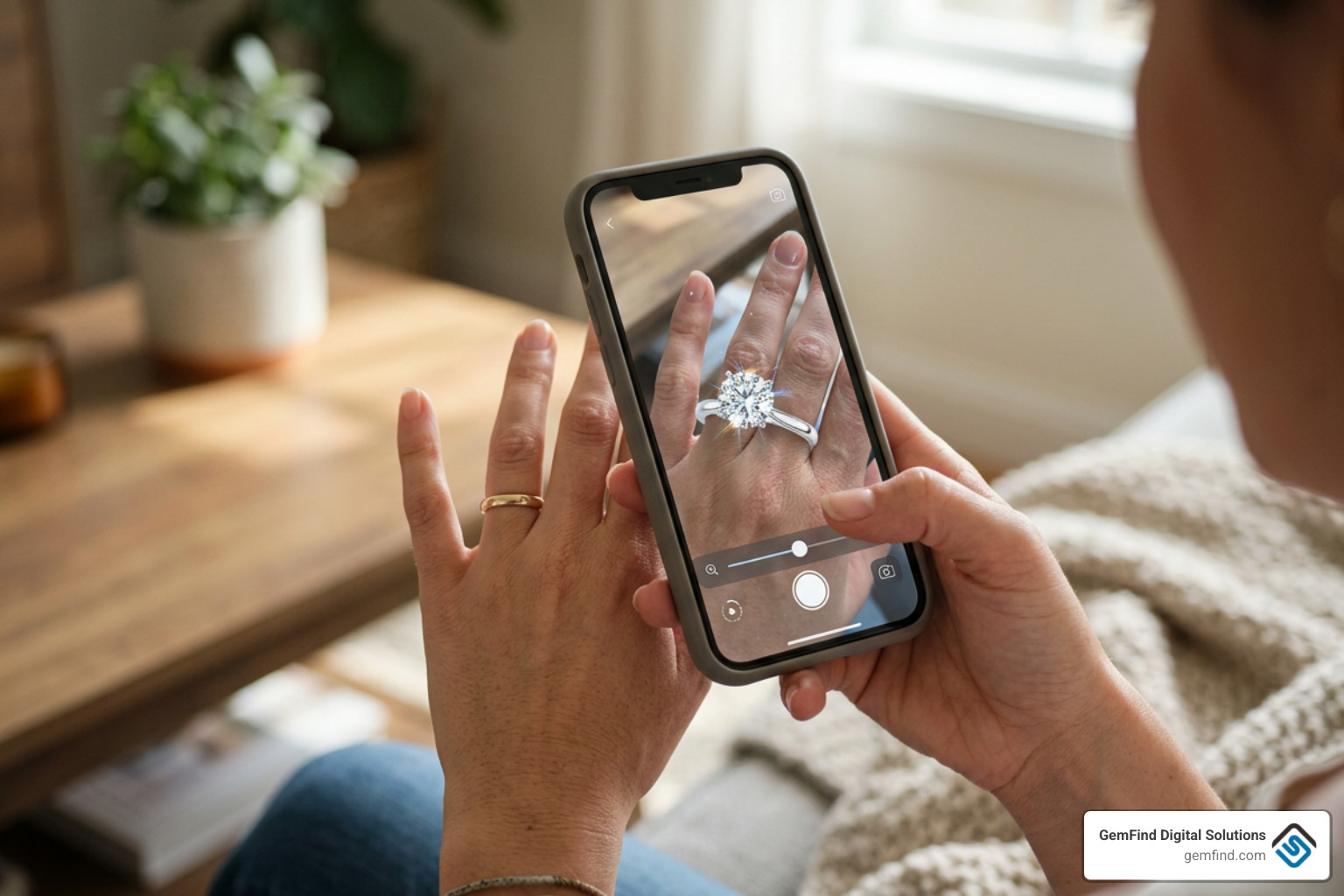
First and foremost, virtual try-on tools supercharge purchase confidence. Instead of trying to imagine how a 2-carat pear-shaped diamond will look on a petite finger, you can actually see it. This visual clarity is why jewelry retailers utilizing AR try-on report up to a 300% increase in sales and a staggering 1000% increase in add-to-cart rates. When customers can see exactly how the ring sits on their hand, the hesitation to click "buy" evaporates.
Furthermore, these tools are a massive win for reducing return rates. Online jewelry retailers face an average 15% return rate on rings, primarily due to incorrect sizing or unexpected styling mismatches. Because every fifth ring sent back for resizing often has to be completely recycled or melted down, this is an expensive logistical nightmare. AR virtual try-on tools significantly mitigate this risk by enabling precise sizing and realistic styling previews from the comfort of home.
This technology is particularly vital for capturing Gen Z consumers. As the oldest members of this demographic navigate their twenties and enter prime marriage age in 2026, their shopping habits are defining the market. Gen Z expects frictionless, tech-forward experiences. They do not want to feel pressured in a physical showroom; they want to design, customize, and experiment on their smartphones first.
To explore how these digital experiences are reshaping the entire jewelry landscape, check out our Virtual Try-On Jewelry Complete Guide and our comprehensive Try-On Jewellery Complete Guide.
How the Virtual Ring Try-On Process Works
The beauty of a modern virtual ring try-on lies in its simplicity for the end user. Jewelers typically offer three distinct ways for customers to visualize their dream rings:
- Live Camera Mode: This is the gold standard of AR. By utilizing your smartphone's camera, the software detects your hand in real time. As you move your fingers, rotate your wrist, or wiggle your hand to see how the diamond catches the "light," the digital ring moves dynamically with you.
- Uploaded Hand Photo: If you want to take your time or try on designs in a low-connectivity area, you can snap a clean, top-down photo of your hand and upload it. The software then superimposes the 3D ring onto your ring finger, allowing you to pinch to resize and drag to align it perfectly.
- Model Hands: For shoppers who might not want to use their own hands—or are shopping secretly for a partner and only have a rough idea of their hand shape—most platforms provide a library of diverse model hands. This allows users to select a hand that closely matches their partner's skin tone and finger shape to get a realistic preview.
Step-by-Step Guide to Augmented Reality Ring Tryon
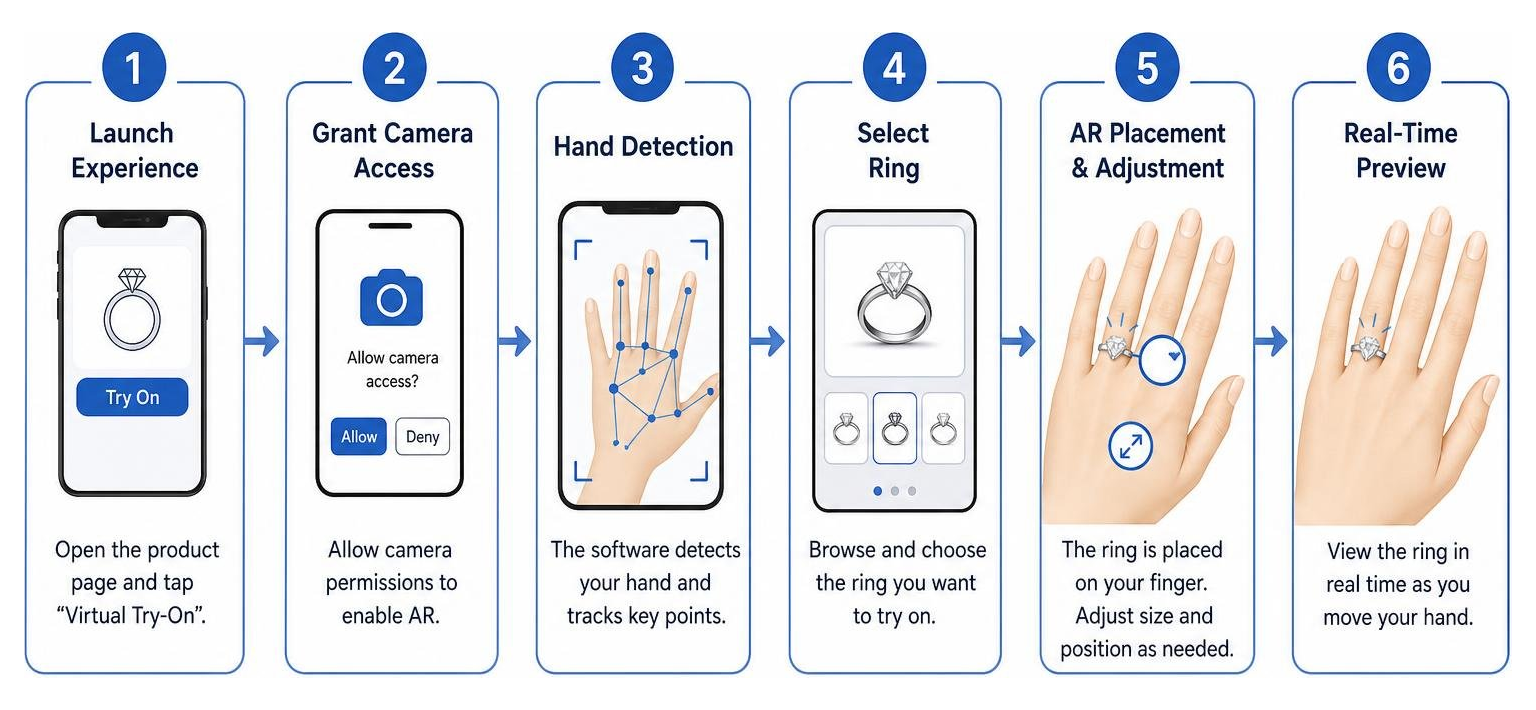
Ready to try it yourself? Here is how to navigate the process smoothly on a mobile browser:
- Launch the Experience: Open your mobile browser and navigate to a jeweler's product page. Look for a button labeled "Virtual Try-On" or "Try It On."
- Grant Camera Access: If you choose the live camera option, your browser will ask for permission to access your camera. Rest assured, reputable platforms process this data locally on your device to protect your privacy.
- Position Your Hand: Hold your hand flat in front of your camera, keeping your fingers slightly parted. The software's neural networks will quickly scan your hand, mapping out key landmarks.
- Customize Your Ring: Use the on-screen sliders and dropdown menus to customize your ring. Swap the metal from platinum to yellow gold, change the center stone from a round brilliant to an emerald cut, or dial the carat weight up and down.
- Experiment with Ring Stacking: Many advanced tools allow you to stack an engagement ring with various wedding bands. This feature is incredibly useful for ensuring that your future wedding set sits flush and looks cohesive.
- Save and Share: Once you find a combination you love, take a screenshot or use the built-in "Share" button to send the image to your partner (or leave it open on your tablet as a "subtle" hint!).
The Technology Powering Virtual Jewelry Fitting
Under the hood, augmented reality ring tryon is a marvel of modern computer vision and software engineering. It relies on three core technological pillars:
- Real-Time Hand Tracking: The software uses highly trained AI models to detect up to 21 distinct hand landmarks in milliseconds. This allows the system to identify exactly where your knuckles, joints, and fingernails are, ensuring the ring stays firmly anchored to the base of the correct finger even when your hand moves.
- Physically Based Rendering (PBR): To make a digital ring look real, it must interact with light the same way a physical piece of jewelry does. PBR technology simulates real-world lighting, reflections, and refractions. This means the metal looks appropriately polished, and the diamond facets sparkle dynamically based on the ambient light in your room.
- WebAR vs. Native Apps: In the early days of AR, users had to download bulky mobile apps to experience virtual try-ons. Today, WebAR (Web-based Augmented Reality) allows these experiences to run directly within mobile browsers like Safari or Chrome. This removes a massive point of friction for shoppers, leading to much higher engagement rates.
To learn more about how these technologies are built and deployed, explore our guide on Augmented Reality Jewelry.
Technical Challenges and Sizing Accuracy
While the technology has advanced leaps and bounds, rendering jewelry virtually still presents unique engineering hurdles. Unlike trying on a virtual hat or a pair of glasses—which sit on relatively rigid parts of the body—fingers are highly flexible, varied in shape, and prone to occlusion (where part of the finger blocks the view of the ring).
To combat placement "jitter," developers use advanced stabilization algorithms. Additionally, virtual ring sizer tools have become incredibly sophisticated. Some platforms allow you to calibrate your screen using a standard physical reference—like a credit card placed on your phone screen—to achieve virtual sizing accuracy with an error margin of less than 0.1mm.
Comparing Virtual Try-On to Traditional Methods
How does virtual try-on stack up against old-school shopping or basic online viewing? Let's look at the breakdown:
| Feature | AR Virtual Try-On | Static 3D Viewers | In-Store Try-On |
|---|---|---|---|
| Convenience | Excellent (Shop 24/7 from anywhere) | Good (View from home, but no hand overlay) | Poor (Requires travel and appointments) |
| Pressure-Free | 100% (Take your time, no sales pitches) | 100% (No sales pressure) | Low (Sales staff are actively guiding you) |
| Tactile Feedback | None (Visual only) | None (Visual only) | Excellent (Feel the weight and texture) |
| Sizing Accuracy | Very High (Using digital calibration tools) | None (Cannot measure on hand) | Perfect (Using physical sizing rings) |
| Customization | Real-Time (Instantly swap metals/carats) | Limited (Often static renders only) | Limited (Only what is currently in stock) |
While physical showrooms will always have a place for that final tactile validation, AR bridges the massive gap between online browsing and in-store confidence. It allows you to narrow down hundreds of options to your absolute favorites before you ever step foot in a store. For tips on making your digital storefront more engaging, read our article on How to Make Your Jewelry Website More Interactive.
How Jewelry Brands Can Integrate Virtual Try-On
If you are a jewelry retailer, integrating an augmented reality ring tryon tool into your e-commerce platform is no longer a futuristic luxury—it is a business necessity to remain competitive. Fortunately, the integration process is highly streamlined.
Most modern AR solutions operate via lightweight APIs or simple embeddable widgets. Instead of rebuilding your website from scratch, you can integrate a plug-and-play widget directly into your existing Shopify, WooCommerce, or Magento product pages.
We can help you get started by:
- Setting Up Your Asset Library: You can upload your existing 3D CAD files (which you likely already use for manufacturing) or even convert flat 2D product images into high-quality AR-ready assets.
- Mapping to SKUs: Once your 3D models are ready, they are mapped directly to your product SKUs so that when a customer selects "14K Yellow Gold" and "Oval Cut," the AR viewer updates instantly.
- Embedding the Widget: A small snippet of code is added to your product detail page, displaying a "Virtual Try-On" button exclusively for mobile users.
If you are running a Shopify store, our custom Shopify Virtual Try-On App is designed specifically to handle this workflow seamlessly. You can also discover more ways to boost engagement with our breakdown of Interactive Tools That Help Jewelers Sell More Jewelry Online.
The Future of Augmented Reality Ring Tryon in Jewelry Retail
As we look ahead, the intersection of jewelry retail and augmented reality is only going to grow deeper and more personalized.
We are already seeing the rise of smart mirrors in physical retail locations. These interactive screens allow in-store shoppers to virtually "wear" and compare dozens of high-end pieces that the retailer might not physically have in stock, seamlessly blending online infinite-aisle convenience with the traditional brick-and-mortar experience.
Furthermore, AI-driven personalization engines will soon be able to analyze the shape and skin tone of a customer's hand to recommend specific diamond cuts, band widths, and metal colors that would look most flattering.
To stay ahead of these rapidly evolving trends, check out our forward-looking Engagement Ring Marketing Guide 2026.
Frequently Asked Questions about Virtual Ring Try-On
How accurate is virtual ring sizing?
When calibrated correctly using on-screen prompts or physical reference cards, digital ring sizers are incredibly accurate, often matching physical sizing tools within a fraction of a millimeter. However, we always recommend verifying your final size with a physical ring sizer before placing a custom order.
Can I stack multiple rings virtually?
Yes! Many advanced AR try-on platforms support multi-ring stacking. This allows you to place an engagement ring on your finger and stack it with different wedding bands or anniversary rings to see how they fit and look together.
Do I need to download an app to try on rings?
No. Thanks to modern WebAR technology, most jewelry brands offer browser-native try-on experiences. You can launch the camera and visualize rings instantly on your smartphone's web browser without downloading any external apps.
Conclusion
The journey to finding the perfect engagement ring should be filled with excitement, not stress. By bringing the showroom directly to your screen, augmented reality ring tryon technology empowers couples to explore, customize, and fall in love with their dream designs on their own terms.
At GemFind Digital Solutions, we combine over 25 years of jewelry-specific digital expertise to help retailers implement these game-changing tools. As a trusted Shopify and Google Partner, we specialize in web design, digital marketing, and advanced e-commerce integrations—including seamless Edge POS connectivity.
Ready to transform your online jewelry store and provide your customers with an unforgettable shopping experience? Explore our Slugjewelry Virtual Tryon Software Complete Guide or reach out to our team today to get started!


