


Why Augmented Reality Earrings Are Changing How People Shop for Jewelry

Augmented reality earrings try-on lets you see exactly how a pair of earrings looks on your own ear — in real time, using just your smartphone camera — before you buy anything.
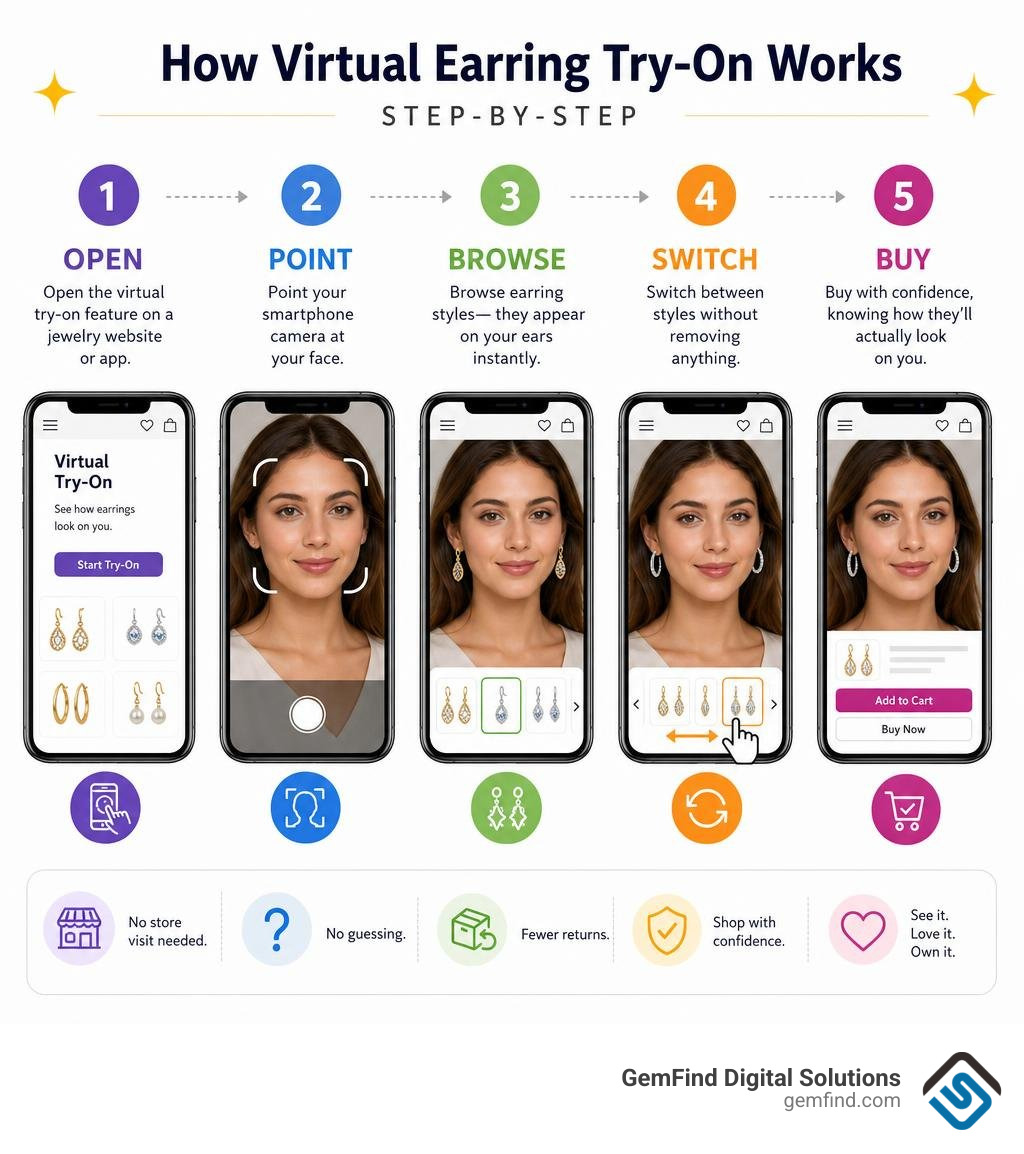
Here's how it works at a glance:
- Open the virtual try-on feature on a jewelry brand's website or app
- Point your smartphone camera at your face
- Browse earring styles — they appear on your ears instantly
- Switch between styles without removing anything
- Buy with confidence, knowing how they'll actually look on you
No store visit needed. No guessing. No returns because the earrings looked different in person.
This matters because online jewelry shoppers have always faced a real problem: you can't feel or see how a piece truly looks on you from a product photo. That uncertainty leads to hesitation — and lost sales. In fact, retailers report that customers who use AR try-on are 65% more likely to complete a purchase compared to those who browse photos alone, and return rates drop by as much as 25 to 40 percent.
AR try-on isn't just a novelty anymore. It's quickly becoming what customers expect from jewelry brands online.
I'm Anthony Arechiga, Vice President of Sales at GemFind Digital Solutions, where I've spent nearly two decades helping jewelry retailers grow through smarter technology — including the rise of augmented reality earrings and virtual try-on tools that drive real results. In this guide, I'll walk you through exactly how to use this technology to fit customers better, sell more, and reduce costly returns.
Augmented reality earrings terms made easy:
How Augmented Reality Earrings Transform the Online Shopping Experience
Historically, buying earrings online has been a bit of a gamble. Unlike rings, which have standardized sizes, or necklaces, which have clear lengths, earrings depend heavily on the unique shape of a person's jawline, the position of their earlobes, and even how their hair falls. A hoop that looks delicate on a product model might look completely different on you.
This is where augmented reality earrings step in to bridge the gap between digital convenience and physical reality. By leveraging your device's front-facing camera, AR technology overlays highly detailed, three-dimensional digital replicas of earrings directly onto your ears. This interactive experience transforms passive browsing into active participation, instantly boosting customer confidence.
Instead of trying to mentally project how a diamond stud or a dramatic drop earring will look on your face, you can see it happen in real-time. This level of personalization makes online shopping feel like a private consultation at a luxury boutique. To understand how this fits into the broader landscape of digital jewelry retail, you can read our Virtual Try-On Jewelry Complete Guide.
Step-by-Step: How to Fit Augmented Reality Earrings on Your Device
Using this technology is incredibly straightforward and requires no technical expertise. If you can take a selfie, you can use AR earrings. Here is how a typical customer interacts with a virtual try-on system:
- Navigate to the Product Page: Find the pair of earrings you like and look for a button labeled "Try It On" or "Virtual Try-On."
-
Choose Your Mode: Most advanced platforms offer two primary viewing options:
- "On Me" Mode: This activates your smartphone or tablet's front-facing camera, allowing you to see the earrings on your own ears in real time.
- "On Model" Mode: If you prefer not to use your camera, you can select a pre-loaded model whose facial structure matches yours to see how the jewelry looks.
- Align Your Face: If you choose "On Me" mode, hold your device at eye level. The smart face detection software will quickly scan your face and locate your ears.
- Interact and Rotate: Turn your head slowly from side to side. The virtual earrings will follow your movements, showing you how they look from the front, three-quarters, and side profiles.
This seamless process allows for instant, real-time visualization that matches the natural flow of a physical mirror. To see a real-world example of this technology in action, check out the PRMAL Virtual Try-On experience.
Single vs. Stack Mode: Coordinating Multiple Ear Accessories
One of the most exciting design trends in recent years is ear curation—the art of styling multiple piercings with a combination of studs, hoops, drop earrings, and ear cuffs. In a physical store, trying on five different earrings across multiple piercings is a logistical nightmare (and often a hygienic concern).
AR technology solves this beautifully by offering "Single" and "Stack" modes:
- Single Mode: Focuses on a single pair of earrings, allowing you to evaluate their individual scale, color, and design.
- Stack Mode: Allows you to coordinate multiple items simultaneously. You can place a hoop in your first lobe piercing, a small diamond stud in your second, and a virtual ear cuff along your helix.
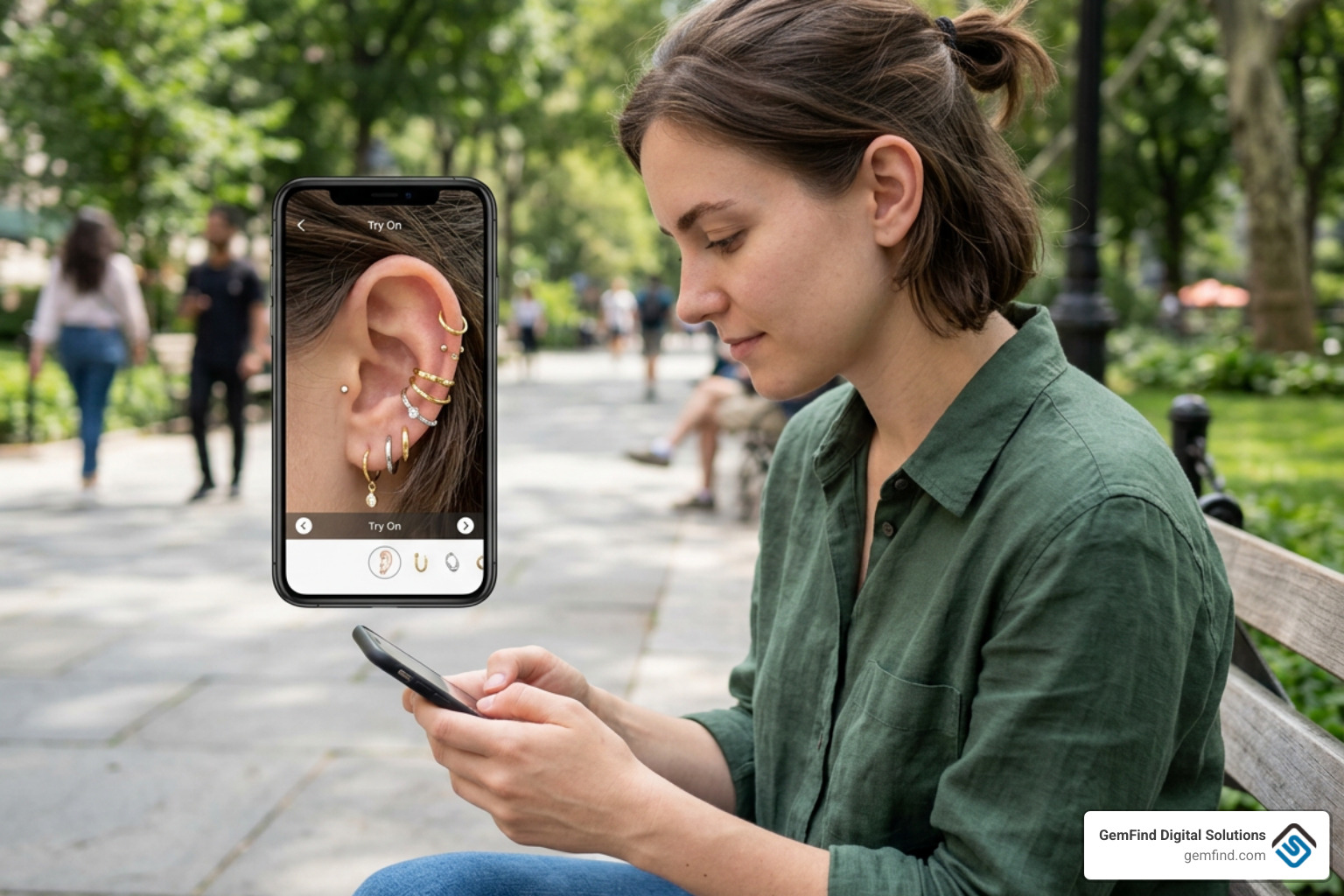
This capability turns your screen into a digital styling canvas, helping you make confident styling decisions and encouraging the purchase of coordinated sets rather than just single items.
The Business Benefits of Virtual Jewelry Try-On
For jewelry brands, implementing AR earring try-on is not just about keeping up with trends—it is a strategic business decision that directly impacts the bottom line. Let's look at how virtual try-on compares to traditional online shopping across key performance metrics:
| Metric | Traditional E-commerce | AR-Enabled E-commerce | Impact |
|---|---|---|---|
| Conversion Rate | 1% – 2% | 1.65% – 3.3% | Up to 65% increase |
| Return Rate | 20% – 30% | 12% – 18% | 25% to 40% reduction |
| Customer Engagement | Average 45 seconds on page | 2 to 3 minutes on page | Over 300% increase |
| Purchase Intent | Standard baseline | 50% higher intent | Faster checkout decisions |
These numbers prove that when customers can visualize products on themselves, they buy more and return less. If you are interested in creating customized experiences for your shoppers, explore our guide on Custom Jewelry Try-On.
Boosting Conversion Rates and Customer Engagement
When you integrate augmented reality earrings into your e-commerce platform, you fundamentally change how users interact with your website. Instead of scrolling through static product catalogs and quickly bouncing to another site, users stick around to play, experiment, and style themselves.
Data shows that average time spent on a product page jumps from a mere 45 seconds to upwards of two to three minutes when an AR try-on tool is present. This highly interactive experience translates directly into a 350% increase in customer engagement.
Furthermore, because the technology removes the primary hurdle of online shopping—the fear of the unknown—purchase intent rises by 50%. Brands that actively integrate these features onto their product pages consistently report double-digit increases in conversion rates. If you operate on the Shopify ecosystem, you can easily implement these features using a Shopify Virtual Try-On App.
Reducing Return Rates for E-commerce Retailers
Returns are the silent killer of online jewelry retail. Shipping high-value items back and forth is expensive, logistically challenging, and carries security risks. Because jewelry is highly personal, online return rates often hover between 20% and 30%.
The primary cause of these returns is a gap between customer expectations and reality—the classic "it looked smaller/larger/different in the photo" problem. AR virtual try-on solves this by providing precise scale representation. When a customer can see the exact millimeter drop of an earring relative to their lobe and neck, the margin for error disappears. Retailers implementing these tools report a 25% to 40% reduction in return rates, saving thousands of dollars in reverse logistics and maintaining healthier inventory levels.
The Technology Behind Augmented Reality Earrings
While the user experience feels like magic, the technology powering augmented reality earrings is a sophisticated mix of computer vision, artificial intelligence, and high-fidelity 3D rendering.
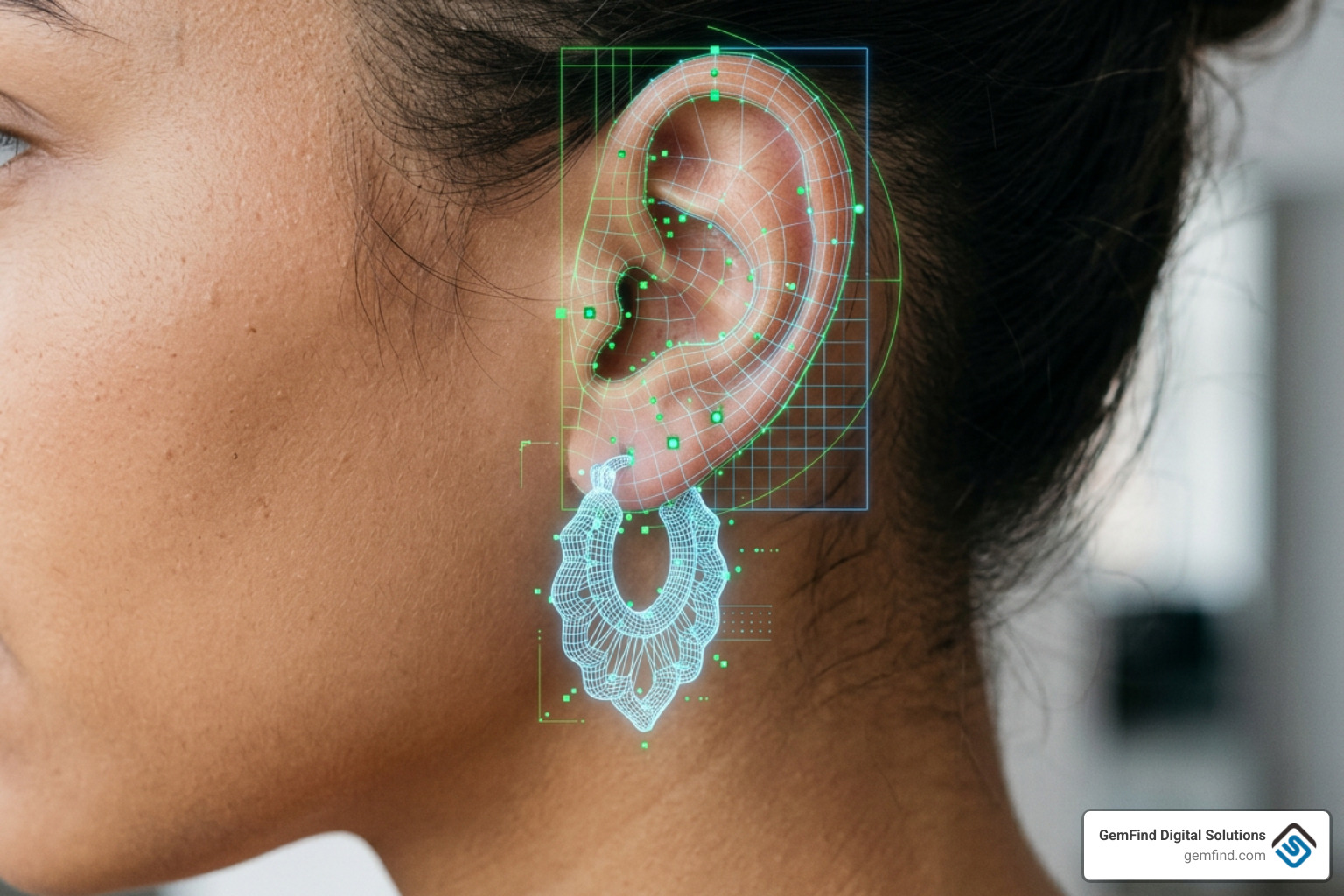
To make a virtual earring look real, the software must perform three complex tasks simultaneously:
- Detect and Track: Locate the user's head and ears in real-time.
- Render: Draw the 3D model of the jewelry with realistic lighting, metal reflections, and gemstone sparkle.
- Composite: Blend the digital model with the camera feed so it looks like it is physically hanging from the ear, even when the user moves.
Real-Time Face Tracking and Ear Landmark Detection
Unlike rings, which rely on hand tracking, earrings require advanced facial and ear landmark detection. The human ear is a complex structural shape with many distinct parts. Modern AR engines use deep-learning models to map up to nine specific ear landmarks, including:
- The Lobe (front and back)
- The Helix (the outer rim)
- The Tragus (the small flap in front of the ear canal)
- The Scapha and Snug (inner cartilage areas)
By identifying these precise coordinates, the software can anchor a digital stud exactly on the lobe, or wrap a virtual ear cuff tightly around the cartilage. Developers looking to build these experiences often utilize specialized tools like the Earring Try-On documentation to map these coordinates accurately.
Physics Engines and Smart Hair Occlusion
To achieve true photorealism, virtual earrings cannot look like static stickers pasted over an image. They need to behave like real objects. This requires two critical advanced features:
- Physics Engines: If you turn your head quickly, a drop earring should swing naturally, decelerate, and settle back into place. Developers achieve this by rigging the 3D model with a skeletal structure and applying dynamic chains that calculate mass, gravity, and damping.
- Smart Hair Occlusion: A challenge in AR earring try-on is hair. If your hair is down, a real earring would sit partially behind or underneath those strands. Smart hair occlusion uses AI segmentation masks to detect hair layers and realistically hide or show parts of the virtual earring based on head rotation.
To see how developers implement these advanced physics and occlusion systems, you can review the technical guidelines in the Earring Try-On | Snap for Developers template.
How to Implement Virtual Earring Try-On for Your Brand
If you are a jewelry retailer looking to adopt this technology, the implementation process is much easier than it was a few years ago. You do not need to build an AR engine from scratch. Instead, you can partner with specialized digital solutions providers to integrate pre-built software-development kits (SDKs) and web plugins directly into your existing website. To prepare your site for this upgrade, read our tips on How to Best Showcase Your Custom Jewelry Pieces on Your Website.
Web-Based AR vs. Mobile App Integration
When planning your AR rollout, you must choose between Web-based AR (WebAR) and a native mobile application:
- Web-Based AR (WebAR): This runs directly within standard mobile browsers (Safari, Chrome, etc.) without requiring the user to download an external app. Because there is zero friction, WebAR sees much higher adoption rates among casual shoppers.
- Mobile App Integration: If you already have a branded mobile app, integrating an AR SDK allows for slightly more powerful processing, enabling smoother physics and higher-resolution rendering.
For most brands starting out, WebAR is the recommended entry point because it captures the widest audience instantly. To explore how these integrations work across different platforms, read about Augmented Reality Jewelry.
Creating AR-Ready 3D Assets
The foundation of any successful virtual try-on experience is the quality of your digital assets. Your AR is only as good as your 3D models. To build a library of AR-ready earrings, you should:
- Utilize CAD Files: Convert your existing manufacturing CAD designs into web-optimized 3D formats like GLB or GLTF.
- Optimize for Real-Time Rendering: Ensure your models use clean geometry with lower polygon counts where appropriate, while keeping high-poly detail in highly visible areas like gemstones.
- Capture Materials Accurately: Apply high-fidelity textures to simulate the exact shine of 18k yellow gold, the cool reflection of platinum, and the refractive brilliance of diamonds.
For more insights on how to capture and present your jewelry assets beautifully, check out our Jewelry Product Photography Tips.
Frequently Asked Questions about Virtual Earring Try-On
How accurate is virtual earring try-on compared to physical try-on?
Modern AR earring try-on is highly accurate, often mapping ear coordinates to within millimeters. It provides an excellent representation of relative scale, overall shape, and how the design complements your facial features. While subtle color nuances and the exact "fire" of a diamond can vary slightly based on your screen's brightness and ambient lighting, the physical proportions are incredibly true to life.
Do I need to download a special app to try on AR earrings?
No. Thanks to modern WebAR technology, most retailers offer virtual try-on directly on their websites. You simply click the "Try It On" button, grant the browser temporary permission to access your front-facing camera, and the experience runs smoothly in Chrome, Safari, or Edge without any downloads.
Can AR earrings simulate realistic movement and physics?
Yes. Advanced AR platforms utilize skeletal rigging and real-time physics engines (like dynamic chain components) to make sure drop and dangle earrings sway naturally when you tilt or turn your head. This prevents the "sticker" effect and makes the virtual try-on feel incredibly realistic.
Conclusion
Augmented reality earrings have evolved from a futuristic concept into an essential tool for modern jewelry e-commerce. By removing the guesswork from online shopping, AR technology builds immediate customer trust, drives engagement up by 350%, and slashes return rates by up to 40%.
At GemFind Digital Solutions, we have over 25 years of industry-specific expertise helping jewelers navigate the digital landscape. As a certified Shopify and Google Partner, we specialize in web design, digital marketing, and cutting-edge virtual tools tailored specifically for the jewelry industry—including seamless Edge POS integrations.
Ready to transform your online store and offer your customers a world-class shopping experience? Get started with the complete jewelry virtual try-on software guide or reach out to our team today to learn how we can help you integrate these powerful tools into your business.


